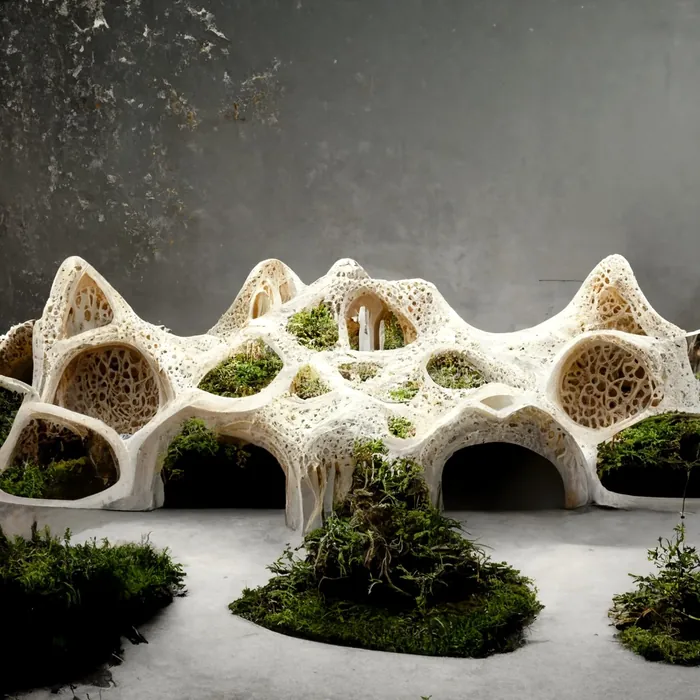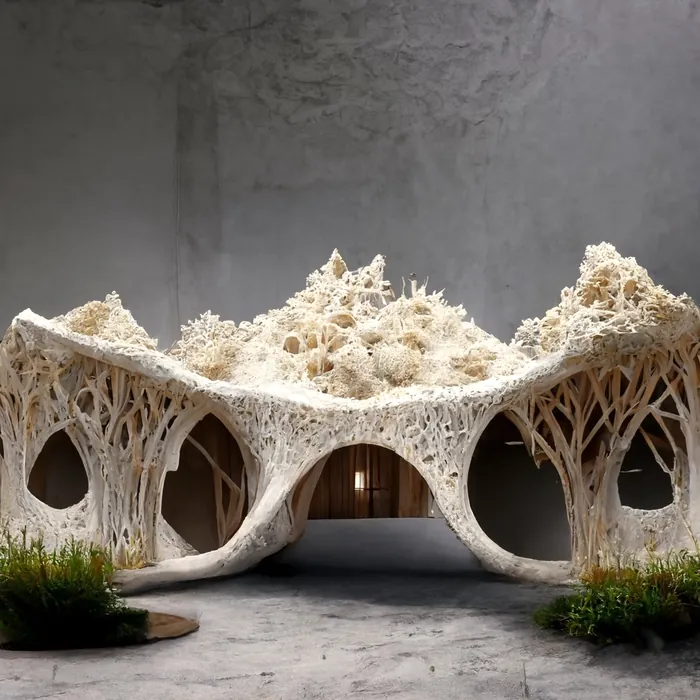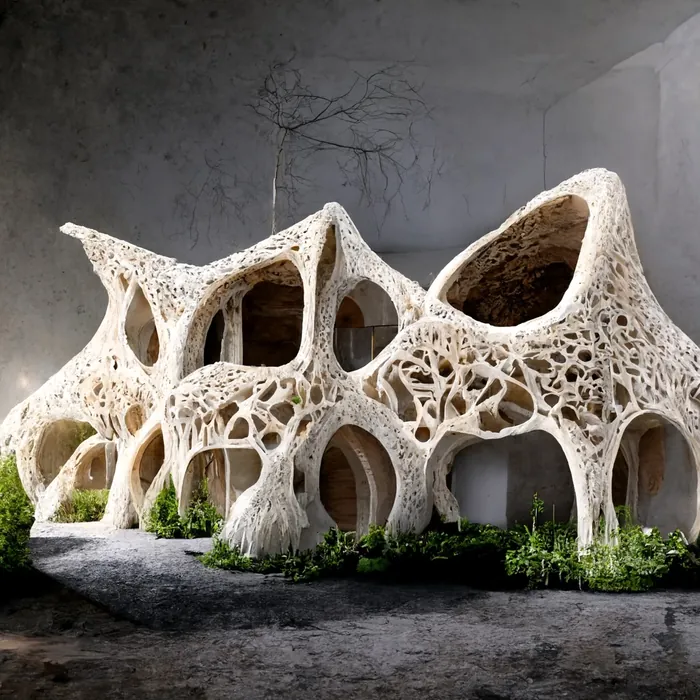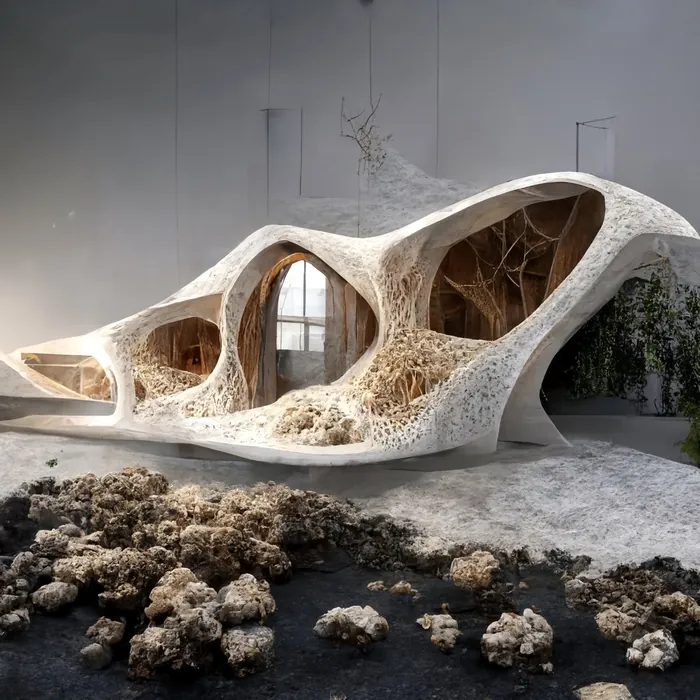
Raffaele Errichiello

Raffaele Errichiello, architect, researcher and designer

An architect and doctoral researcher in Umeå, Sweden. I design building parts in an engineered living material: a paste of biochar and wood waste, 3D printed, then grown through and bound by mycelium that stays alive inside it.

Biology as a design variable.

A part gets its qualities from three things I can design: the recipe, the printed geometry and the fungus itself. The toolpath decides where air gets in and where water stays, and the mycelium grows to match. Printing makes this precise and repeatable in a way moulds and hand packing are not: the same file gives the same part, layer for layer.

Printed. Grown. Welded.

“What if building parts could be printed, grown and welded together by a living organism?”

The first line of my 2026 paper in Architectural Intelligence, and the question behind my doctorate.

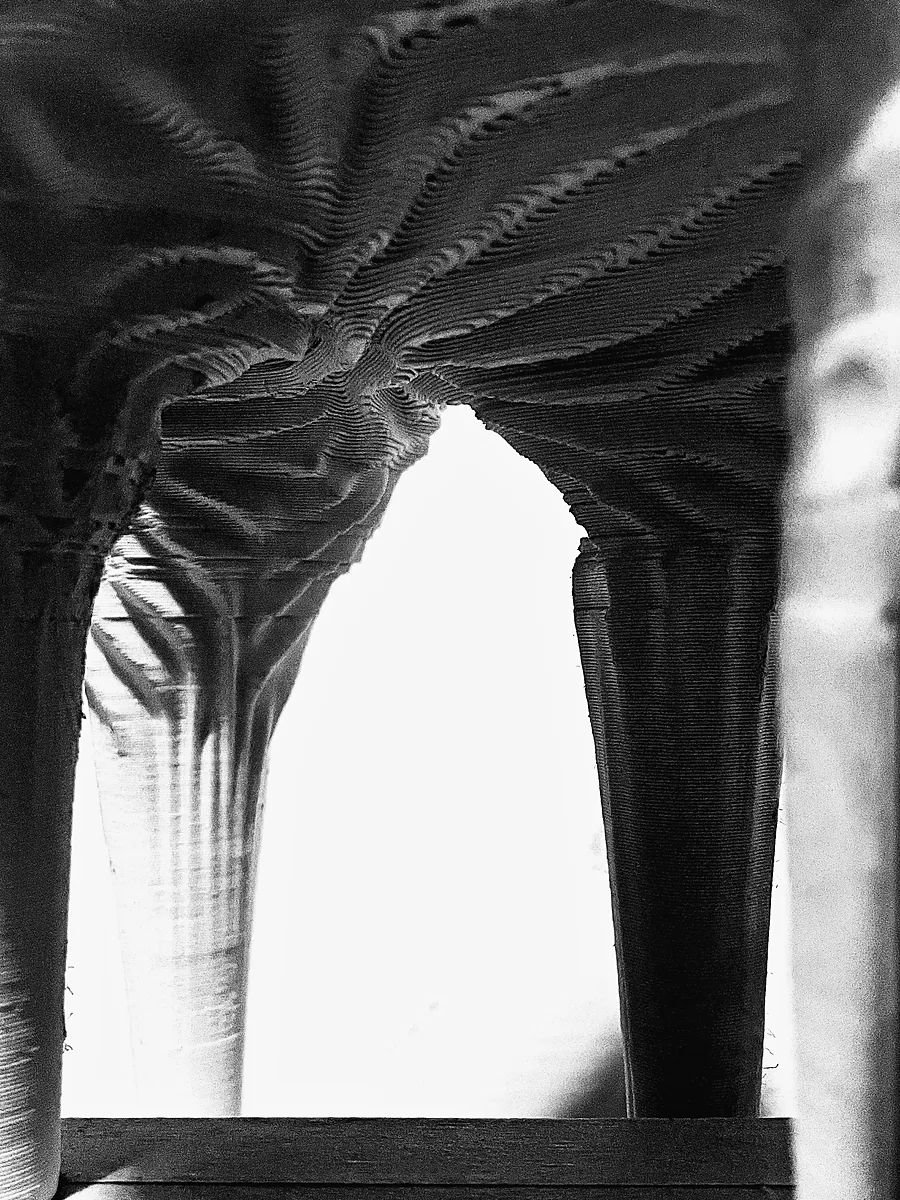
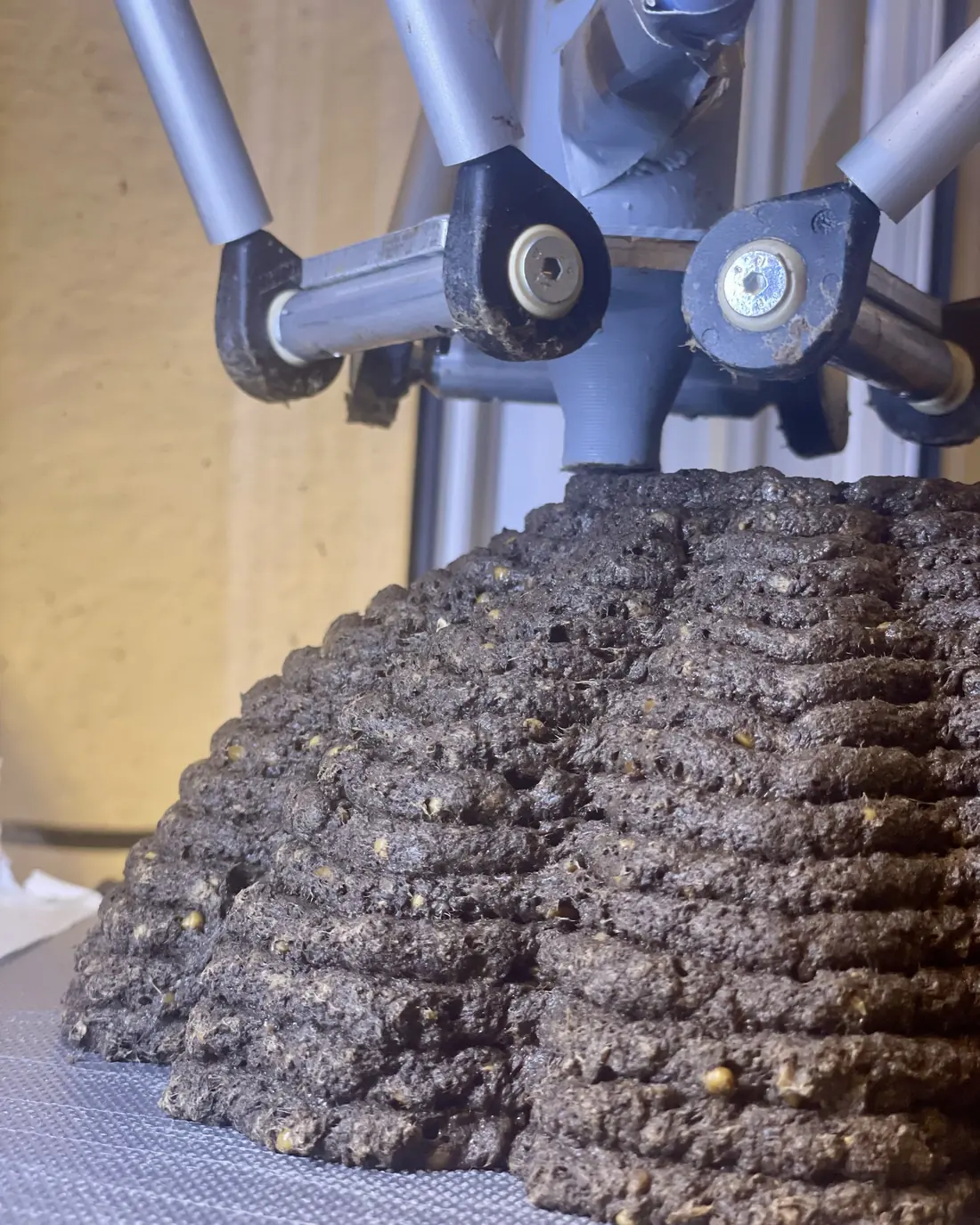
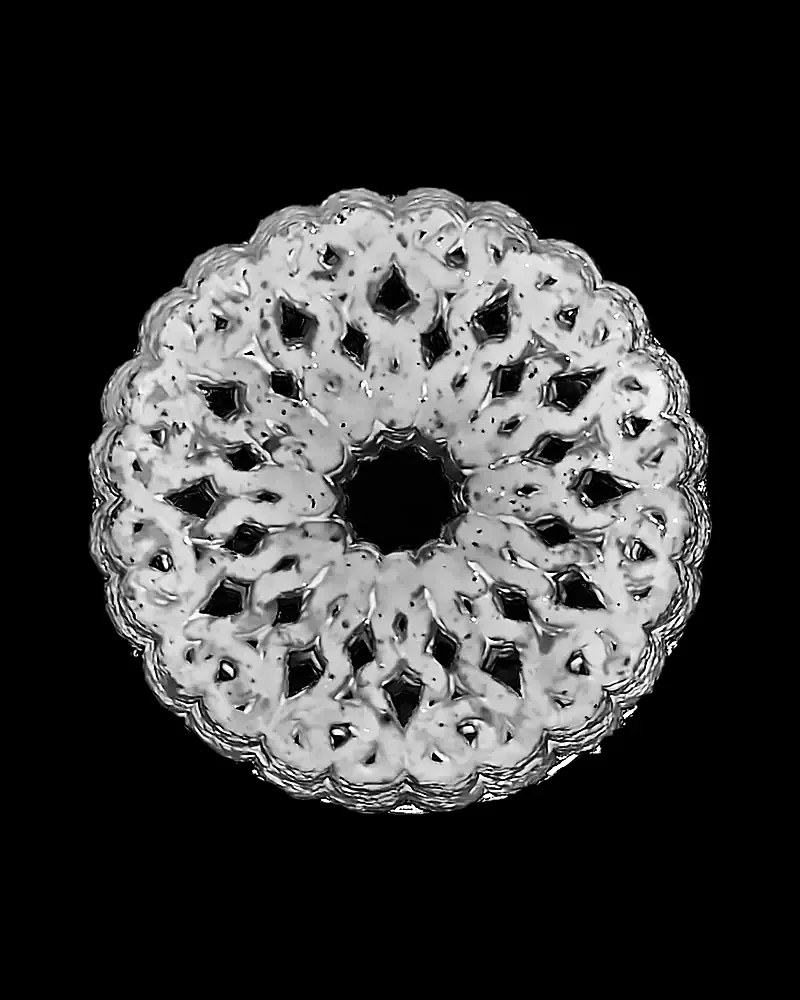
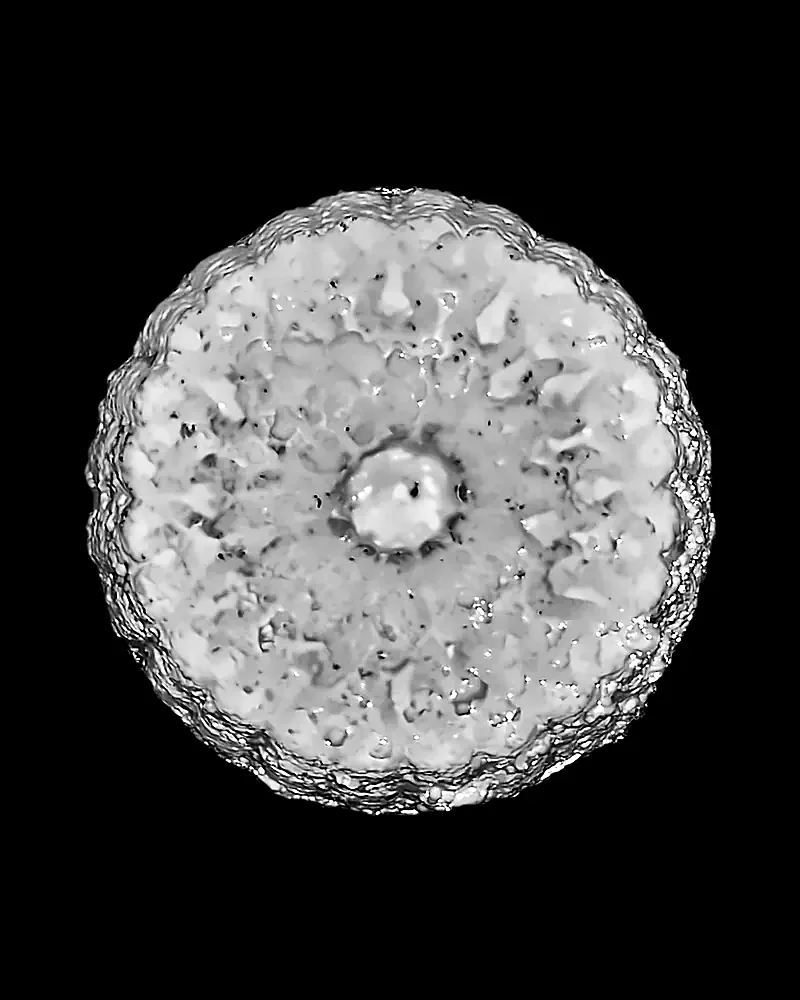
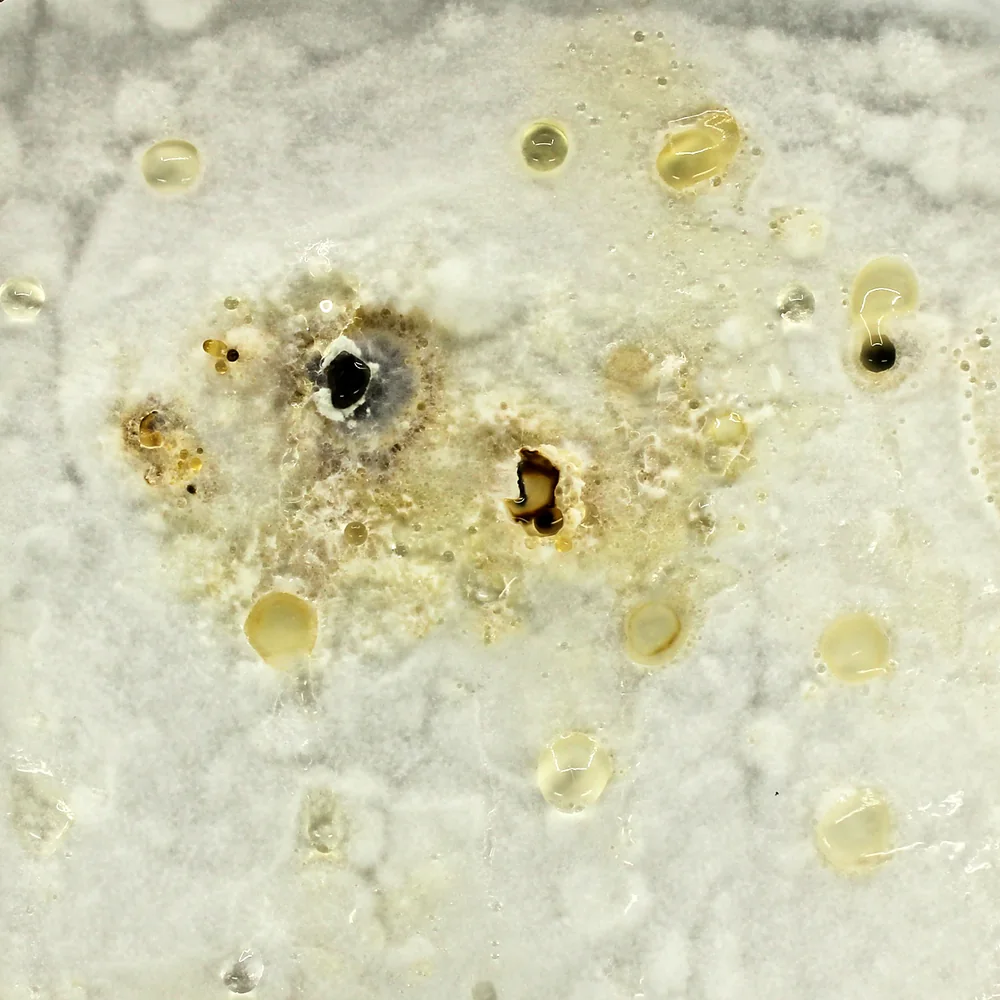
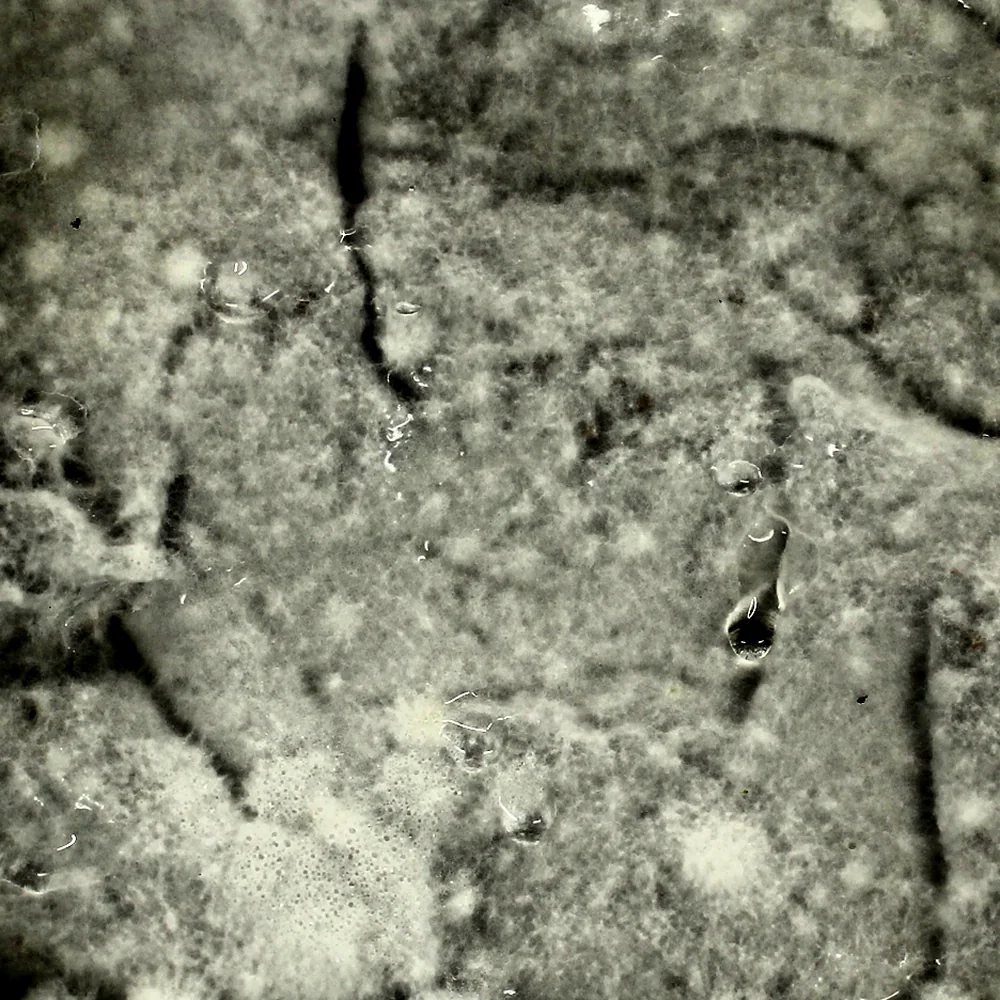
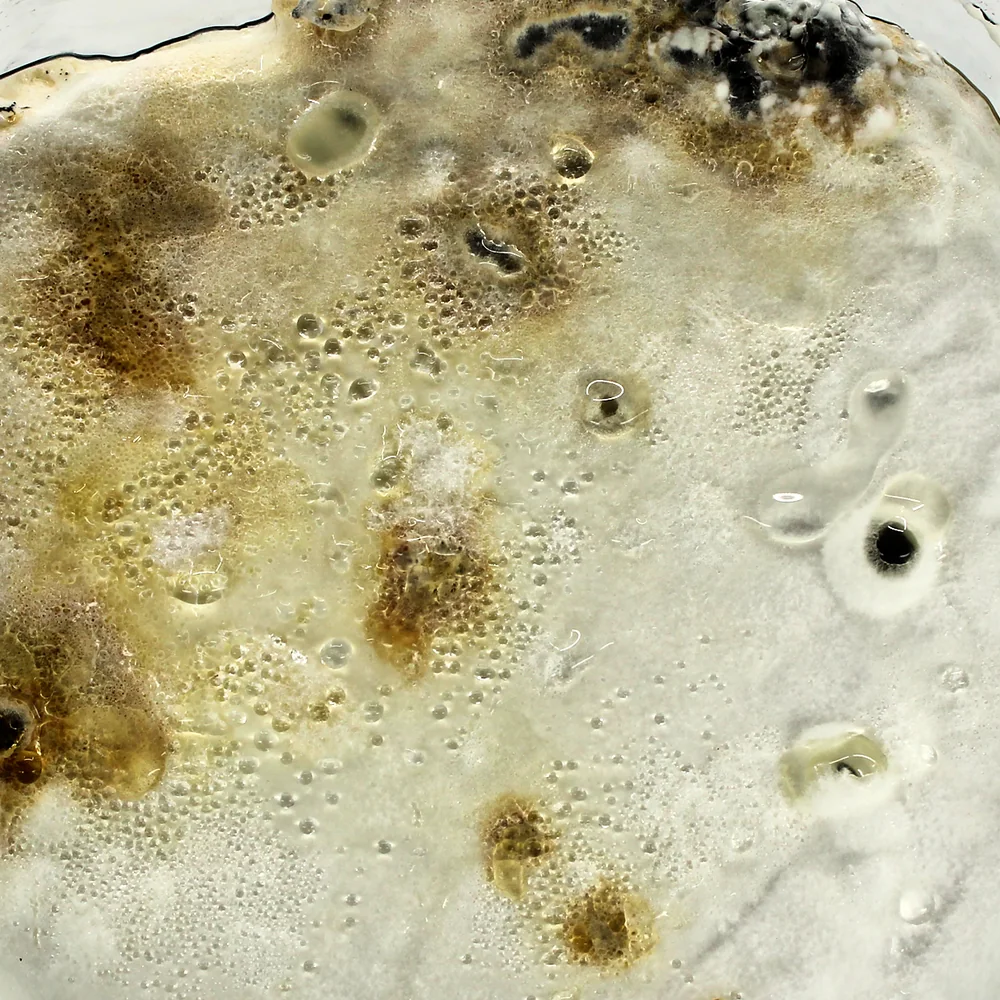
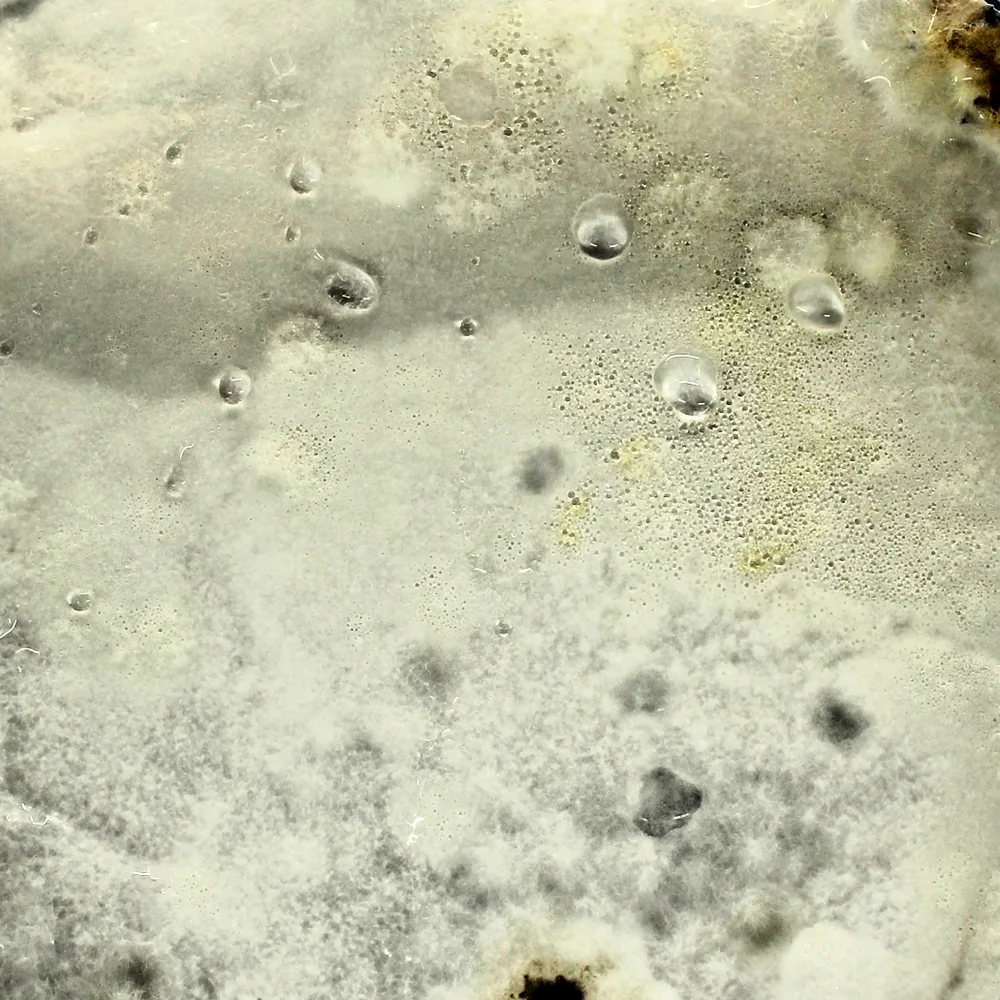
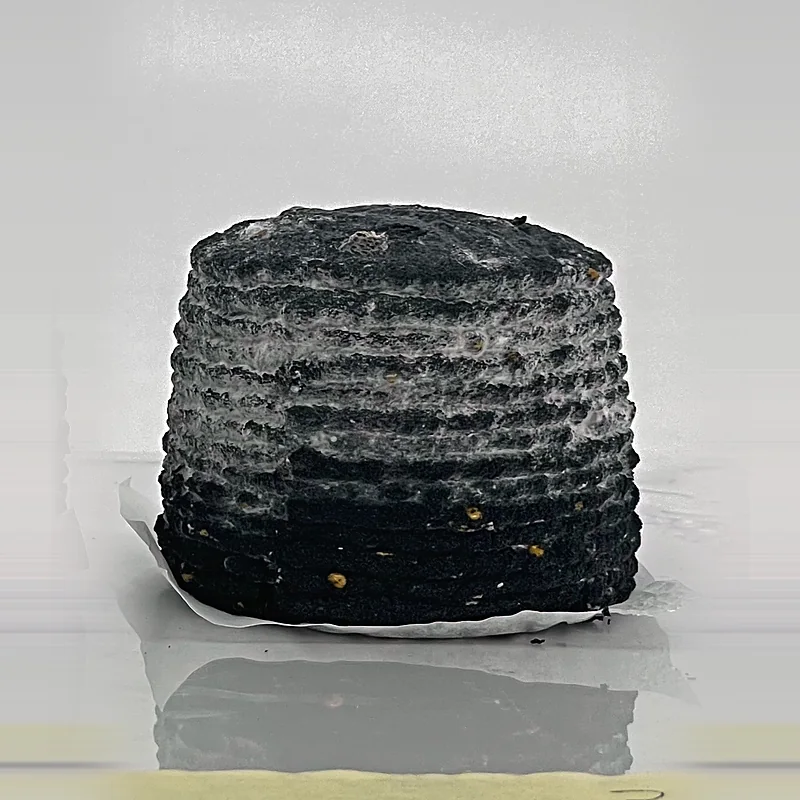
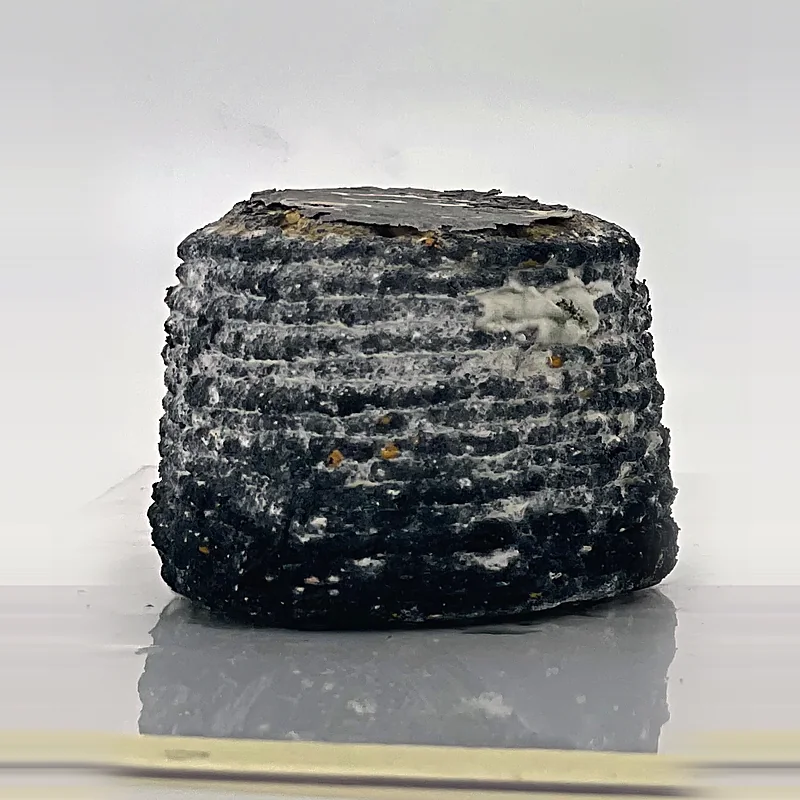
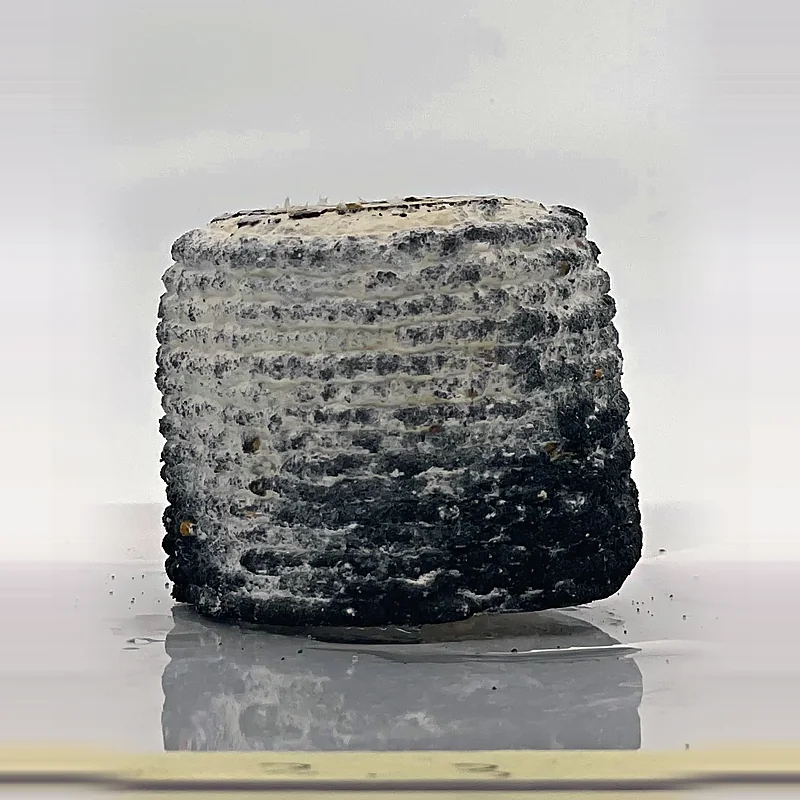
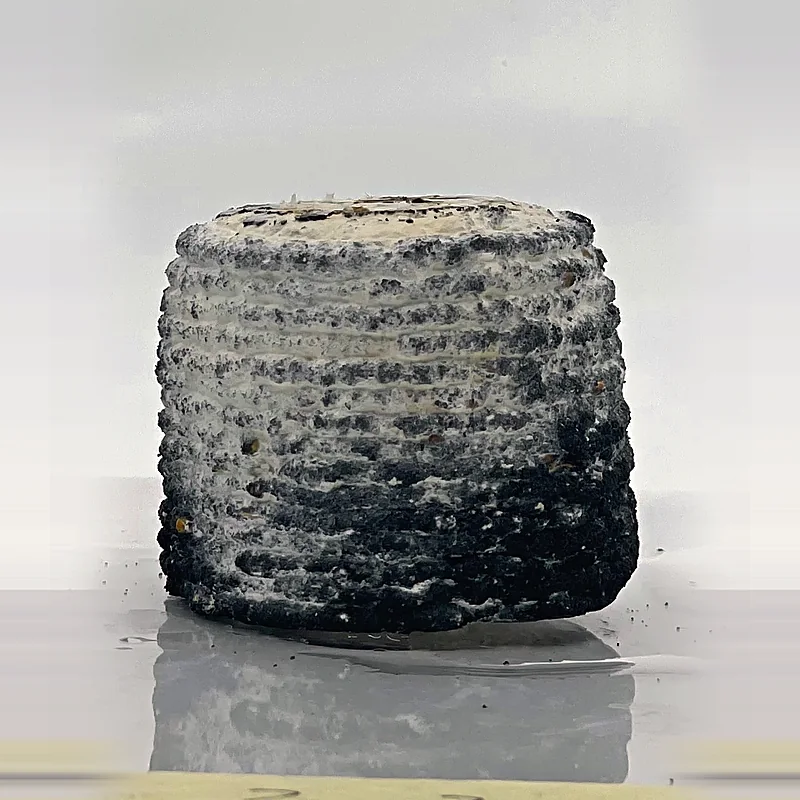
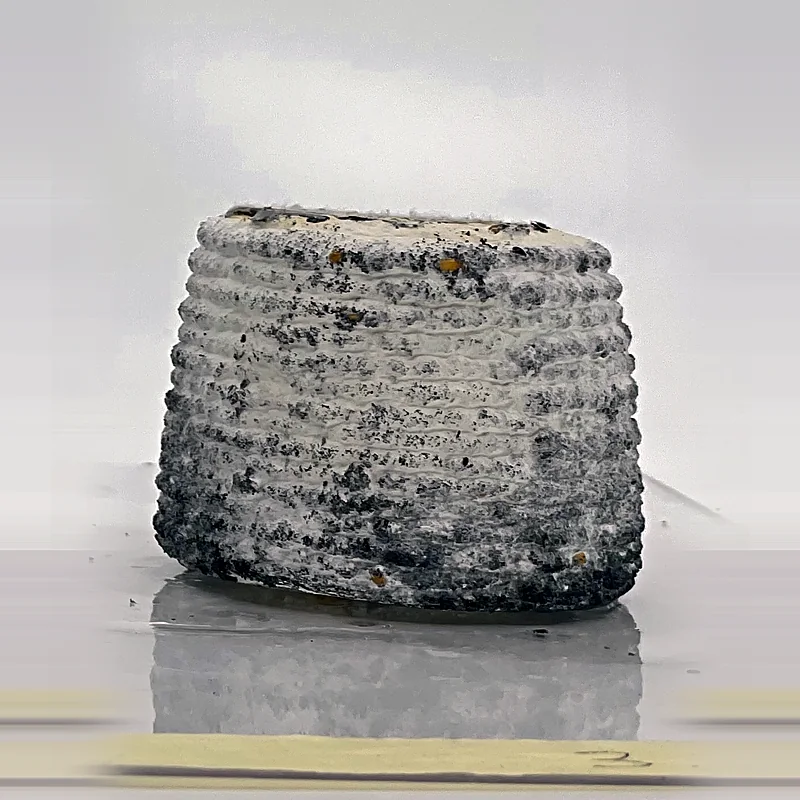
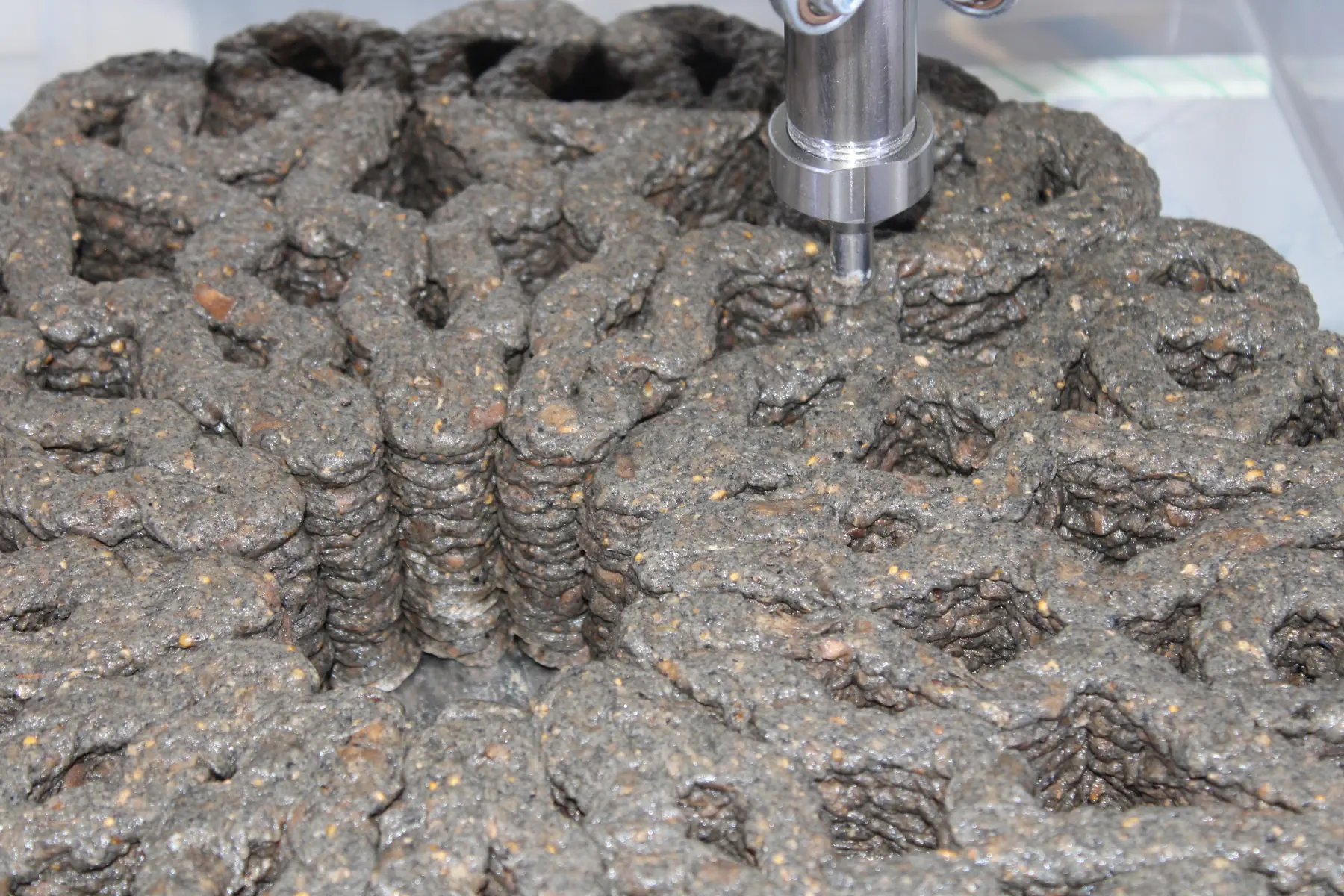
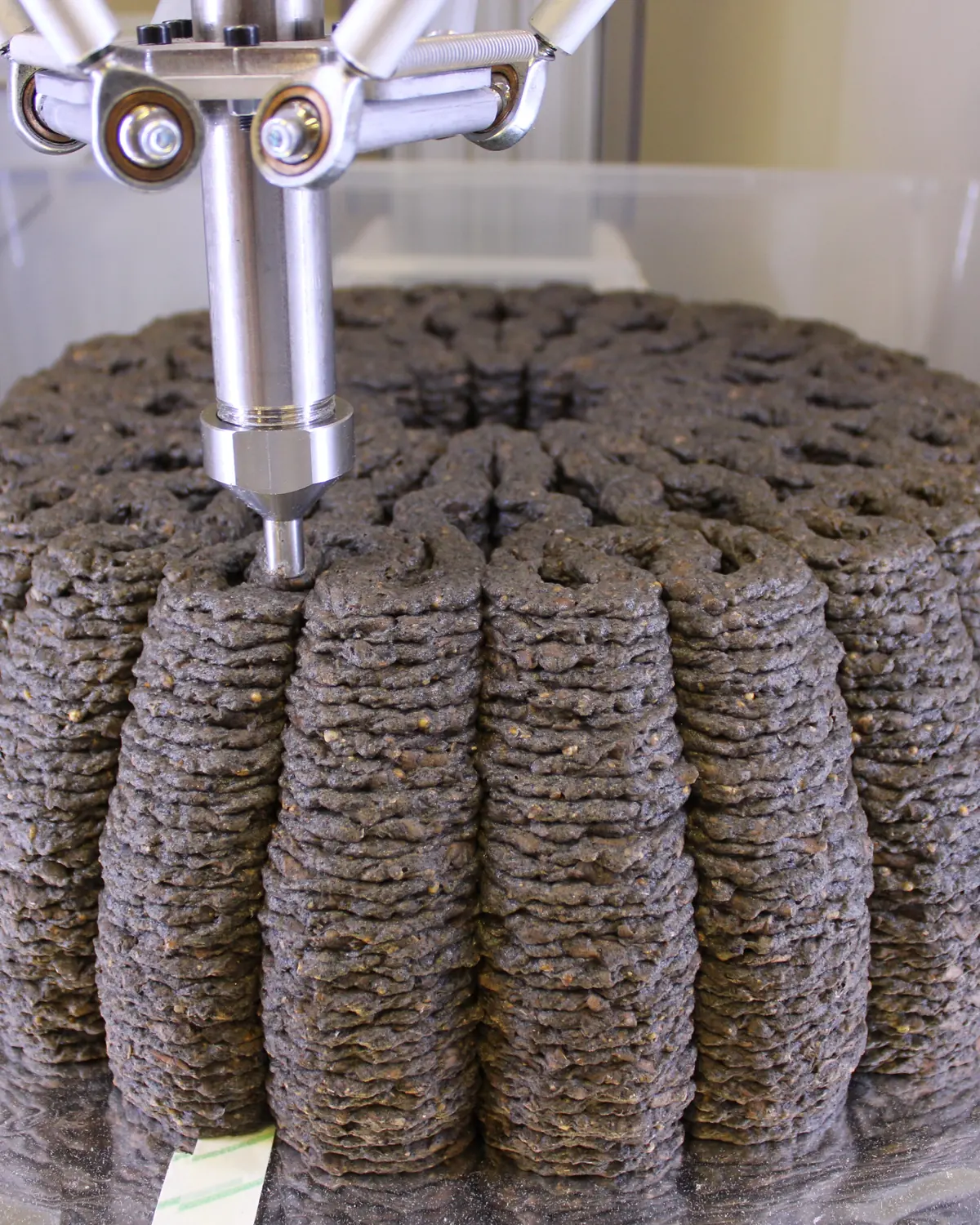
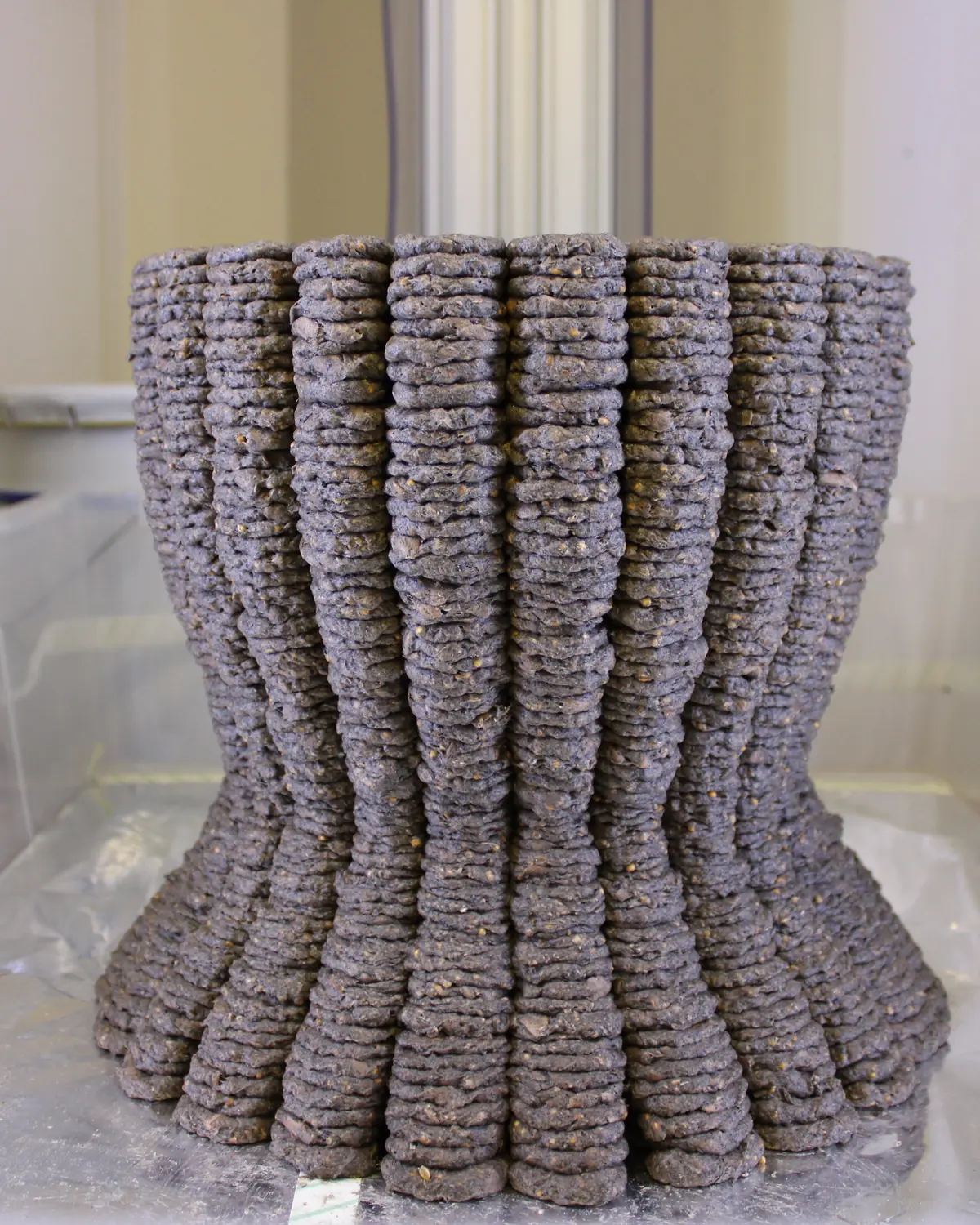
Under the glass: demonstrator D2 being printed at the Material Practices Lab, Umeå, March 2026.

Portrait of Raffaele Errichiello

I trained as an architect in Naples and found my material in the north of Sweden.

My first structure was a frame of chestnut poles carrying three hammocks, built in a field near Lecce in 2016. In 2019 I came to Umeå School of Architecture as an Erasmus student to research my master's thesis, and kept coming back. In the school workshop I started growing objects from what others threw away: sawdust, cardboard, coconut fibre. That became a chair, the trophies for Sweden's national design awards, a logo for Netflix, and then a doctorate.

Since 2024 I have been a doctoral candidate at the Material Practices Lab, supervised by Julio C. Diarte Almada and Gireesh Nair. I study how the printed geometry of a living material changes how it grows, how strong it becomes and how much it shrinks, so that AURORA, the grown pavilion I have been designing since 2019, can one day be built. In 2027 I will spend five months at Tohoku University in Japan, working with a forest ecologist and a building engineer.

Doctoral candidate
Umeå University, 2024 to 2028
Architect
M.Arch, DiARC, University of Naples Federico II, 2014 to 2022
Teaching
Studio 12, Umeå, 2022 to 2024. ProtoLAB, Wrocław, 2024 and 2025
Languages
Italian, English, Spanish, some Swedish
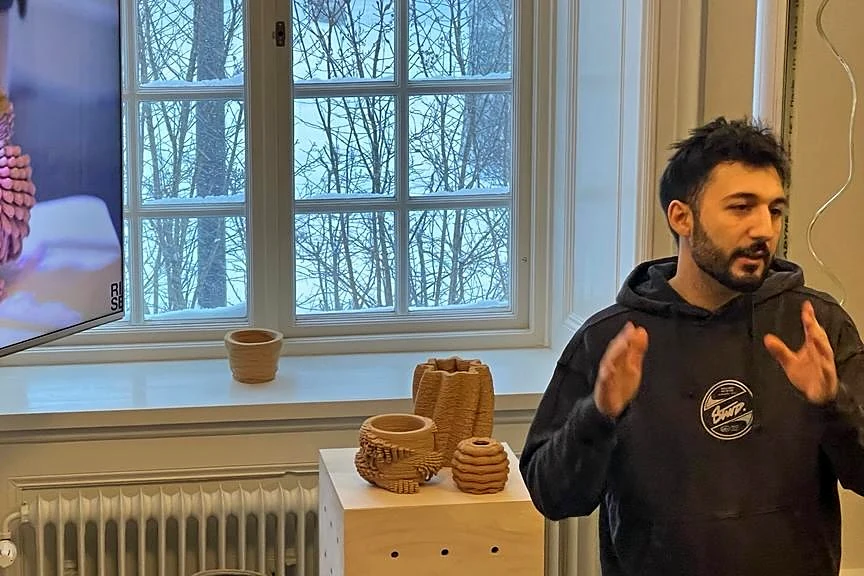
Raffaele talking students through printed clay tests, in a black hoodie, a snowy window and the printed pieces behind him
Talking students through the first printed tests, Umeå, December 2022.

Coltivare strutture.Growing structures.

That was the title of my master's thesis, and it still describes the work. One line searches for form: structures that find their own shape, from three hammocks in Lecce to the shells of AURORA. A second grows matter, objects bound together by fungi. A third works with people: building, teaching and mapping with others. Since 2024 my doctorate has carried the matter line to the scale of building parts, while AURORA waits. When the doctorate ends, the three lines meet again in AURORA, printed and grown at full size.

  • School
  • Form
  • Matter
  • People
  • Doctoral research
  • Waiting
  • Planned

Swipe sideways to follow the lines. Each point opens its project.

Spring 2023, writing about the Design S awards

“…a mycelium-based fiber-reinforced polymer suitable for 3D printing architectural structures.”

That was the material I said I wanted to develop next, made from the surplus of local manufacturers. A year later it became my PhD.

Doctoral research, 2024 to 2028

Geometry as a design controlfor living materials

Why

Building parts that keep carbon,grown from what is left over

Construction needs materials that are low in carbon, can go back into a cycle, and can be shaped without much waste. Mycelium, the root network of a fungus, can bind wood residues into parts that are light and insulating, with no glue and no firing. Biochar, the charcoal left when wood waste is heated without air, holds its carbon in a stable form. In Umeå both come from what the forest and the workshops leave behind.

Printing these pastes needs no mould and allows shapes a mould cannot make. The difficulty is that the material is alive: wet paste slumps, growth follows air and water, and parts shrink as they dry. My doctorate asks whether the printed geometry itself can steer all three, so that a grown part keeps its shape and several parts can be joined into a larger element.

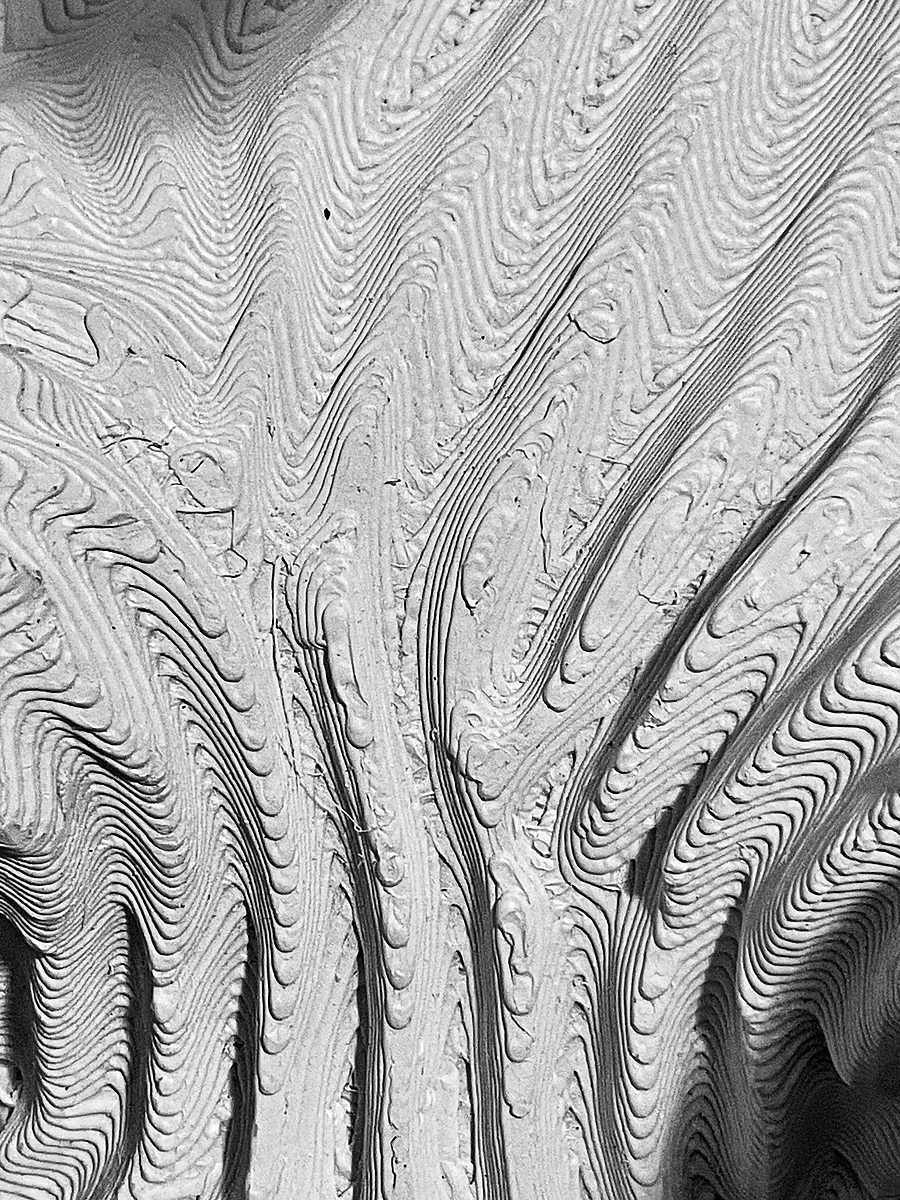
A printed toolpath does more than draw an outline. Its gaps let air in, its dense knots hold water, and the fungus grows accordingly. I design the pattern as a small climate for the fungus, then measure what it does to growth, strength and shrinkage, so that a printed part keeps its size and shape while it dries.

The Material Practices Lab: grow tents, a work table and shelves of printed samples

The Material Practices Lab, Umeå School of Architecture, with the grow tents on the right.

The material is a paste of biochar, sawdust from the school's wood workshop, cardboard pulp and spawn of Ganoderma lucidum, the reishi mushroom. A clay printer shapes it without a mould, the fungus binds it in about two weeks, and printed parts can be joined by growing them together instead of gluing them.

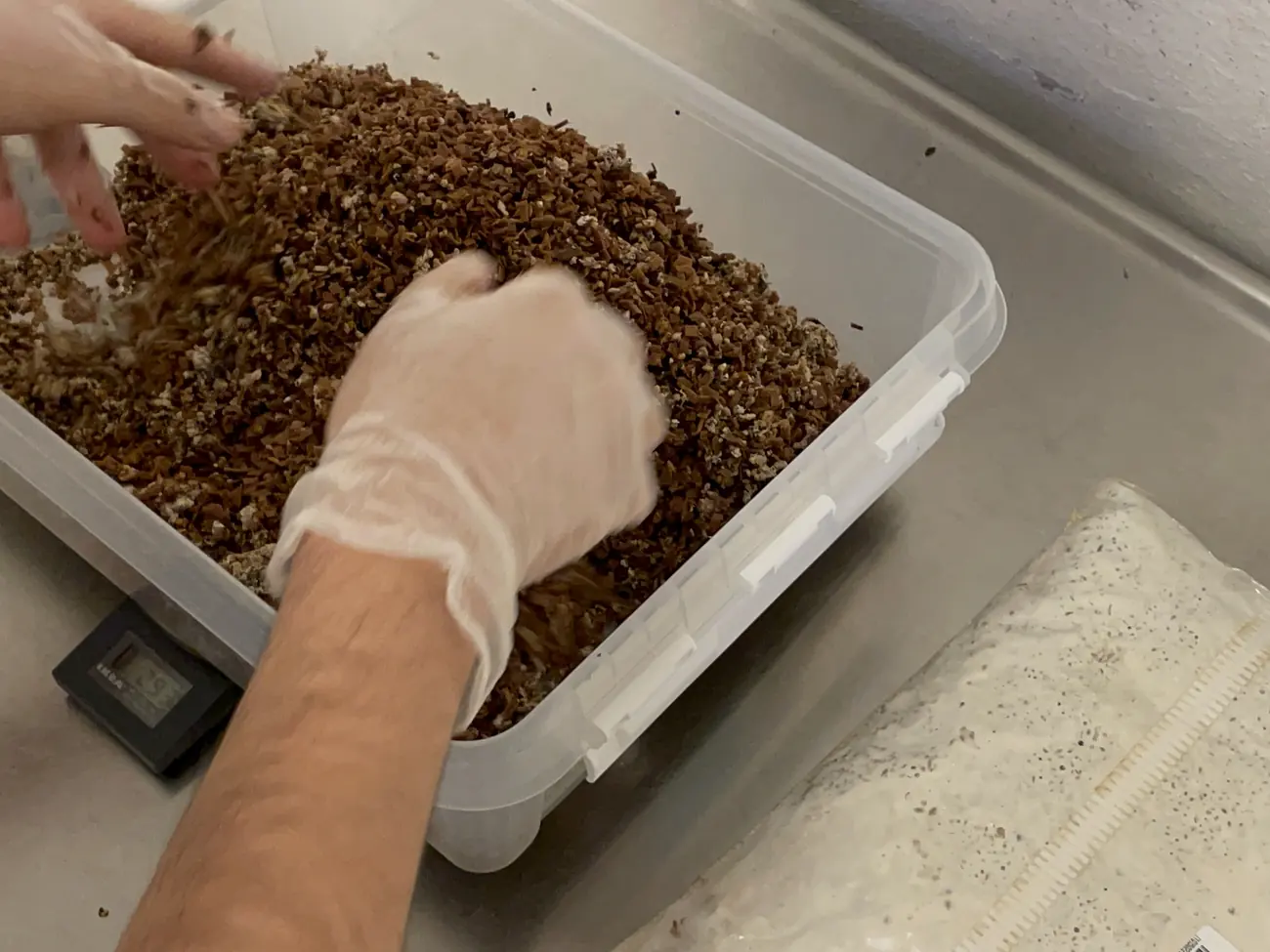
  1. Gloved hands mixing a wood-based substrate in a plastic tub

    Mix

    Biochar and wood fibres are sterilised, then kneaded with flour, binders and the reishi spawn.

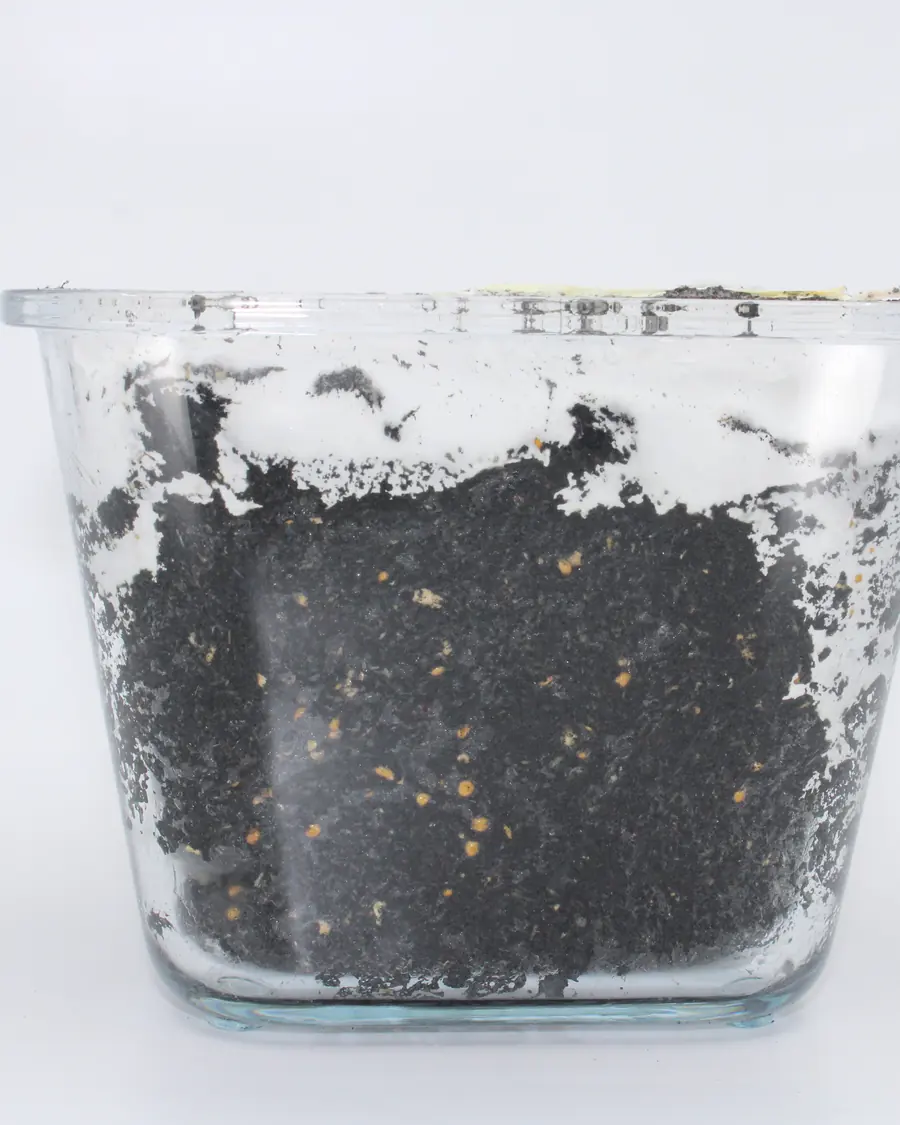
  2. Dark biochar mix in a glass container, threaded with white mycelium

    Let it colonise

    The mix rests for about two weeks, so the fungus is established before printing.

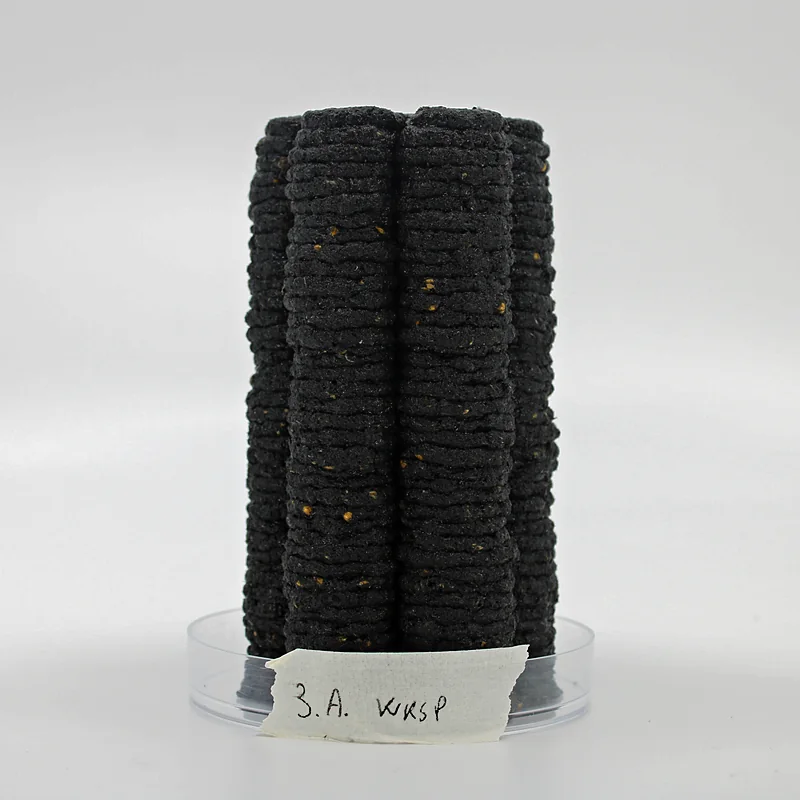
  3. Print

    A clay printer lays the paste through an 8 mm nozzle, in one line that never stops.

  4. Grow

    Two weeks in a humid chamber at 24 °C, filmed by the night camera of the fermentation room, date stamp and all.

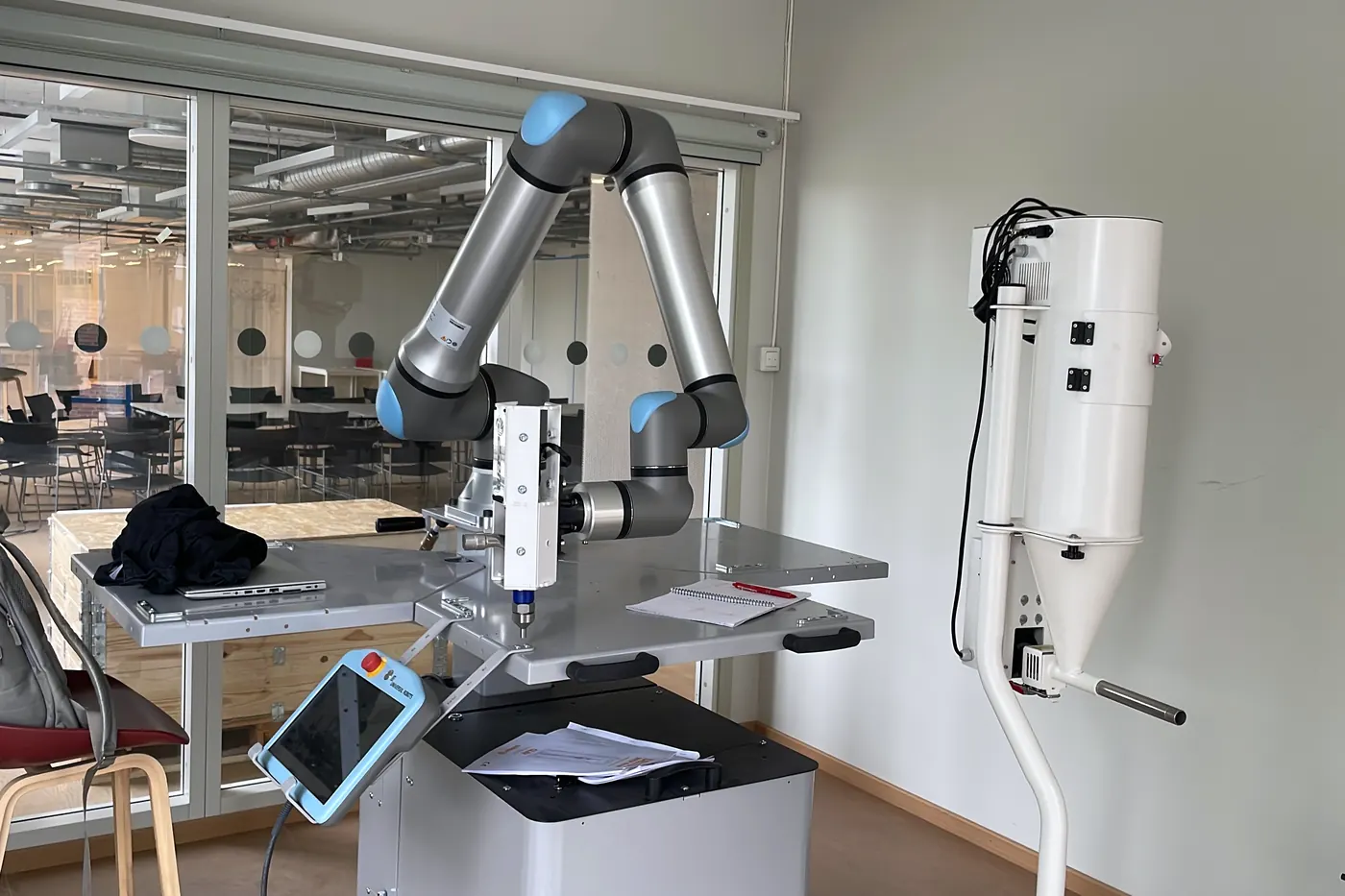
A UR15 robot arm fitted with a paste extruder, in the Material Practices Lab

And a robot arm

Next to the clay printers, the lab has a UR15 robot arm fitted with a WASP extruder for liquid deposition printing. It reaches further than a printer bed, which matters once the parts grow towards the size of a building element.

A pattern borrowed from brain coral

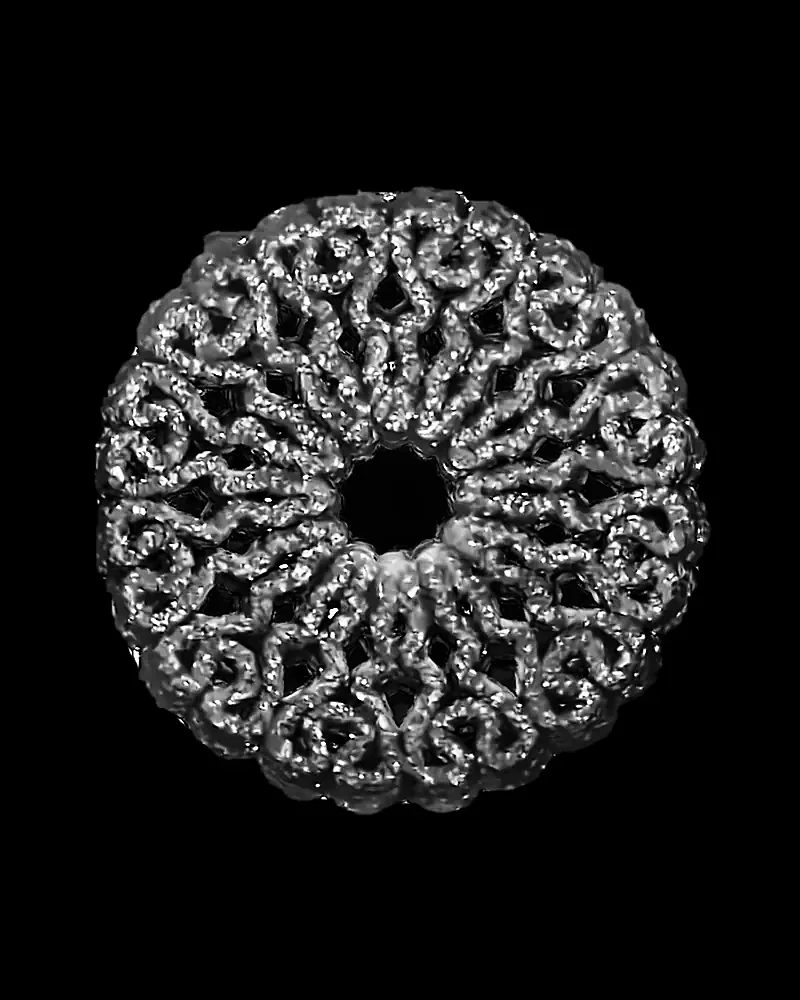
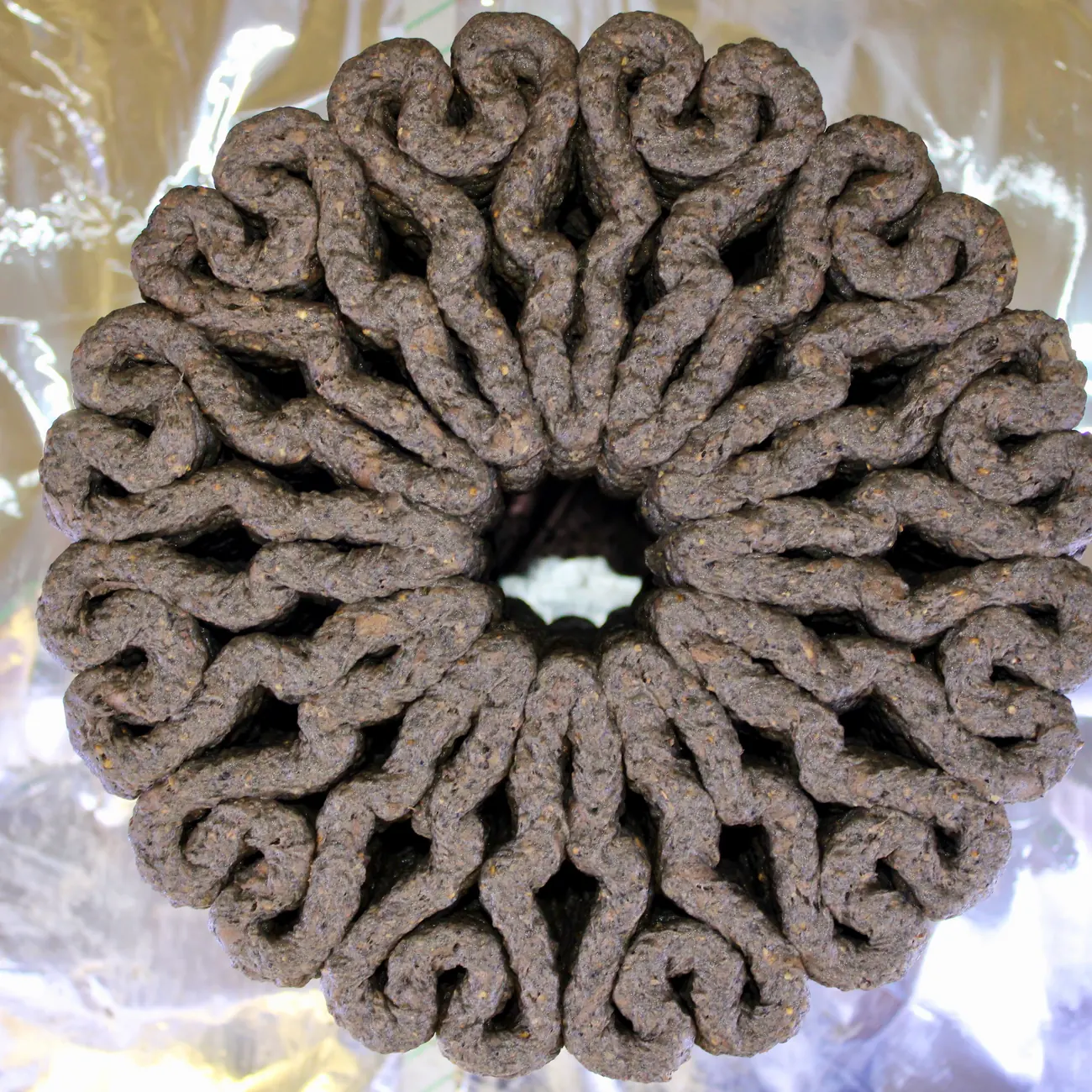
The toolpath is a reaction-diffusion pattern, the chemistry that paints stripes on fish and folds the surface of brain corals, where the folds help water circulate. Printed, the folds become corridors for air between walls that carry the load.

Two numbers carry the design

Merging points, where the line touches itself and fuses, and porosity, the share of open space. Holding both steady from a 6 cm test cylinder to a 40 cm demonstrator lets small tests speak for large parts.

This is the real file

The drawing is the demonstrator's G-code, played back as the printer moves: 96 layers, one line that never stops, a little over five hours of printing at 1,200 mm per minute. The loupe rides on the nozzle.

Wide end up

The drawing shows the piece the way it stands. On the printer bed it is the other way round: the first layers are the widest, so the paste prints standing on them, and the grown piece is turned over.

1of 96
Layer
4mm
Height
0m
Line laid
0 h 00
Printing time

Eight days in the chamber

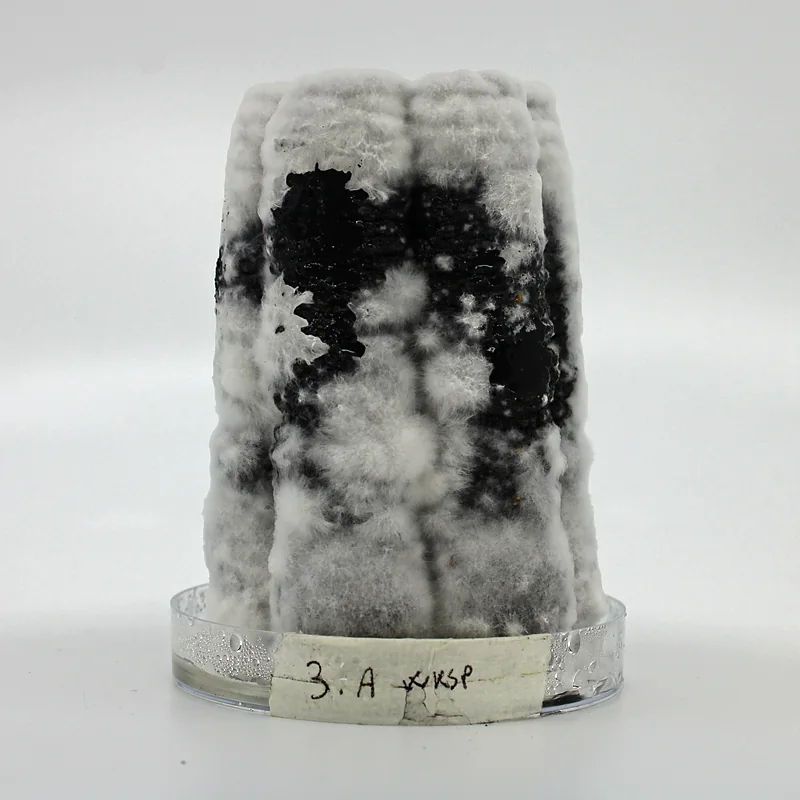
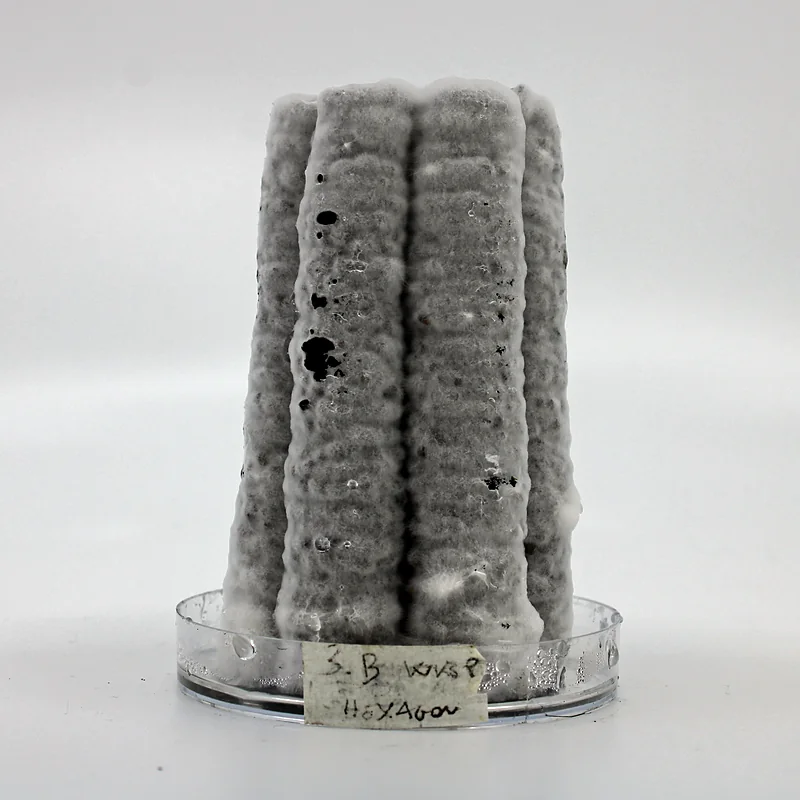
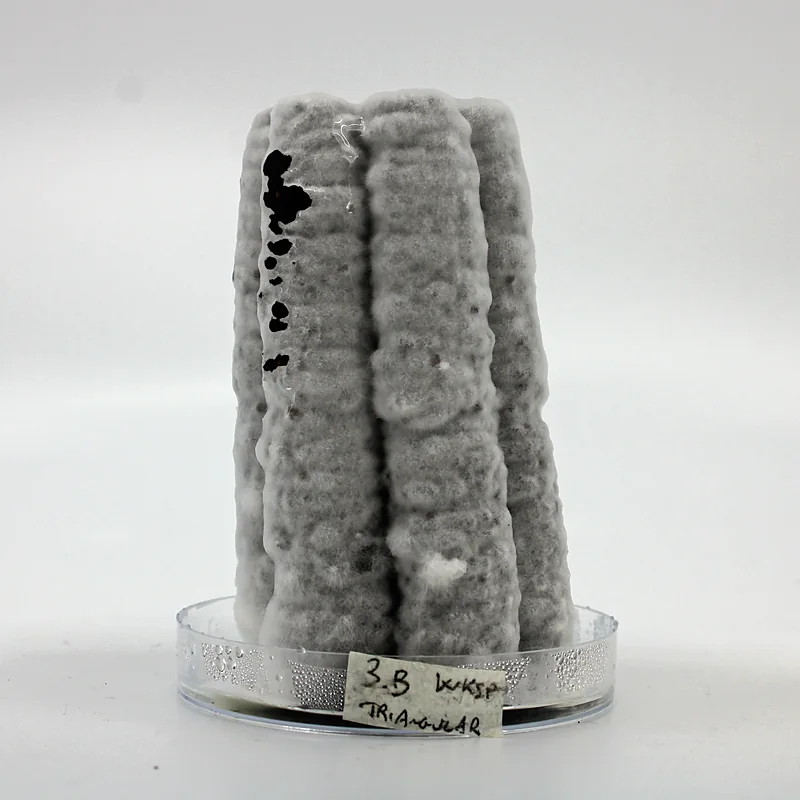
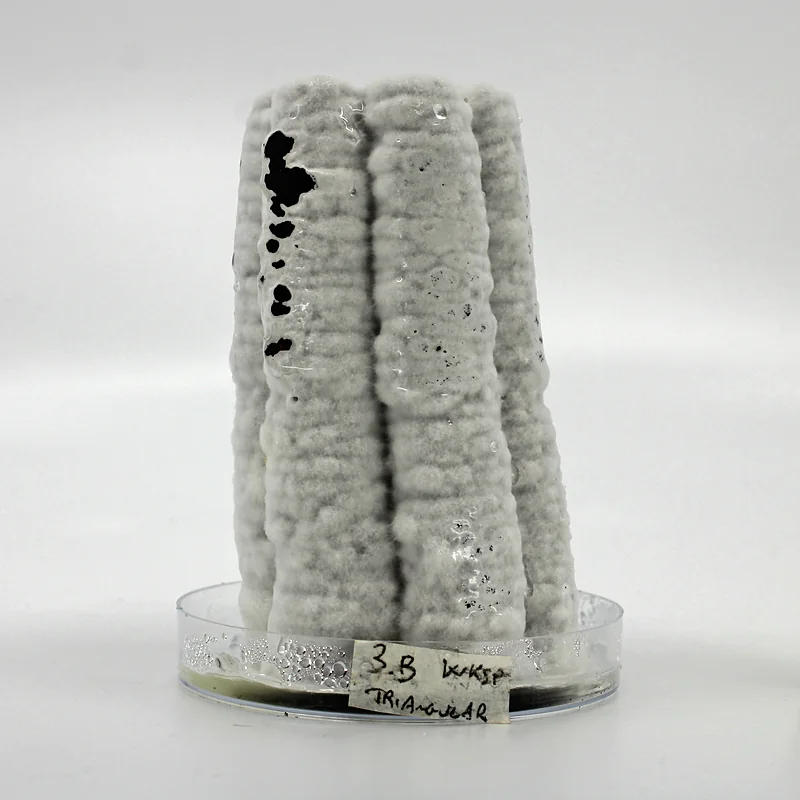
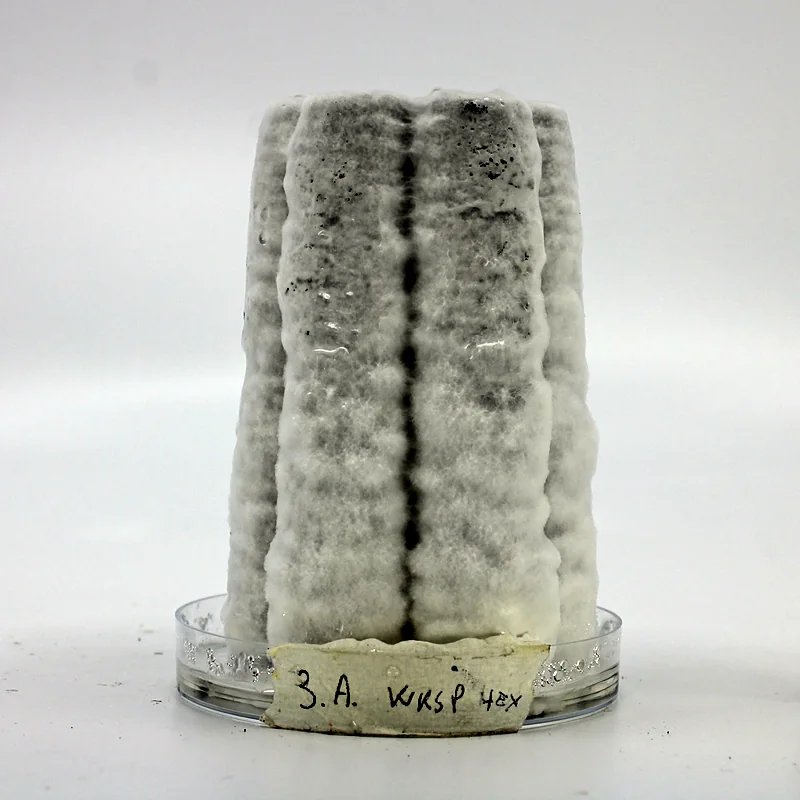
The fermentation room's night camera looked down on demonstrator D2 from 17 to 25 March 2026. Under the dish you see its own grey picture; around it, the same film stained.

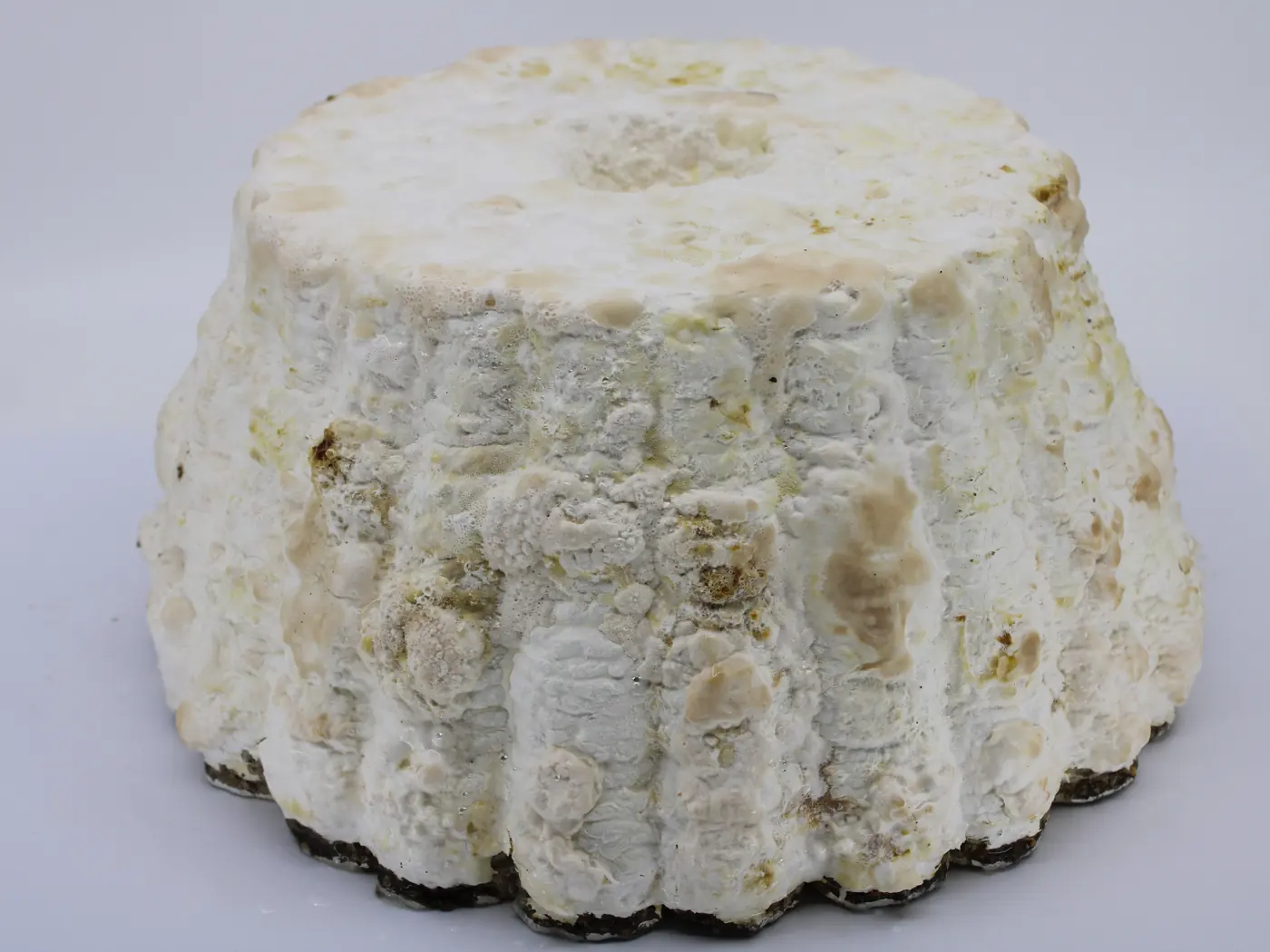
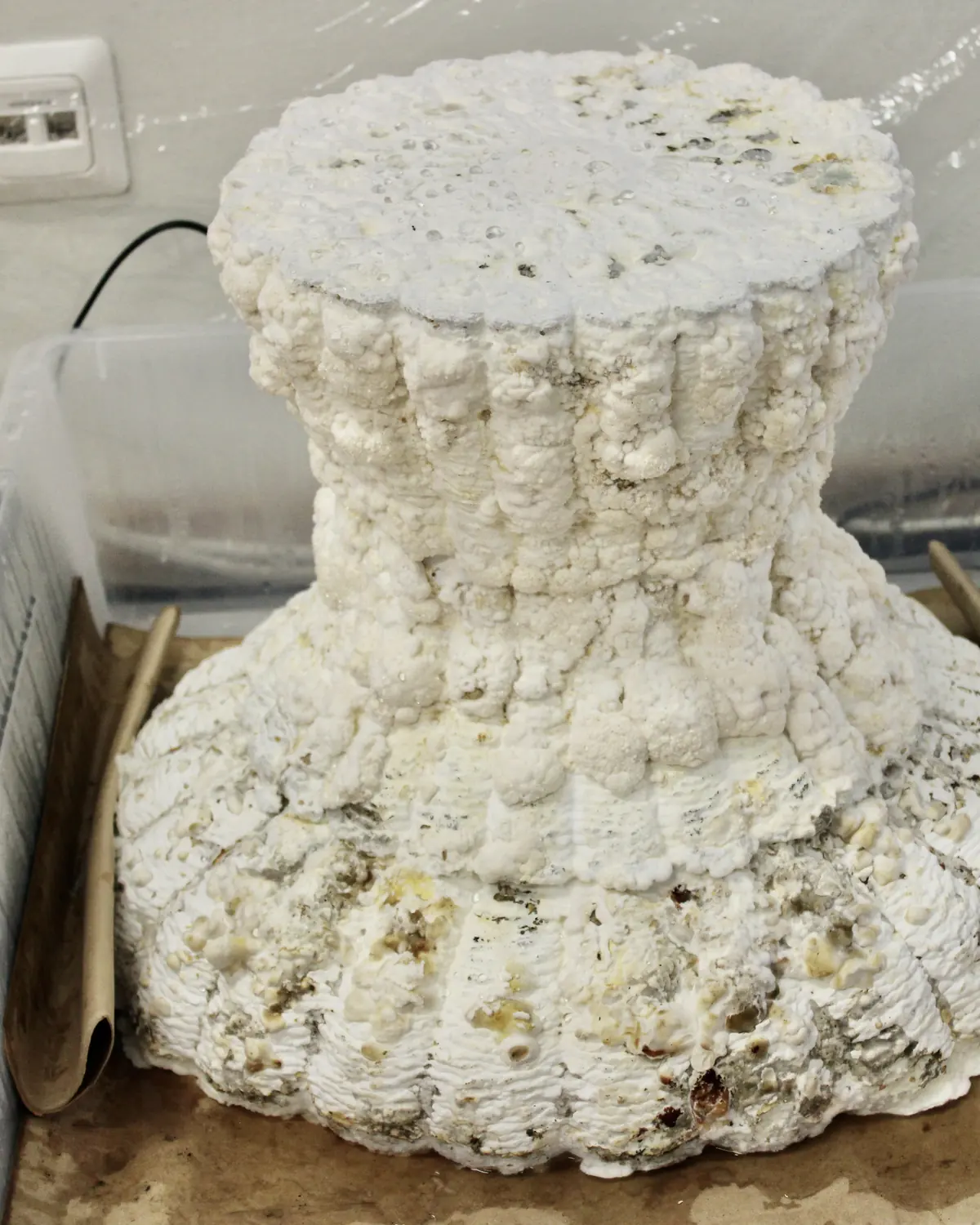
A white skin closes over the print

Hyphae, the fine threads of the fungus, cover the grey paste. The printed pattern stays readable underneath.

Then it is dried, not baked

Drying in air leaves the fungus dormant rather than dead, so a seam could in principle be woken up again, to repair a part or to join it to another.

Tue 17 March
0 h in the chamber

Every sample growsits own way

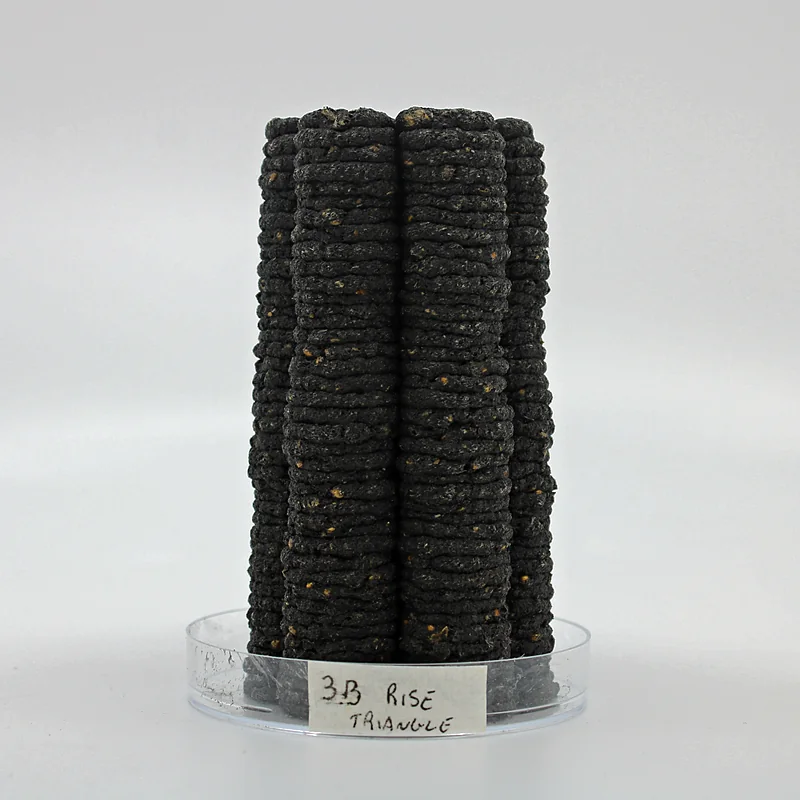
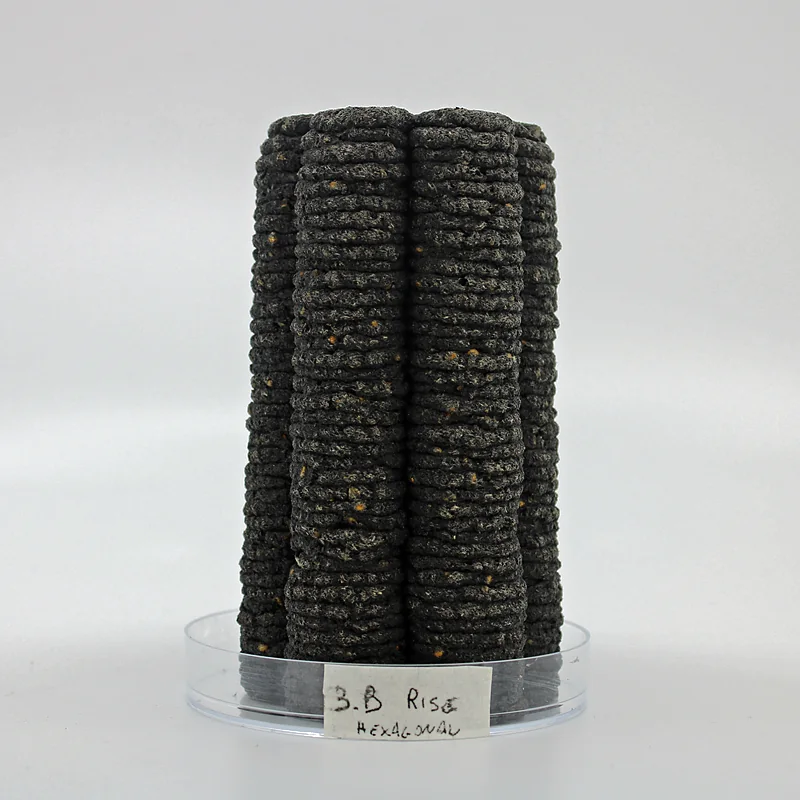
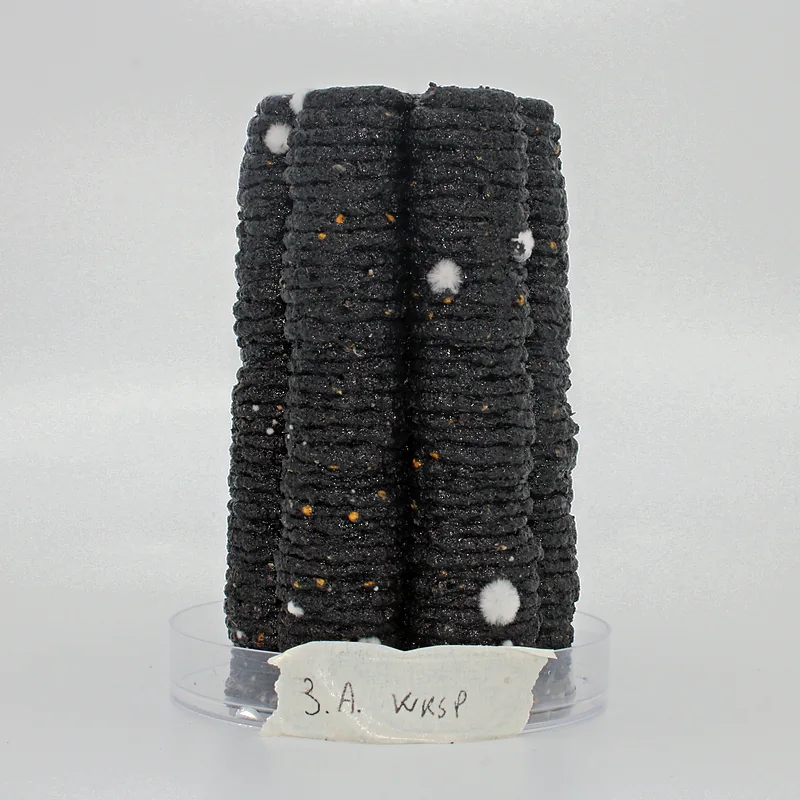
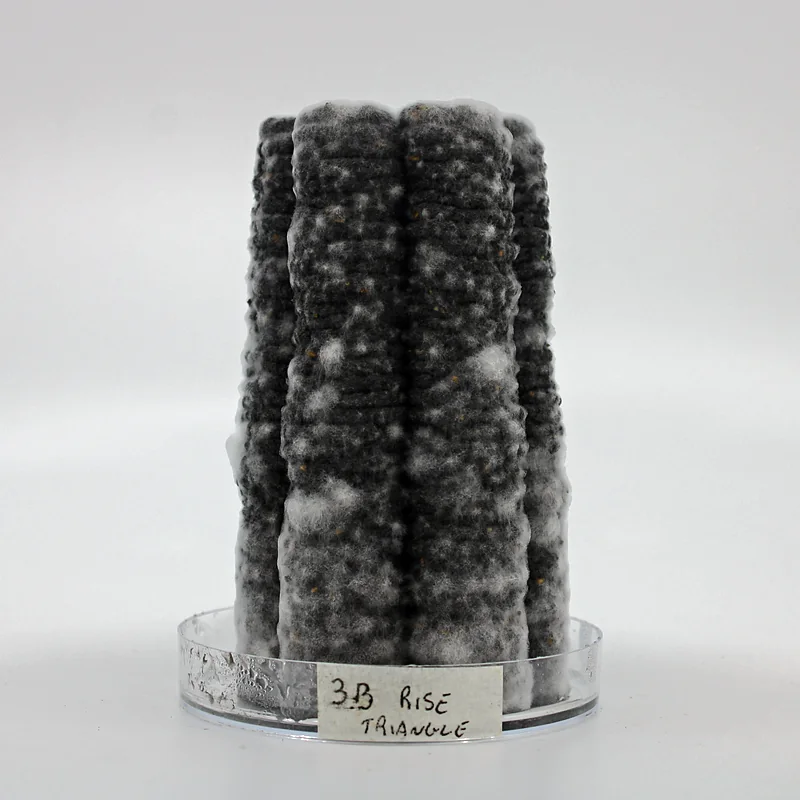
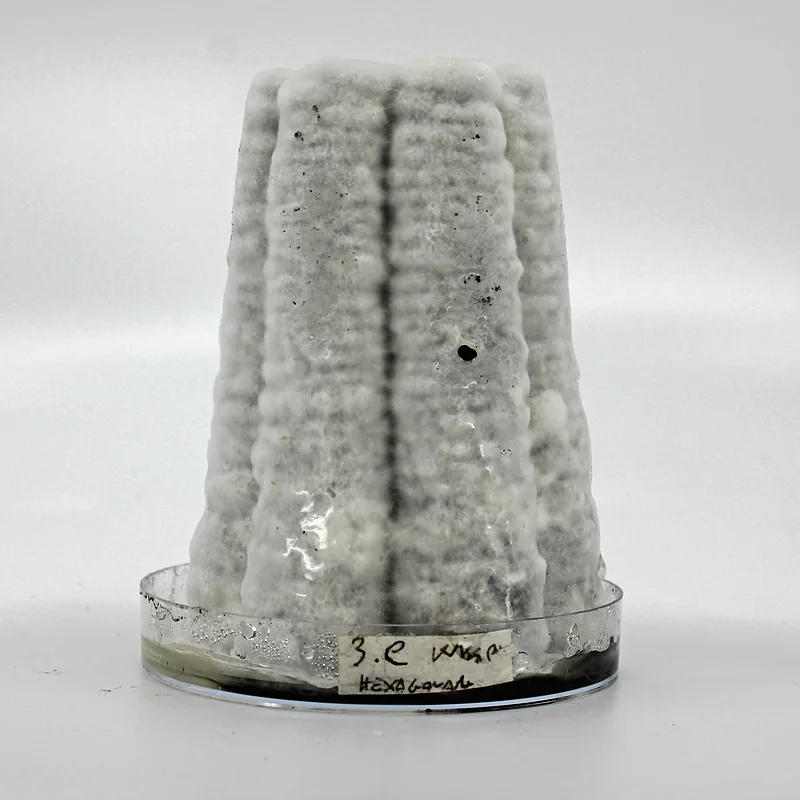
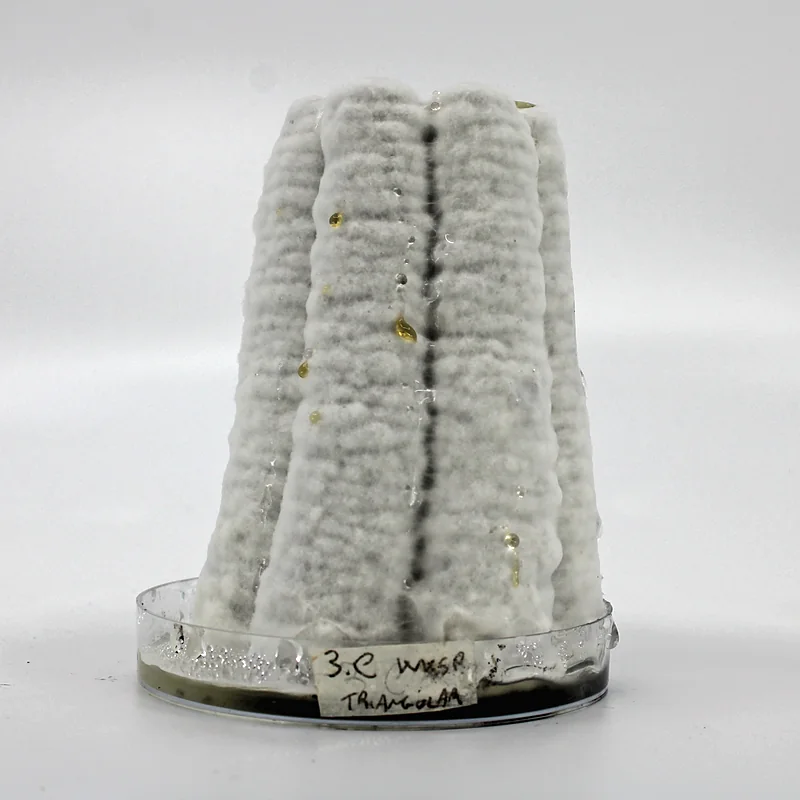
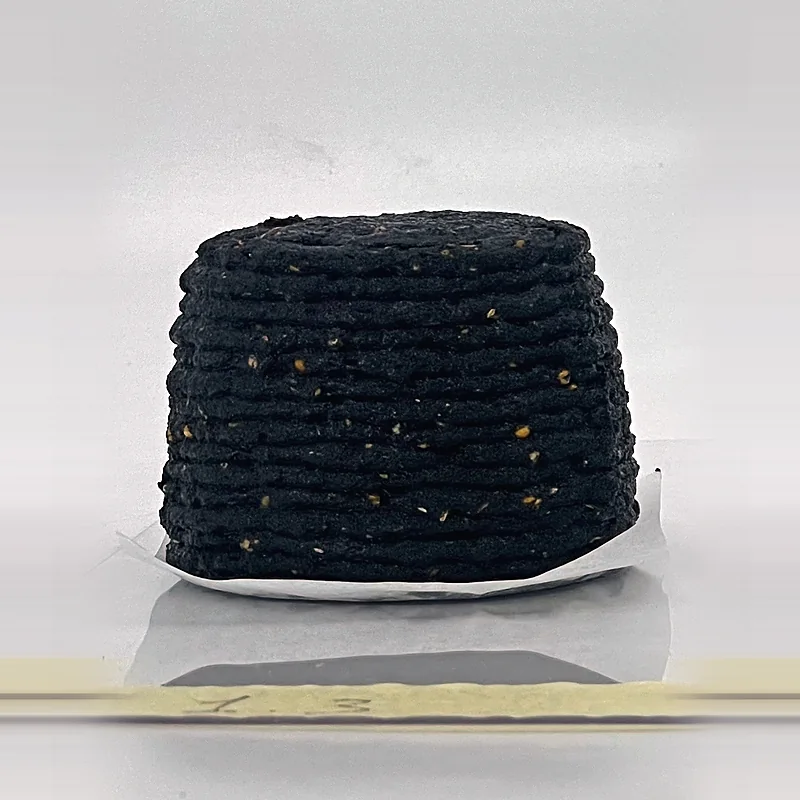
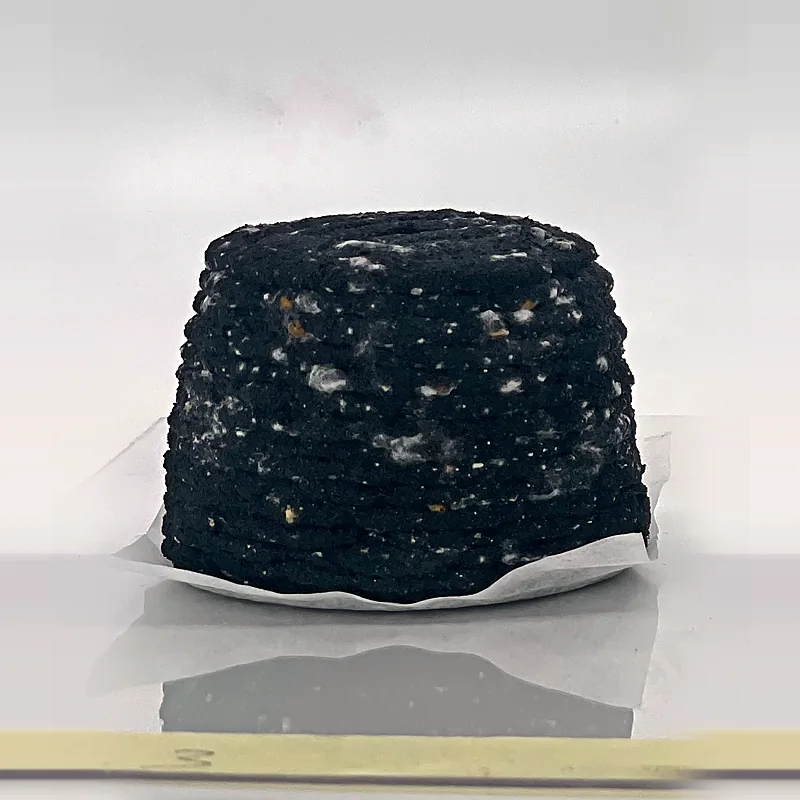
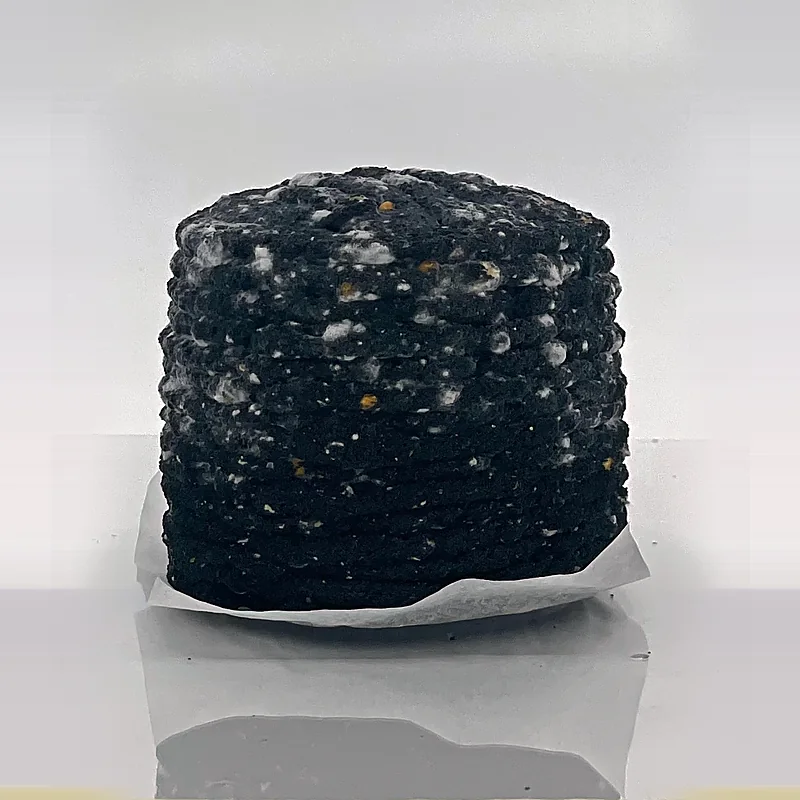
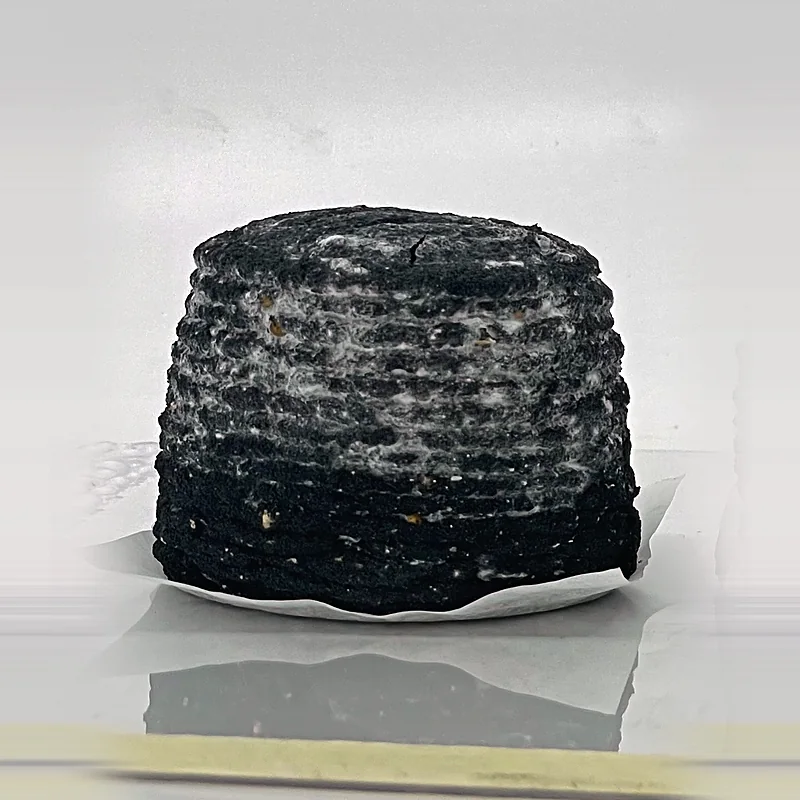
Printed cylinders and blocks from the tests behind the 2026 paper, shown as they change: fresh black paste, first white threads, full colonisation, and the samples where growth stalled.

Tall printed cylinders, from fresh black paste to fully white with mycelium
Demonstrator D2 from above, growing from day 0 to day 8 and back, in a loop
Seen from above, the inside of a glass box of biochar mix fully grown over by white mycelium
Short printed cylinders from the same batch, from fresh black paste to white with mycelium

From left: tall cylinders from fresh paste to white; D2 from above on days 0, 3 and 8; six glass boxes of mix from above, fully grown, July 2023; short cylinders from black to white. The dish labels are the lab's own.

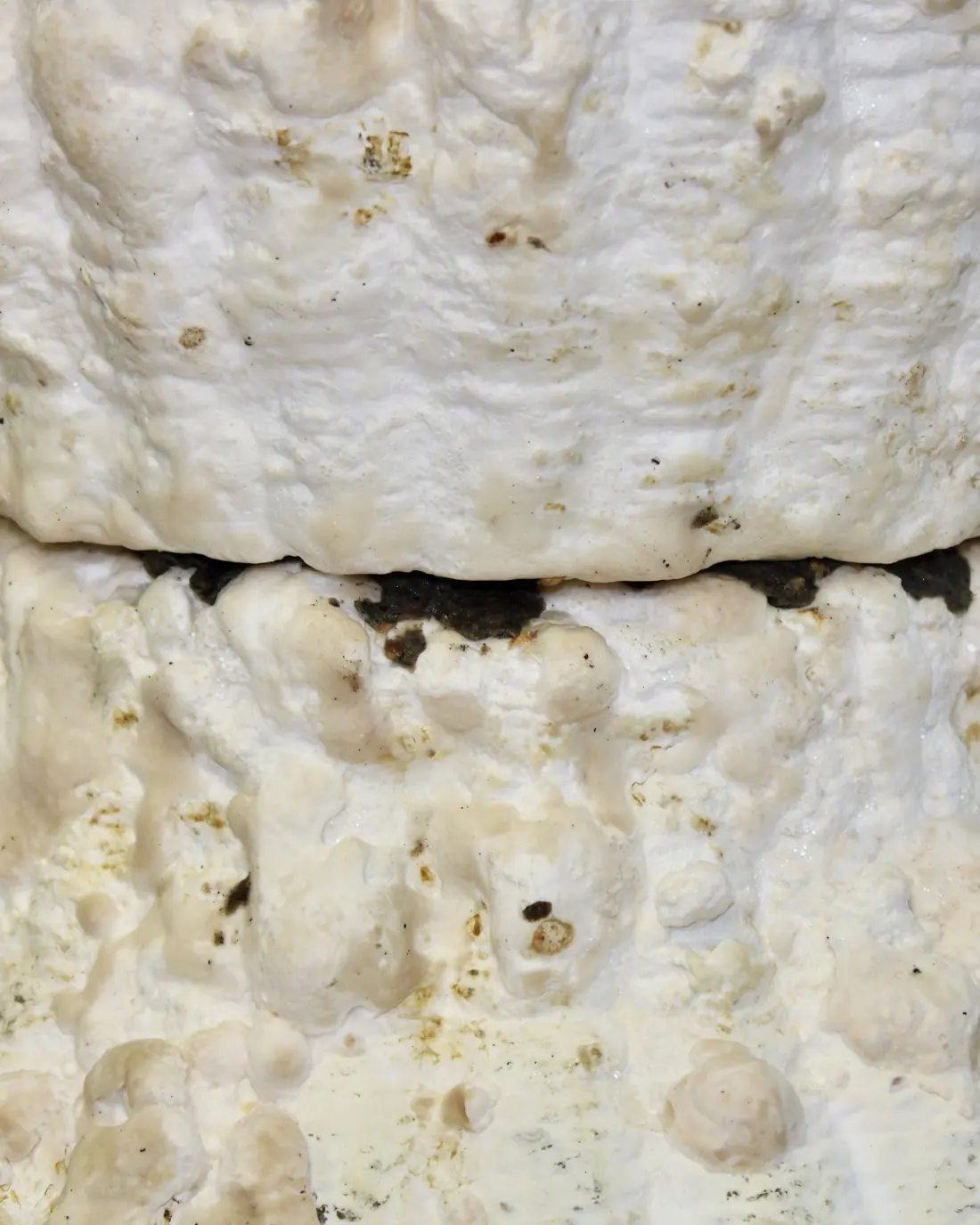
Close-up of the joint between two printed segments before growth
The same joint after growth, bridged by white mycelium

The joint between two segments, before and after growth.

Welded by the fungus

Fresh paste can only hold so much height and overhang, so demonstrator D1, 40 cm tall, was printed in three segments. After two weeks of growth, a thin layer of fresh paste went between them, and within seven days the mycelium had grown across the joints. The part was then left to dry in air for at least four weeks.

No glue, no screws. The joint became an essay, below.

Anatomy of a Living Joint

UOU Scientific Journal 10, In Detail, December 2025

The joint between the printed segments became an essay in the UOU Scientific Journal of the University of Alicante. Its pattern comes from a brain coral: the ridges leave open channels where air reaches the fungus and closed wells where moisture stays, so hyphae from both segments grow across the seam and weld them without glue.

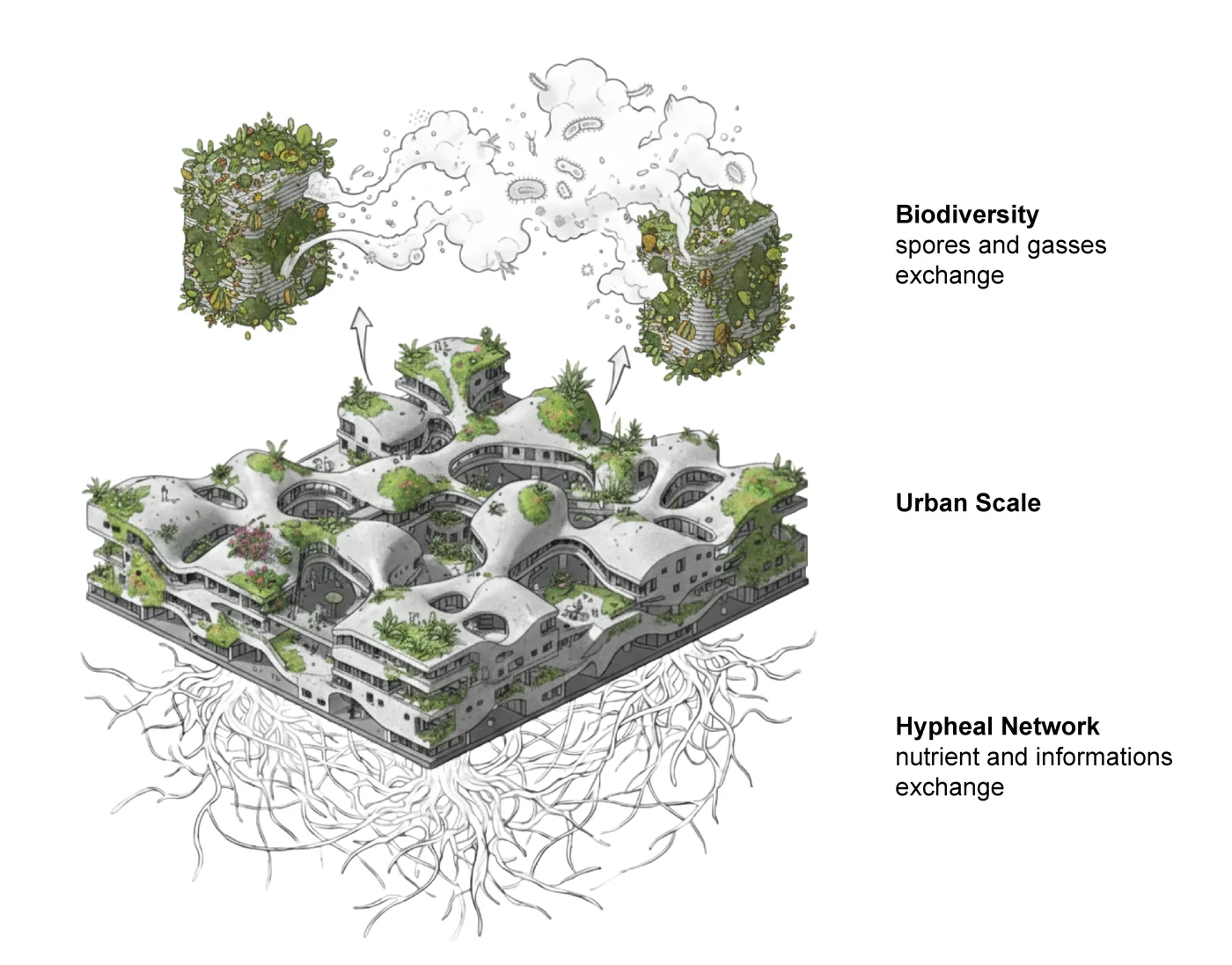
The essay follows the joint through the scales, the way Charles and Ray Eames did in Powers of Ten: hyphae a few micrometres wide, a 30 mm sample, the joint in centimetres, a 9 metre pavilion and a city block whose buildings share a fungal network underground. Read the essay, open access.

The joint cut through from end to end, from the slides of my PhD review in November 2025.

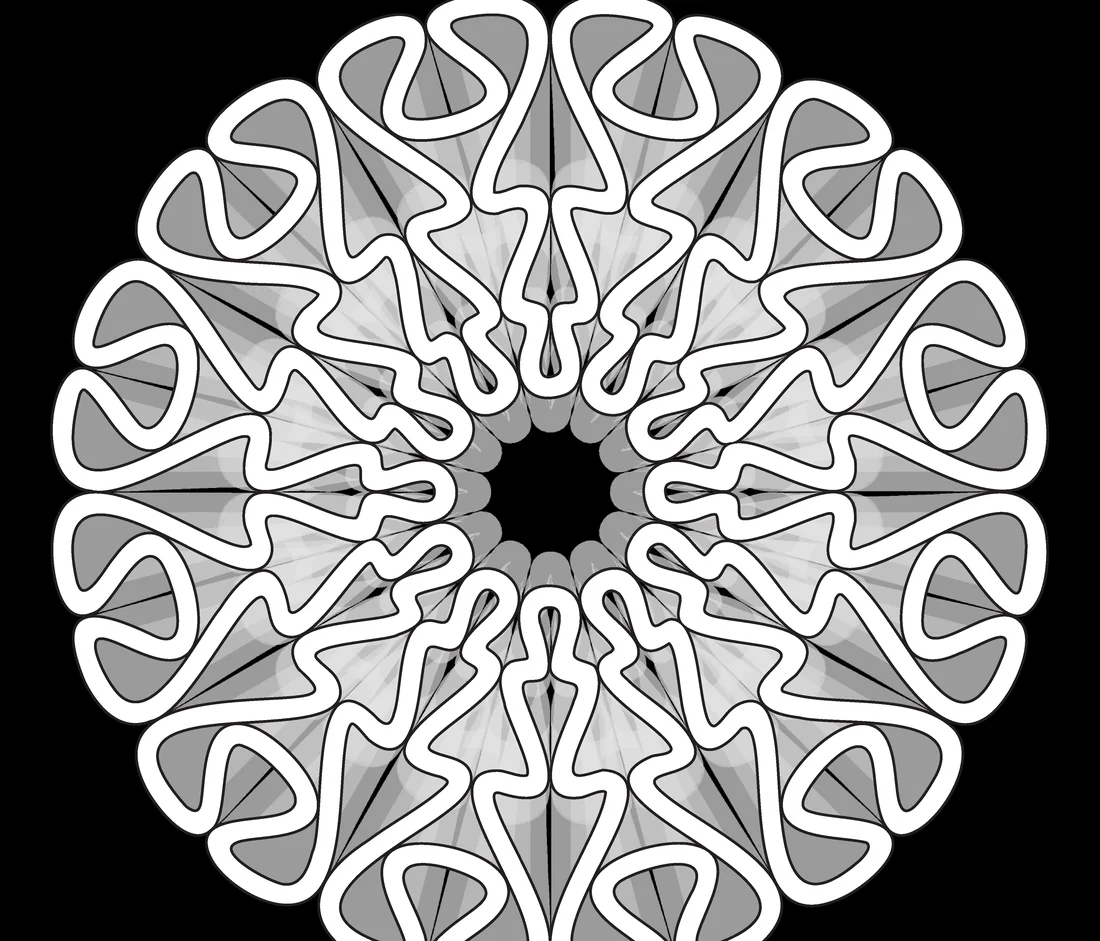
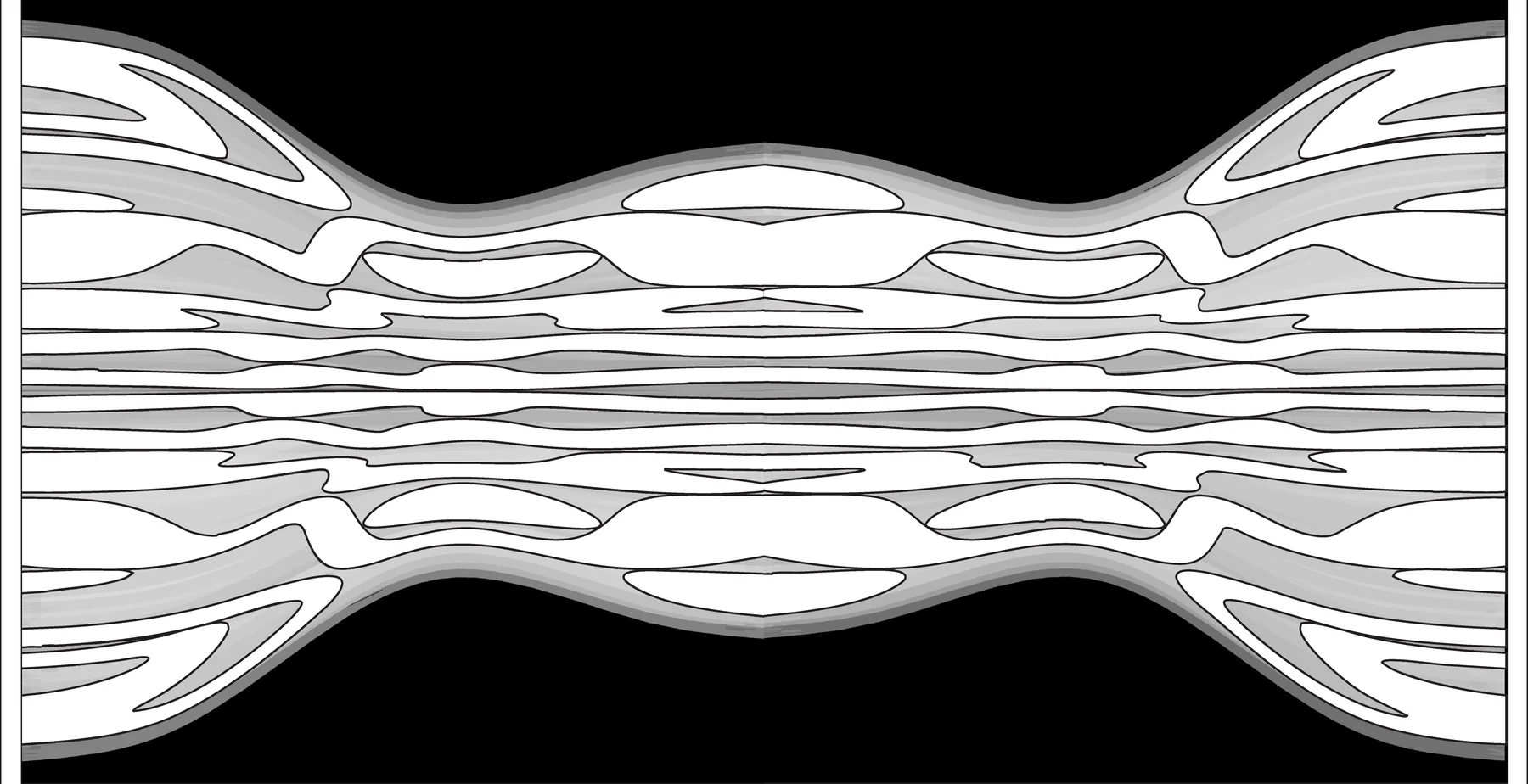
Horizontal section of the joint: white ribs folding in a ring around a dark centre, on black
Longitudinal section of a printed column: white and grey channels running its length, narrowing at the seams

The joint in centimetres: the horizontal section drawn from the coral, 30 cm across, and a 60 cm section along a column, where the welded seams repeat.

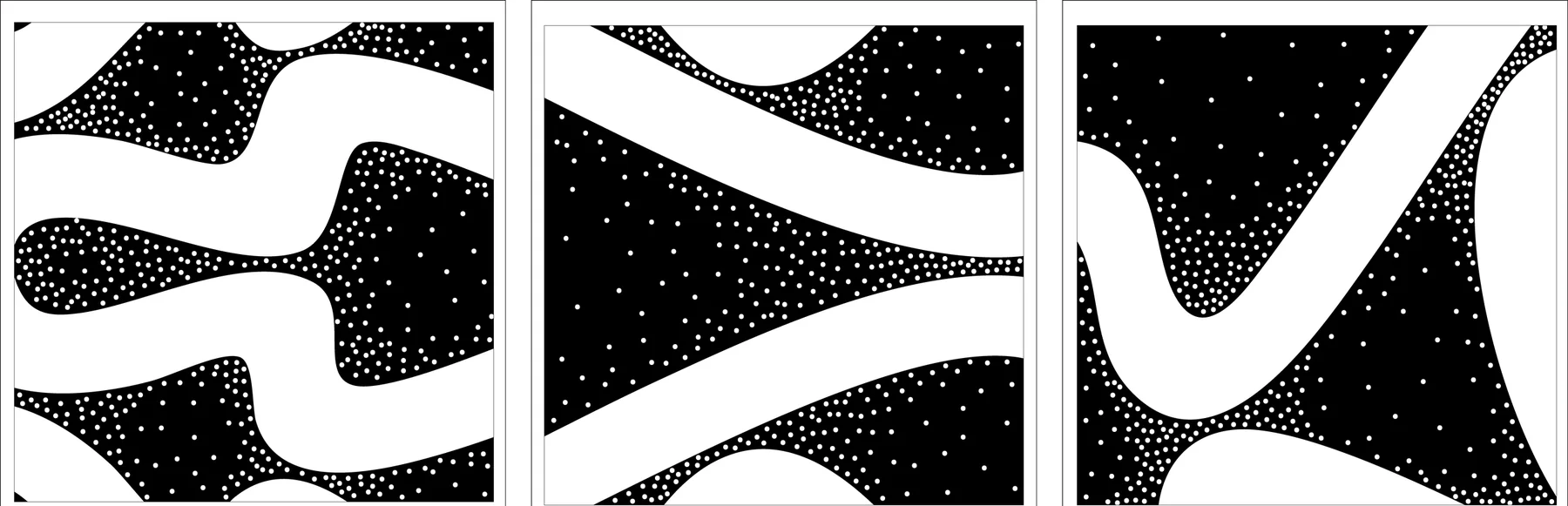
Three square details of the pattern in black and white, dotted where moisture gathers

Three 30 mm samples: where the pattern opens, air reaches the fungus; where it closes, the dots show the moisture that stays.

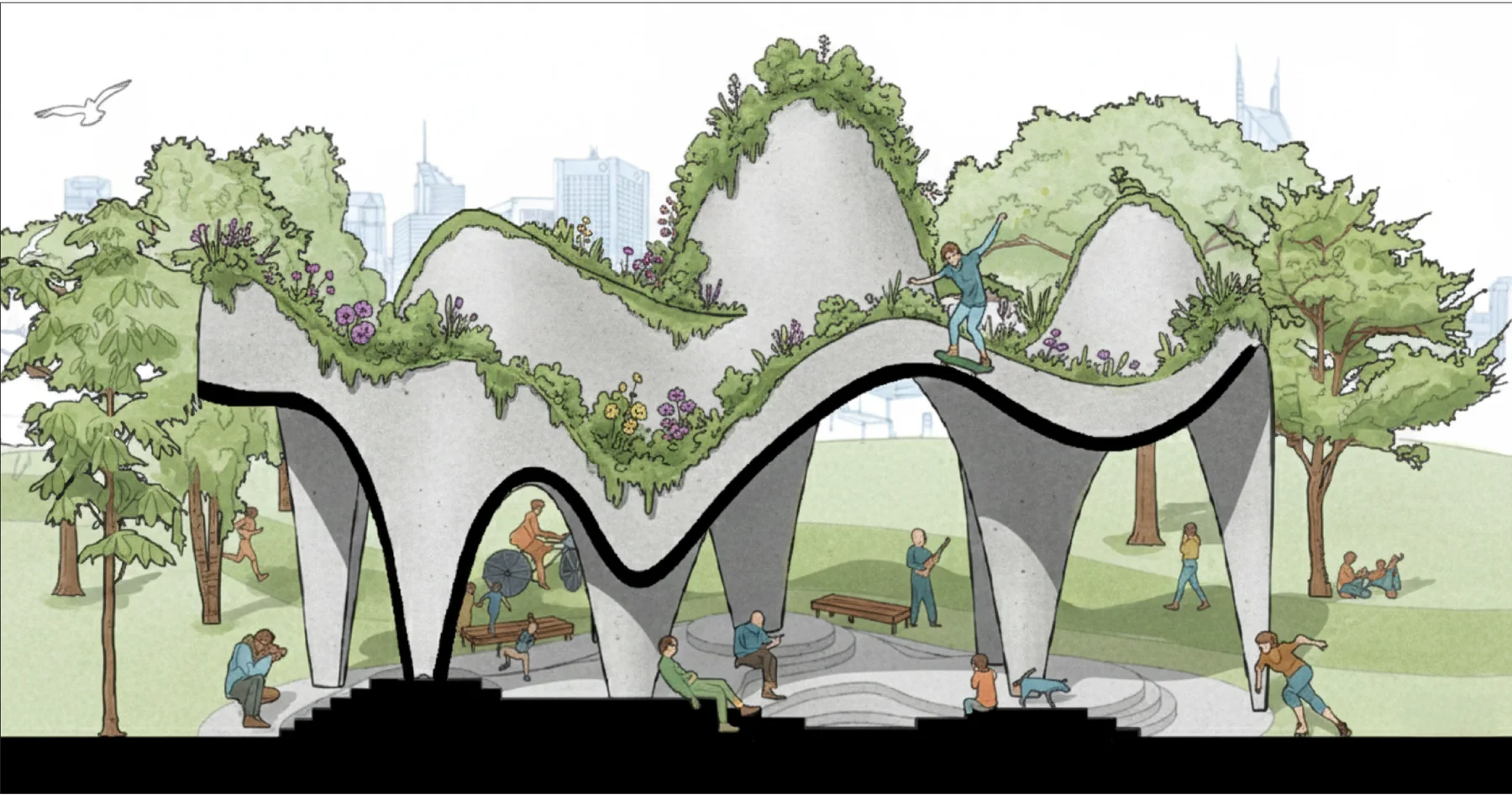
Section perspective of a planted pavilion of grey shells in a park, people sitting, cycling and skateboarding under and on it

A small pavilion printed in parts and welded by the fungus, 9 by 9 m and 6 m high, in section perspective.

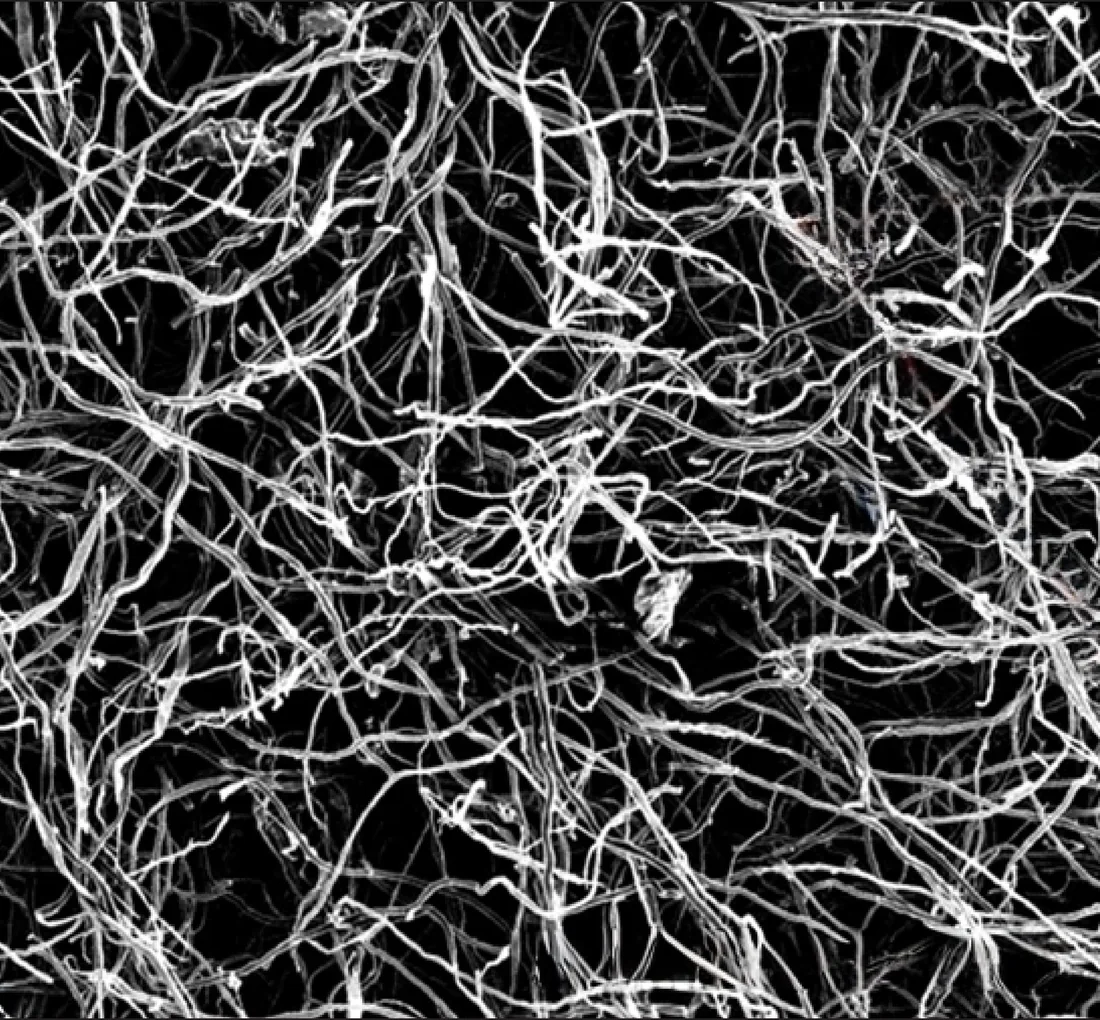
Electron microscope image of white fungal threads crossing in a dense web on black
Exploded axonometric drawing of a planted city block, with spores rising above it and a web of hyphae below the ground
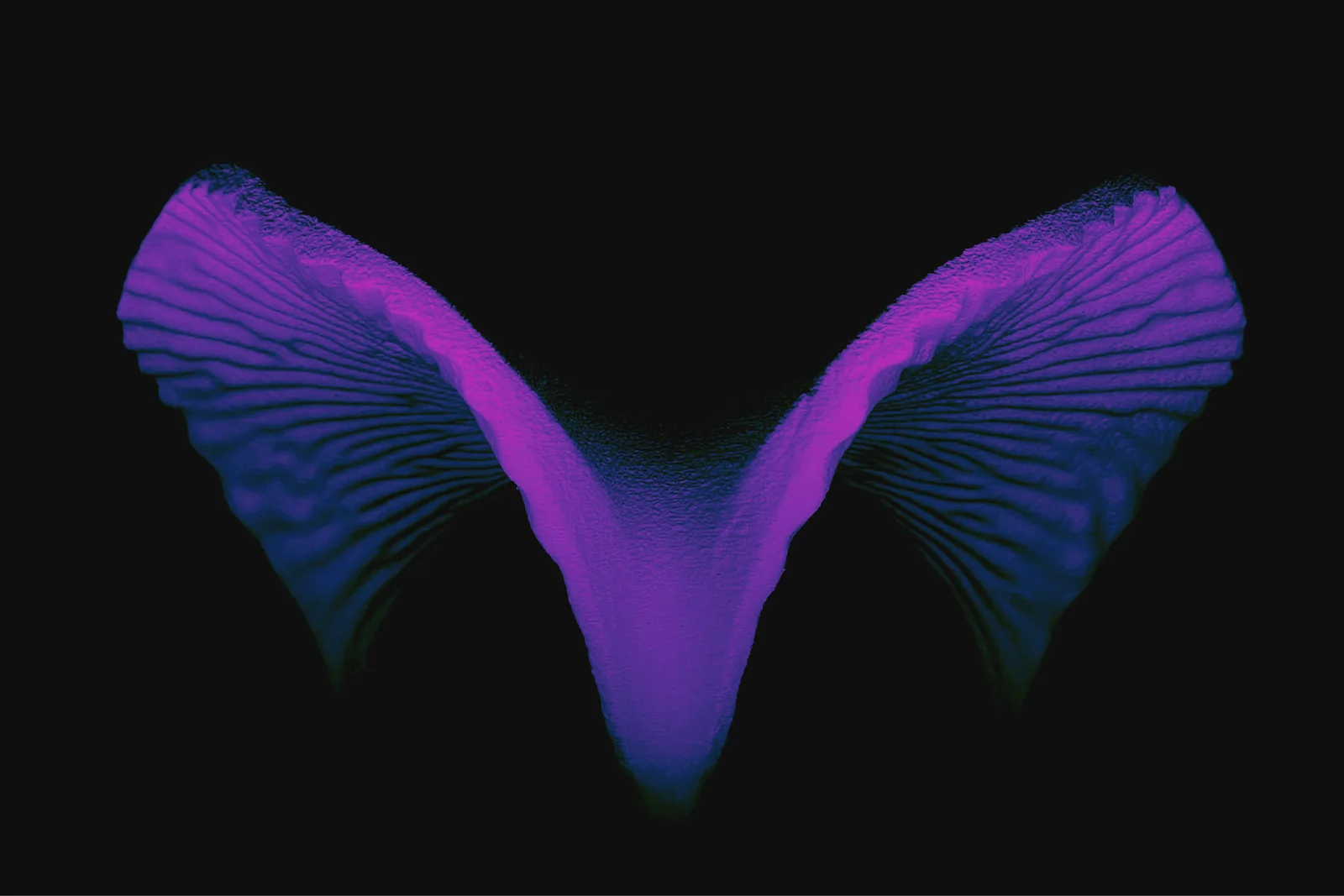
Render of a ribbed V-shaped shell in violet on black

From the micrometre to the city: hyphae bridging the pores of a substrate under the electron microscope, adapted from Islam et al. 2017 and Motamedi et al. 2025; a city block with planted facades above and a shared mycelial network below; a modular shell for printing.

From printerto fruit

Two demonstrators, from wet paste to finished object. D1 was published in 2026. D2, all white, was printed in March 2026 and shown at EURAU in Umeå that June.

The nozzle above the brain-coral pattern, laying a new layer
Laying a layer.
A delta clay printer printing the top of a demonstrator
On the delta printer.
A freshly printed grey demonstrator, hourglass-shaped
Just printed, still wet.
The fresh print from above, a ring of brain-coral folds
From above, the pattern is the whole design.
A white segment after two weeks of growth
A segment after two weeks of growth.
White demonstrator assembled from segments, in the lab
Segments joined by the fungus.
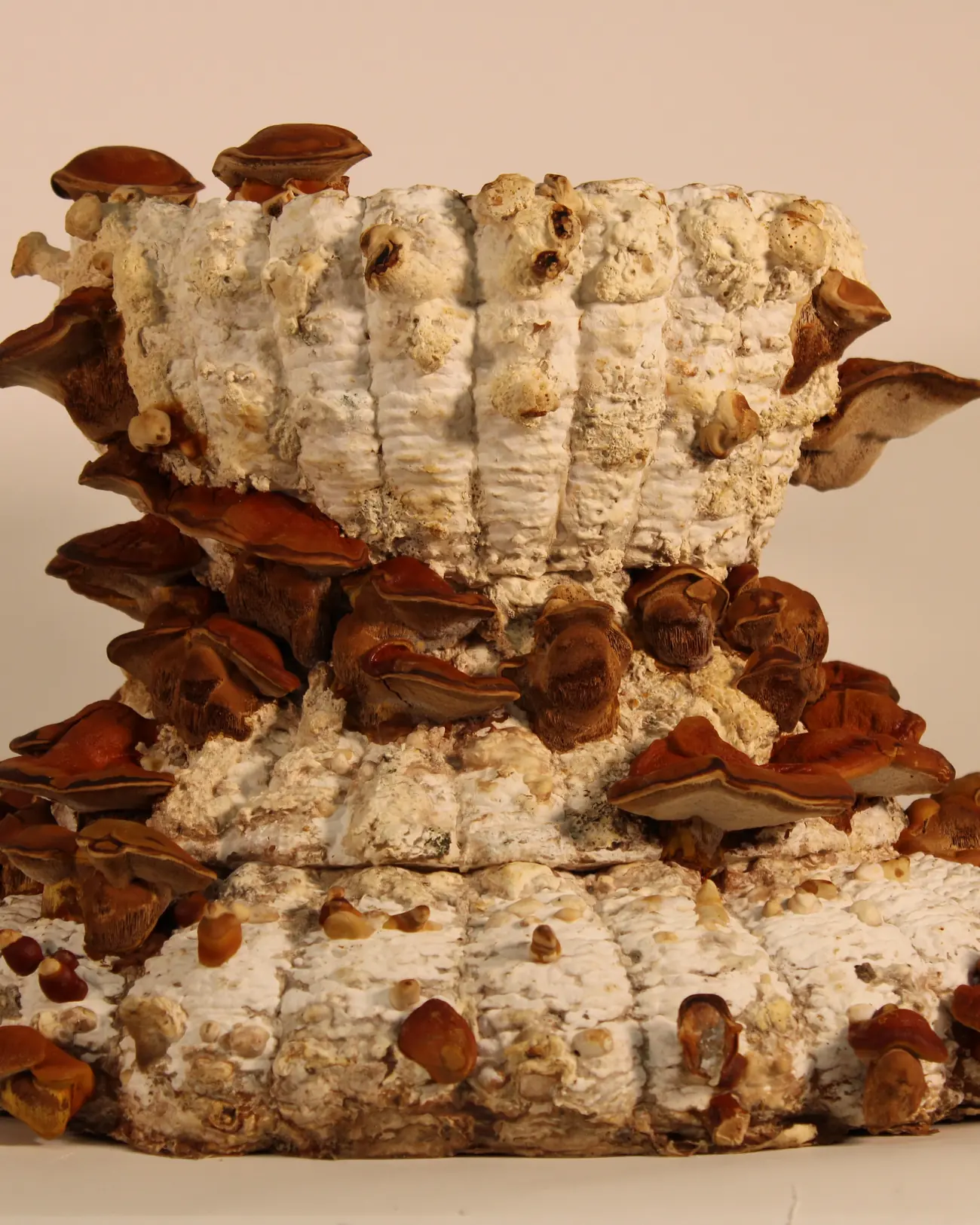
Demonstrator D1 with red-brown reishi caps growing from it
D1, fruiting.
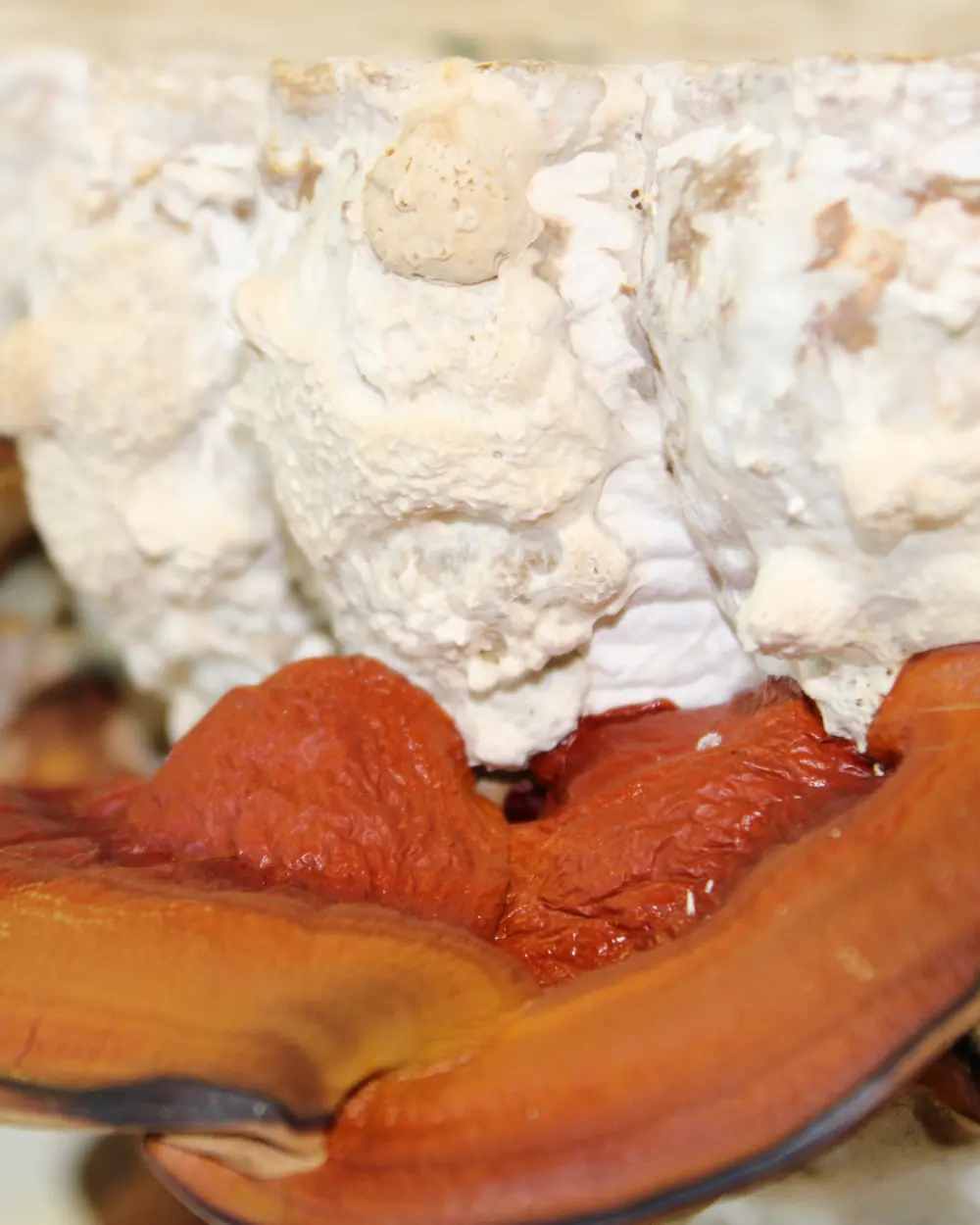
Close-up of glossy reishi caps under white mycelium
Reishi, Ganoderma lucidum.
Demonstrator D2 seen from above at an angle
D2, 2026.
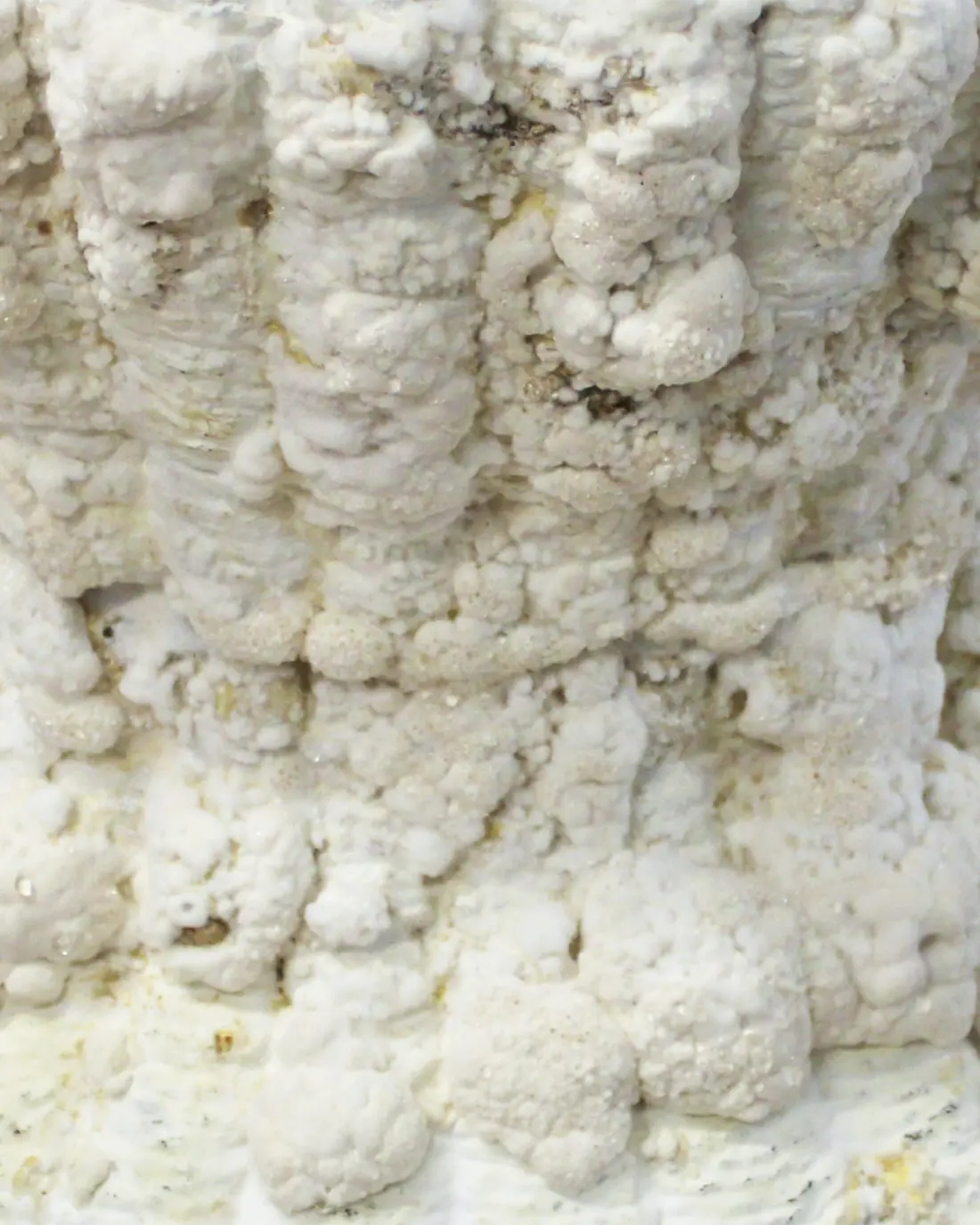
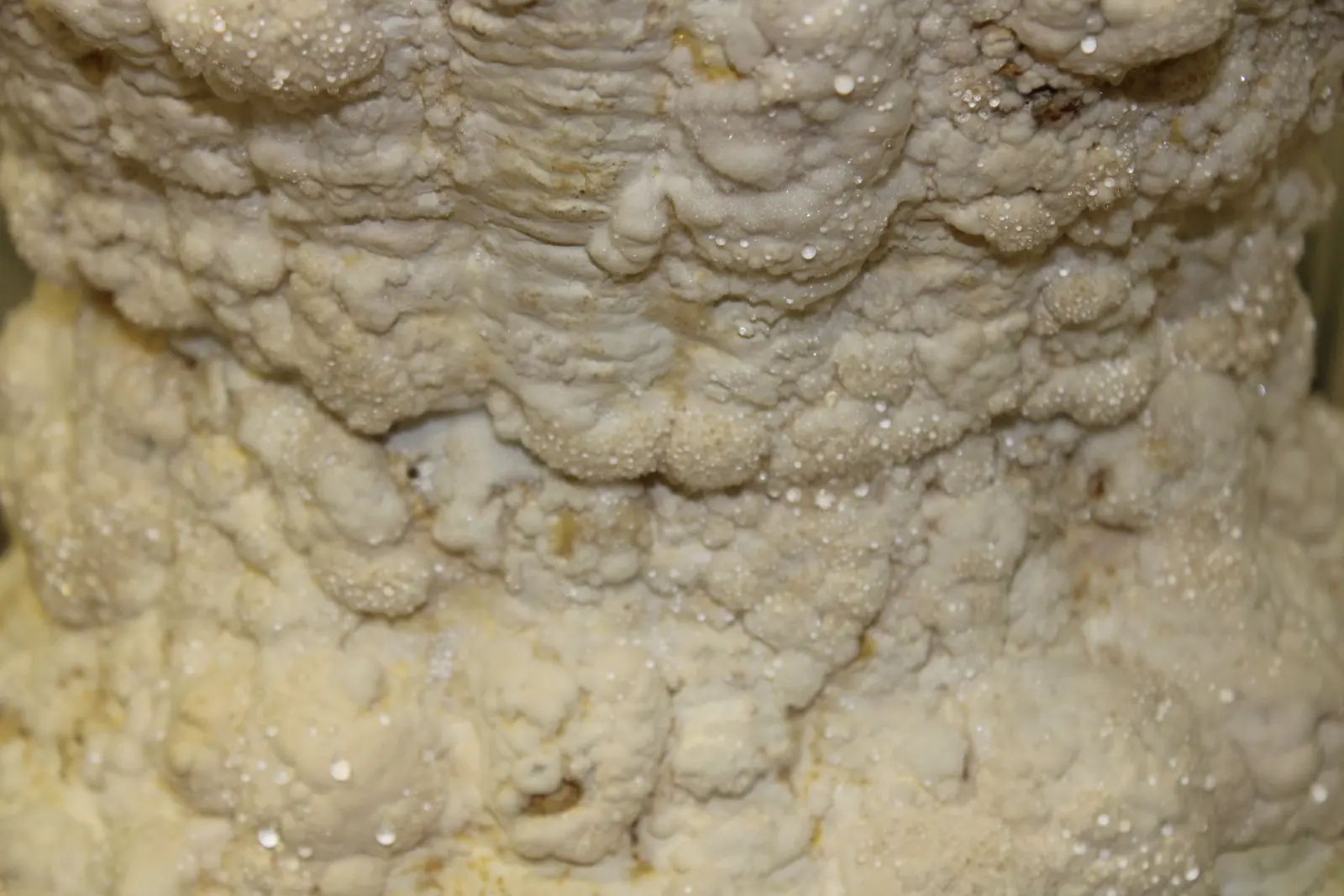
Macro photograph of the mycelium surface
The surface, close.

2025, Umeå

Demonstrator D1fruited on its own.

ABC

D1 as designed

From its G-code: 96 layers in three printed segments. S1 from 0 to 112 mm, S2 from 112 to 236 mm, S3 from 236 to 384 mm.

D1, grown and dried

The segments welded into one piece by growth, then dried in air. The reishi fruited by itself. October 2025.

Section A-A’

A cut off the axis: the two welds run straight across the section.

Section B-B’

Through the axis: the vent stays open all the way up the middle.

Section C-C’

Farthest from the axis, so the narrowest of the three cuts.

D1 from its G-code, then the grown piece and the three cuts of the paper, all photographed from the same side in October 2025. Cut out of their backgrounds for this page. The film runs as you scroll.

Demonstrator D12025

Material
Biochar-mycelium composite, Ganoderma lucidum
Size
400 mm across, 400 mm high
Made
Printed in three segments on a WASP 40100 clay printer, welded by growth, dried in air

The red-brown caps are reishi fruiting bodies. They appeared by themselves after assembly. In a building part they are a side effect to avoid, but they also show that the fungus stayed alive through printing, growing and welding.

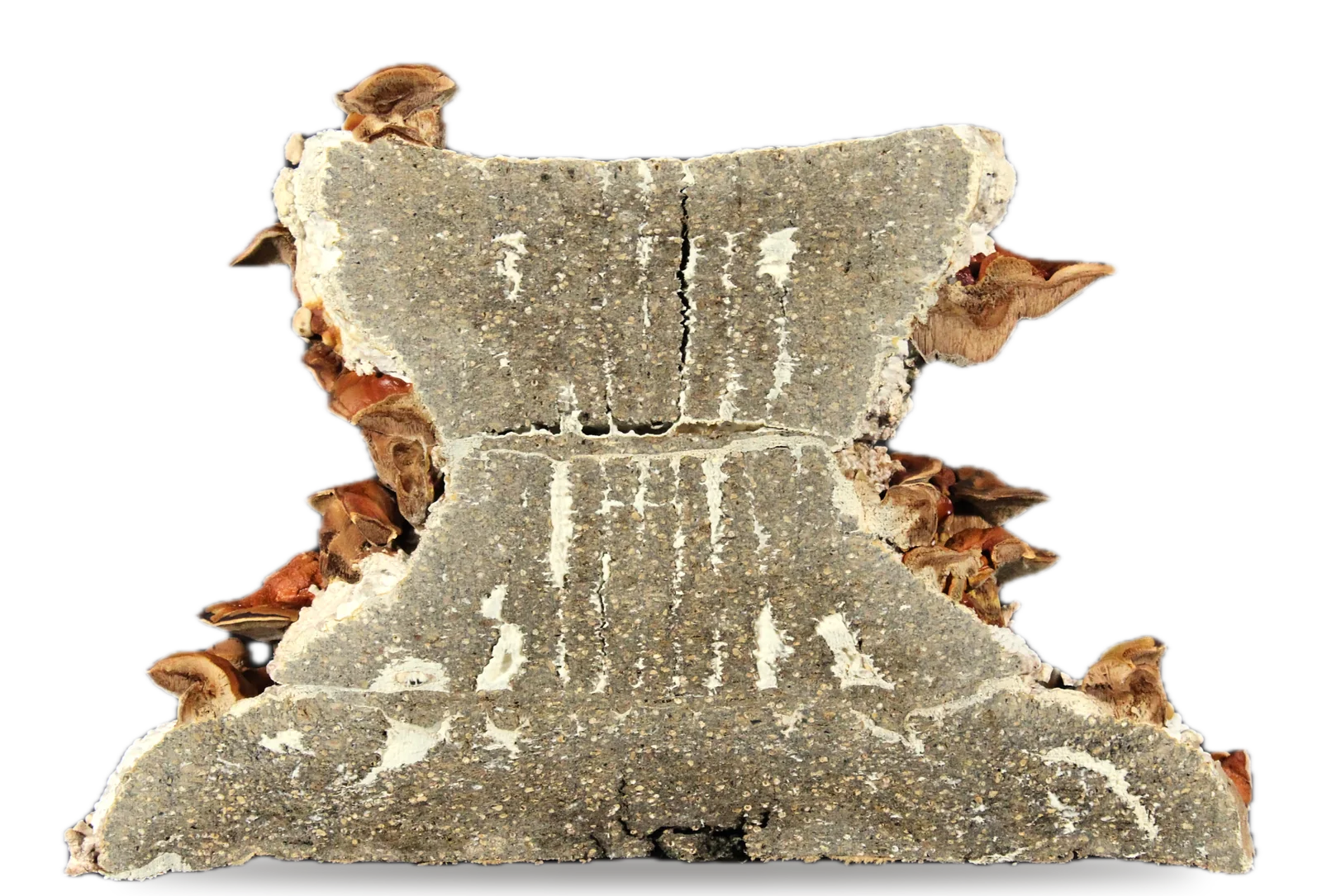
Demonstrator D1 cut in half, showing the hourglass profile, the two welds and the walls and corridors inside, reishi caps along its edges
Cut in half. Sections like this one were used to check the air corridors inside.
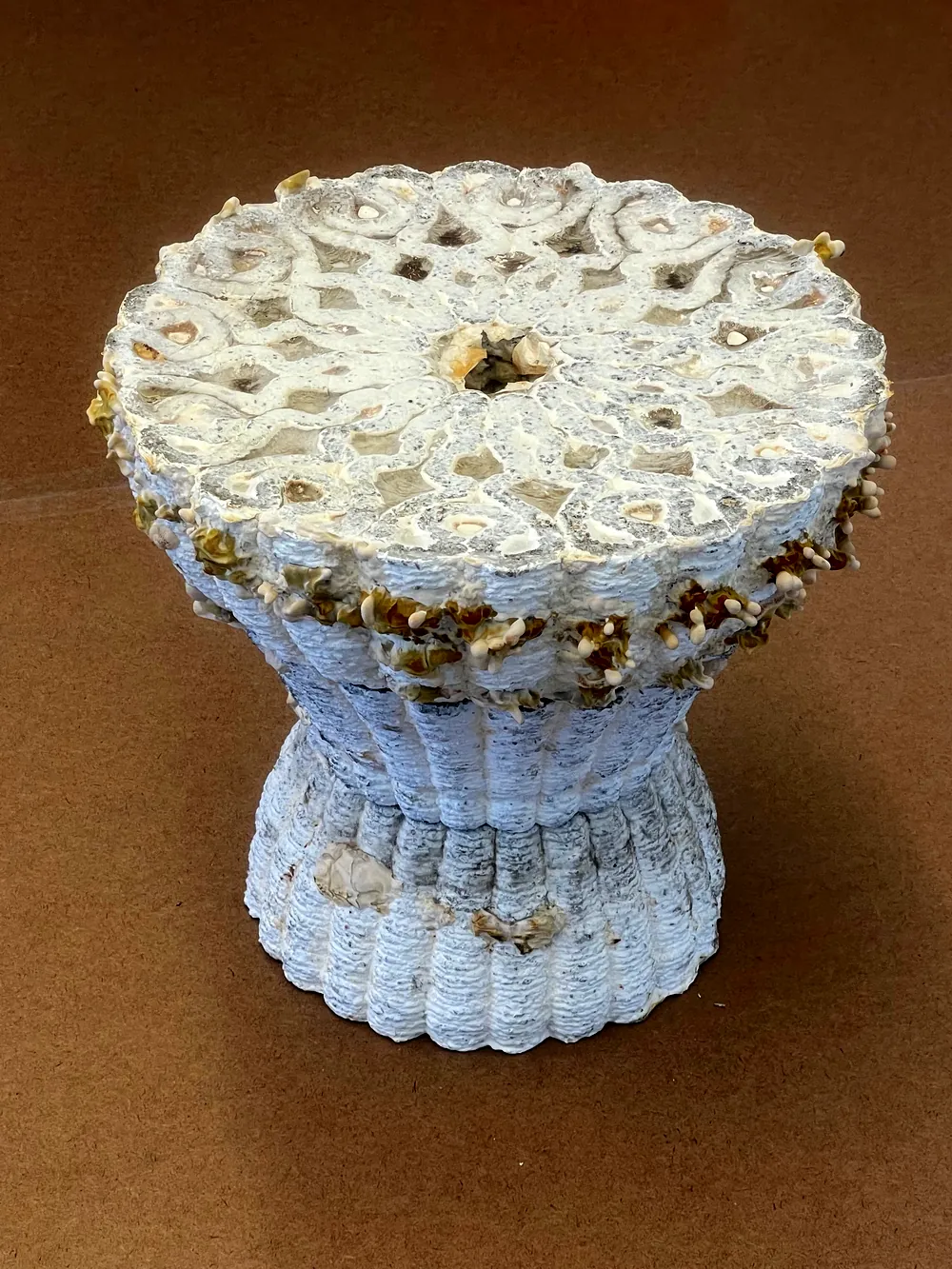
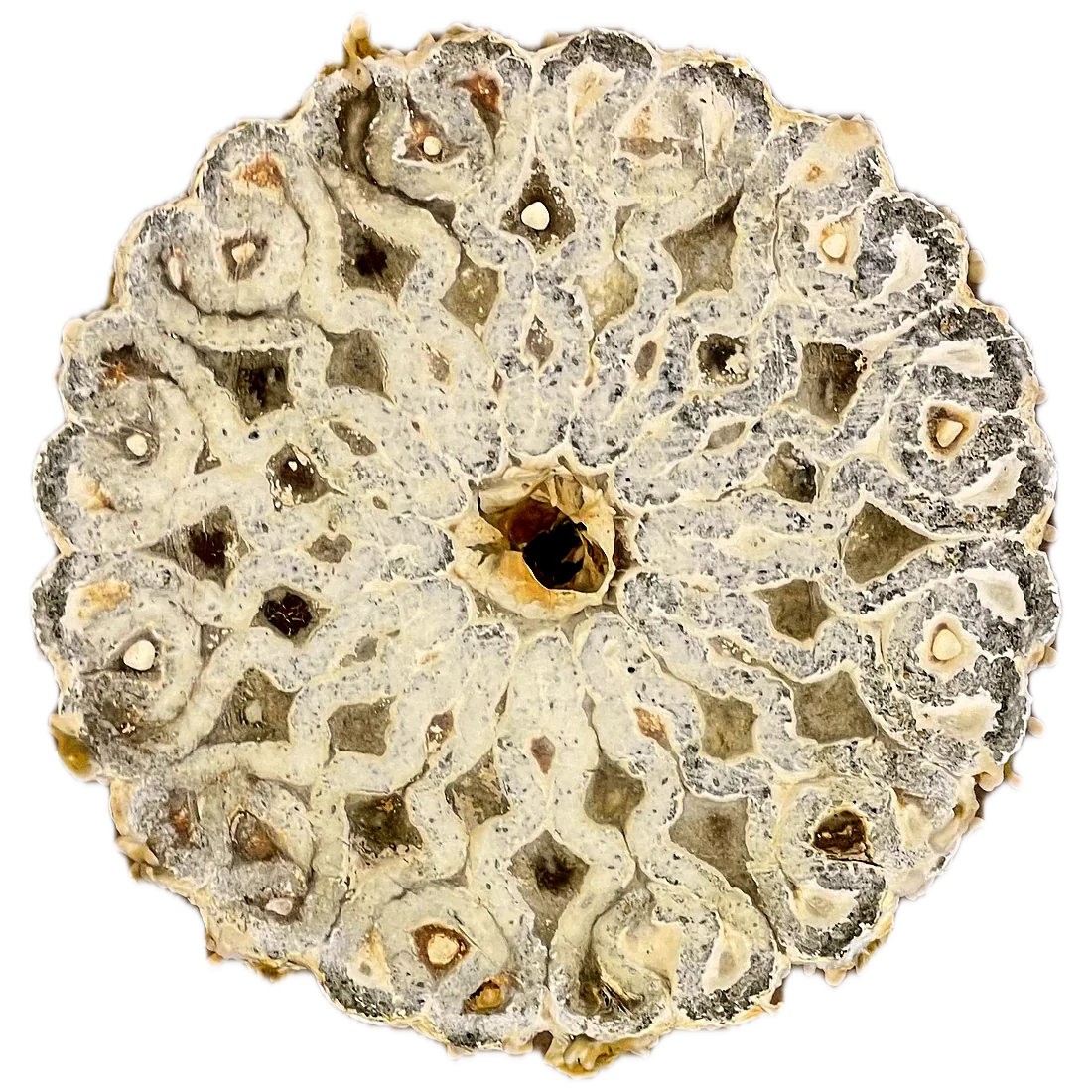
Demonstrator D2 seen from straight above: a round top of looping printed walls around a central vent, white mycelium over grey biochar, with small mushrooms along the edge
D2 from above, May 2026.

Demonstrator D22026

Material
The biochar-mycelium composite of D1, with its water content adjusted
Made
Printed in three segments, March 2026
Shown
EURAU26 Latitudes, Umeå School of Architecture, June 2026

Adjusting only the water content of the material was enough to make a noticeable difference. D2 grew white all over, and small mushrooms came up all around its top.

Other studies on the recipe are under way, so that a living material grows as accurately, and as predictably, as possible.

The top segment of D2 seen from the side, ringed with small yellow-brown mushrooms
The top segment of D2 from fourteen sides, photographed at the Material Practices Lab in 2026.

Shrinkage while drying

3to5%

Vertical, for printed samples under specific conditions. One earlier study of mycelium composites measured 9 to 20%.

Growth before assembly

14days

At 24 °C for each printed segment.

Welding by growth

7days

For the fungus to join the three segments into one piece.

Sitting and standing on demonstrator D2, 2026.
Compression tests, 29 April 2025. Cut so the press makes one steady descent: every half second the film jumps to another sample at the same press height, the tall ones first, then the short ones.

Does it hold?

Demonstrator D2 holds me sitting down and standing on one leg. The compression tests are more careful: on one day in April 2025 we crushed samples of different recipes, shapes and sizes, one after another.

The first results suggest the brain-coral toolpath can make parts stronger, but there are still too few samples to be sure. The next round of tests is designed to settle that.

Now

Early findings,shared with colleagues

The results so far are early ones: printed parts that keep their size within a few percent as they dry, segments that grow into one piece in a week, and a toolpath that may make parts stronger. I put them in front of other researchers while they are still early, on a table and in talks, and their questions go back into the work.

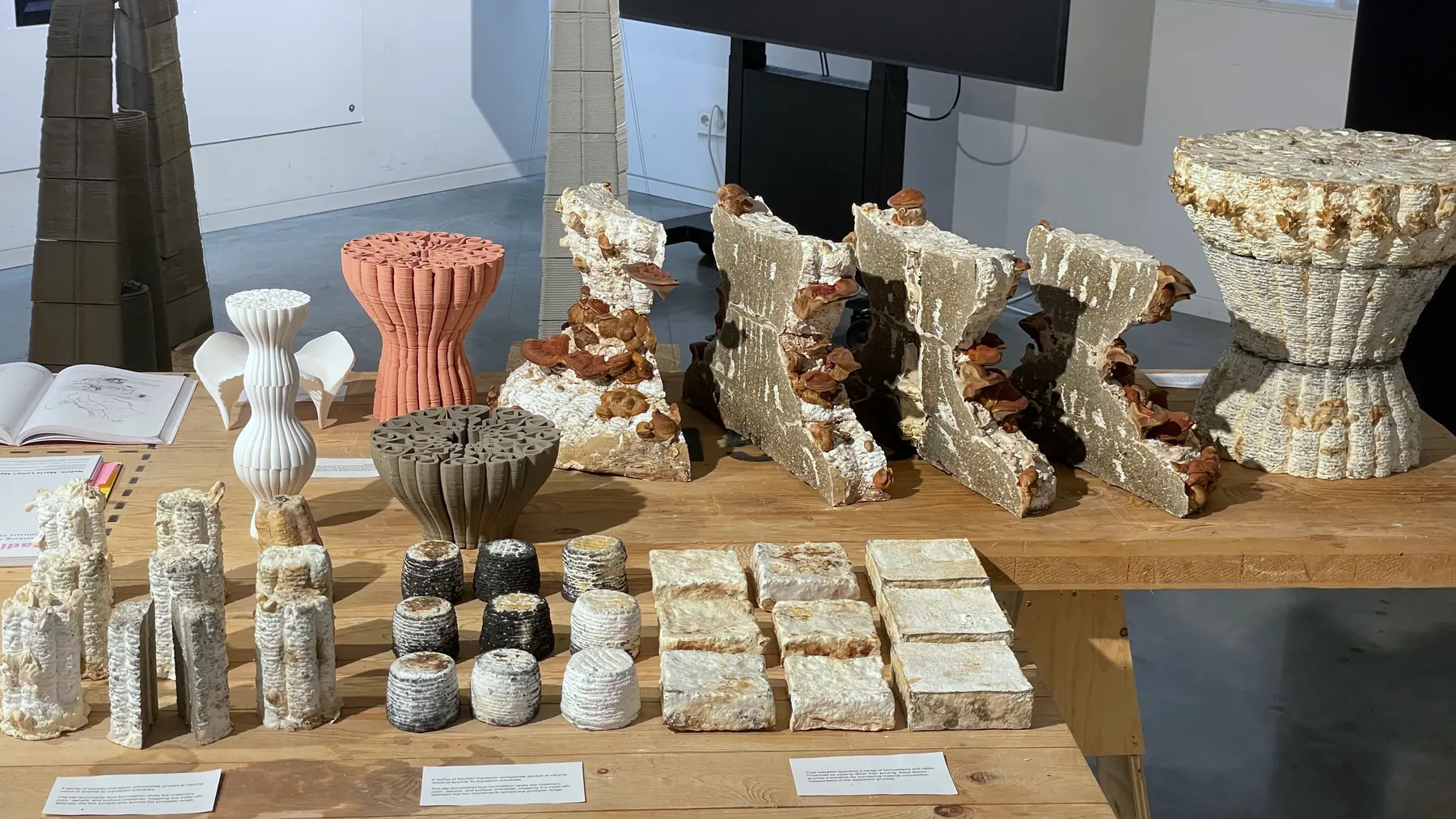
A long table covered with printed and grown pieces: demonstrators, cylinders, blocks and terracotta tests

Every printed piece so far on one table at EURAU26 in Umeå, June 2026, where I presented the paper on biochar-mycelium composites for circular construction in northern Sweden and chaired a session.

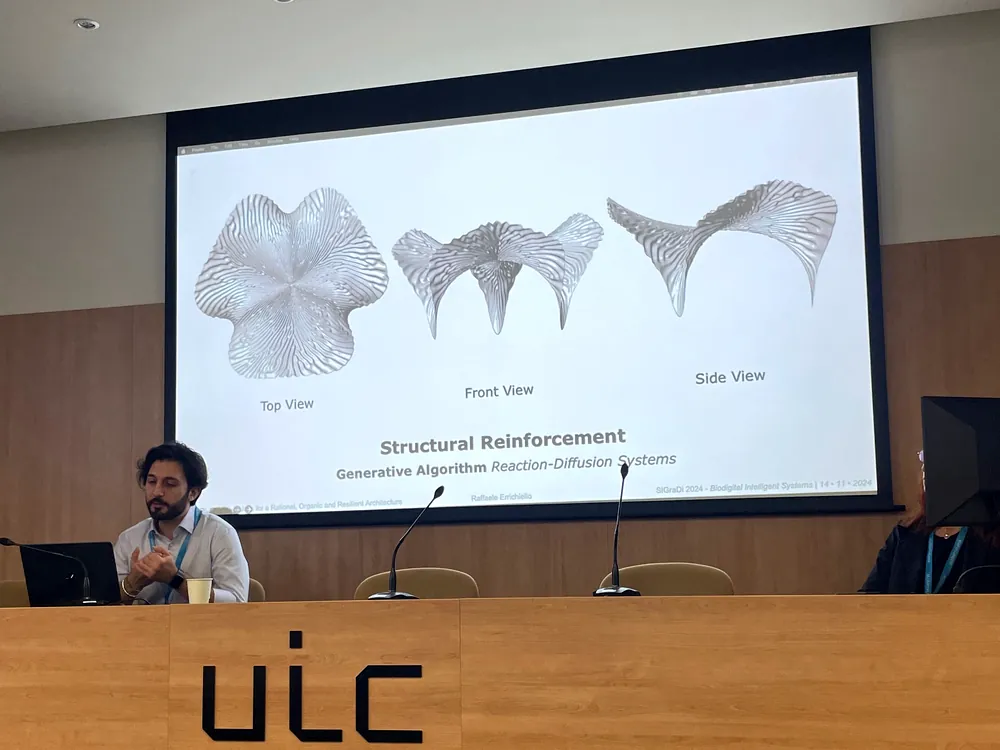
Raffaele at the speakers' table at UIC Barcelona, the slide behind him showing AURORA's reaction-diffusion reinforcement in top, front and side view
SIGraDi 2024, UIC Barcelona, November 2024: AURORA, the shell the doctorate starts from, and its reaction-diffusion reinforcement.
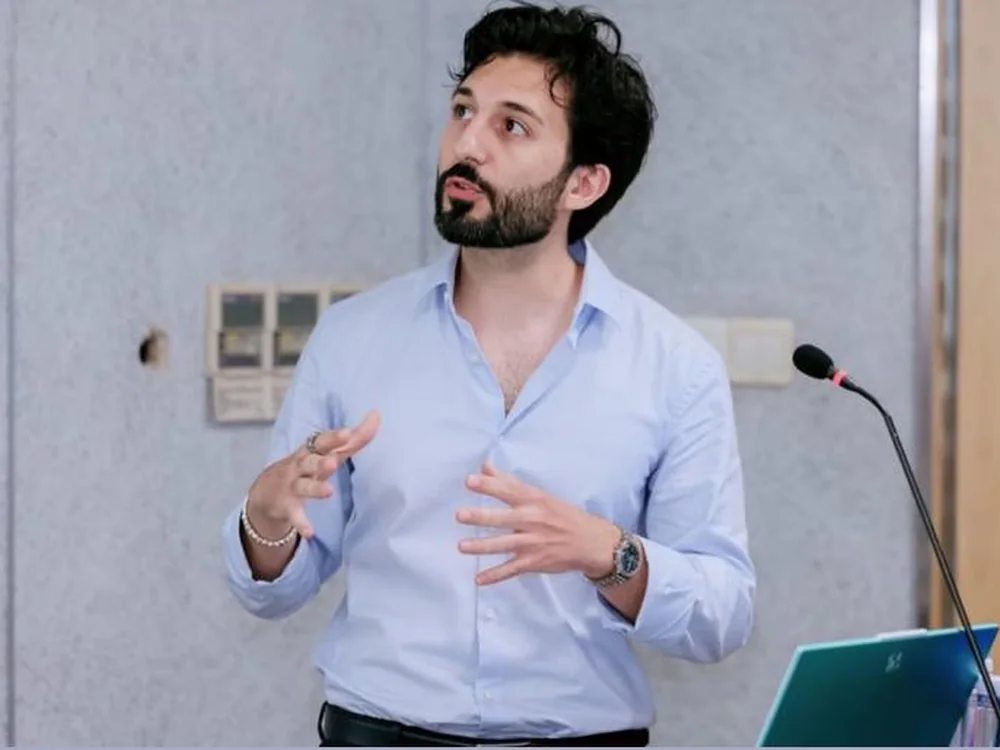
Raffaele presenting at Tongji University, gesturing as he speaks, a microphone beside him
DigitalFUTURES and CDRF 2025, Tongji University, Shanghai, July 2025: the first results on the mix and the print settings.
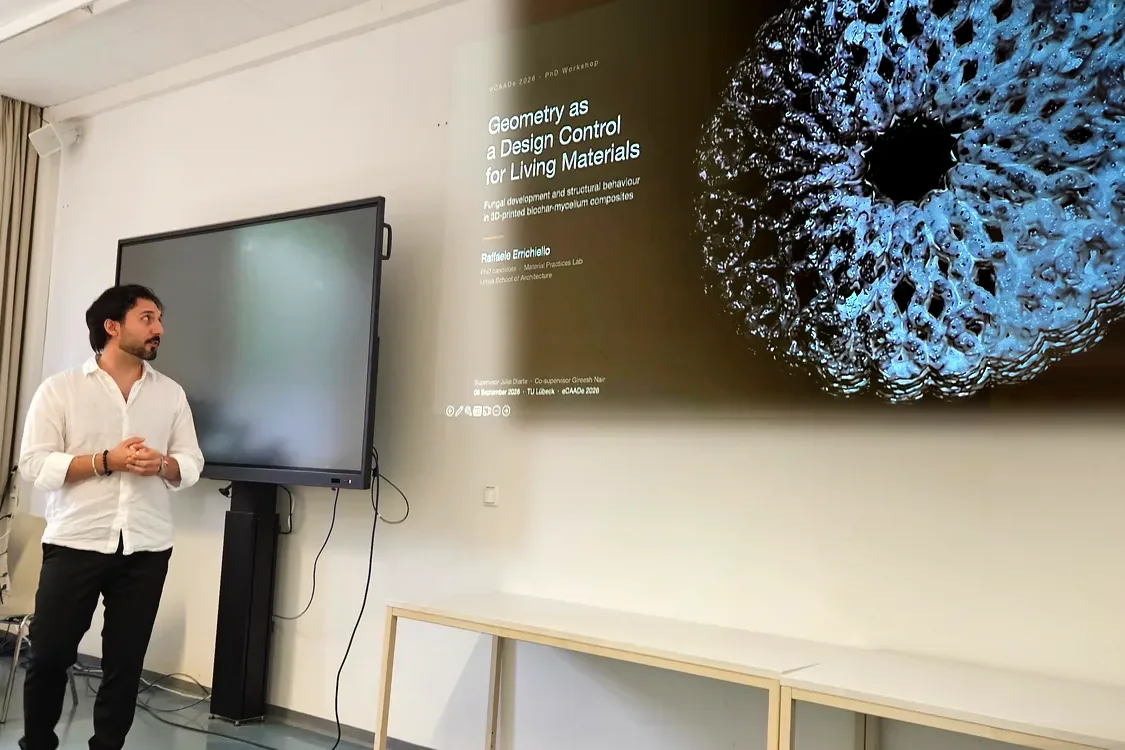
Raffaele beside the projected title slide, Geometry as a Design Control for Living Materials
eCAADe 2026 PhD workshop, TU Lübeck, 8 September 2026: geometry as a design control for living materials, with the first findings on toolpath and growth.

Work, 2016 to 2025

Projectsalong the way

Ten years of projects in the order they happened, from a frame of chestnut poles to a pavilion that is still waiting to be grown.

2016, Lecce

haMMMocksthree hammocks on three poles

2016

Lecce
FormPeople

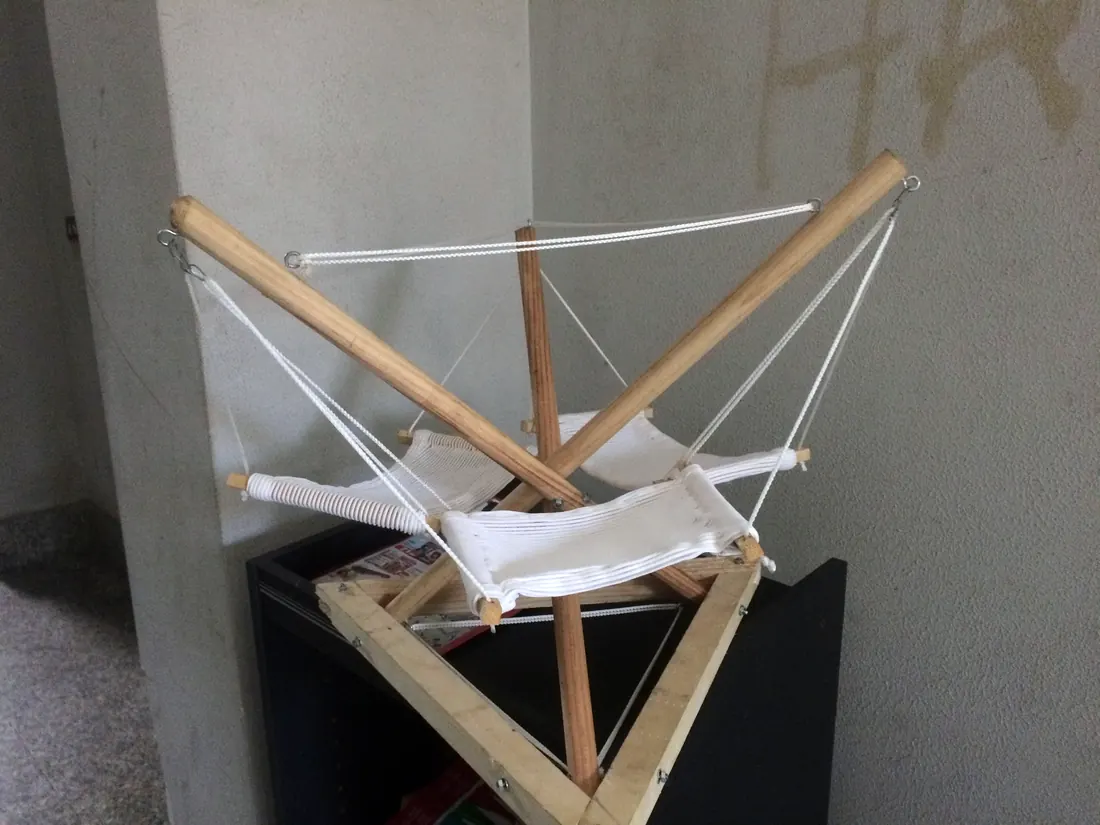
Rest areas designed and built for Masseria Ospitale, Lecce, summer 2016.

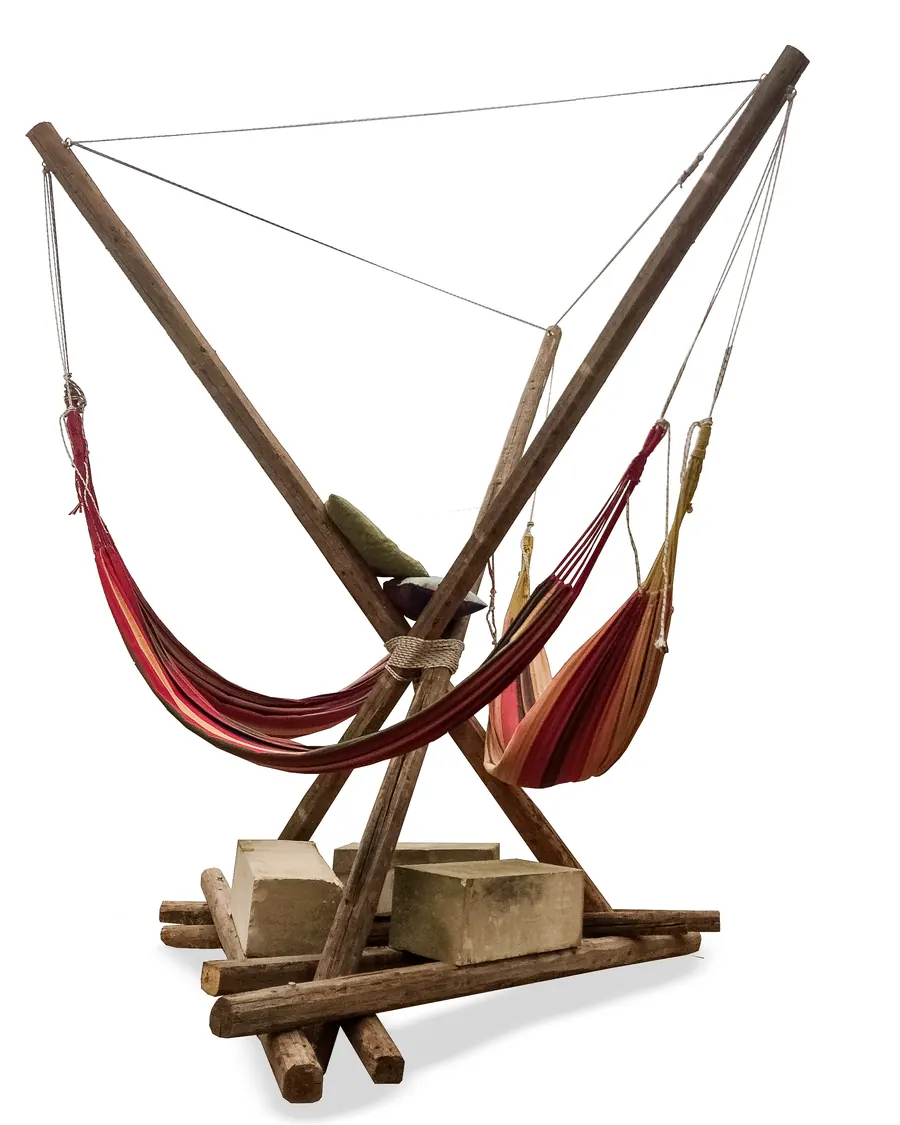
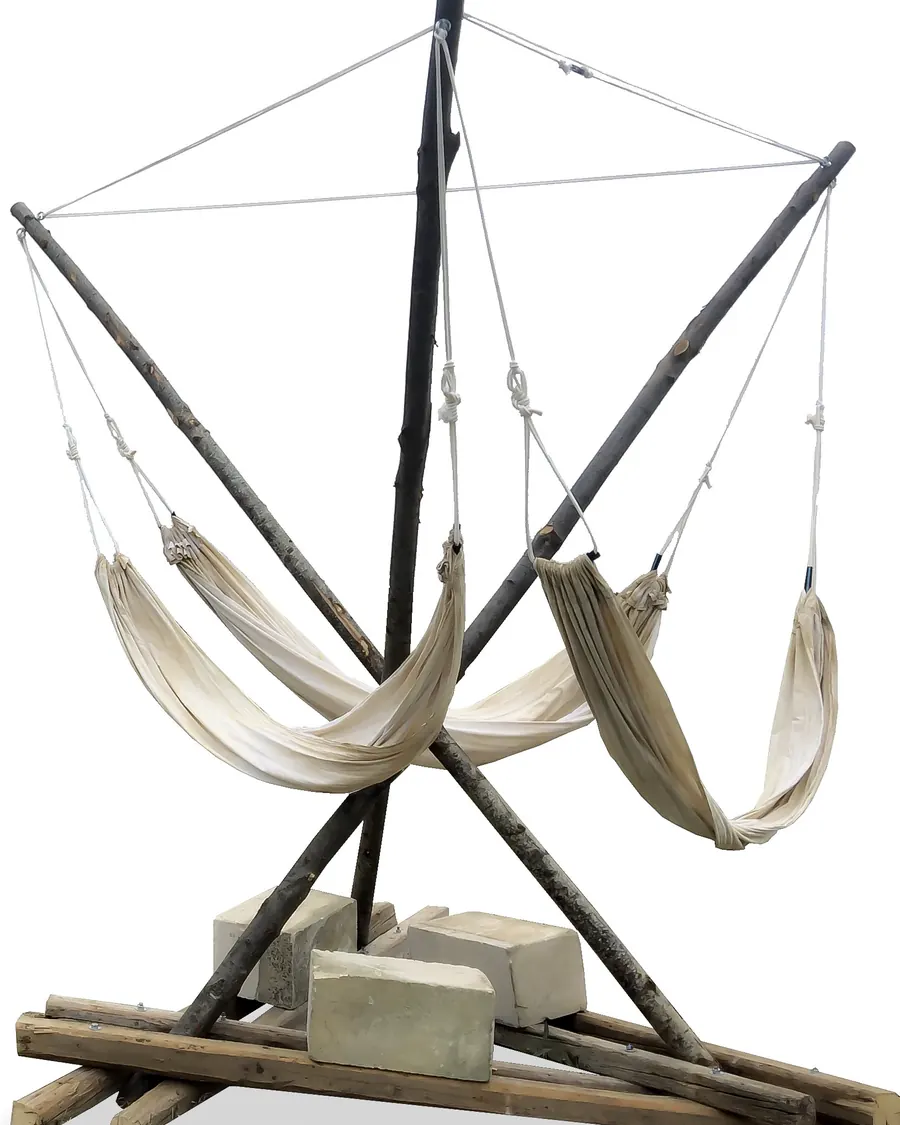
Three crossed chestnut poles on stone blocks, carrying three white hammocks
The same frame of chestnut poles with red striped hammocks

The frame in two versions, June 2016.

A 3D model of the frame, built for this page from the 2016 drawings and put up in order: the poles, the rope at the crossing, the steel wire, the base and its stones, then the hammocks. Drag to turn it.

The name has three capital Ms for its three poles, the three mazze, as we call them in Neapolitan. The Masseria had asked the university for places to rest, and we designed them from what was already in its store, so each frame cost nothing. Three chestnut poles cross at one joint, held by threaded steel bars, and carry three hammocks between them, with cables tying their tips together. Geometry gives the frame both its strength and its look.

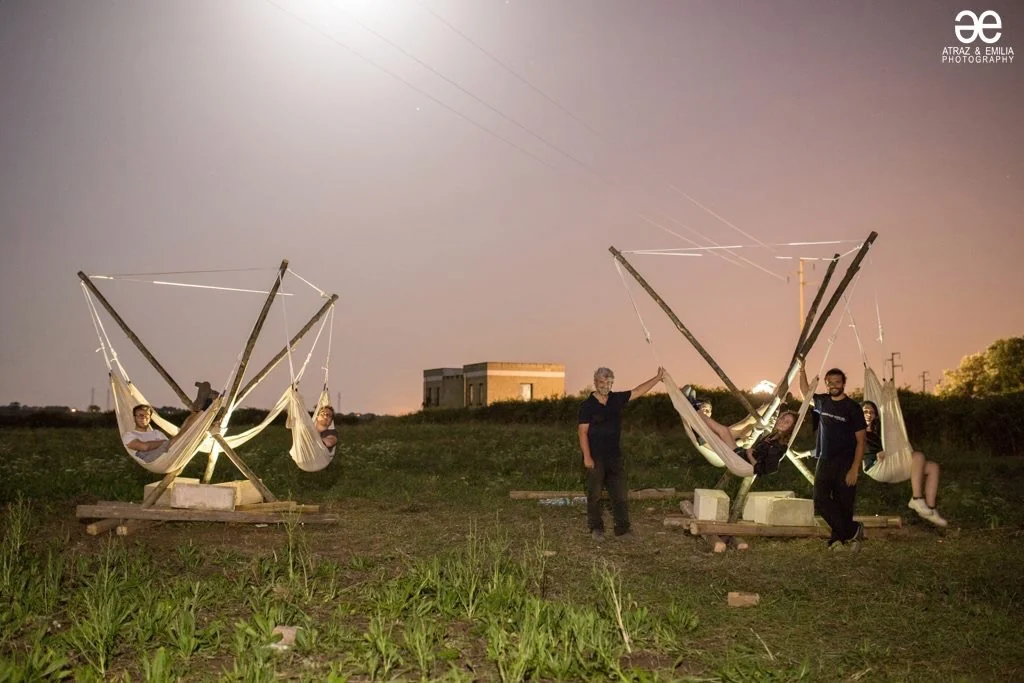
The poles hold each other up through reciprocal forces, and the frame needs weight to stay balanced. With one person in it, it stands only because of the anchors at its feet; the more people sit in it, the steadier it gets. It began with a few printed pages on tensegrity and a sketch on squared paper. We drew the parts in Rhino, tested a table-top model and raised the frames in a field among olive trees. It was the first structure I watched find its shape under load, and the first one I built together with others.
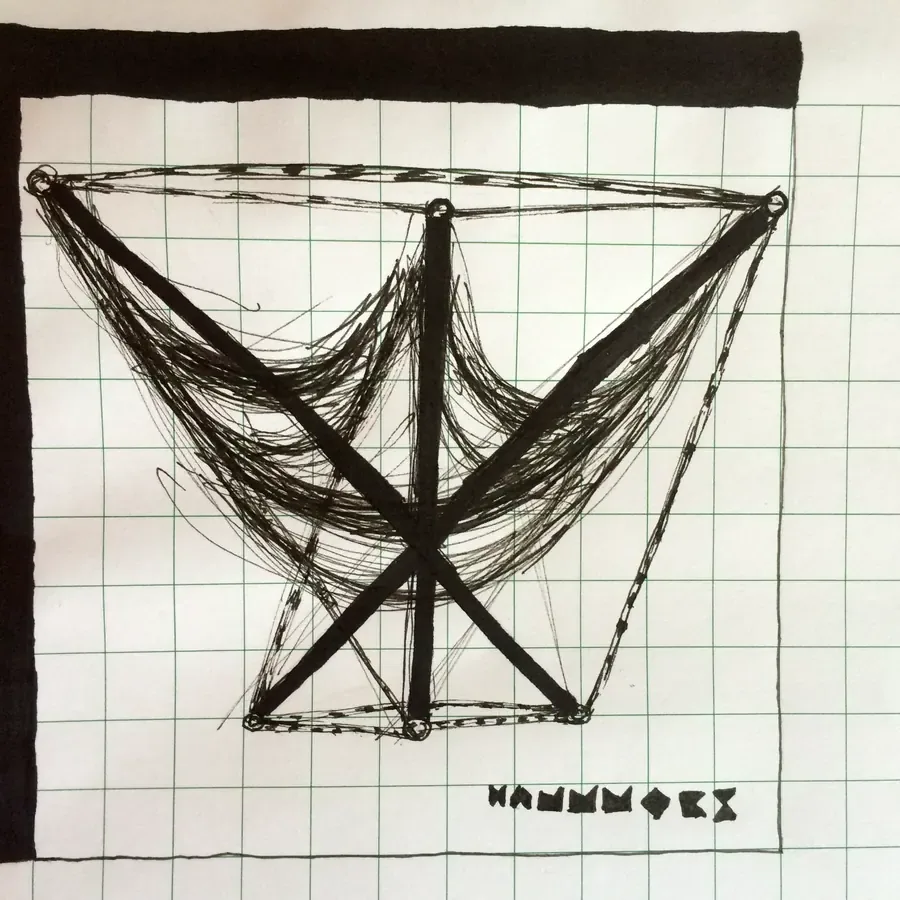
Pencil sketch on squared paper of crossed poles with curves hanging between them
The chestnut frame going up, an AI film made from the June 2016 photographs.
Table-top model of the frame: wooden sticks, string and three canvas seats
The two finished frames lit at night in the field, people resting in the hammocks, the glow of the sky behind them
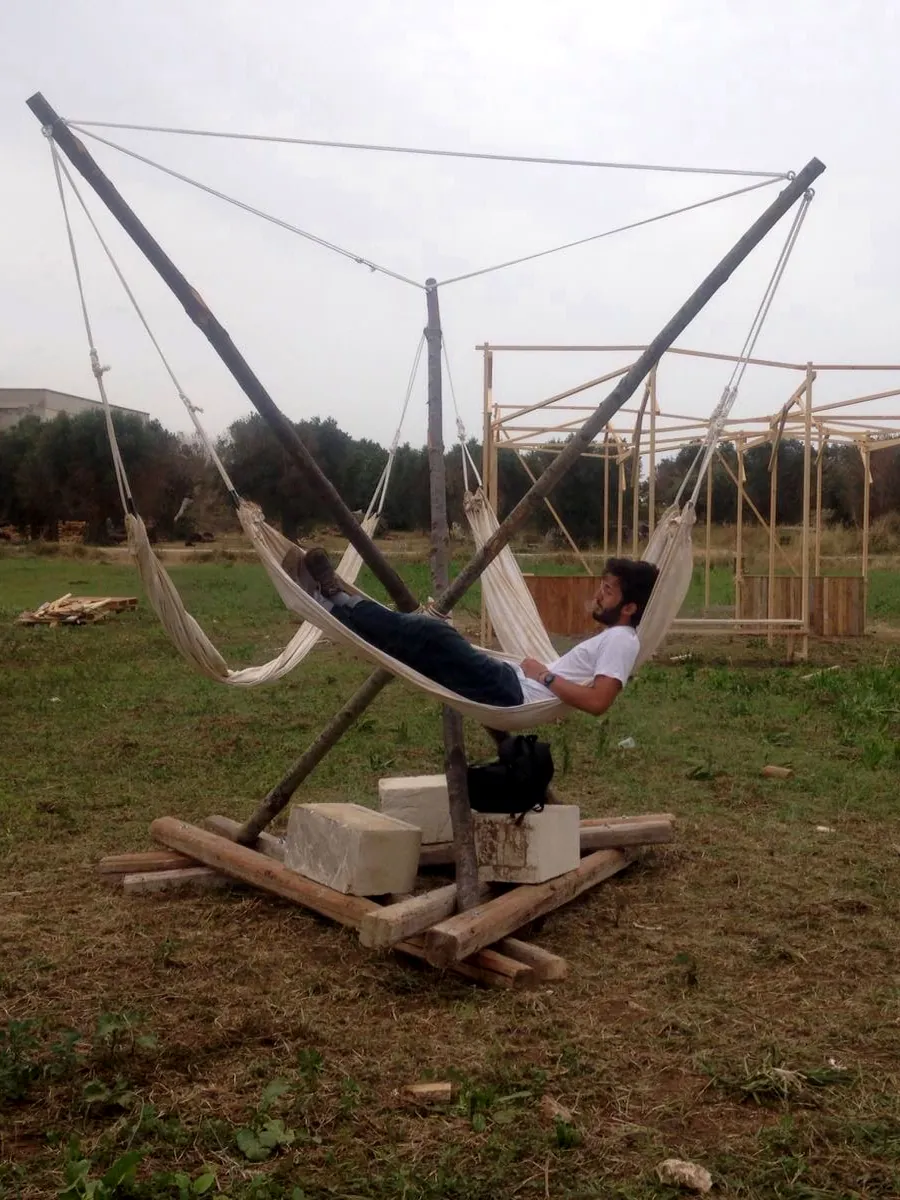
Raffaele lying in one of the hammocks of the finished frame in the field

Left to right: the table-top model; the frames at night in the field (photo: Atraz & Emilia Photography); trying one out.
2019 to 2020, Umeå

Stasys: shells in the snow

2019to 2020

Umeå

Form

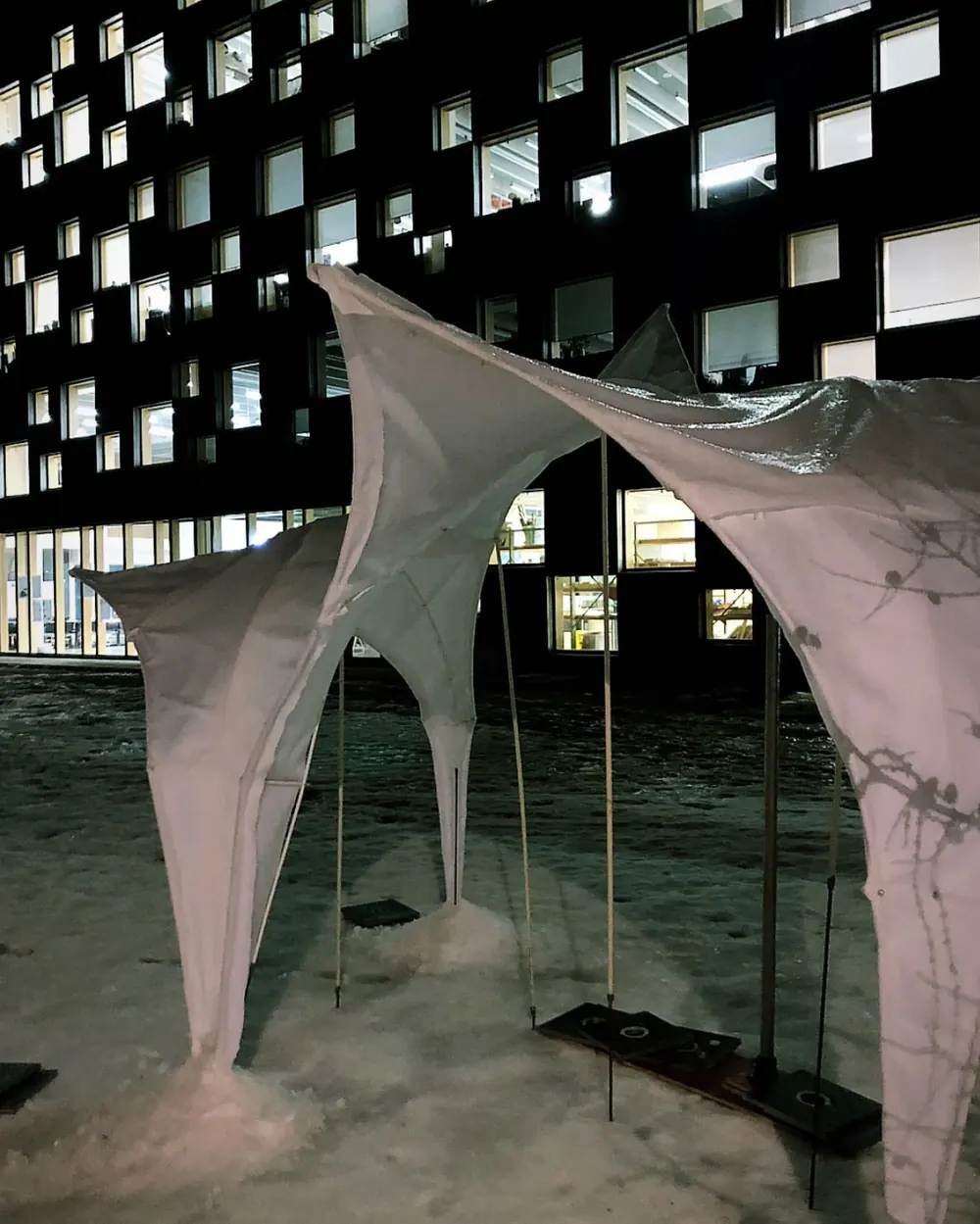
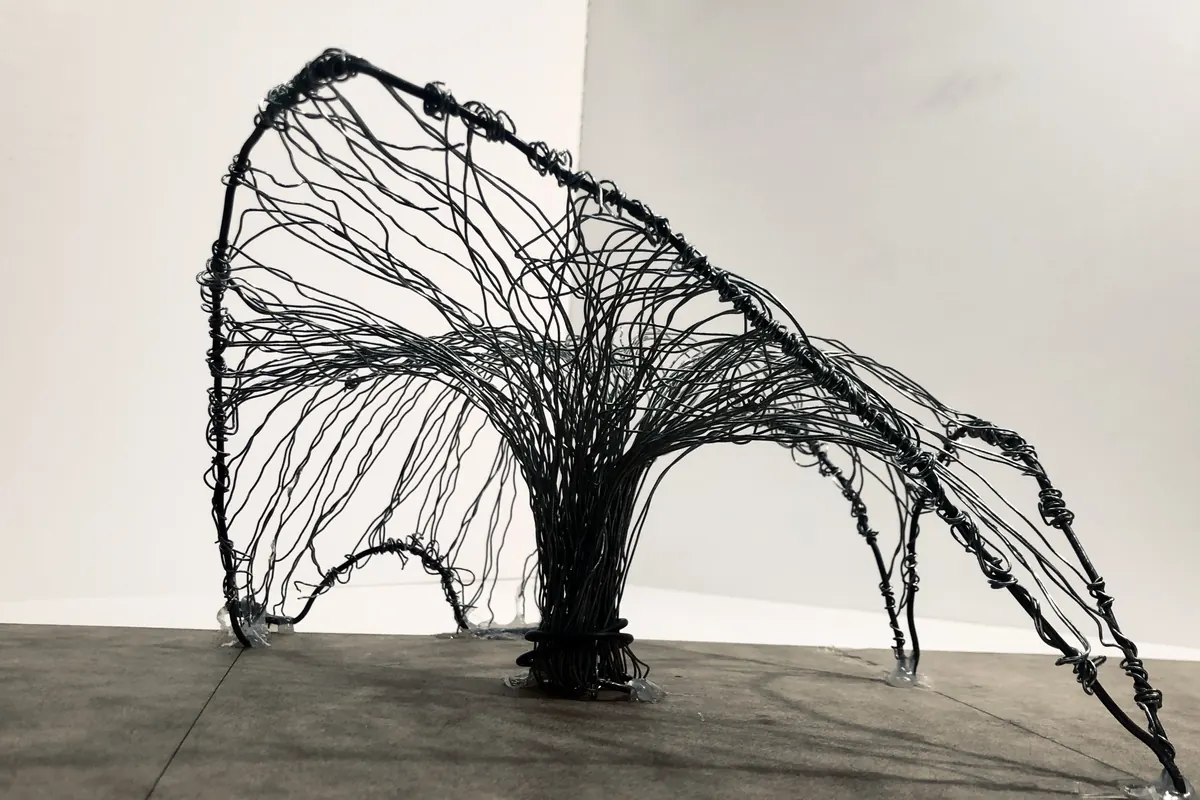
Form-finding studies and a fabric prototype with Fabiana Polichetti, during our Erasmus year at Umeå School of Architecture, September 2019 to March 2020.

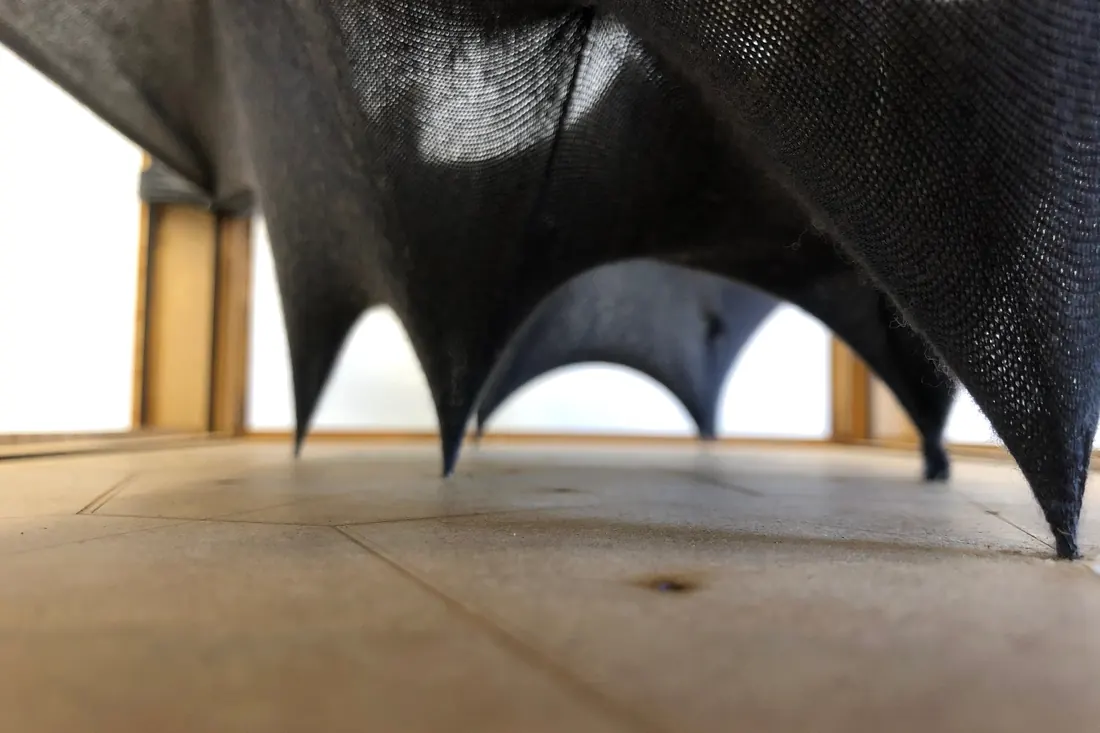
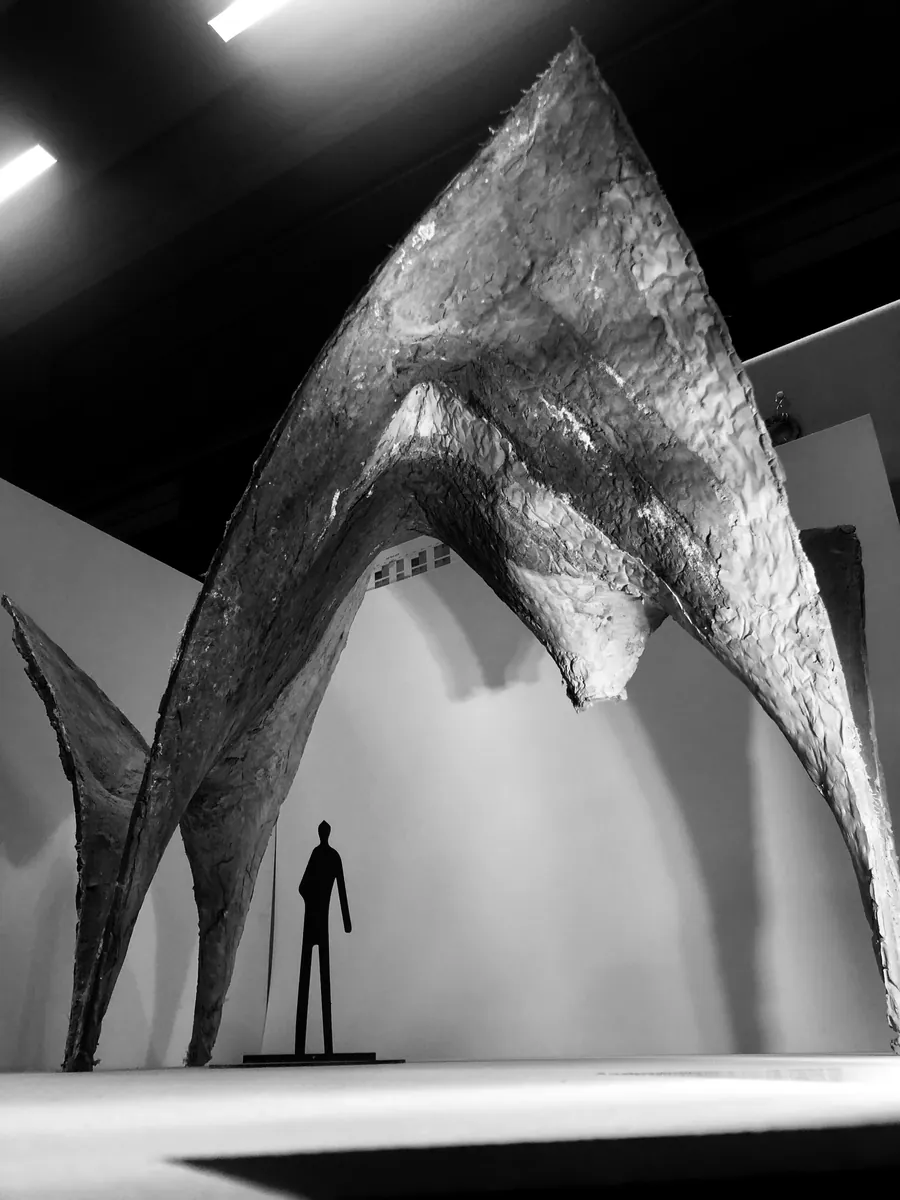
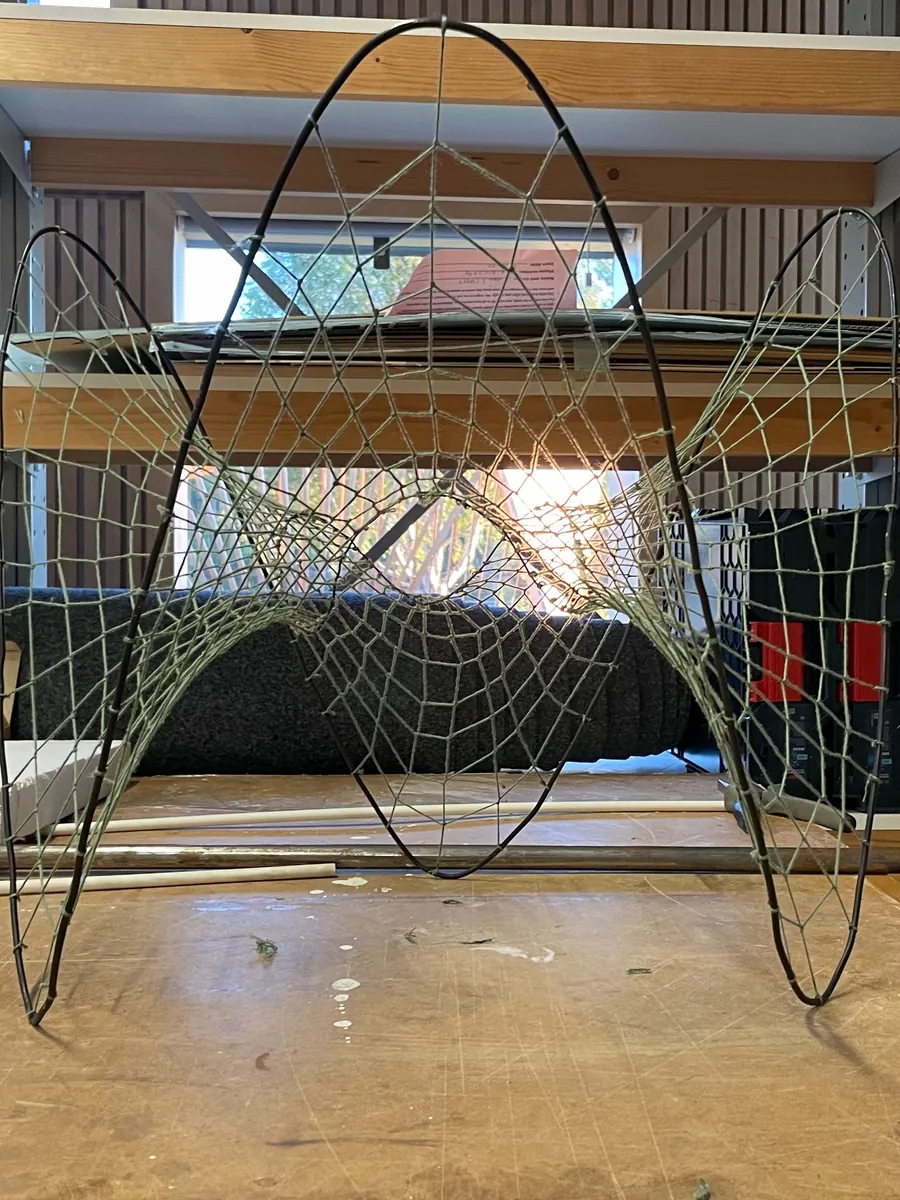
In Umeå we tried to let structures find their own shape. First came models of wire and net, then fabric soaked in a coating and left to stiffen, then simulations of minimal surfaces: the smallest surface that can span a given edge, the way a soap film does.

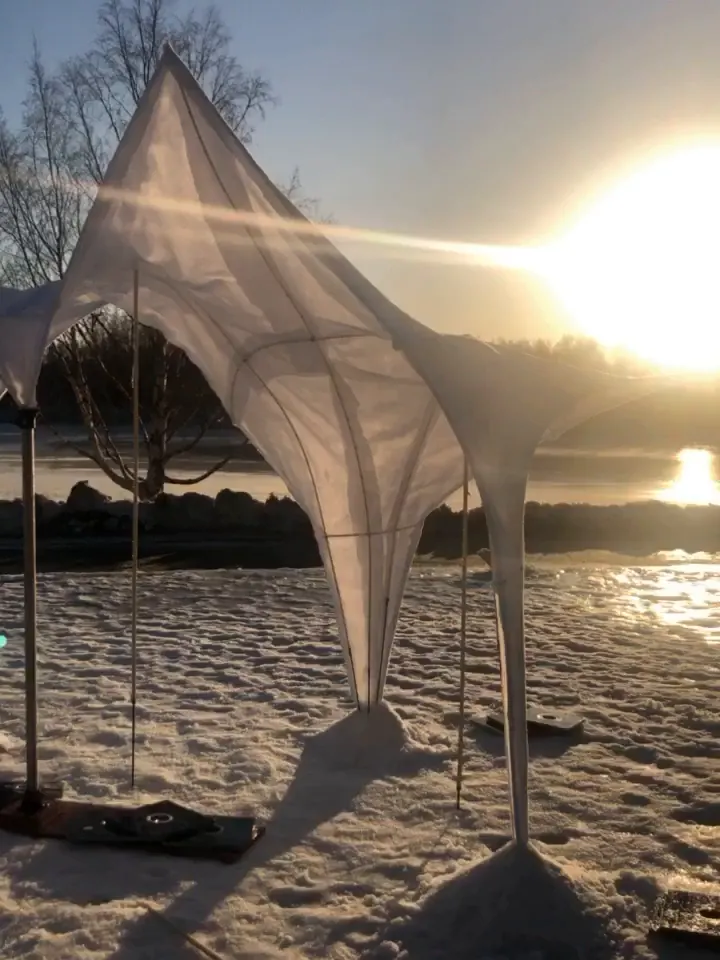
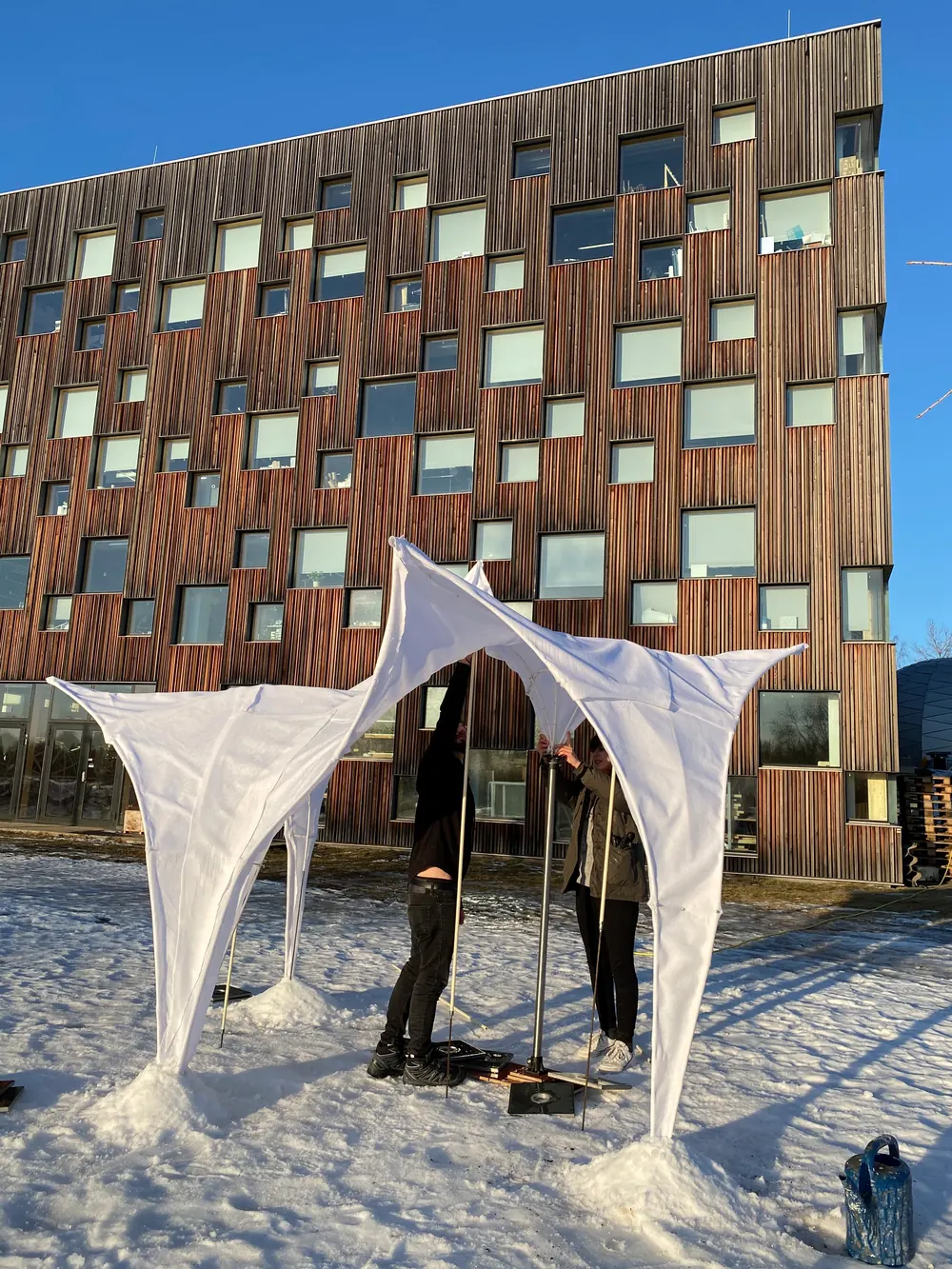
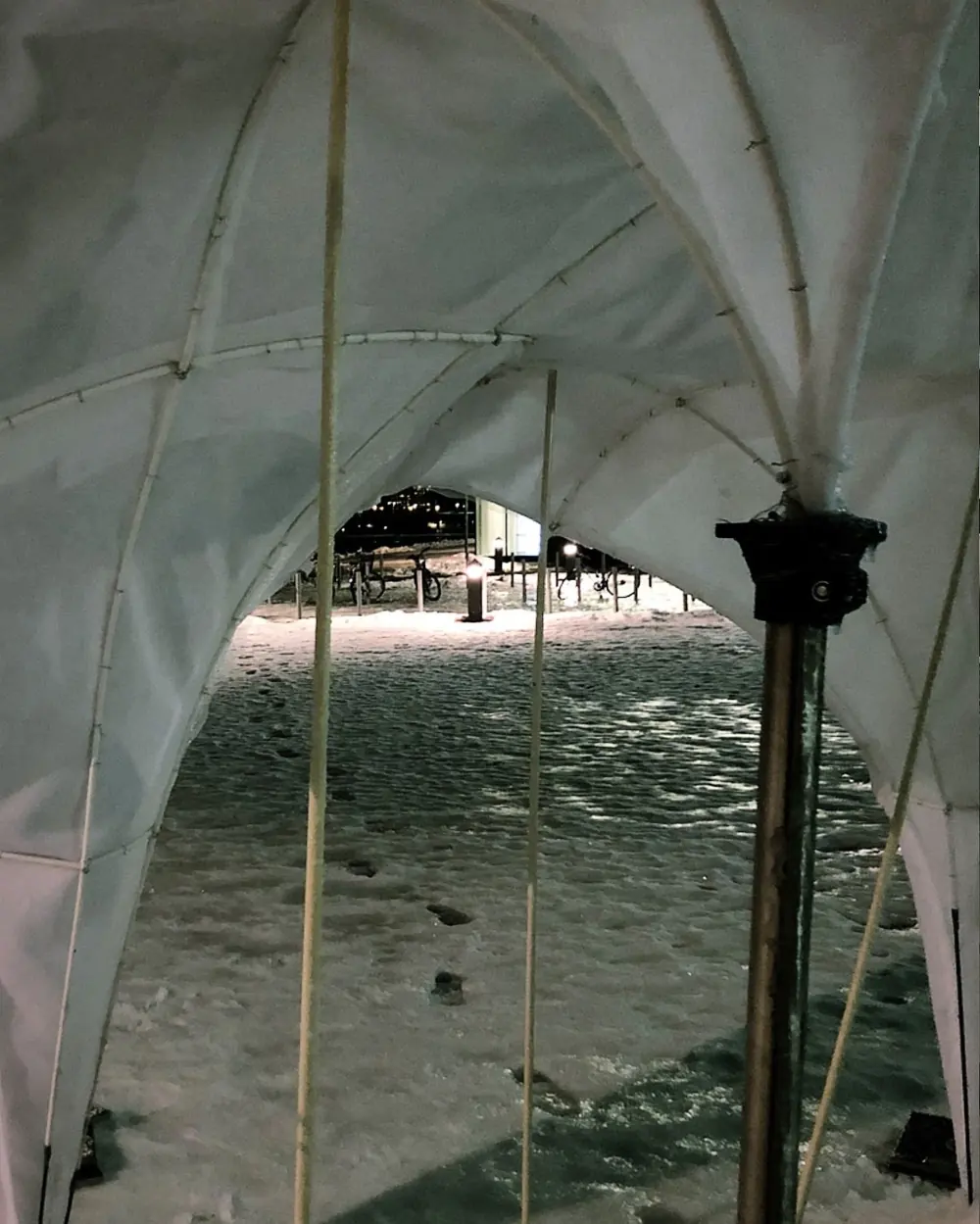
In February 2020 the shells went outside. A fabric prototype on slender poles stood in the snow in front of the school, in low sun and at night.

A white fabric minimal surface standing in the snow at night, in front of the lit school building
A model of black wire and net, its surface hanging between thin columns
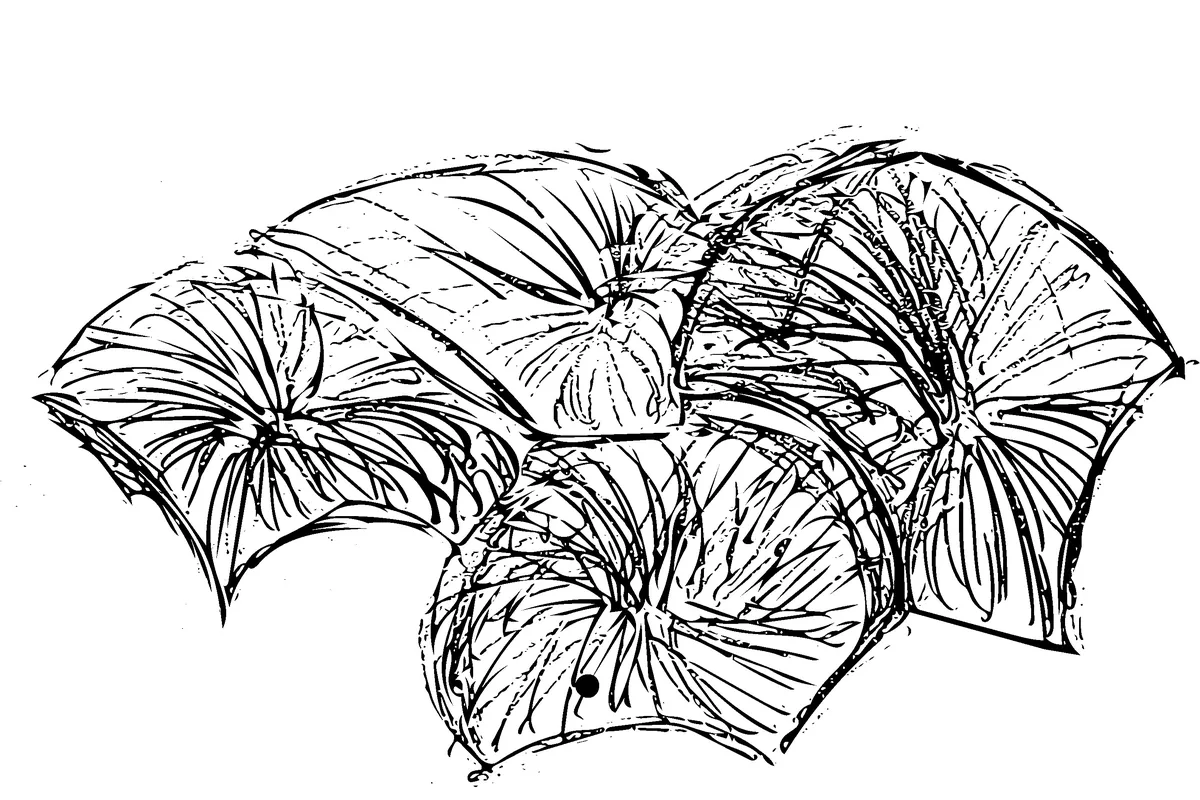
Ink sketch of a cluster of shells, each one ribbed from its support outwards
A dark coated fabric model with four pointed supports
Black and white photograph of a tall shell model with a small human figure for scale
The fabric prototype against the low winter sun
The prototype in front of the school's timber facade, two people adjusting the poles from behind
Looking up inside the fabric prototype
The concrete model, December 2019: rods bent into arches, chicken wire over them, plastic film shrunk onto the wire with a heat gun, a coat brushed on, then the concrete.
The pipes, the night of 4 February 2020: the plan taped on the floor of the school hall, then the white pipes bent into place.
The net, 12 February 2020, pulled over the pipes with Fabiana Polichetti in the workshop: four timelapses from that evening, in the order of the work and framed alike, so each shot picks up the net where the last one left it.
Outside, 14 February 2020: the shells in the snow, sprayed with water until the net iced, and the same shells at night.

2020 to 2022, Naples

Coltivare strutture

2020to 2022

Naples

FormMatter

Master's thesis with Fabiana Polichetti, supervised by Sergio Pone: "Coltivare strutture. Bio-compost e strutture parametriche" (Growing structures: bio-compost and parametric structures). University of Naples Federico II, 2020 to January 2022.

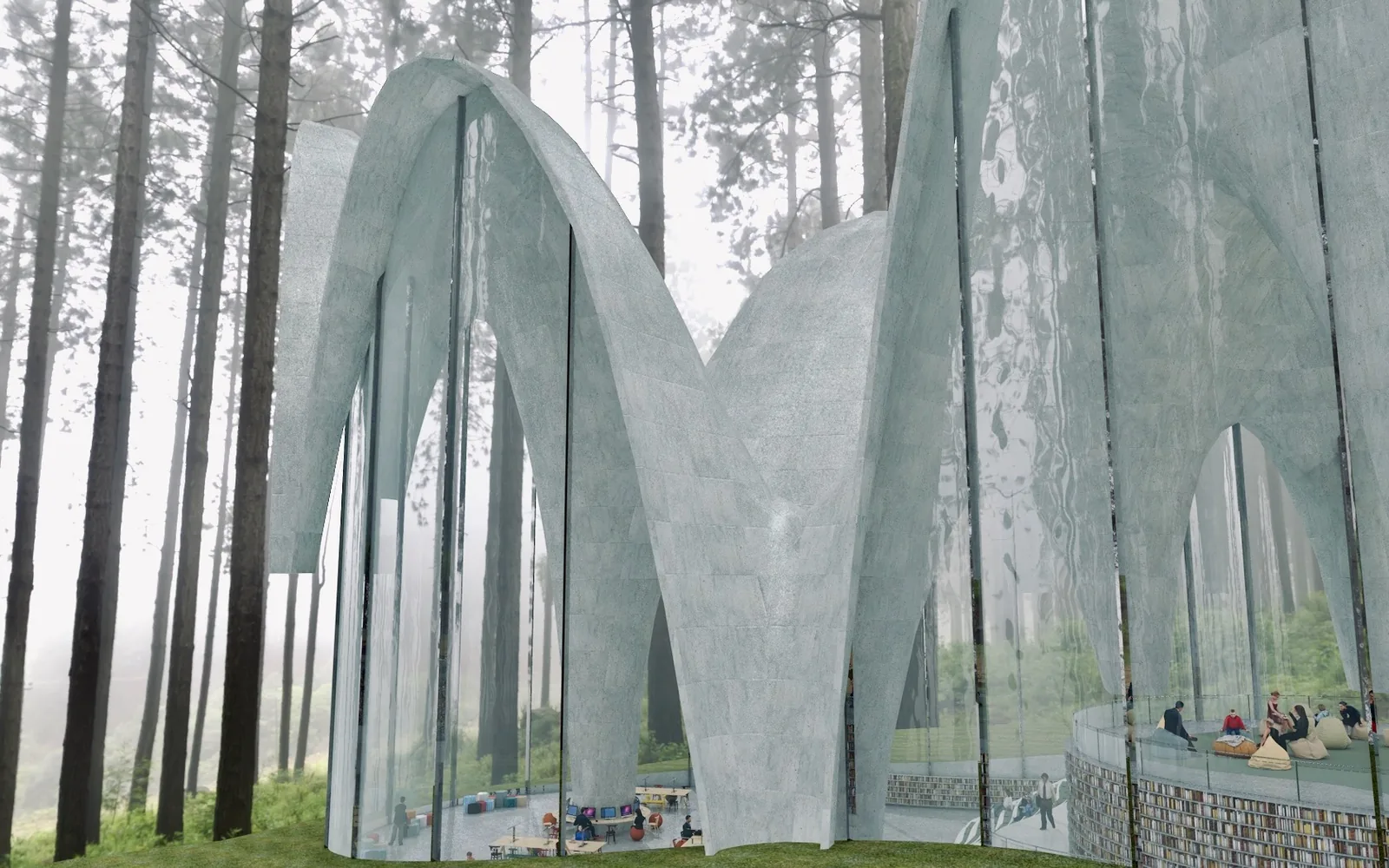
Back in Naples, the shells from Umeå became a thesis about growing a structure rather than only assembling it: a skin of bio-compost bound by the mycelium of Pleurotus ostreatus, the oyster mushroom, carried by a frame. We designed it three times, for three places.

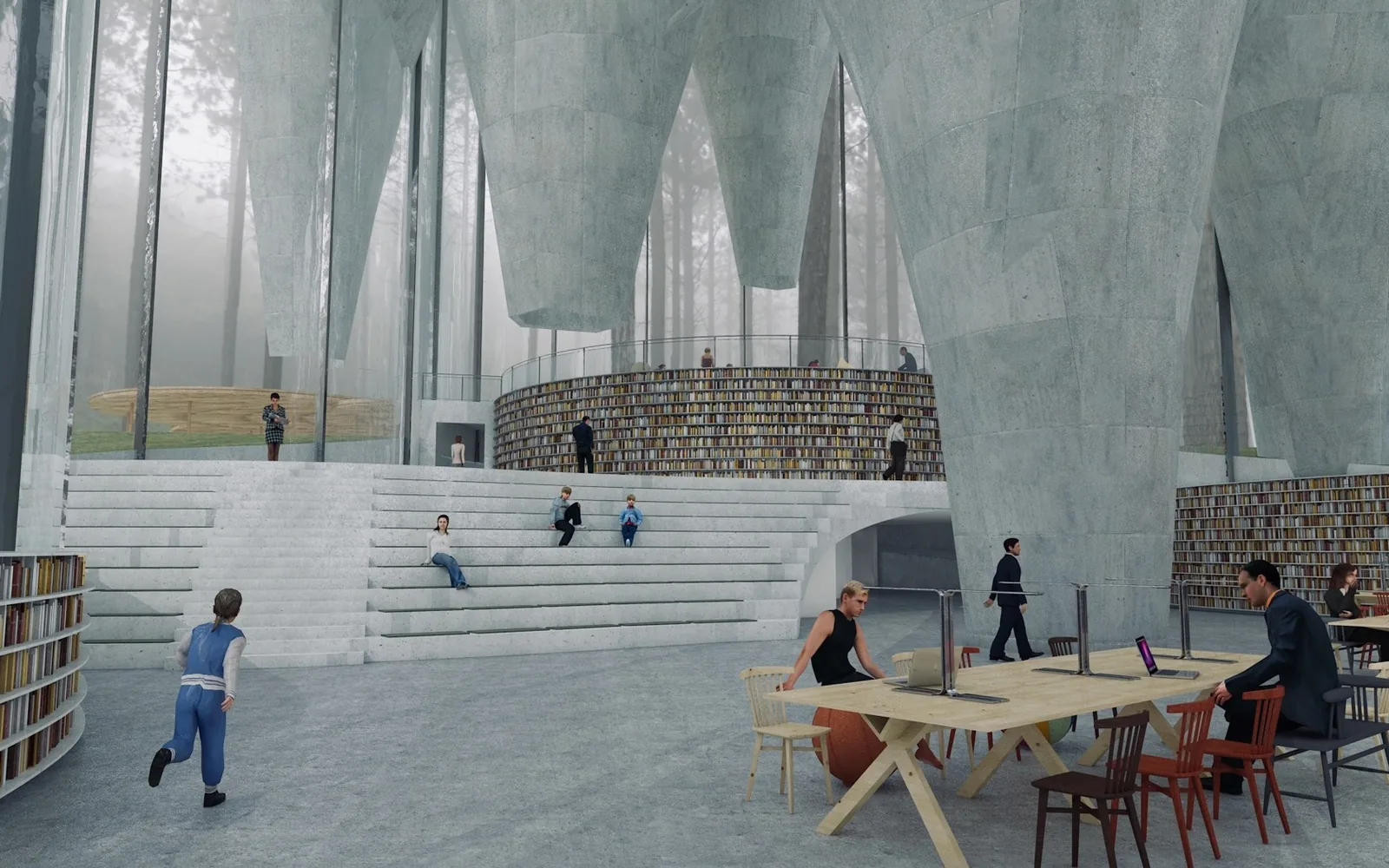
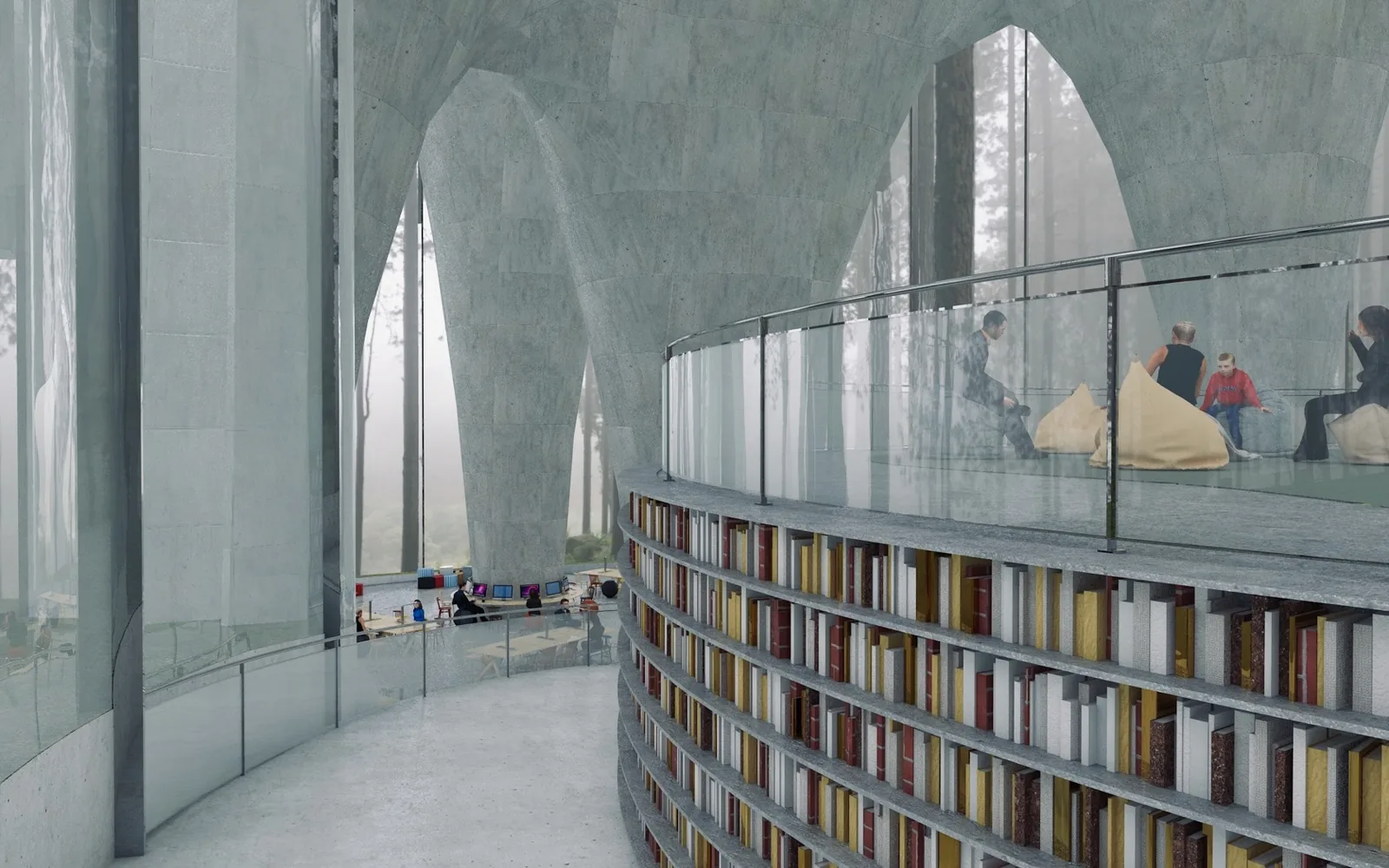
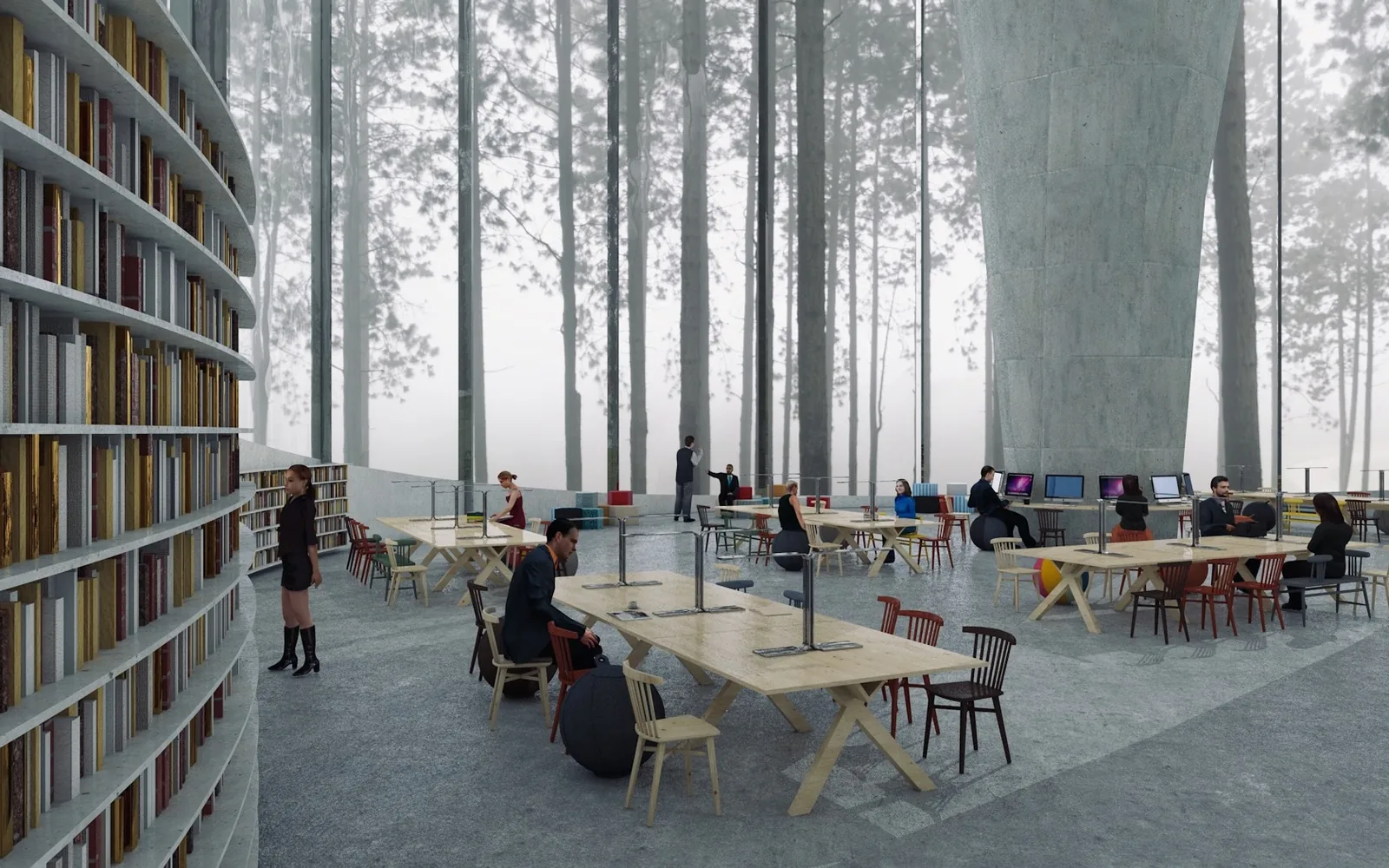
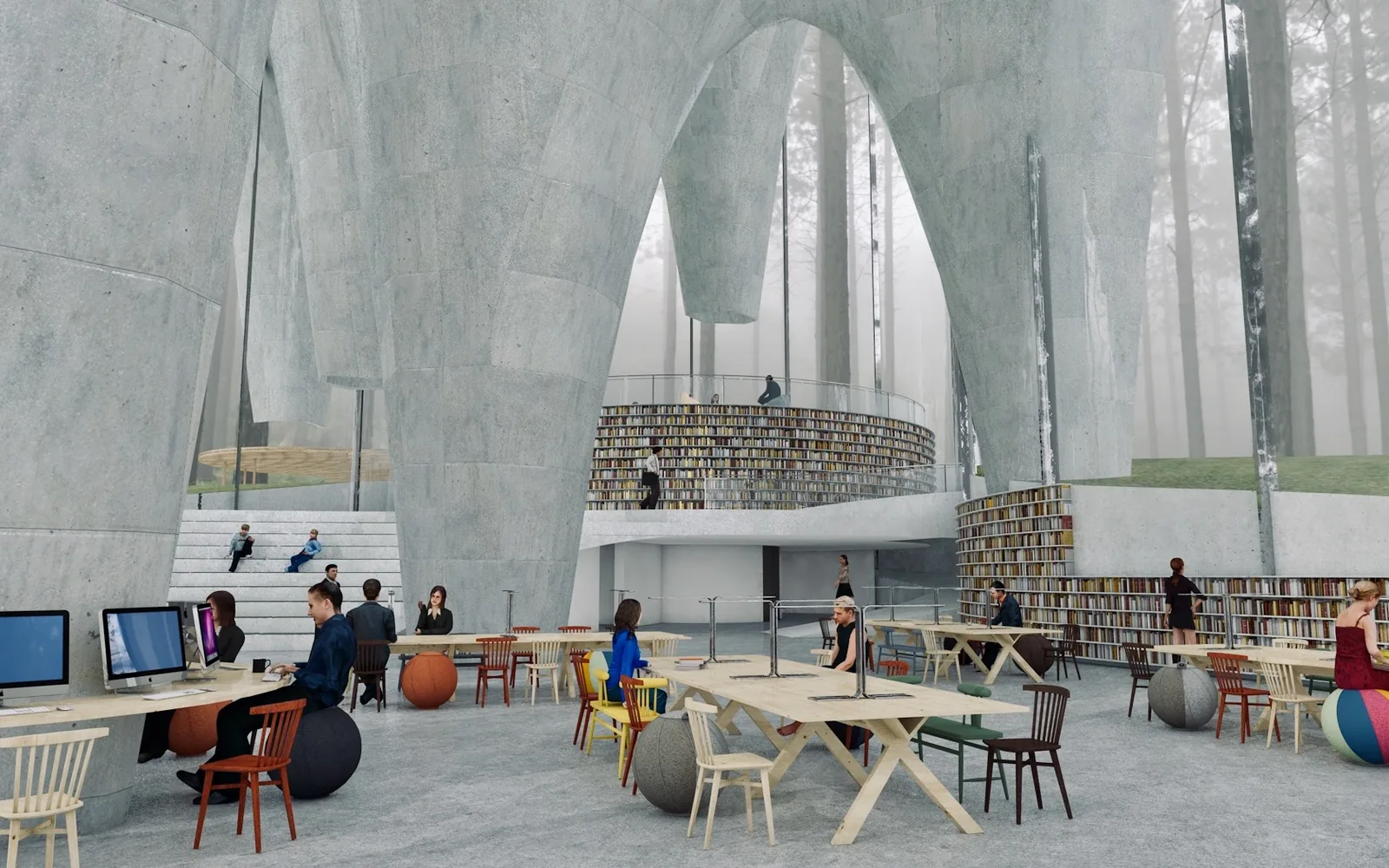
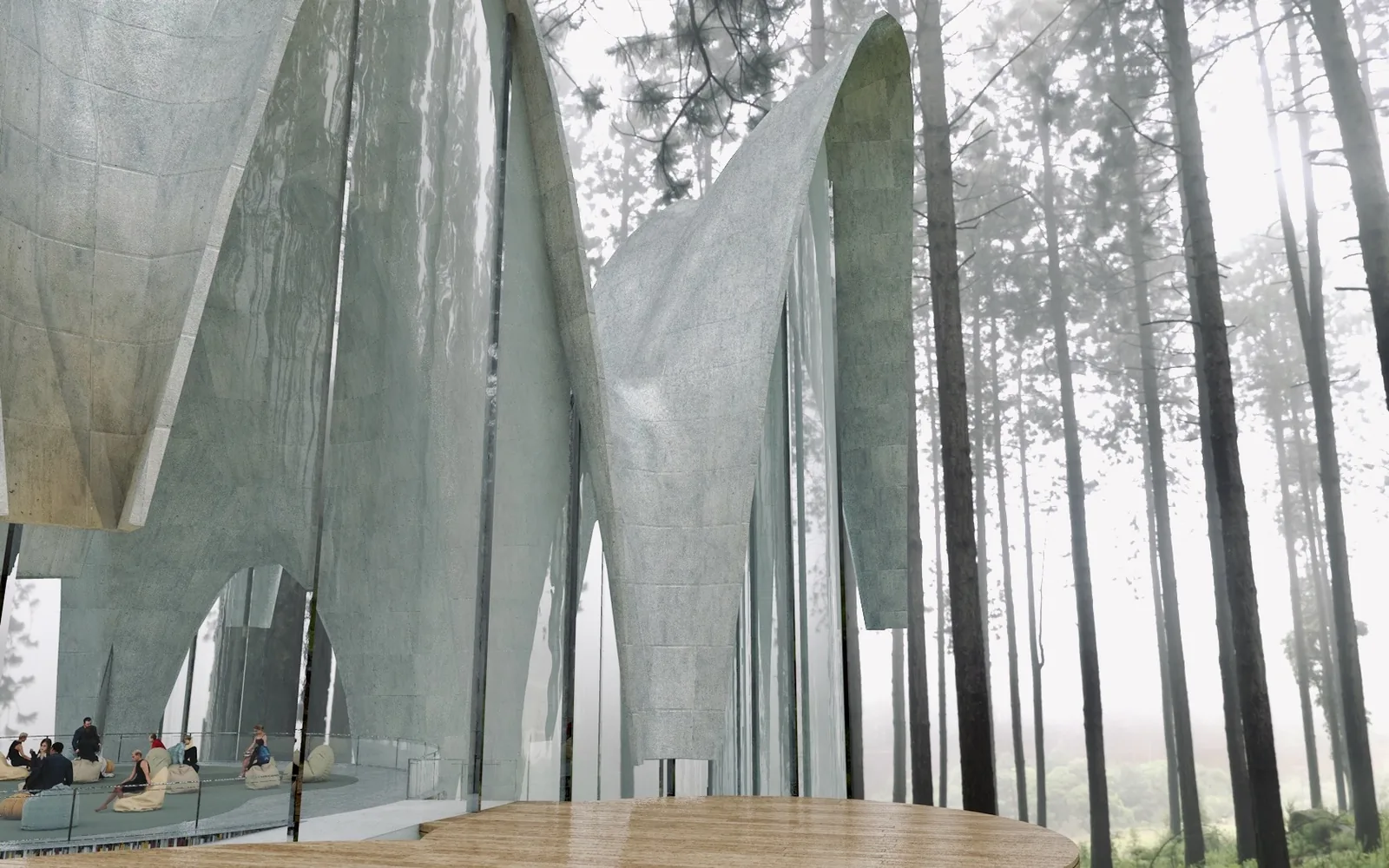
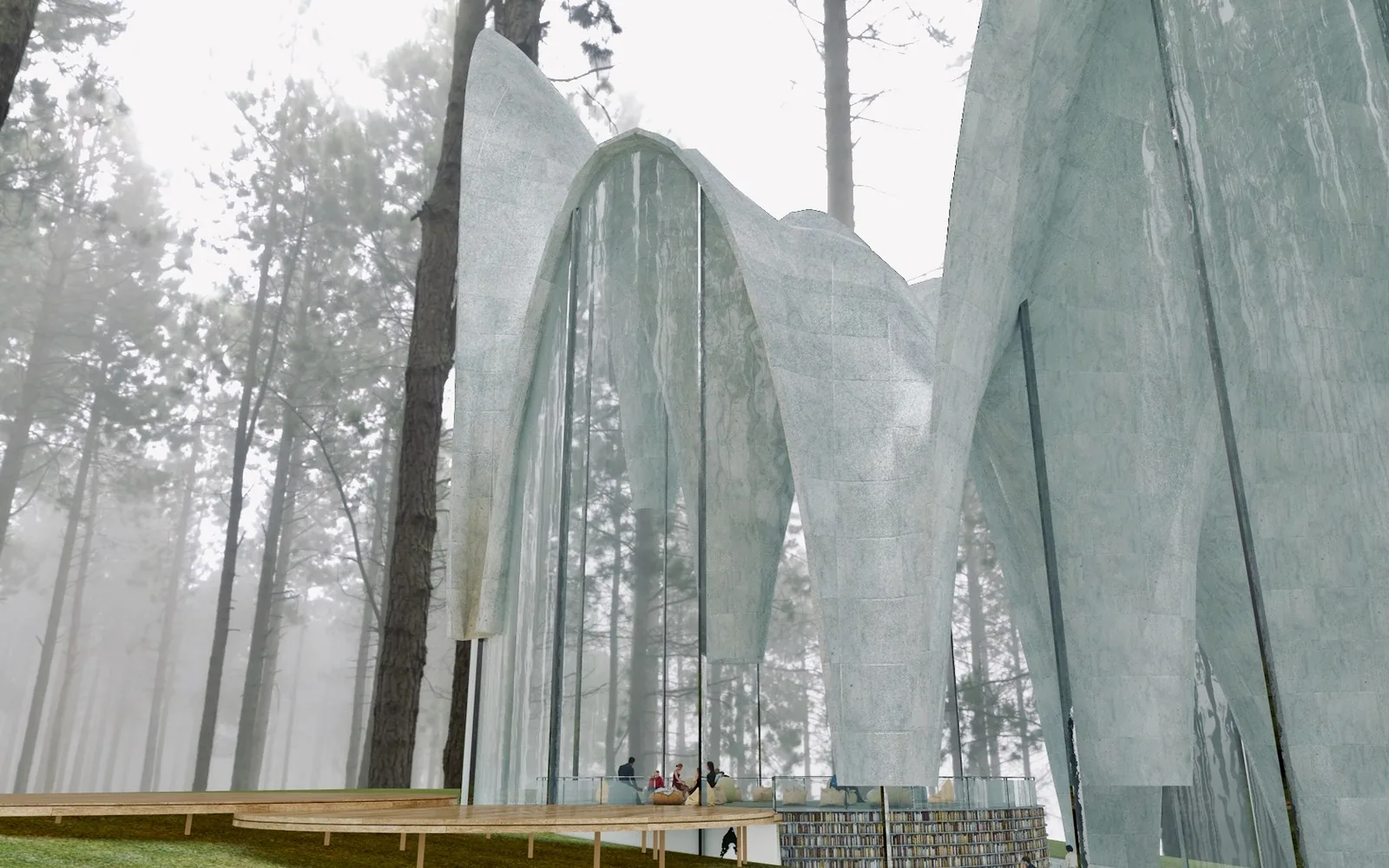
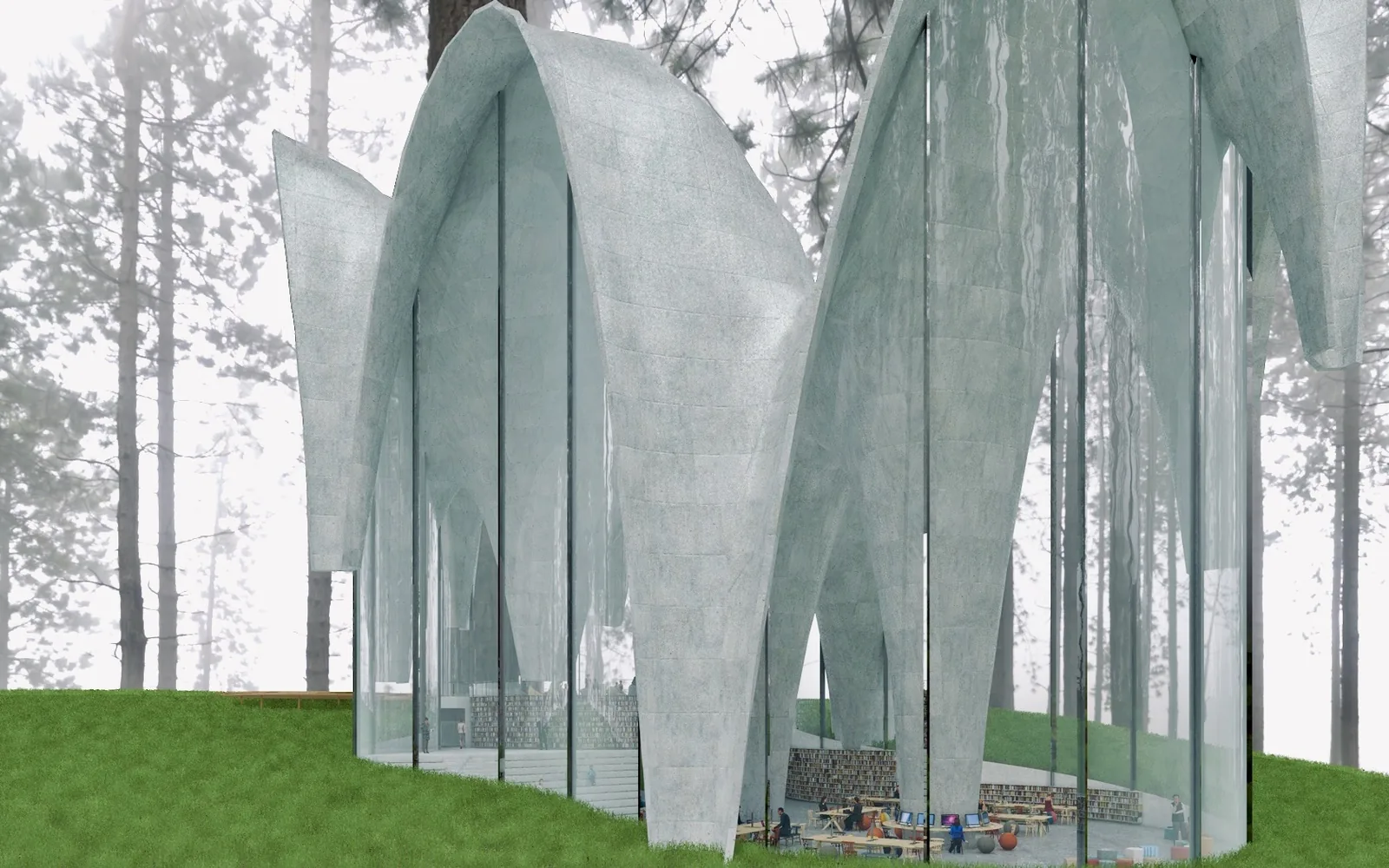
A library among pines

August 2020

The first design: tall shells in a pine forest, glazed between their legs, with the reading rooms underneath.

Rendering of tall pale shells standing among pine trunks, glass walls between their legs
Rendering inside the library: steps for sitting, long tables and shelves of books under the shells

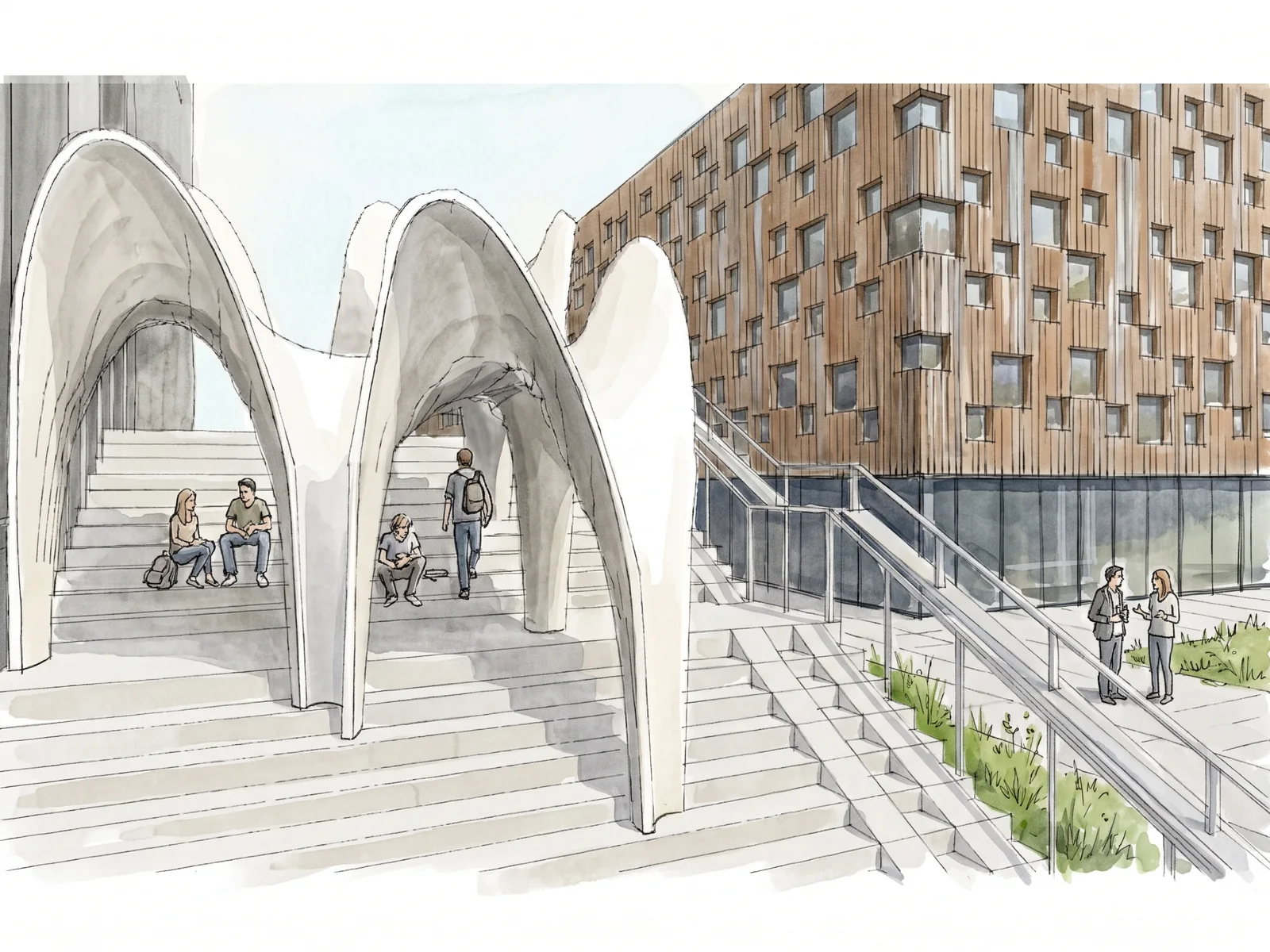
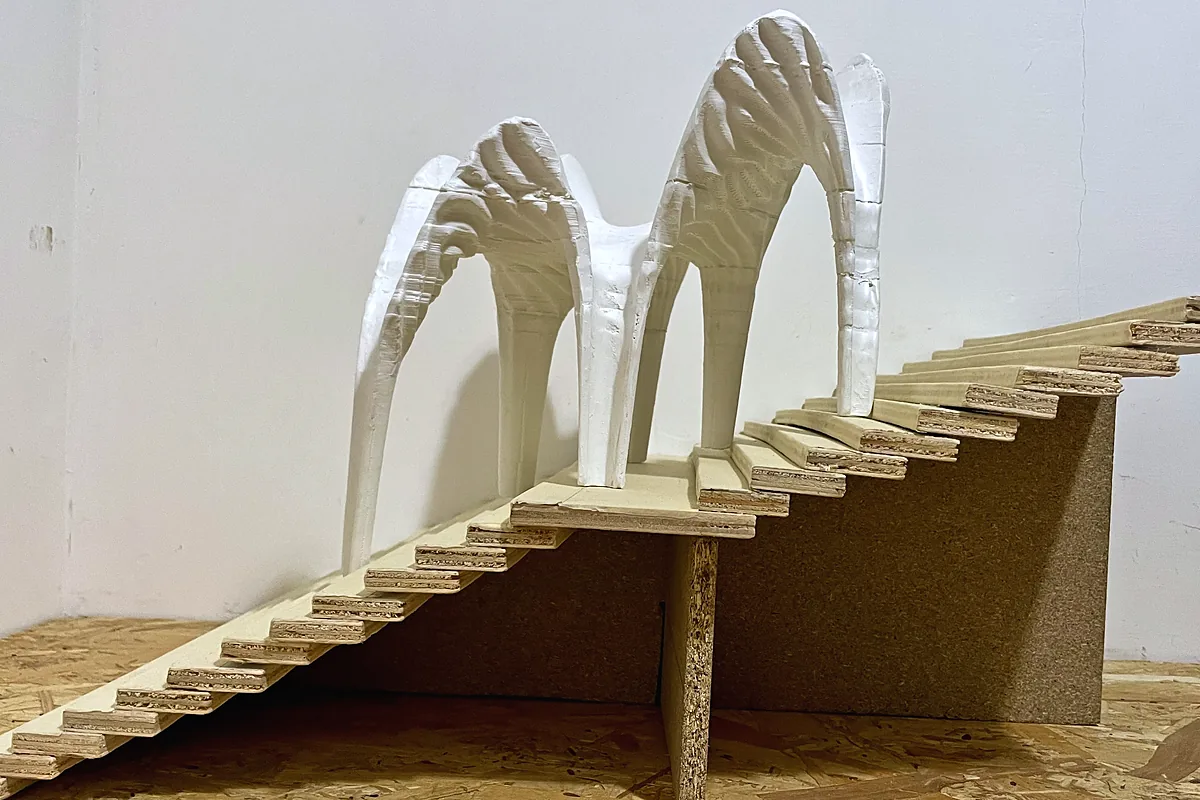
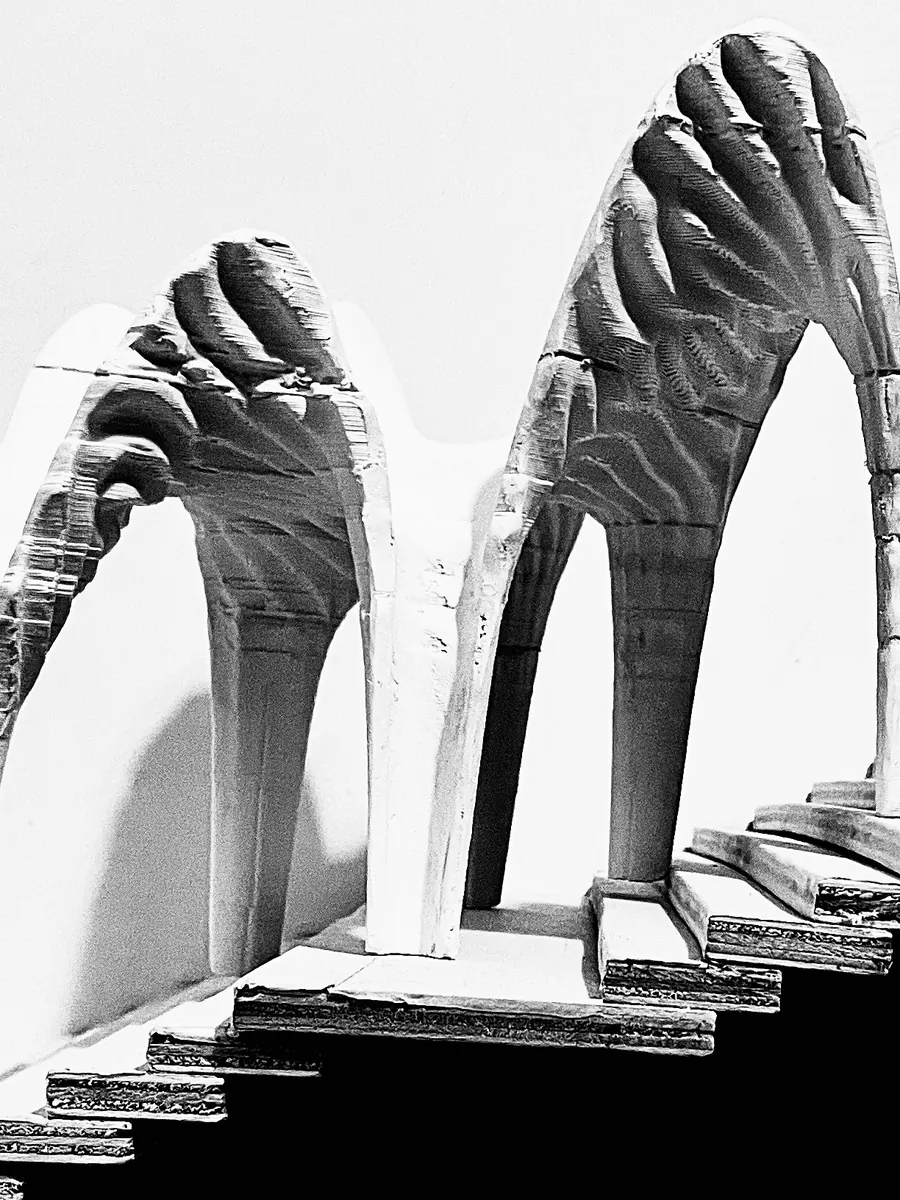
Shells on the steps

November 2021 to January 2022

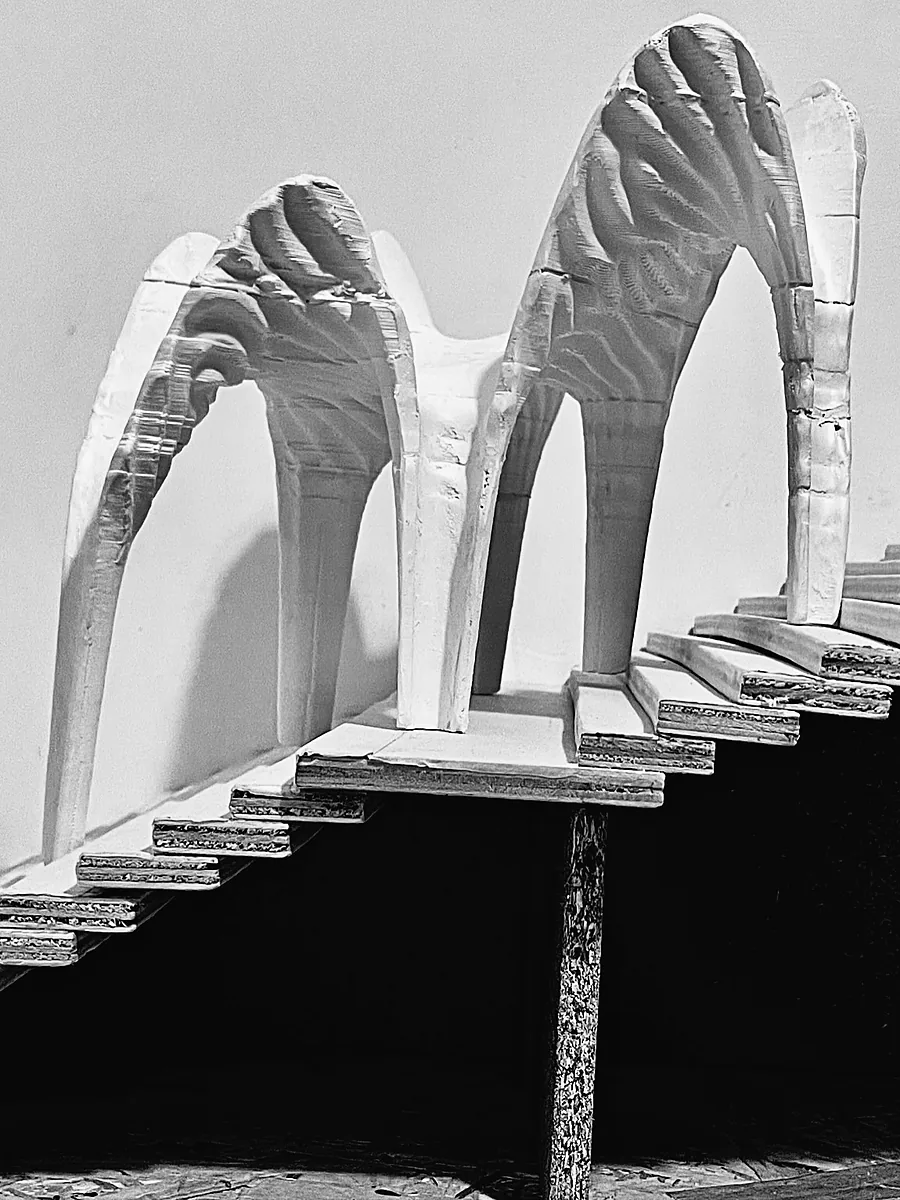
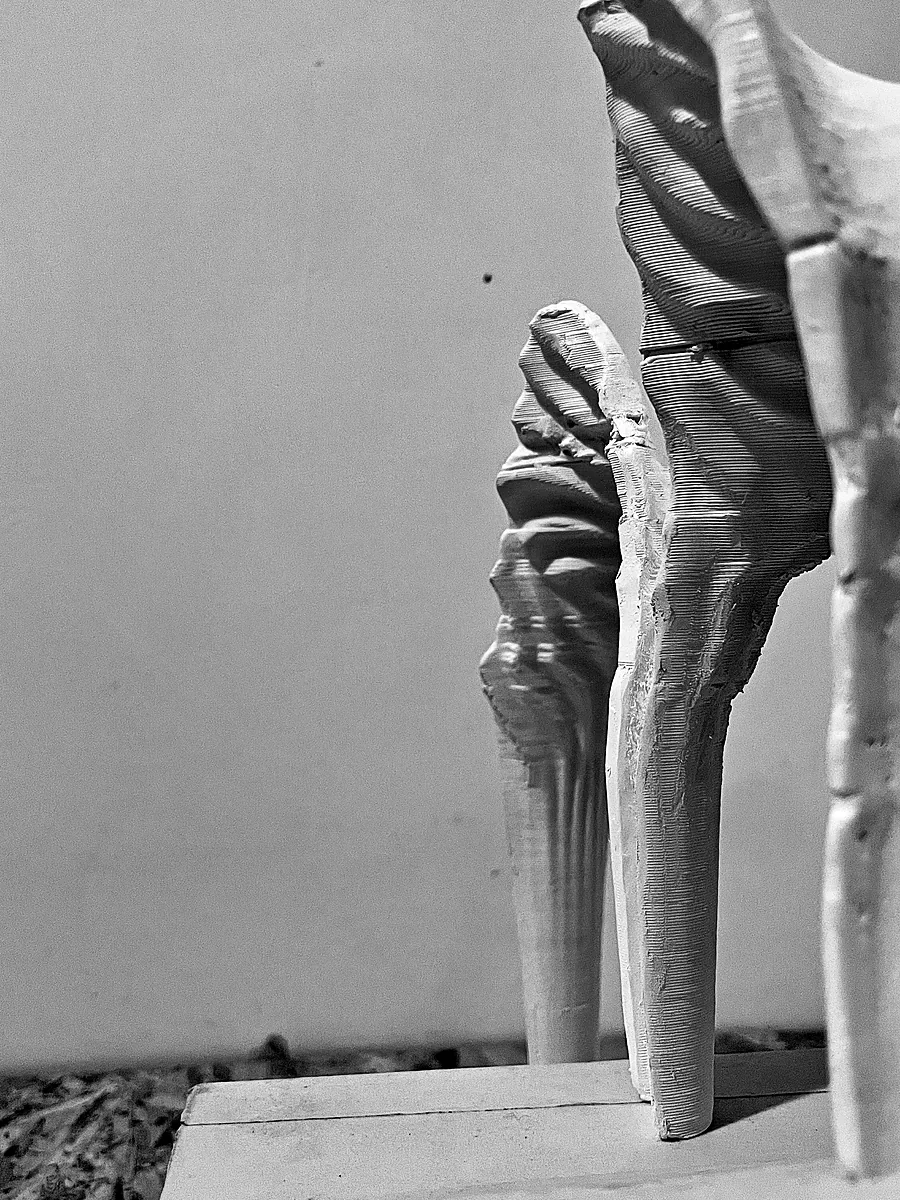
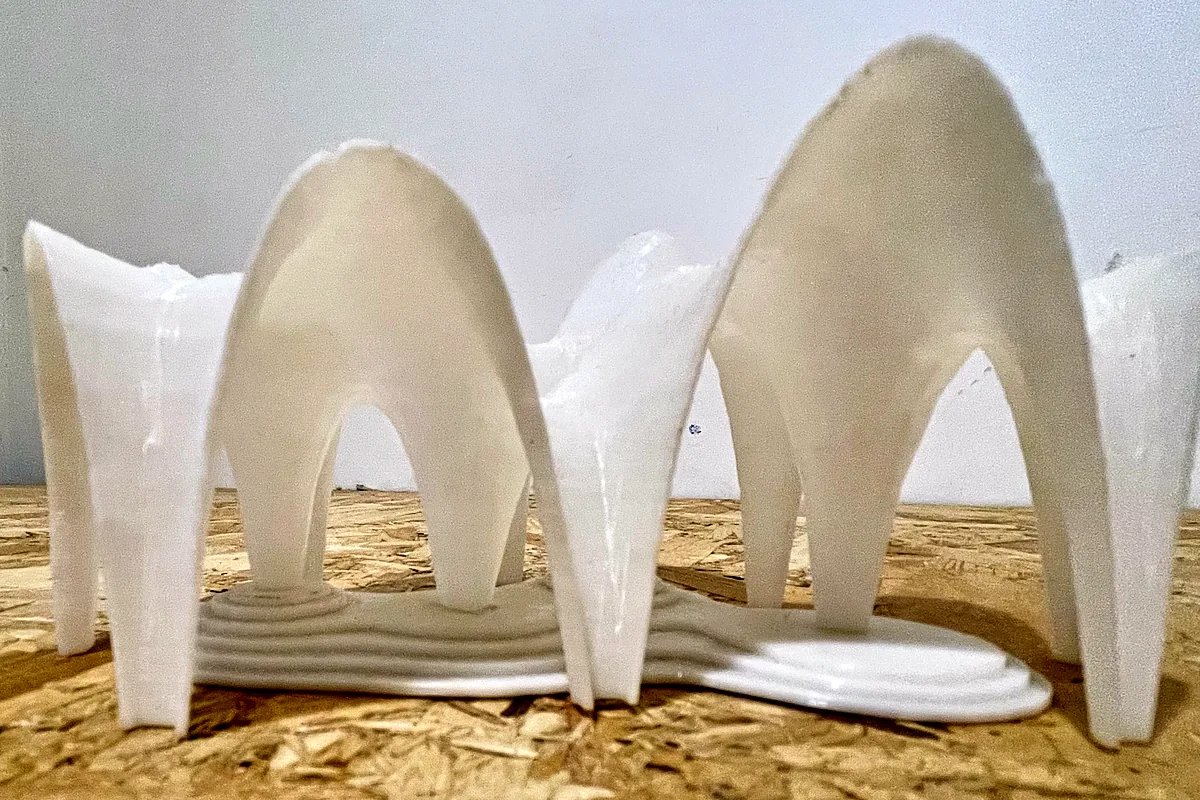
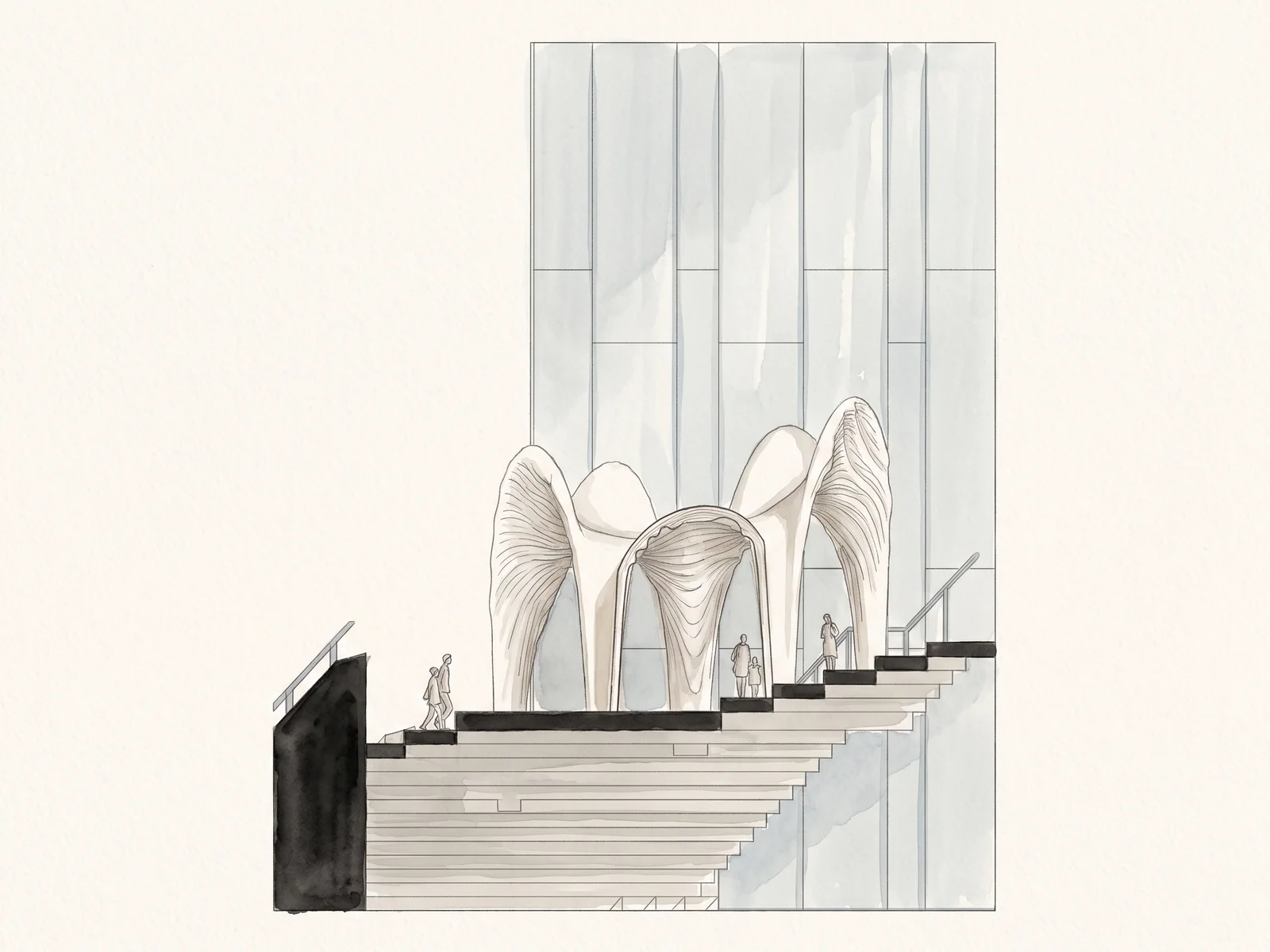
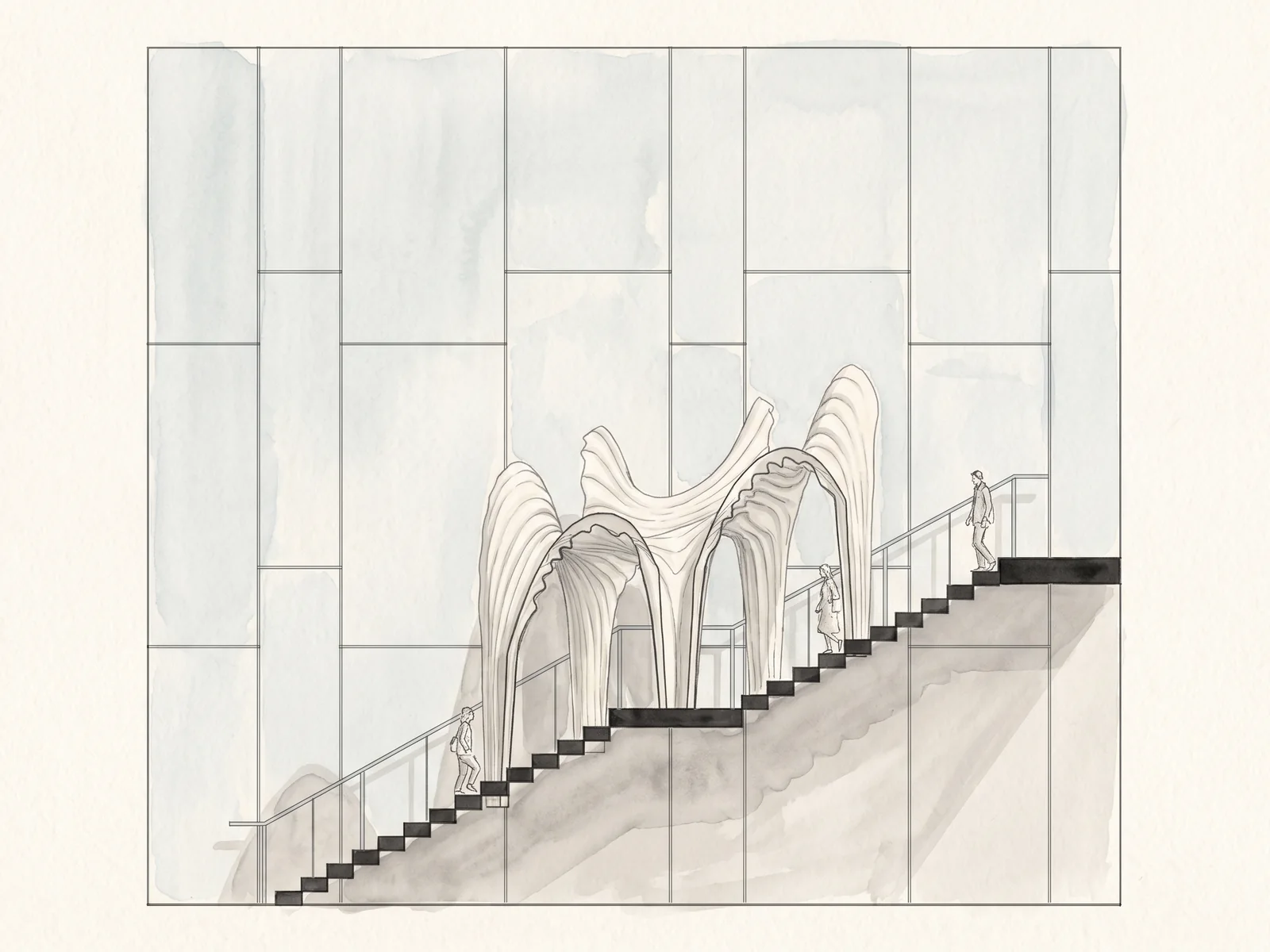
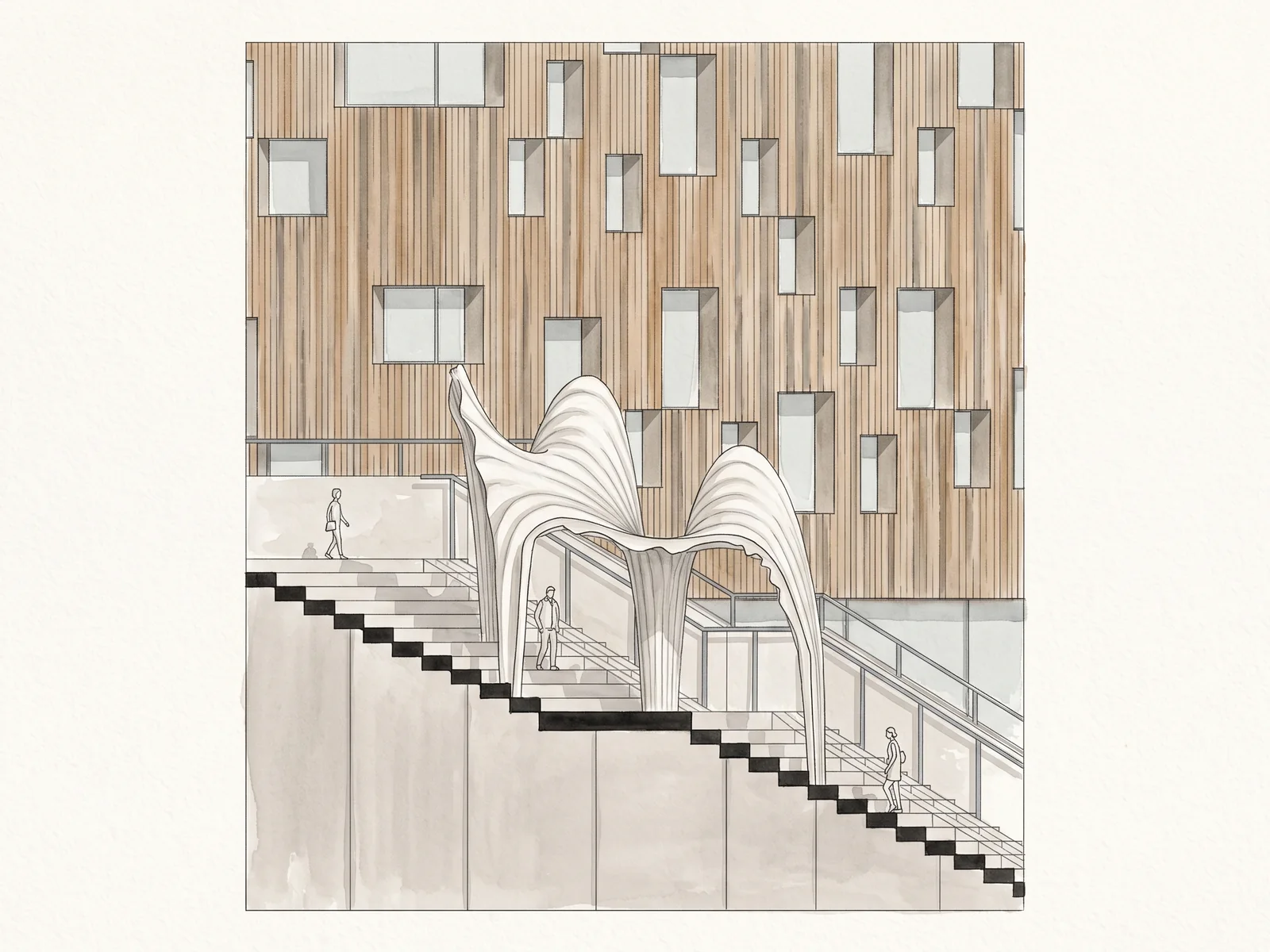
Ribbed shells set on a flight of outdoor steps, a stage by the river in Umeå. They were drawn over the stair in Rhino and 3D printed at small scale to test the ribs.

Line and watercolour drawing of pale shells standing over a wide outdoor stair beside a brick building, students sitting on the steps under them
3D printed white ribbed shells on a model of a staircase
Black and white photograph of the ribbed shells on the stair model
Rendering of the ribbed shells on the steps by the river, the Umeå Arts Campus behind them

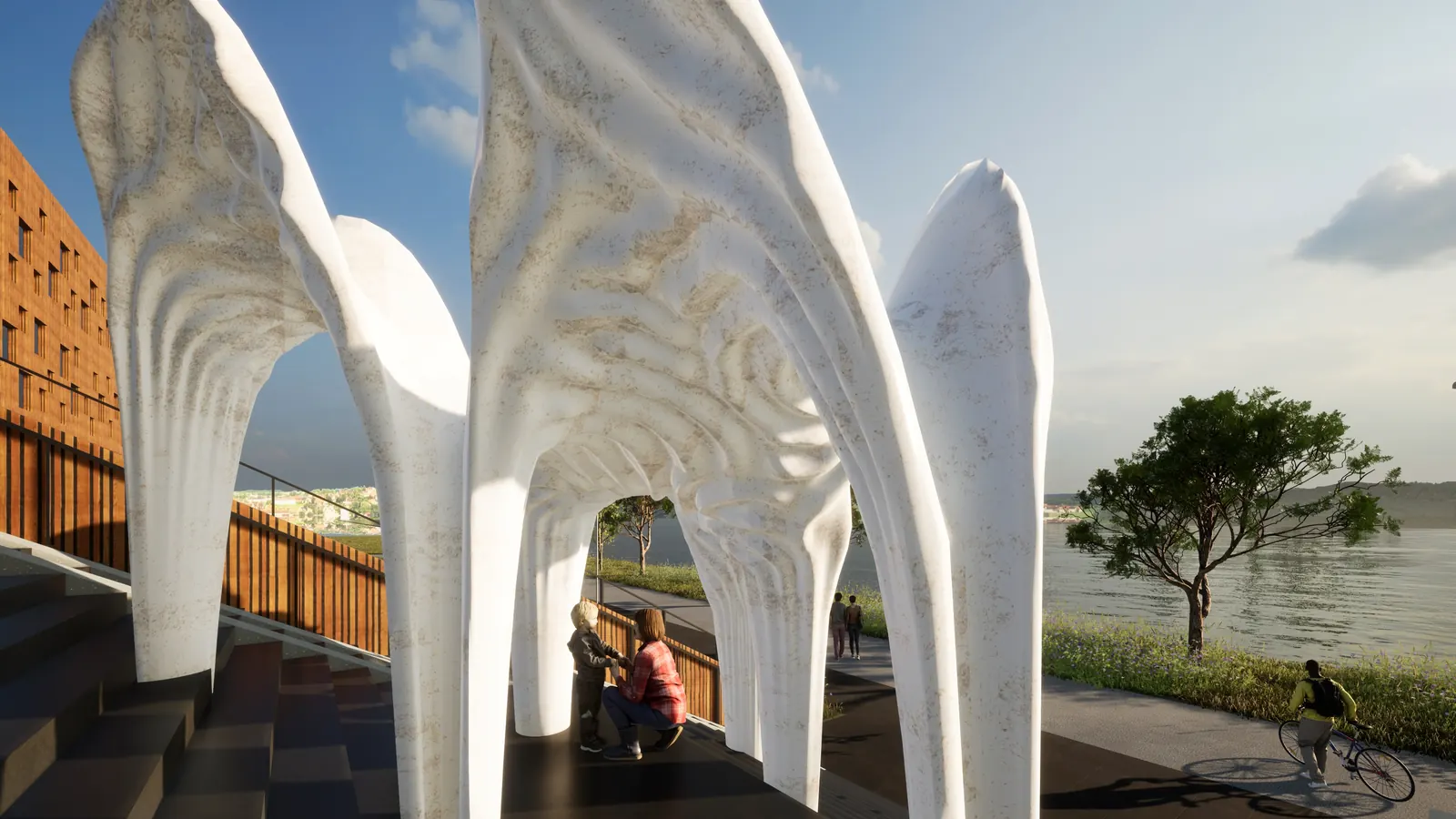
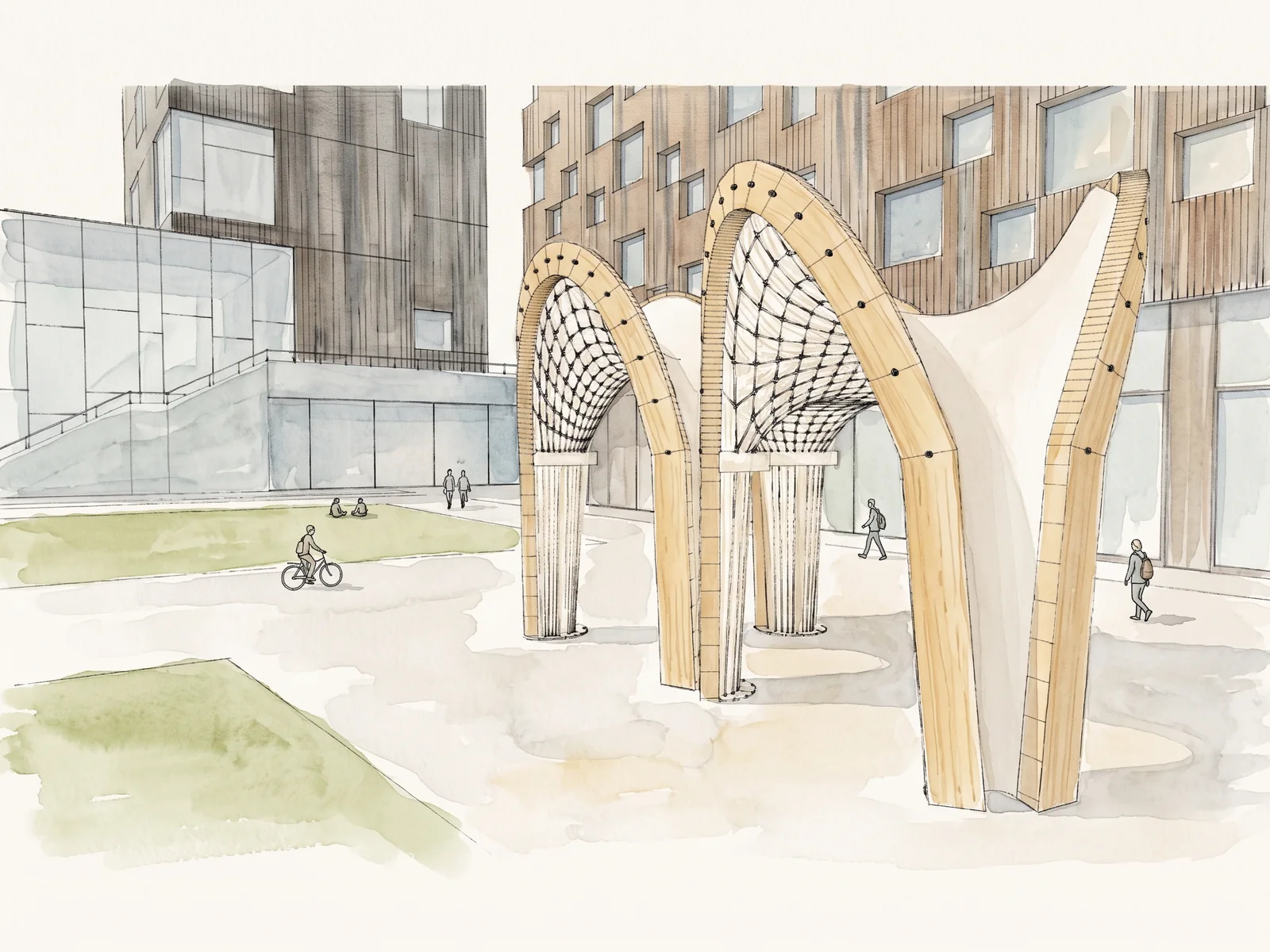
Flat shells in front of the university

December 2021 to January 2022

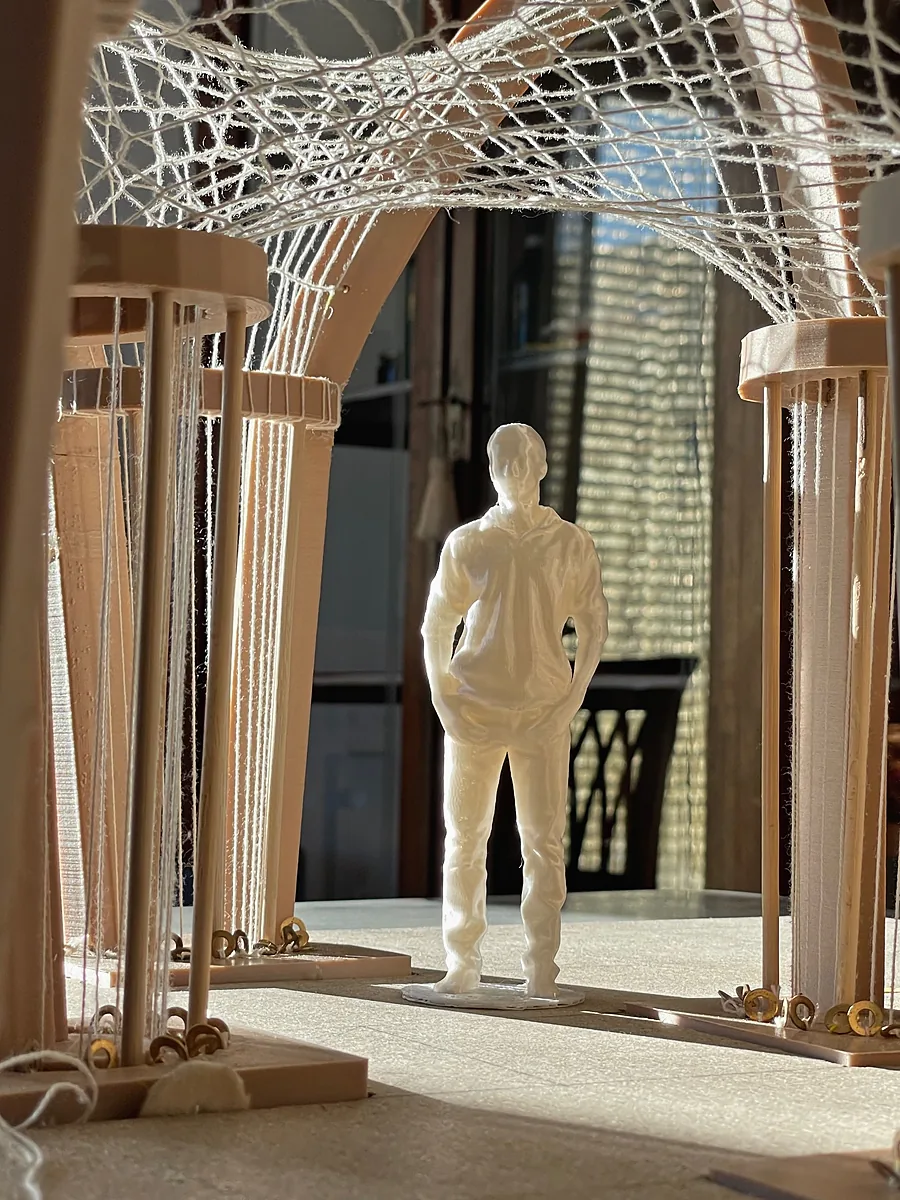
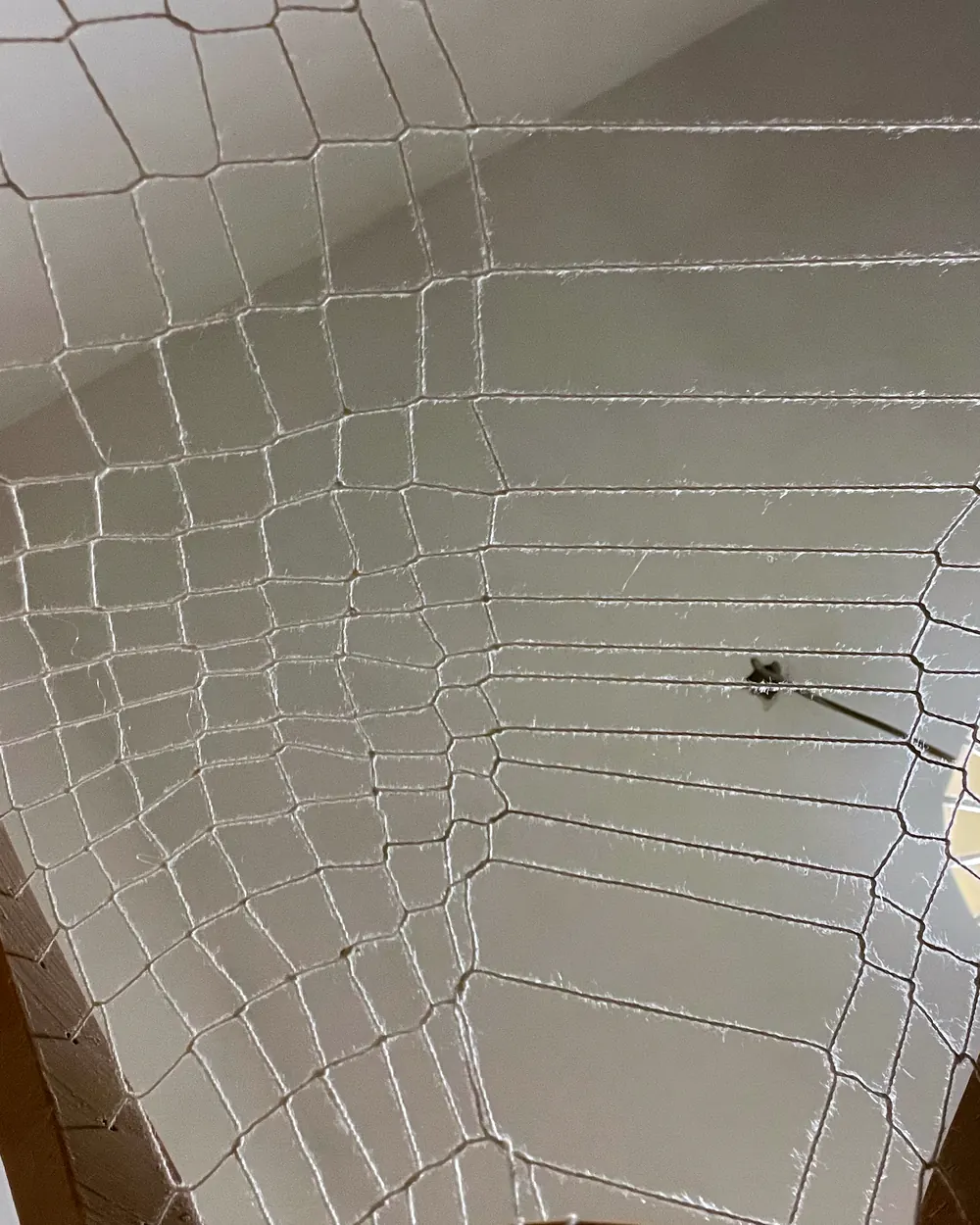
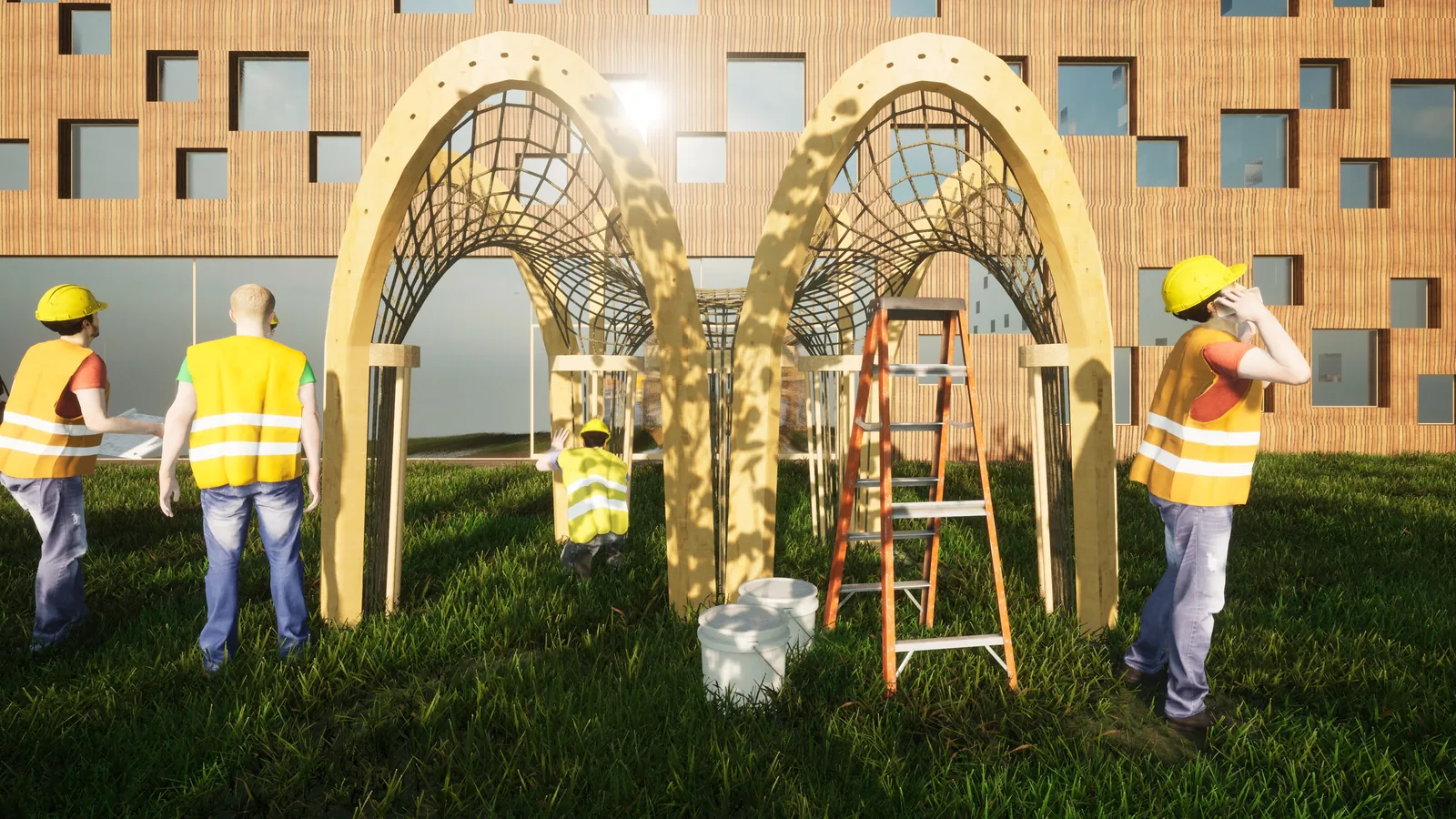
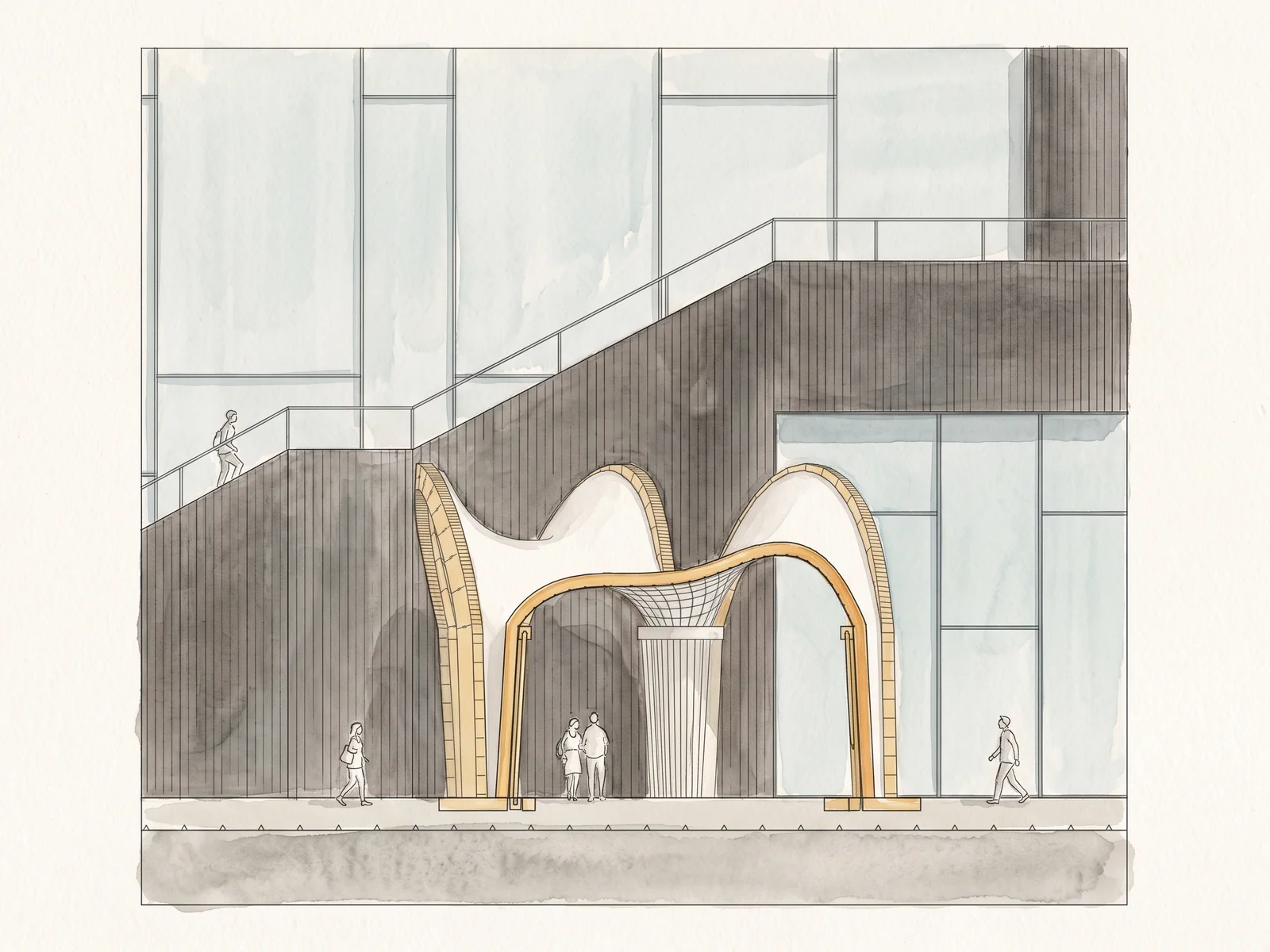
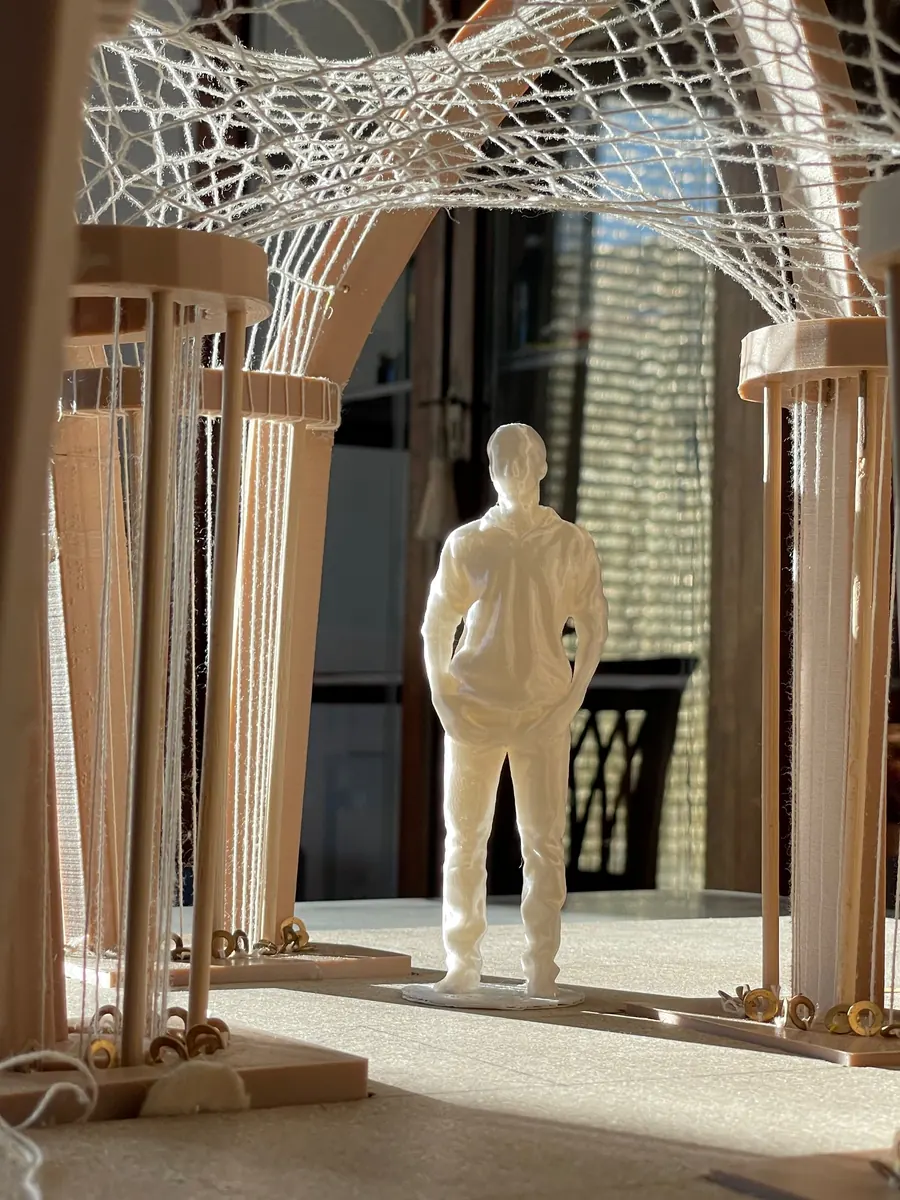
Low shells on the lawn. This is the one with the net: arches cut from board carry a net of string, and the net carries the skin. At full size the arches would be timber, raised on site.

Line and watercolour drawing of timber arches carrying a net of string and a pale skin, on a lawn in front of the university, people sitting under them and crossing the square
Model of arches cut from board carrying a net of white string, a small printed figure standing under it
Close view of the net of white string stretched between the arches
Rendering of the timber arches and net being raised on the lawn by builders in hard hats
3D printed model of the flat shells, white, on a wooden board
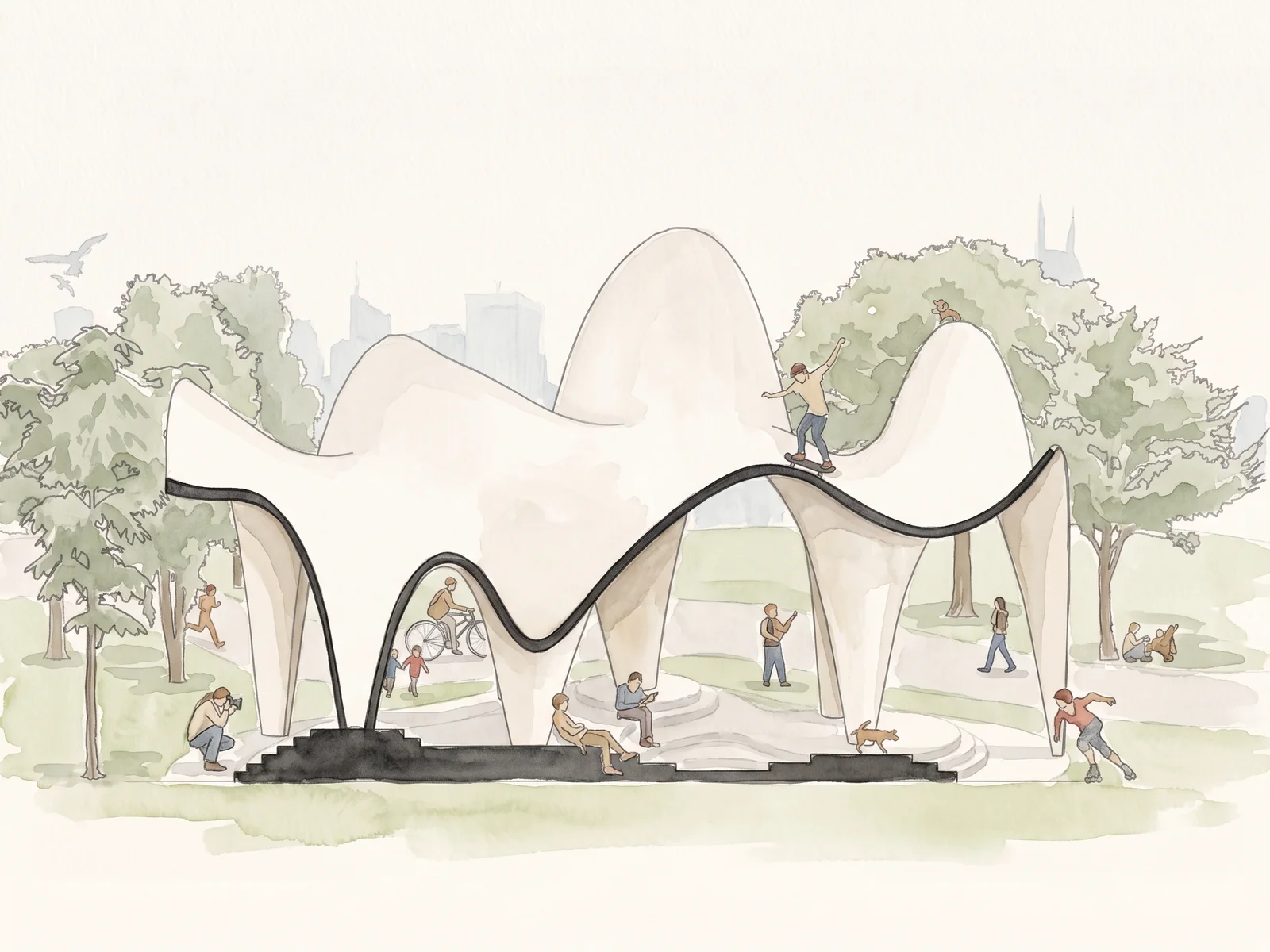
Line and watercolour section perspective of the same flat shells in a park, people sitting and cycling under them and a skateboarder on the roof

The printed model of the flat shells, January 2022, and the same shells in section perspective, a drawing of September 2021 coloured with AI.

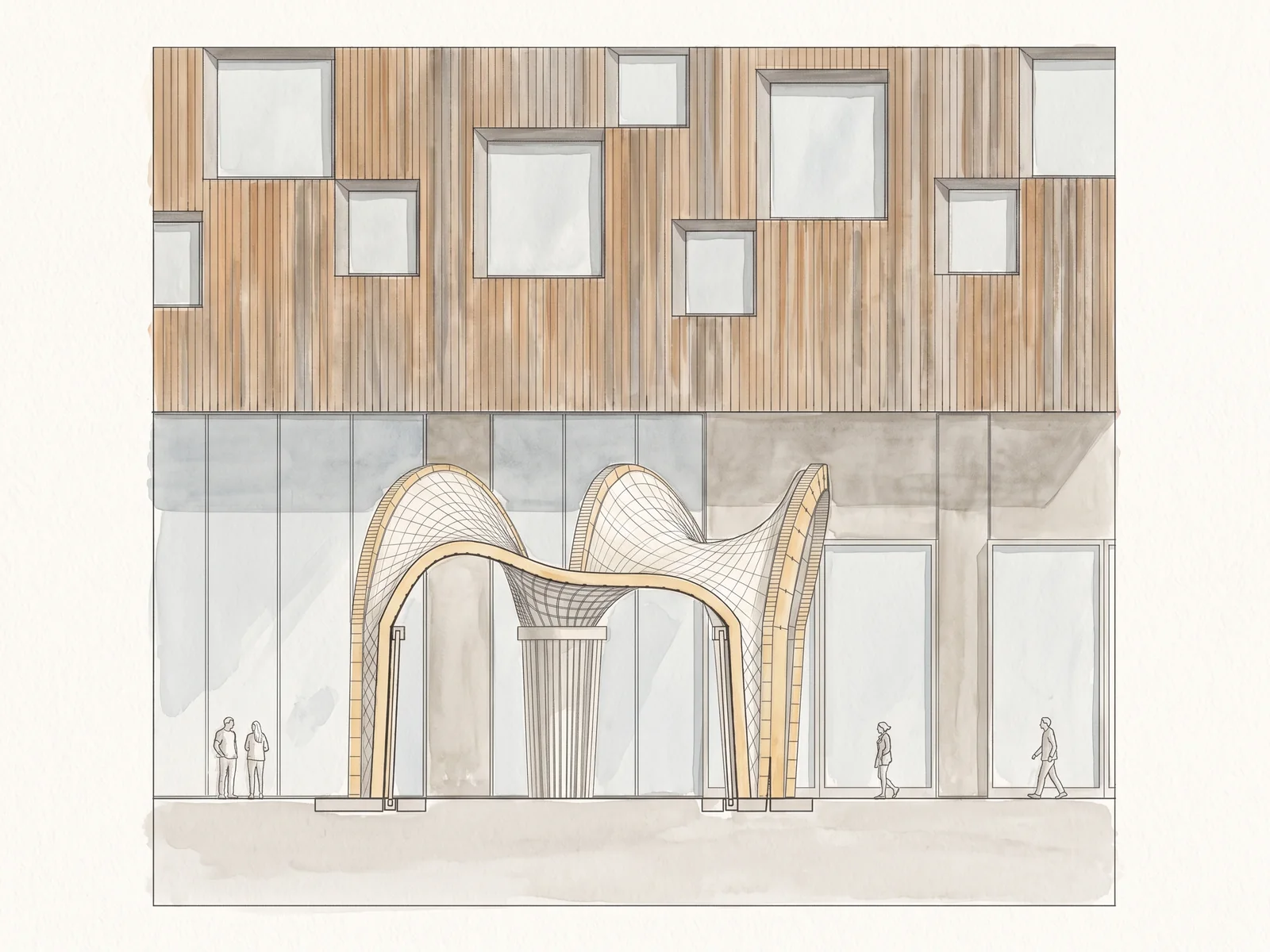
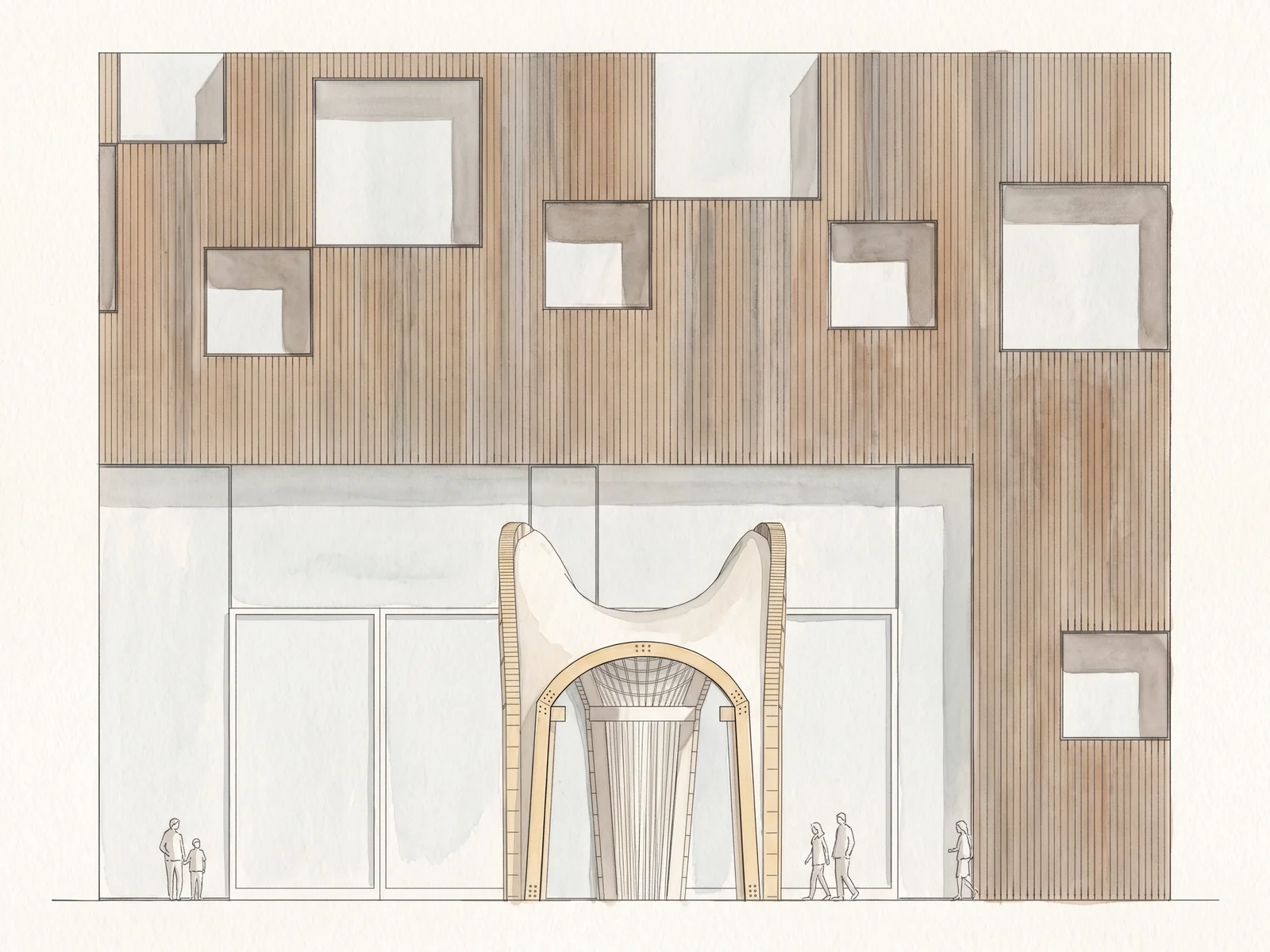
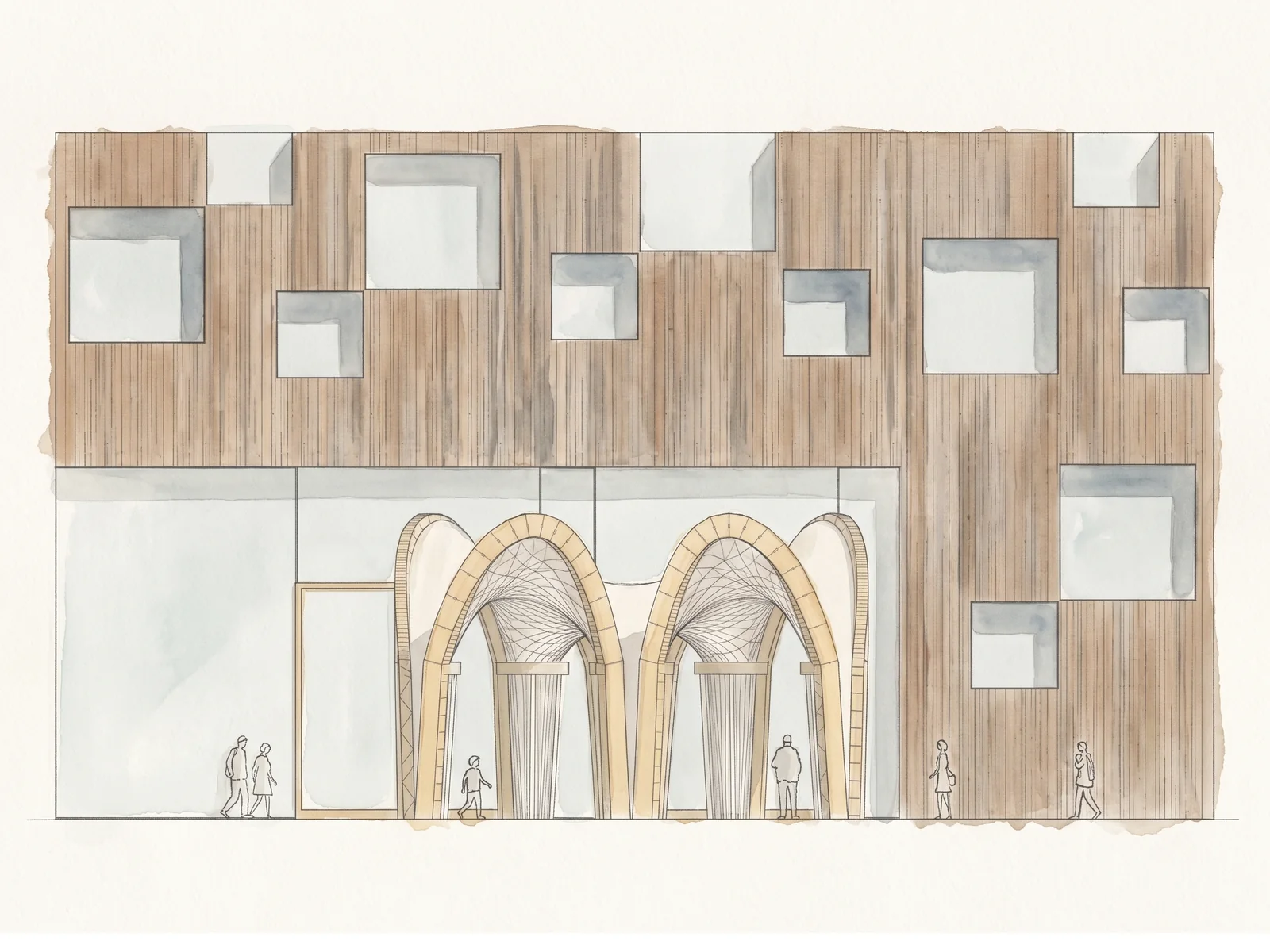
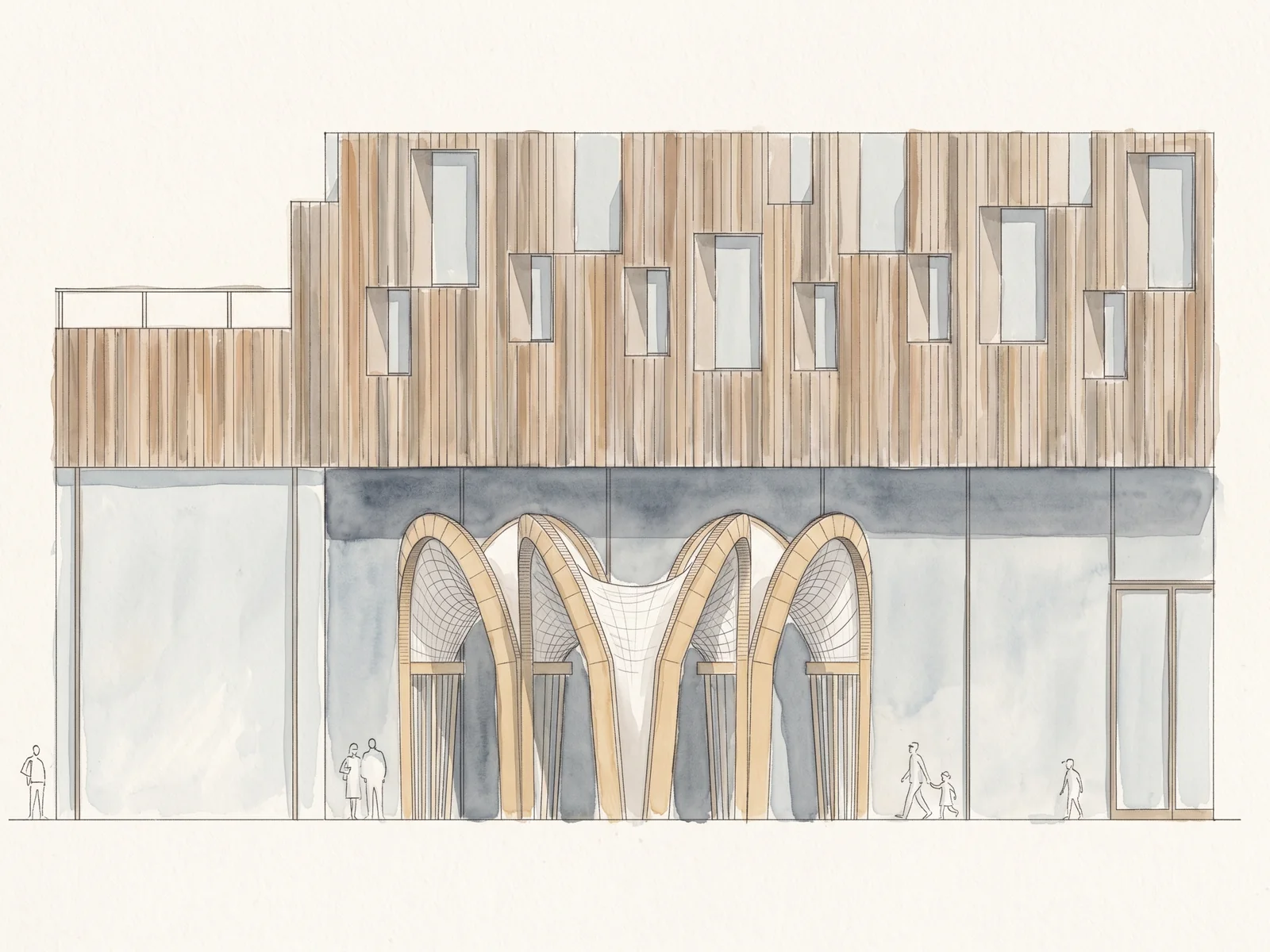
Coloured elevation: the flat shells with their timber arches and net in front of the larch facade of the School of Architecture, people walking past
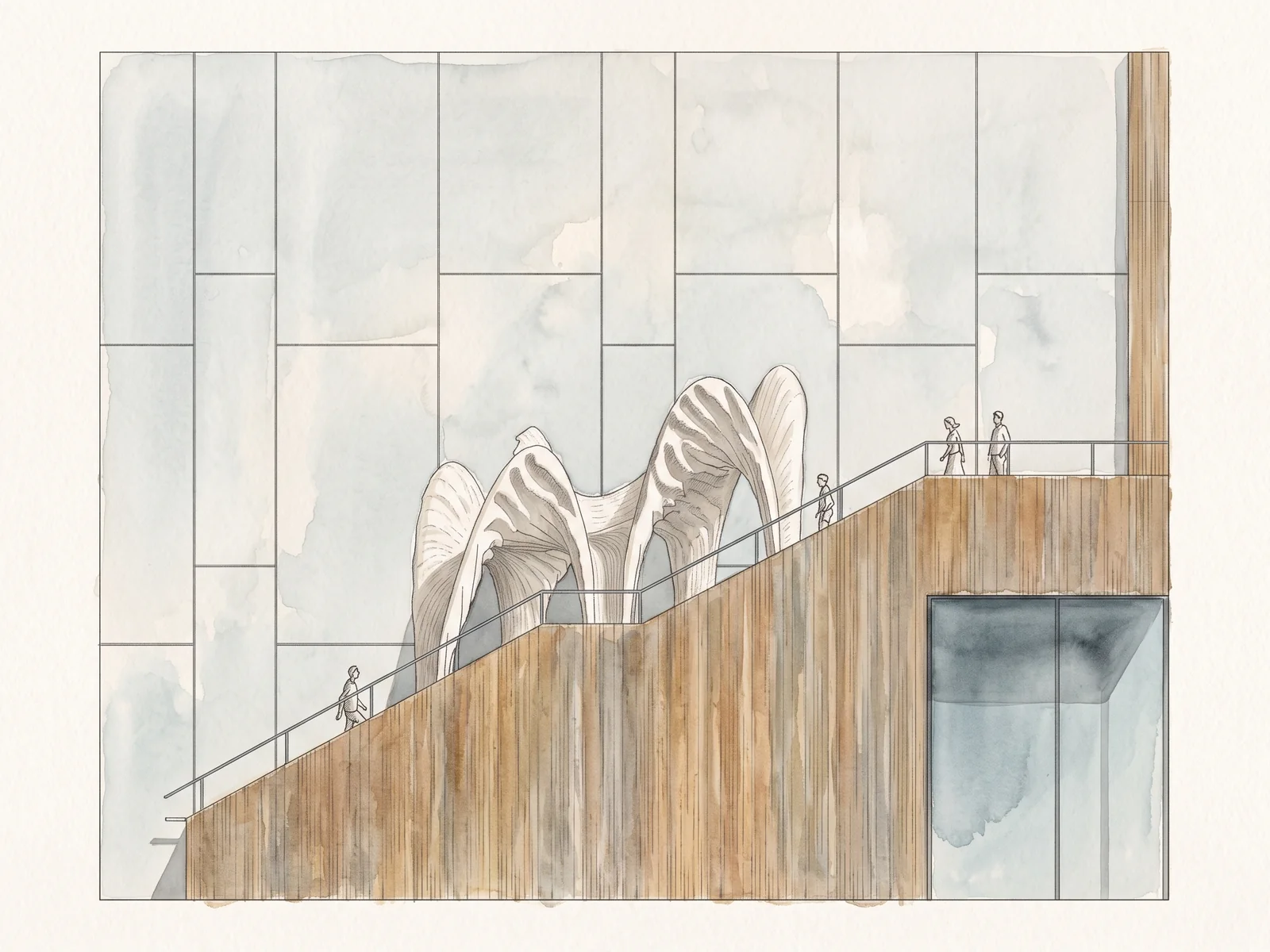
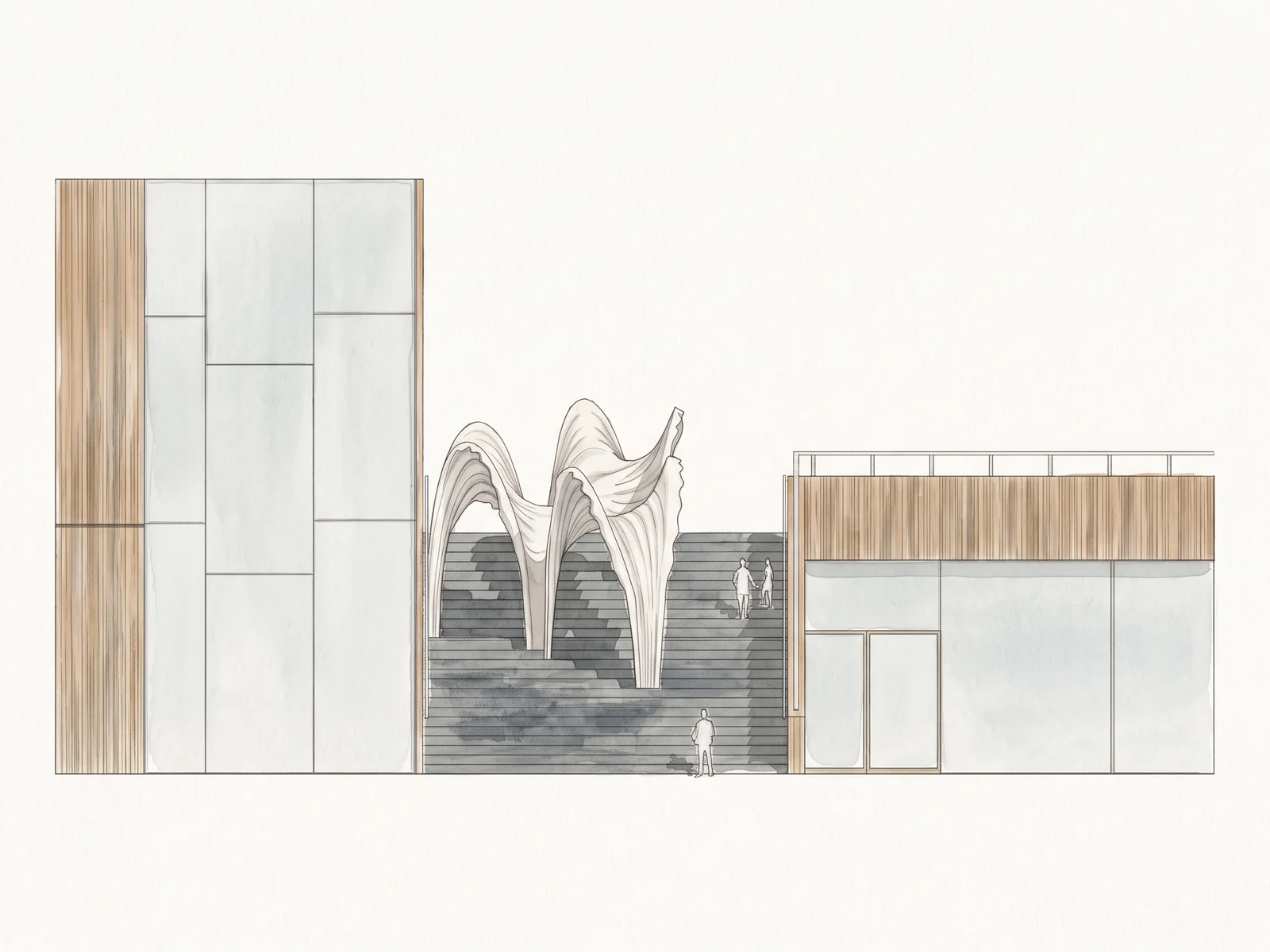
Coloured section through the flat shells, the timber arches cut, the net funnel in the middle, the museum stair behind

Elevations, left, and sections, right, of the flat shells and the shells on the steps, between Bildmuseet and the School of Architecture. Archicad drawings of December 2021, coloured with AI.

Three designs, three places. Renderings from 2020 and 2022, Archicad drawings from December 2021, the stair and net models from the winter of 2021 to 2022.

2021 to 2022, Naples and Umeå

First experiments with mycelium

2021to 2022

Naples, Umeå

Matter

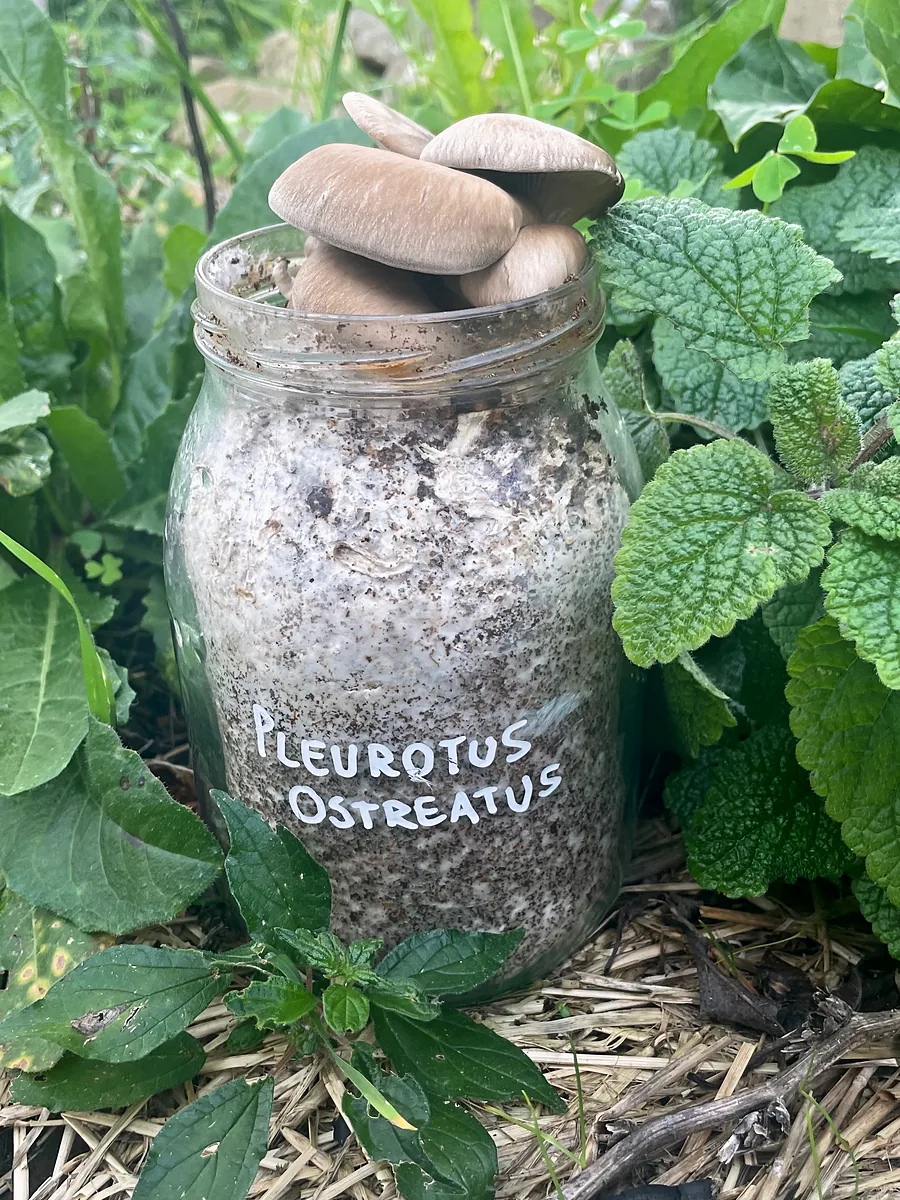
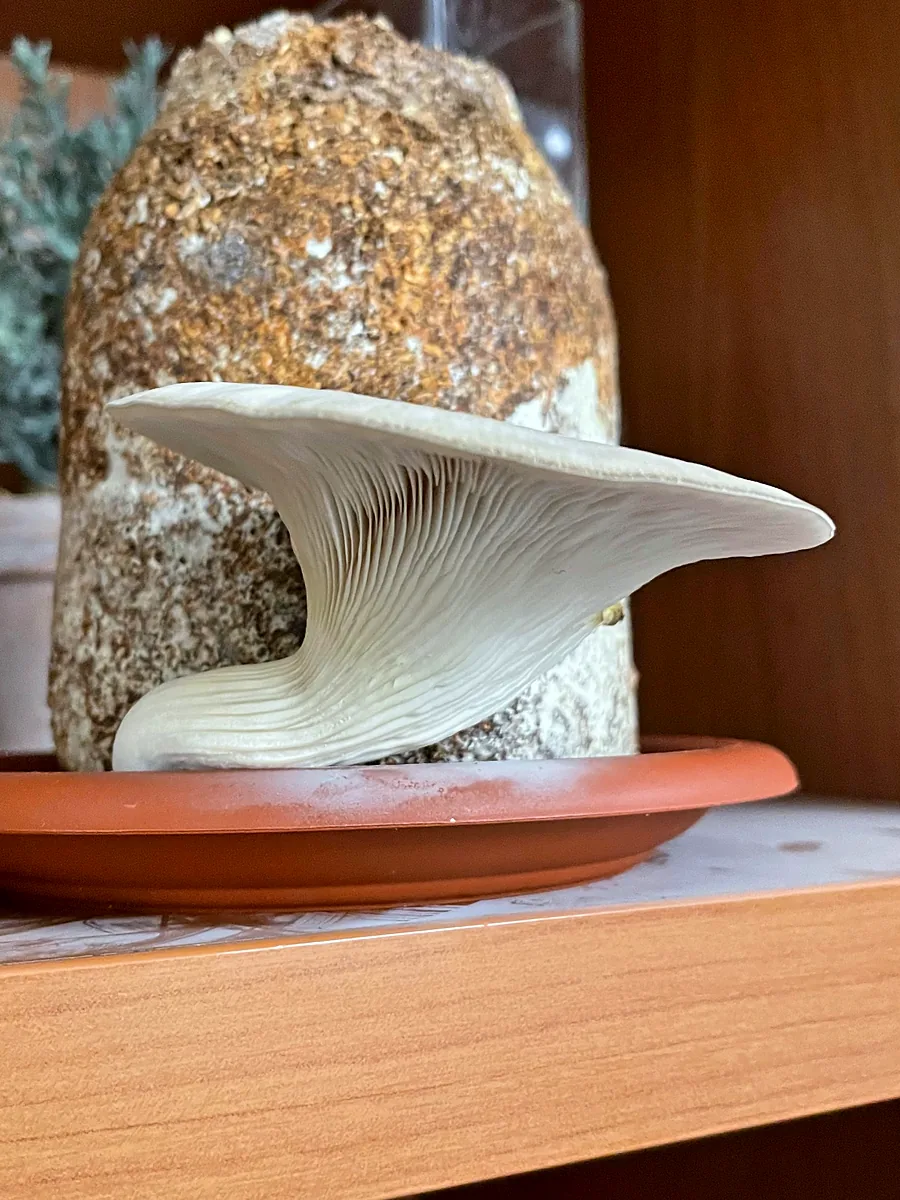
Alongside the thesis, November 2021 to May 2022: growing Pleurotus ostreatus, the oyster mushroom, at home near Naples, a visit to the farm Il Rivo above Sorrento, then the first sterile cultures in Umeå.

Mixing day, 19 January 2022, filmed from above: the substrates weighed and mixed, the bags filled and taped, sterilised in a pressure cooker, then inoculated with spawn.

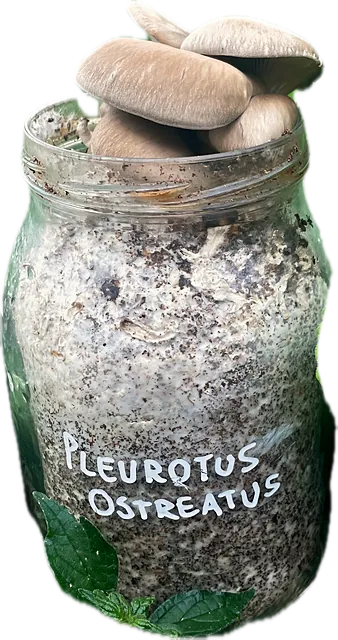
A jar labelled Pleurotus ostreatus among garden plants, grey oyster mushrooms growing from the top
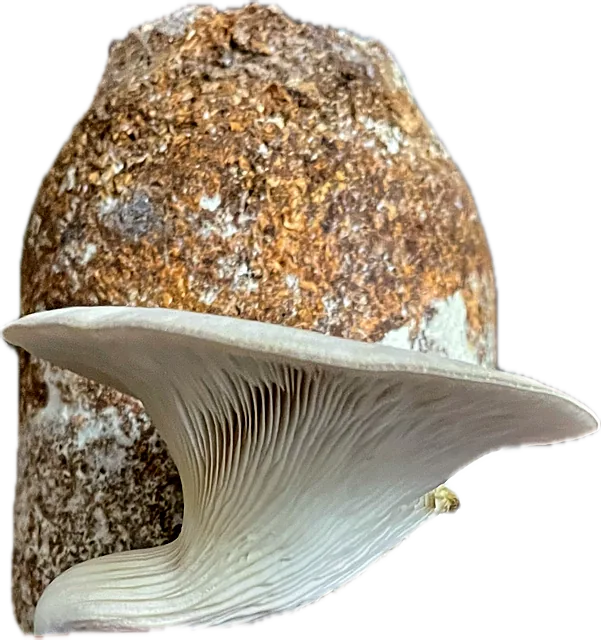
A block of substrate on a plant saucer with a large white oyster mushroom cap growing from its side

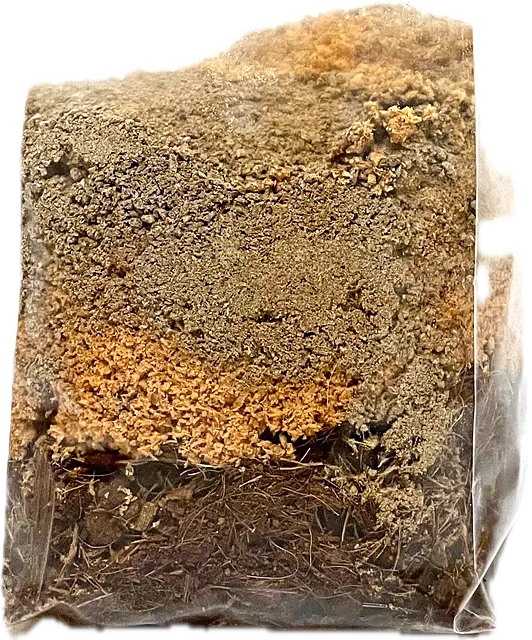
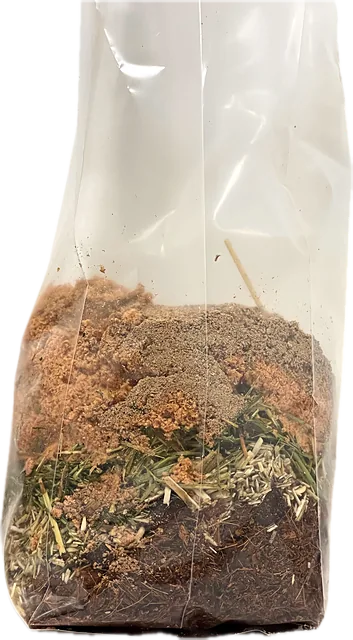
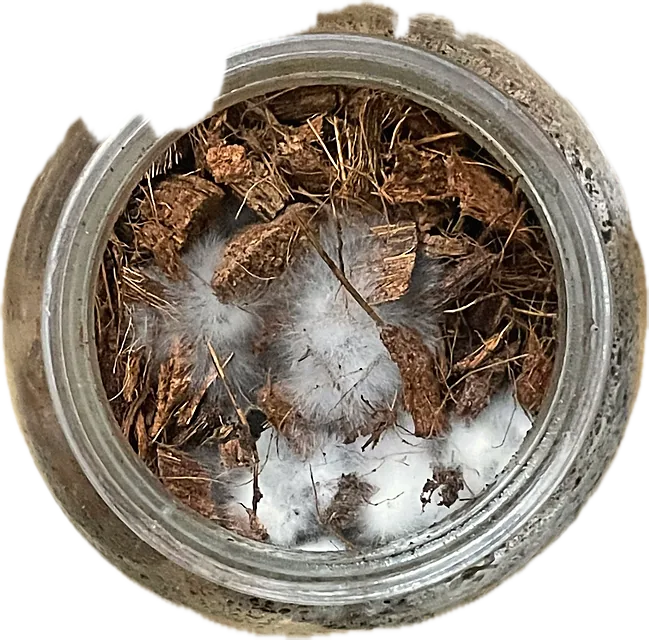
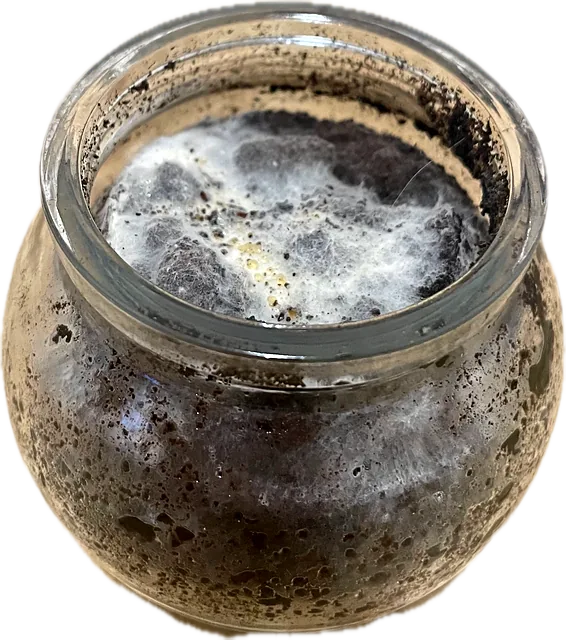
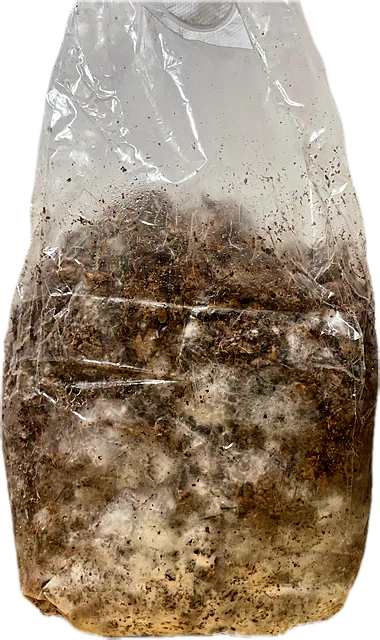
Before designing with a living material I had to learn to grow it. I mixed substrates in different proportions, filled bags and jars, sterilised them and inoculated them with spawn, then watched which mixes the mycelium took over, which stayed bare and which grew mould.

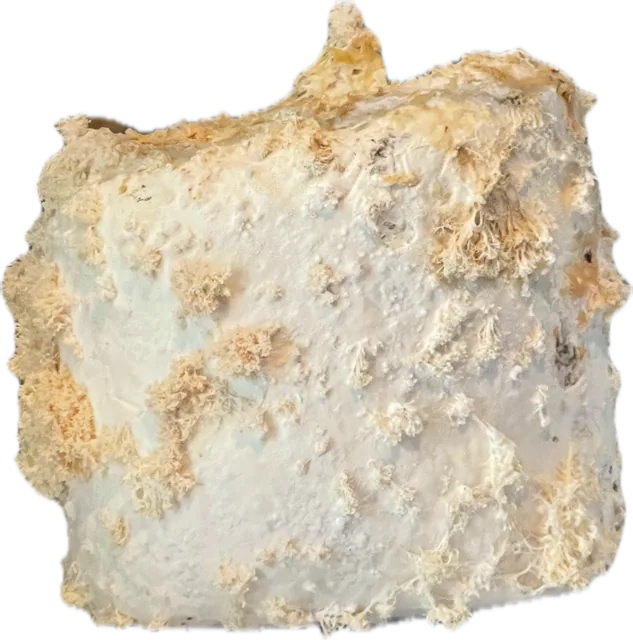
In January 2022 we saw the first fruit at Il Rivo, a permaculture farm in Sant'Agata sui Due Golfi above Sorrento, where a jar of Pleurotus ostreatus and a block of lion's mane, Hericium erinaceus, were prepared with the help of Chiara Sente. Until the REishi chair, everything I grew myself was Pleurotus ostreatus. From the chair on, it is Ganoderma.

  1. A grow bag of layered substrate, orange and brown

    15 Nov 2021, Naples

    Layers of substrate in a grow bag

  2. A grow bag of substrate with straw

    16 Nov 2021, Naples

    With straw

  3. A jar of coarse chips seen from above, white mycelium between them

    9 Dec 2021, Naples

    Coarse chips, the mycelium taking hold

  4. A jar of dark substrate with white mycelium on top

    3 Jan 2022, Naples

    A darker mix in a jar

  5. A grow bag whitened by mycelium

    19 Jan 2022, Naples

    A bag grown through

  6. A white block of substrate covered in the shaggy cream tufts of lion's mane

    20 Jan 2022, Il Rivo, Sant'Agata

    Lion's mane, prepared by Il Rivo

  7. A jar labelled Pleurotus ostreatus with grey oyster mushrooms growing from the top

    20 Jan 2022, Il Rivo, Sant'Agata

    Oyster mushrooms in a jar, prepared by Il Rivo

  8. A block with a large white oyster mushroom cap

    21 Feb 2022, Naples

    A cap on a block

  9. A cylinder of colonised substrate

    7 Mar 2022, Naples

    A cylinder out of its mould

  10. A grow bag of colonised substrate in Umeå

    6 May 2022, Umeå

    In Umeå

Ten specimens from the first experiments, cut out of their photographs and set on one shelf in the order they were made. Not to scale.

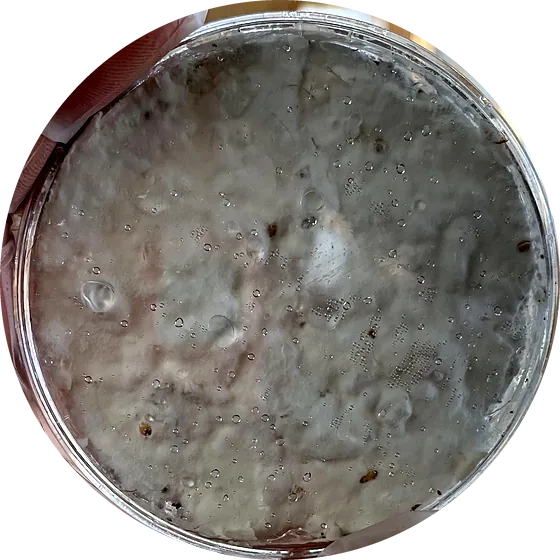
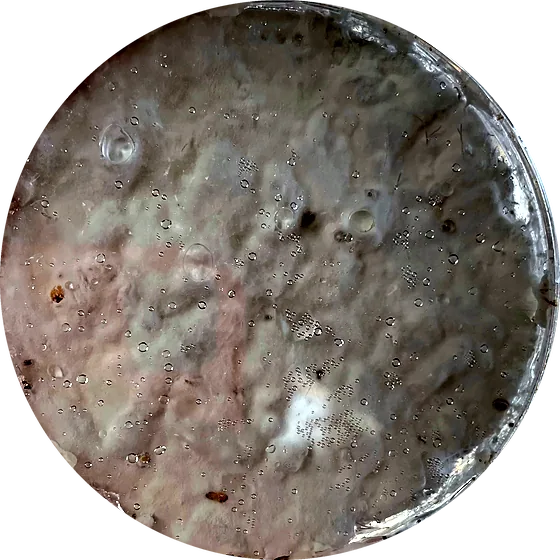
  1. A petri dish with clumps of substrate under a white film of mycelium
  2. A petri dish of speckled dark substrate grown over in white
  3. A petri dish covered in a smooth grey mycelium
  4. A petri dish almost fully white
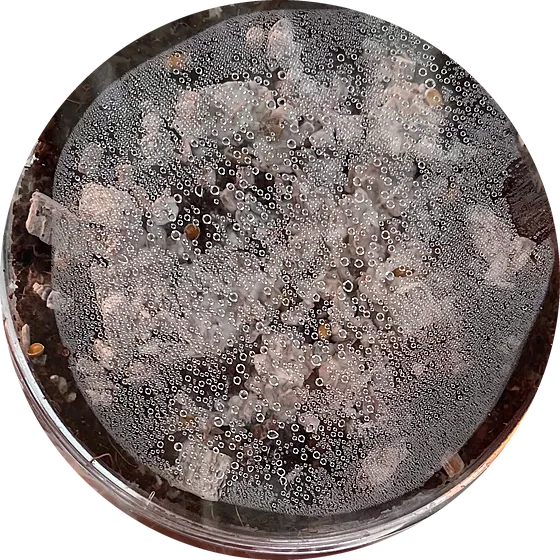
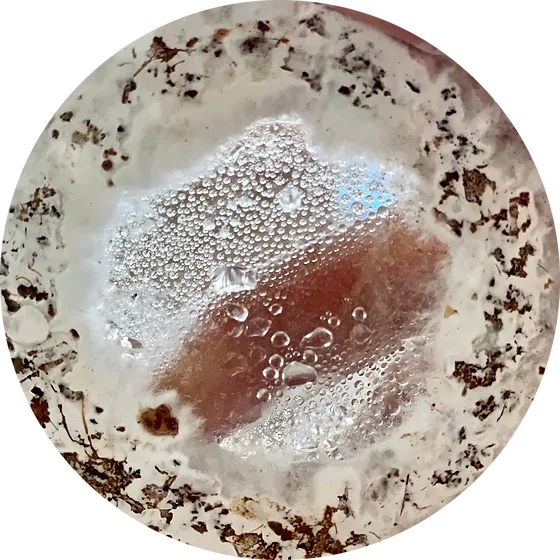
  5. A petri dish with a ring of substrate and condensation in the middle

The first sterile cultures, in petri dishes, Umeå, May 2022.

2022, Umeå

REishi chair

2022

Umeå

Matter

First UMA Furniture Fair, Umeå School of Architecture, May 2022. Awarded. Made during my Erasmus+ traineeship with RISE.

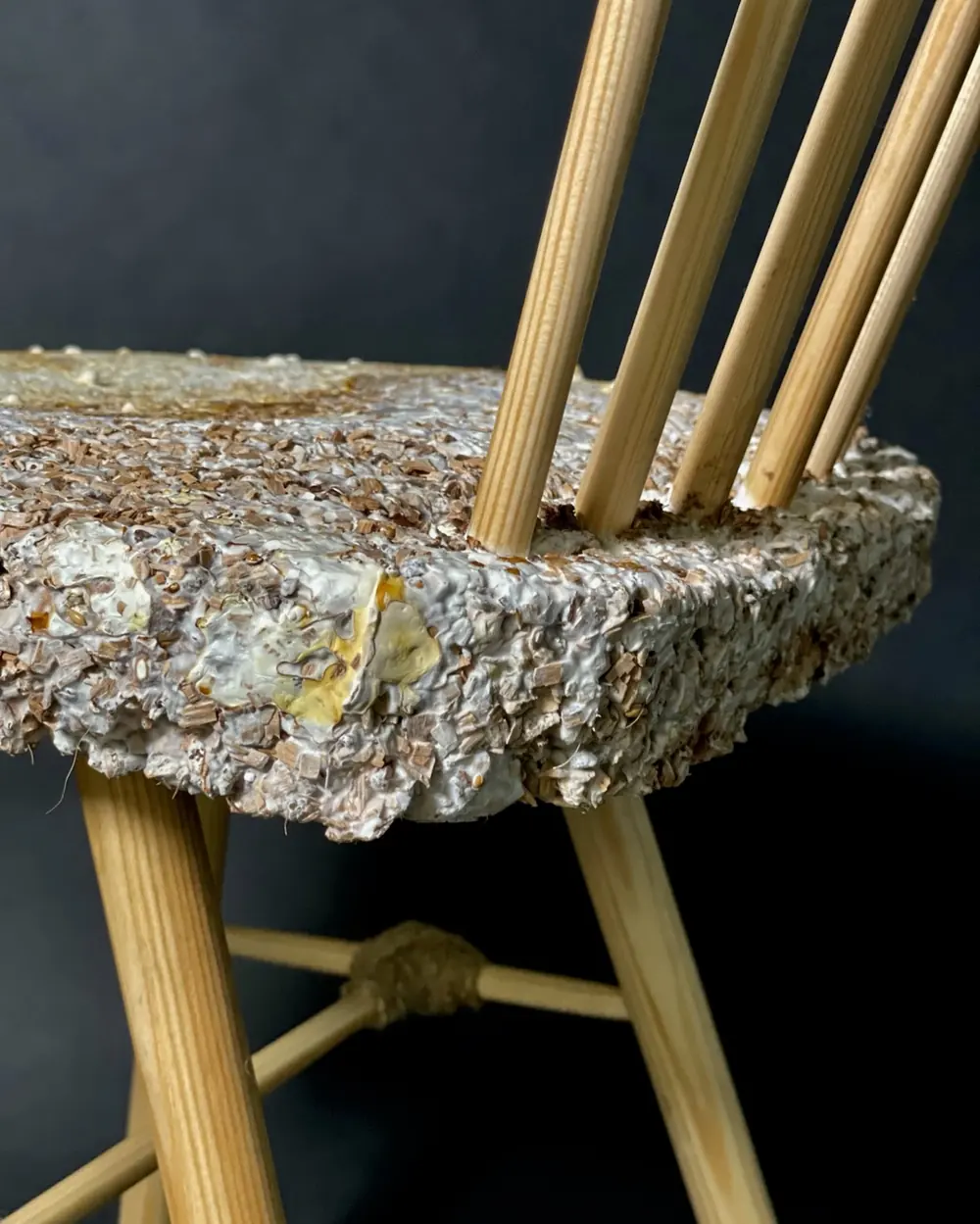
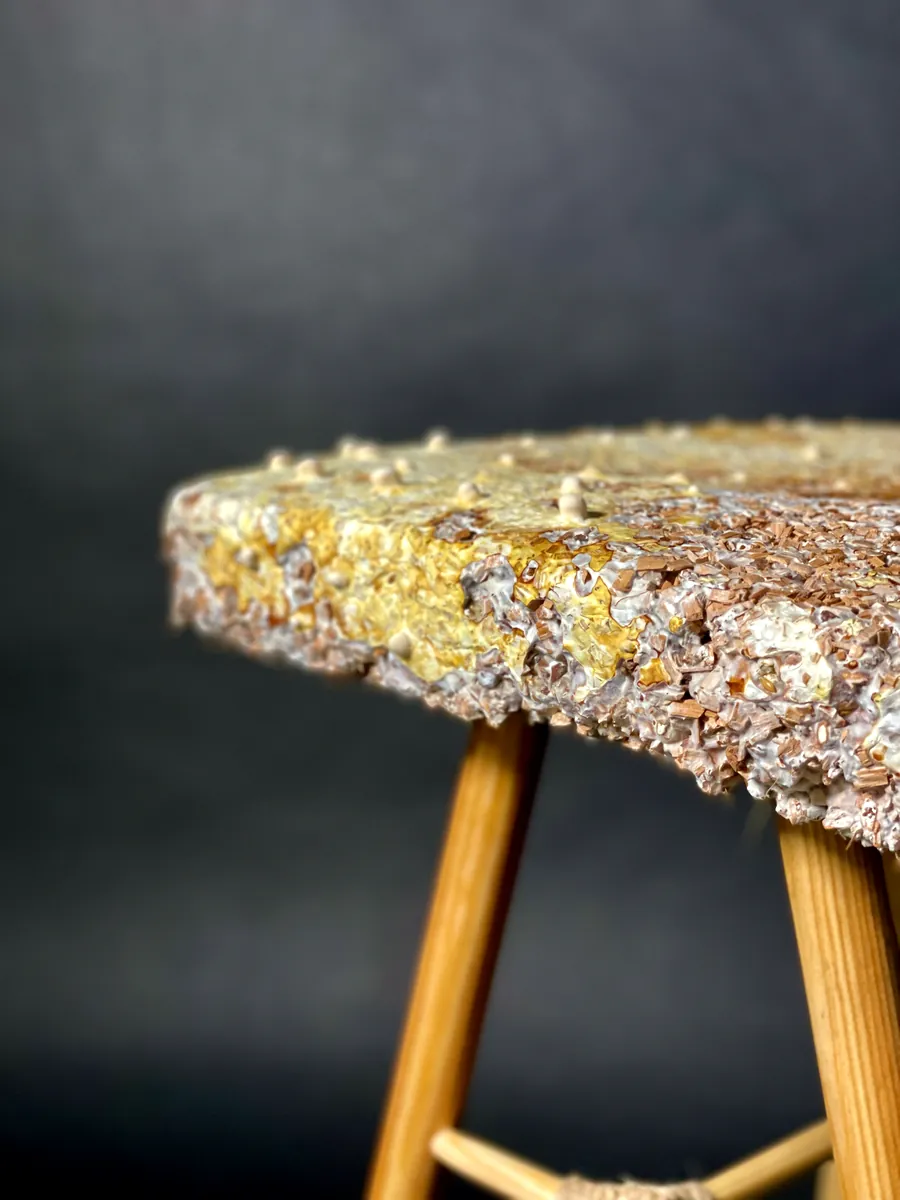
A chair with a grown mycelium seat on turned wooden legs

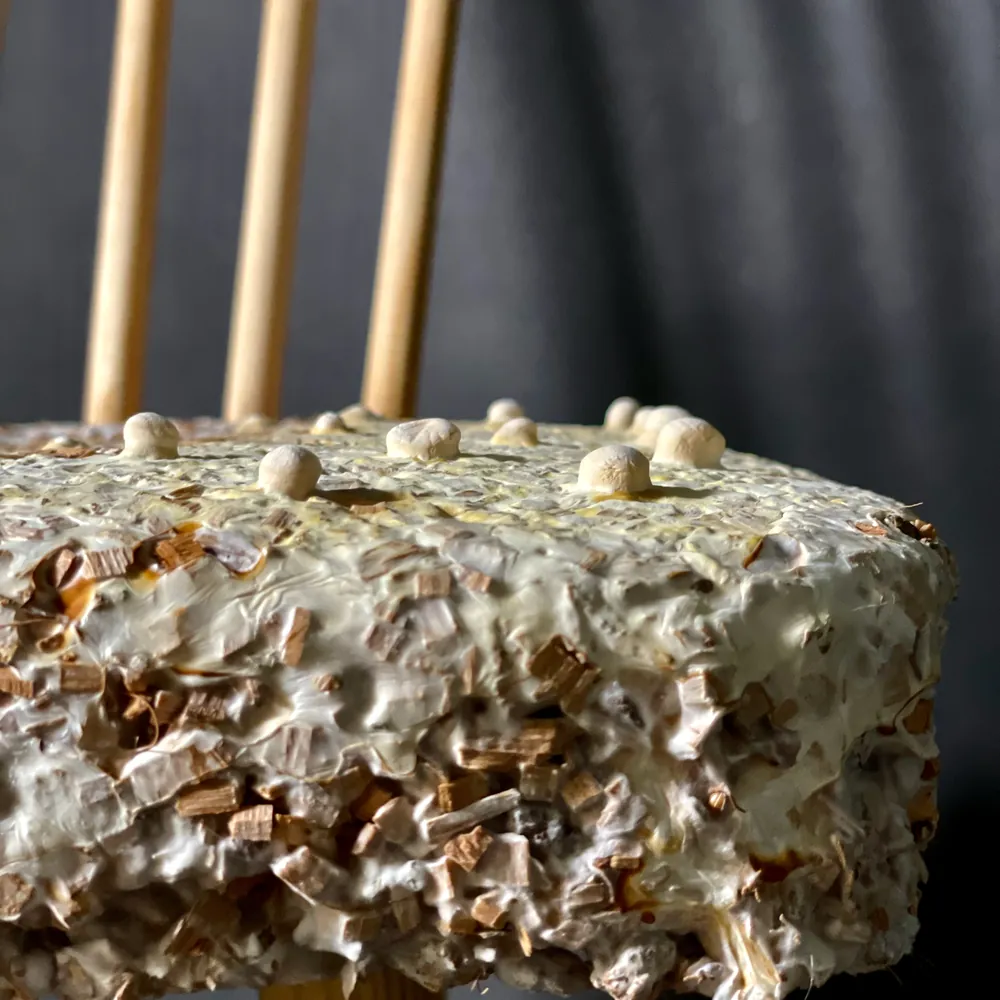
My first grown object: a seat of workshop leftovers, bound by the mycelium of the reishi mushroom and set on turned wooden legs. I packed the substrate by hand into a mould shaped around the joints of the legs, and the fungus did the rest.

It won an award at the school's first furniture fair for bio-fabrication and circular design.

The making, April to May 2022.
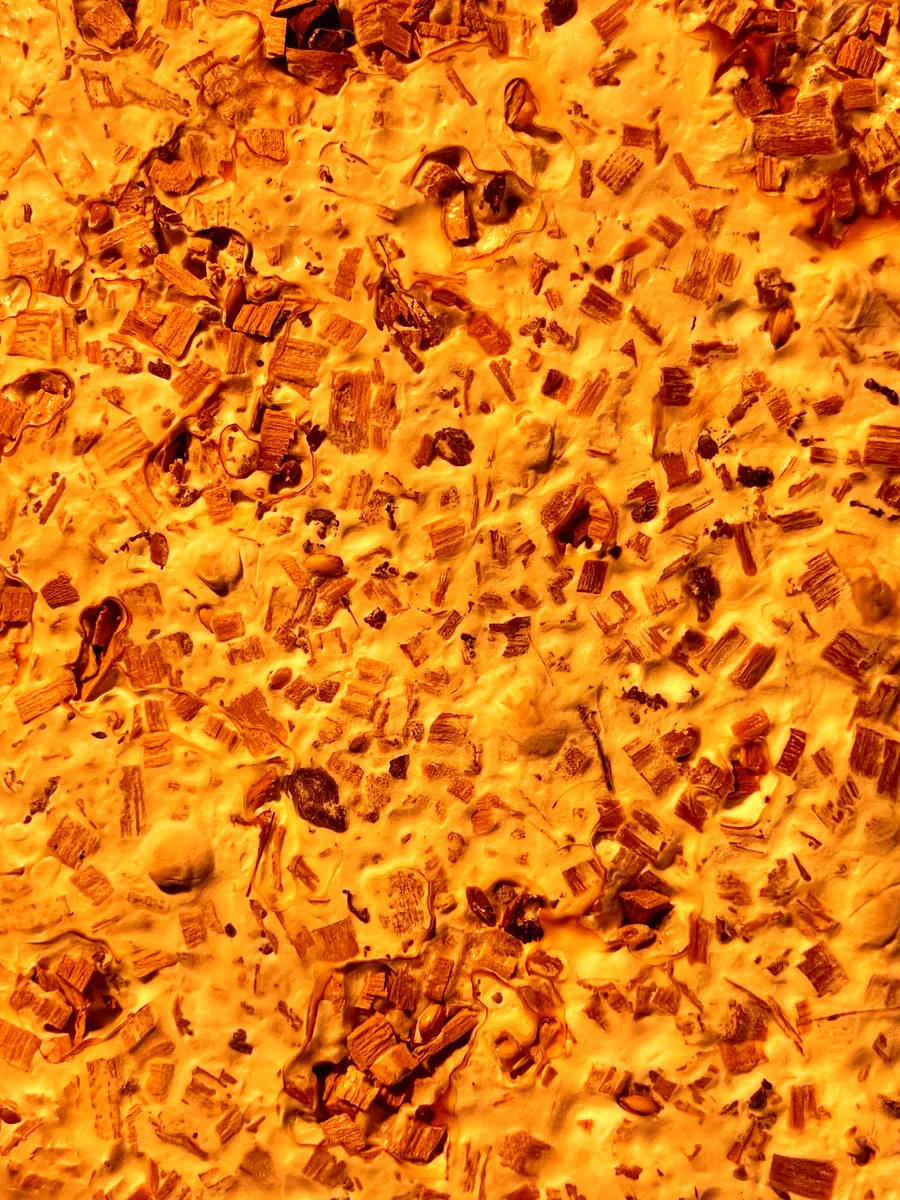
The seat's surface lit orange from behind, the substrate full of holes
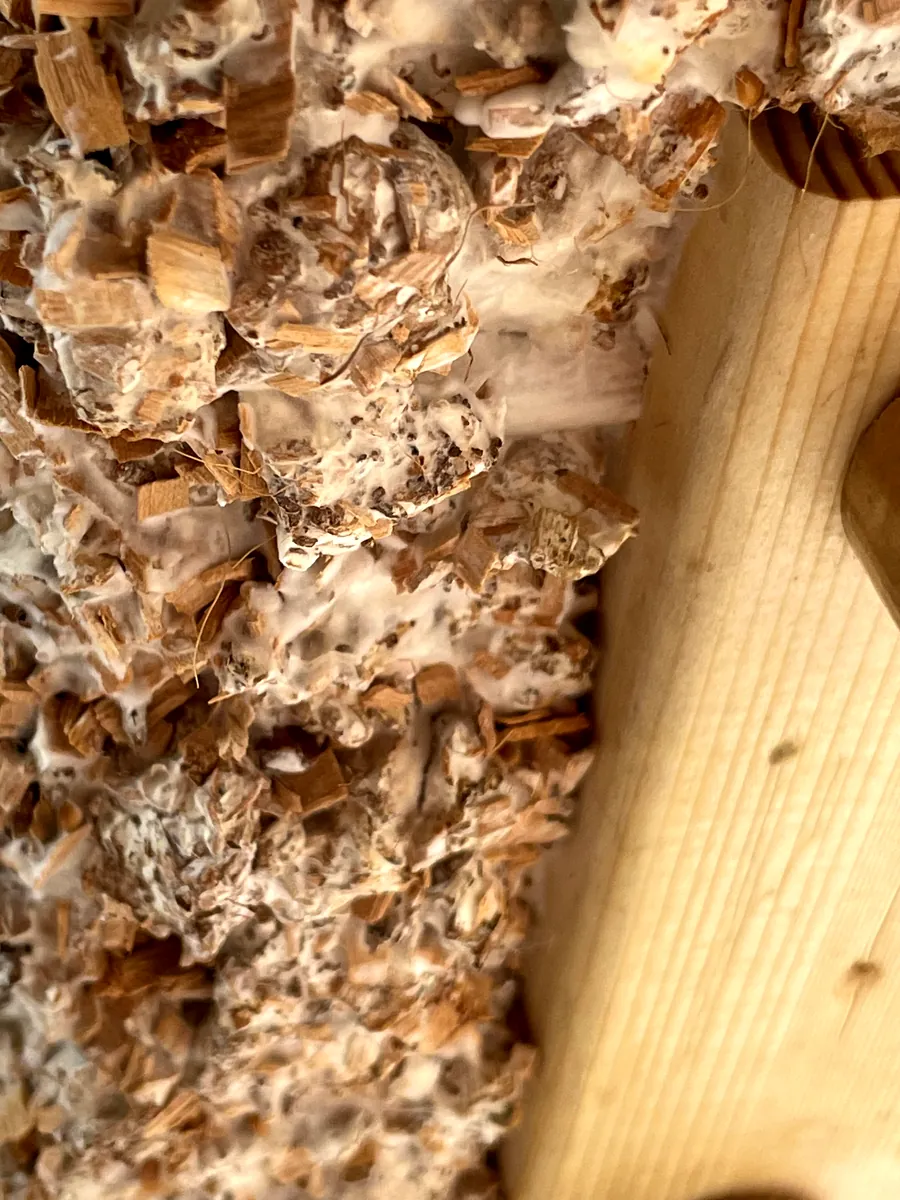
Close-up of a wooden leg entering the grown seat, wood chips bound by white mycelium around it
The edge of the seat on its turned leg, close
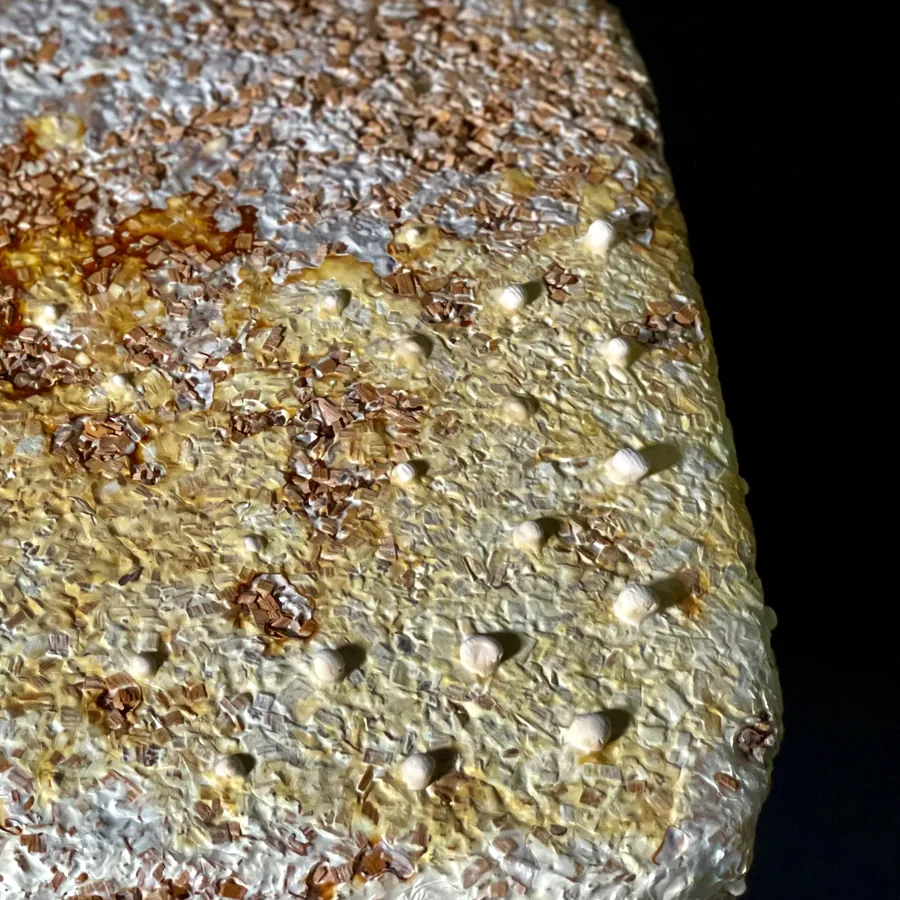
The seat surface close up: wood chips bound by mycelium, dotted with small holes

The surface in warm light, and the finished chair photographed against black, May 2022.

2022, Umeå

MK3

2022

Umeå

Form

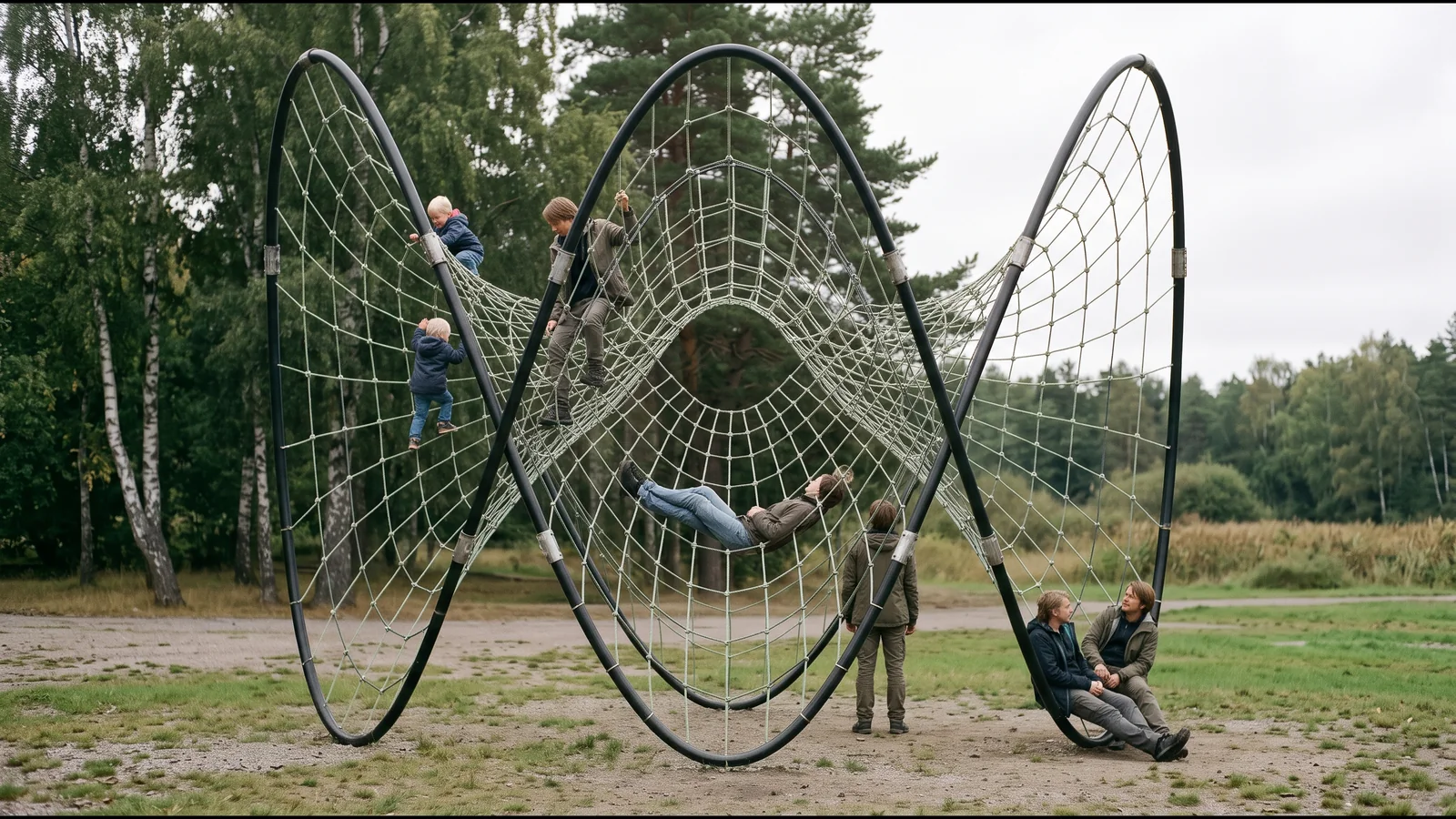
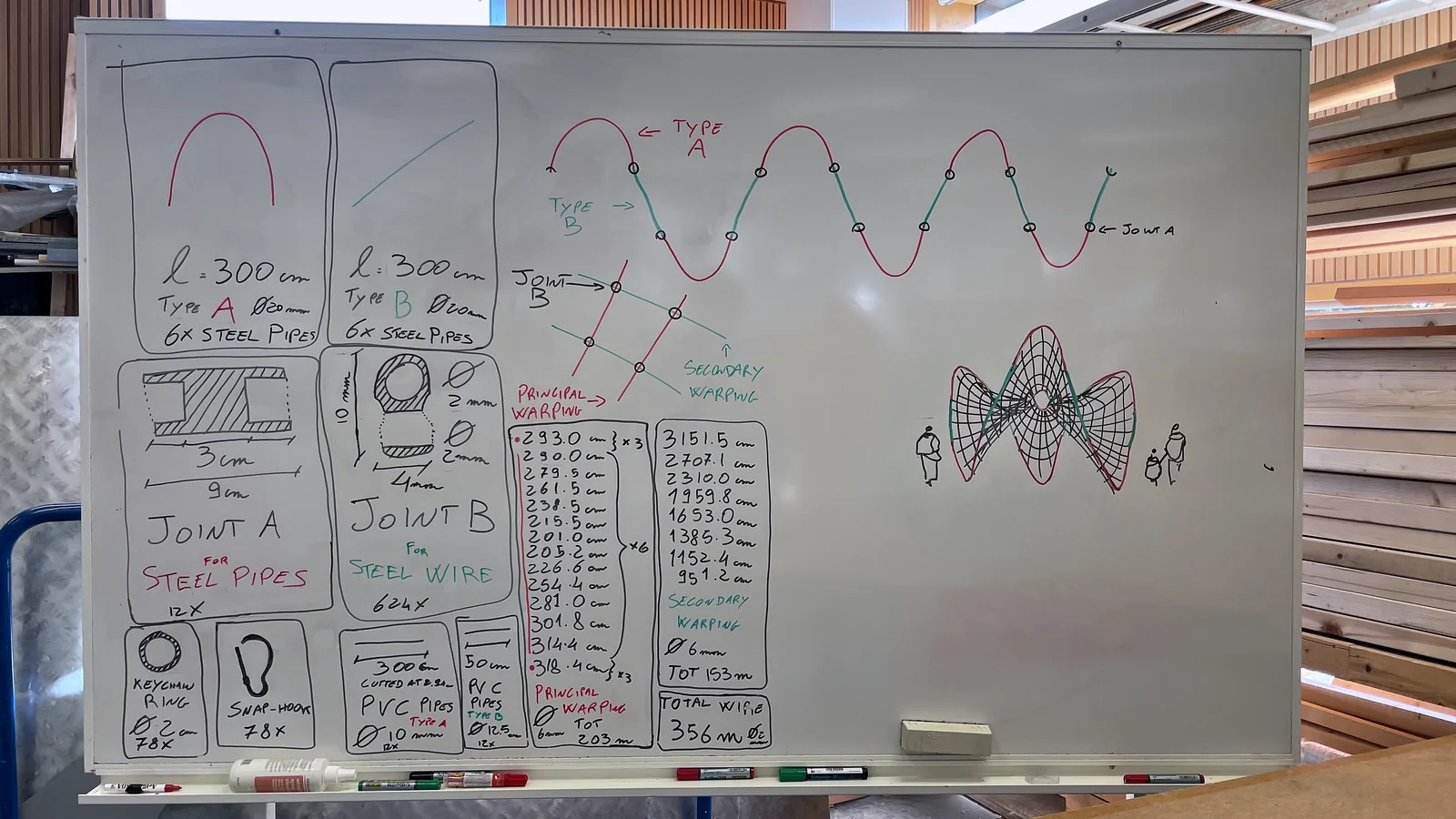
The third version of the thesis shell, in steel and rope, in the workshop of Umeå School of Architecture, June to September 2022.

Rendering made with Gemini: MK3 at full scale in a meadow, a wave of thick black steel tube with a rope climbing net, children and adults climbing it, one resting in the net, two sitting on the tubeThe workshop whiteboard seen from the front: the two pipe types, the joints, the lengths of rope and the shell sketched with people for scale
MK3 at full scale, a rendering made with AI, and the whiteboard of its parts.

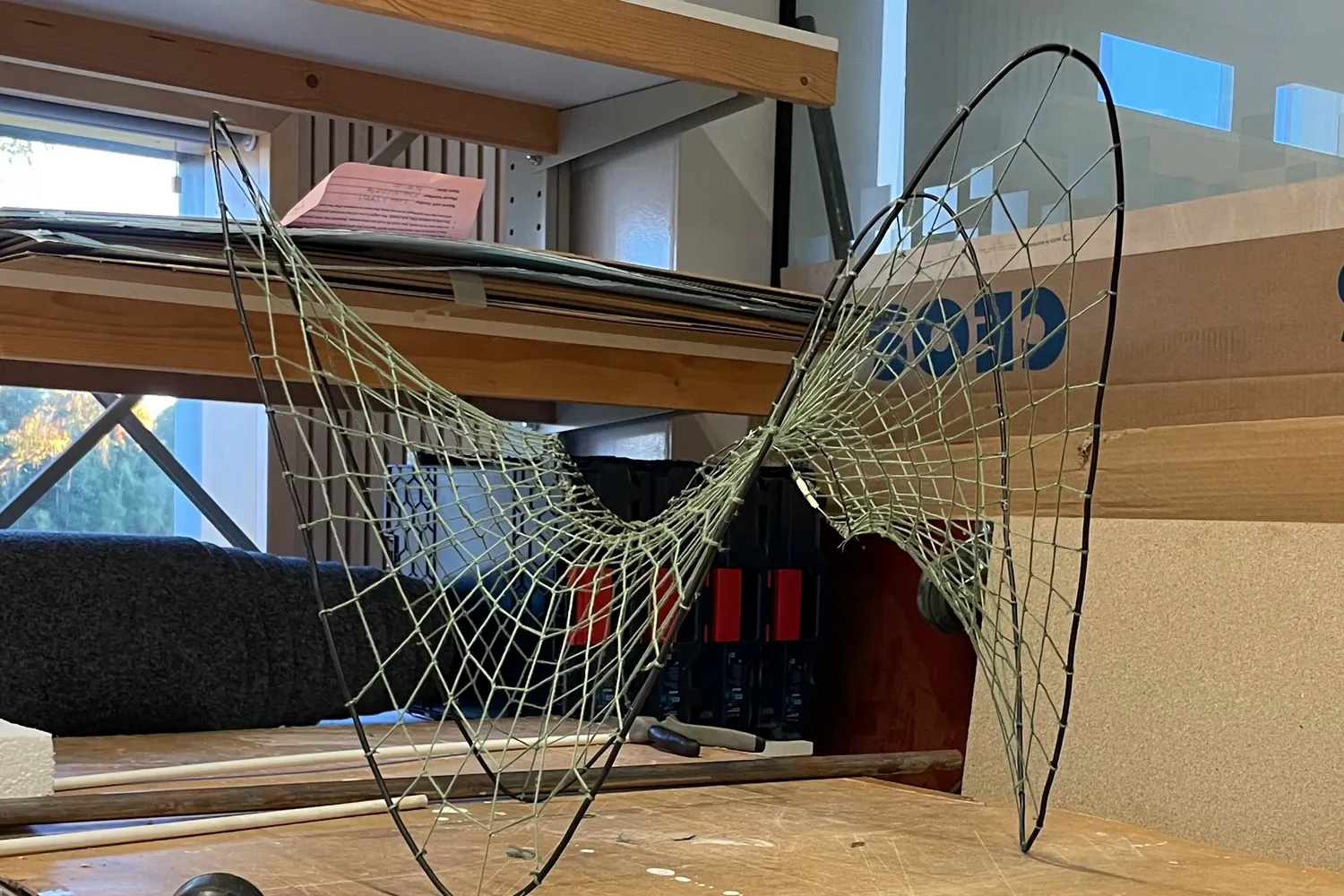
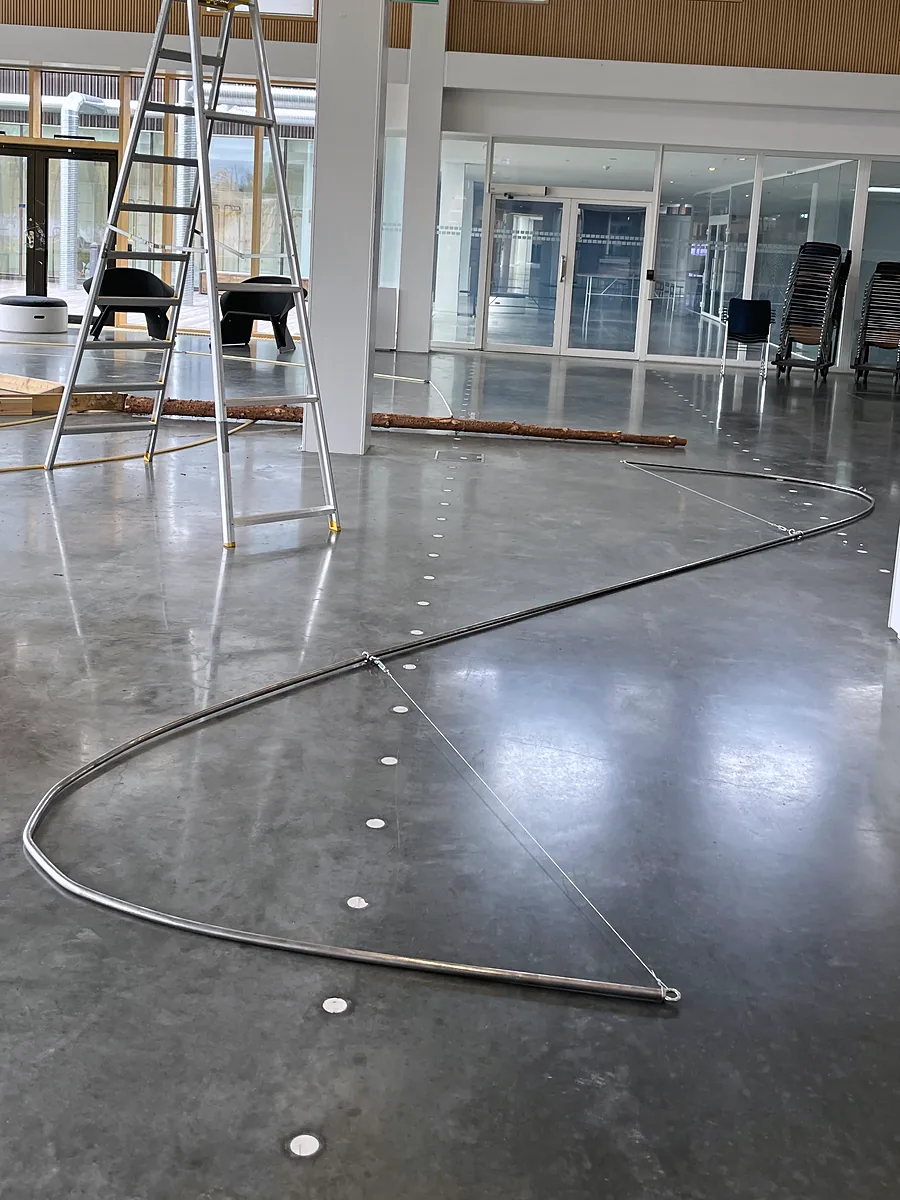
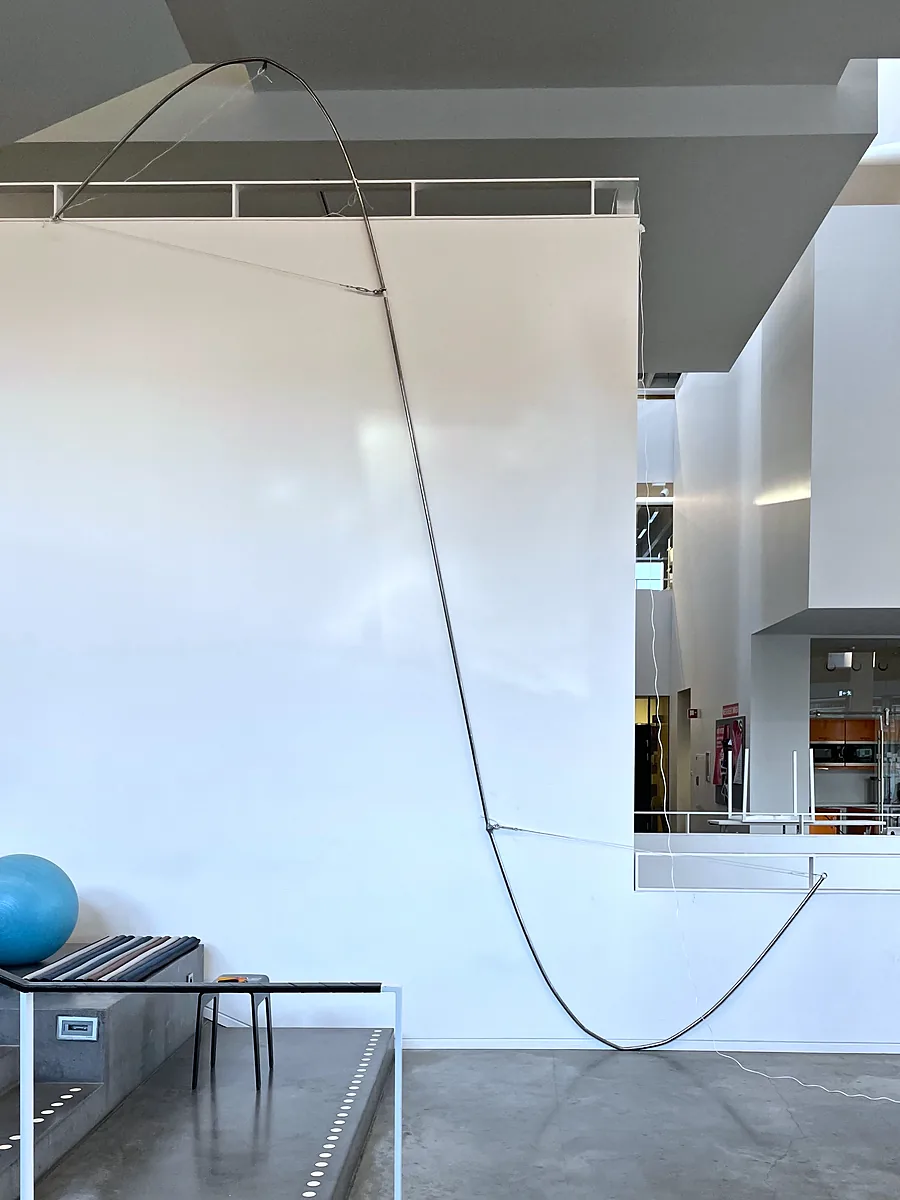
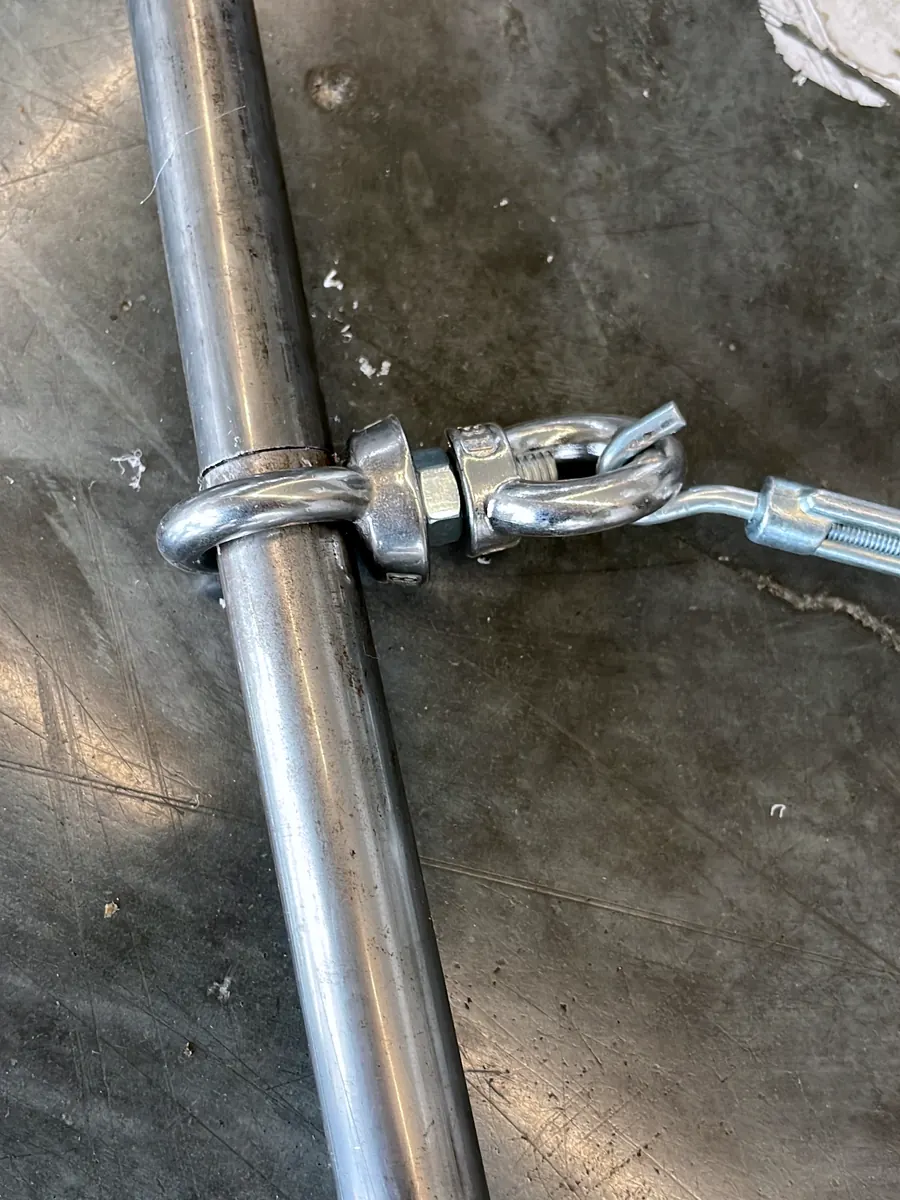
The thesis shell, rebuilt in steel and rope. Steel tubes were bent on a plywood jig and joined with clamps, and nets of rope were stretched between them. I set out the saddle surfaces in Kangaroo, a physics solver for Grasshopper, and bent the tubes to match the simulation.

MK3 is the step between the thesis and AURORA: the same shapes, now carried by parts that can be made and assembled in a workshop.

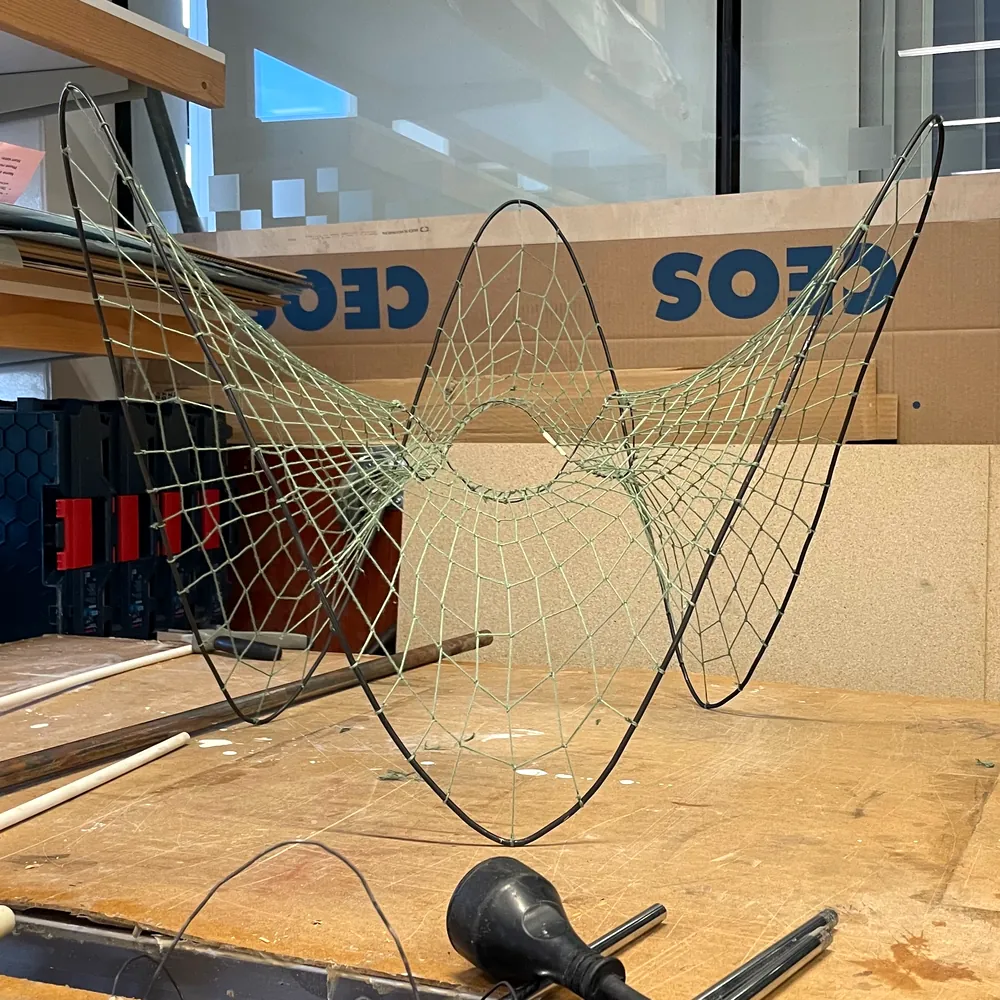
MK3 on the workbench: bent steel hoops with a rope net drawn between them
A rope net stretched between bent steel rods on a workbench
A long steel tube bent into a large S, laid on the concrete floor of the school hall

A test net on bent rods, the bending jig at work in July 2022, and the bent parts: the large S on the hall floor, a tube hung against the wall, a clamp joint.

2022, Teg, Umeå

Pallet Parliament

2022

Teg, Umeå

People

With Alejandro Haiek Coll and Rebecca Rudolph, for Umeå Municipality and Umeå School of Architecture. Teg, Umeå, September 2022.

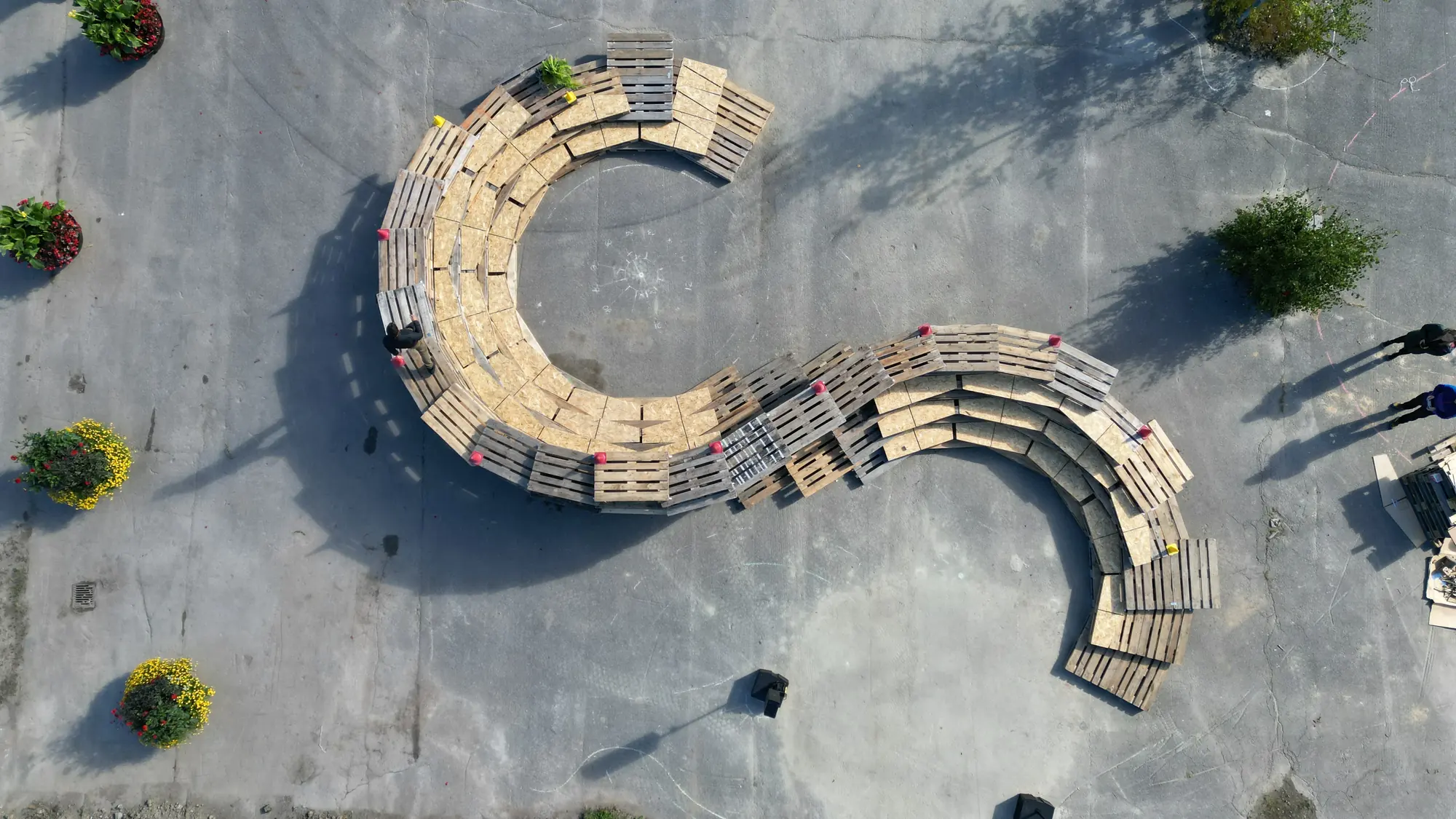
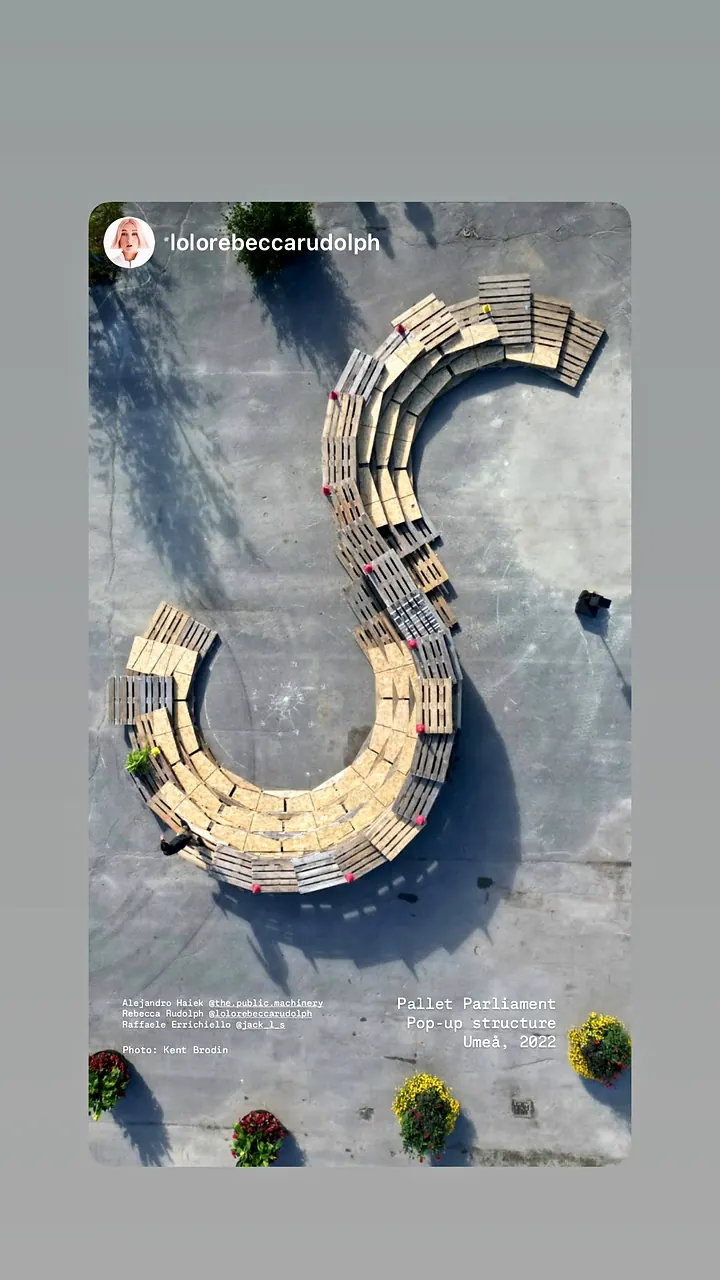
Aerial view of curving rows of stacked pallets forming an amphitheatre on asphalt

From above. Photograph by Kent Brodin.

Along the rows, 29 August 2022, four days before the opening.
The opening, 2 September 2022: a band on the asphalt and the neighbourhood on the pallets. Clip from @the.public.machinery.

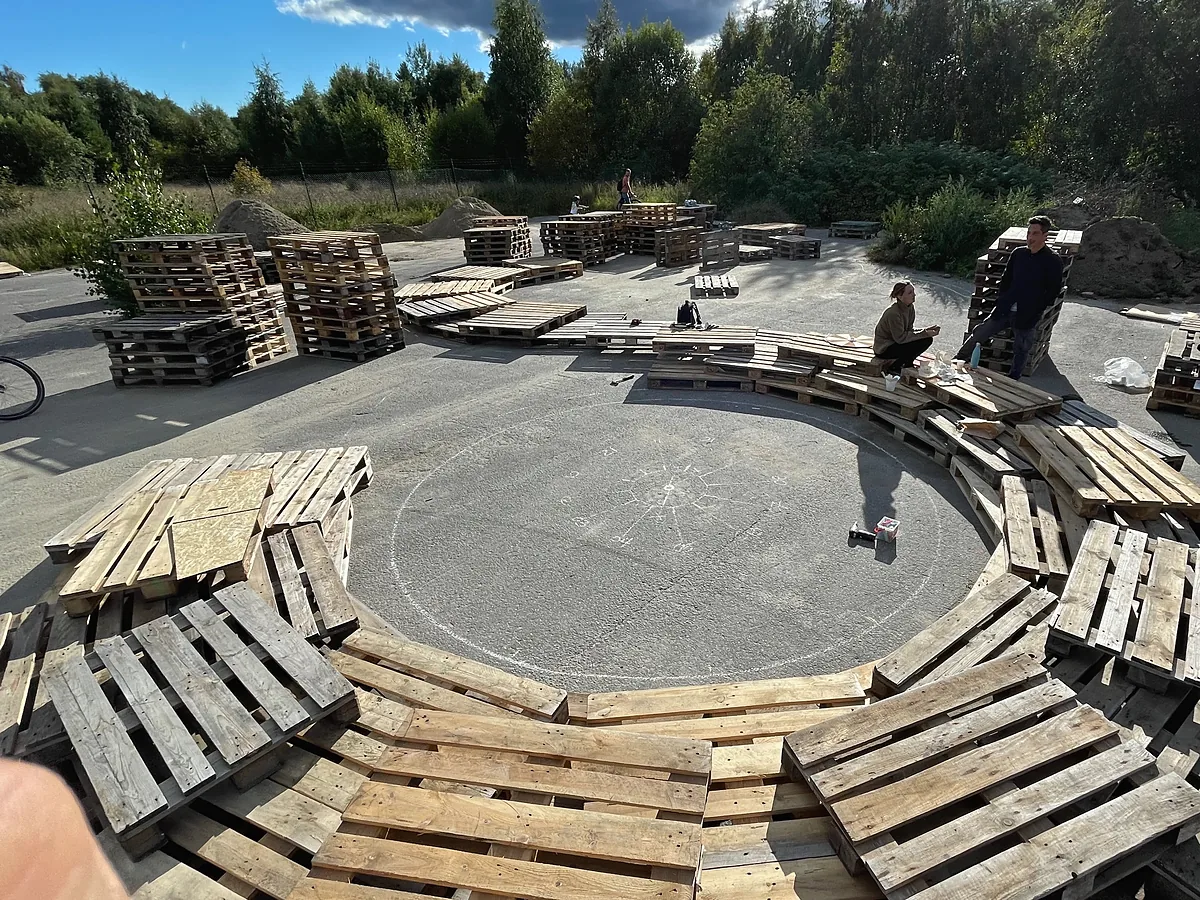
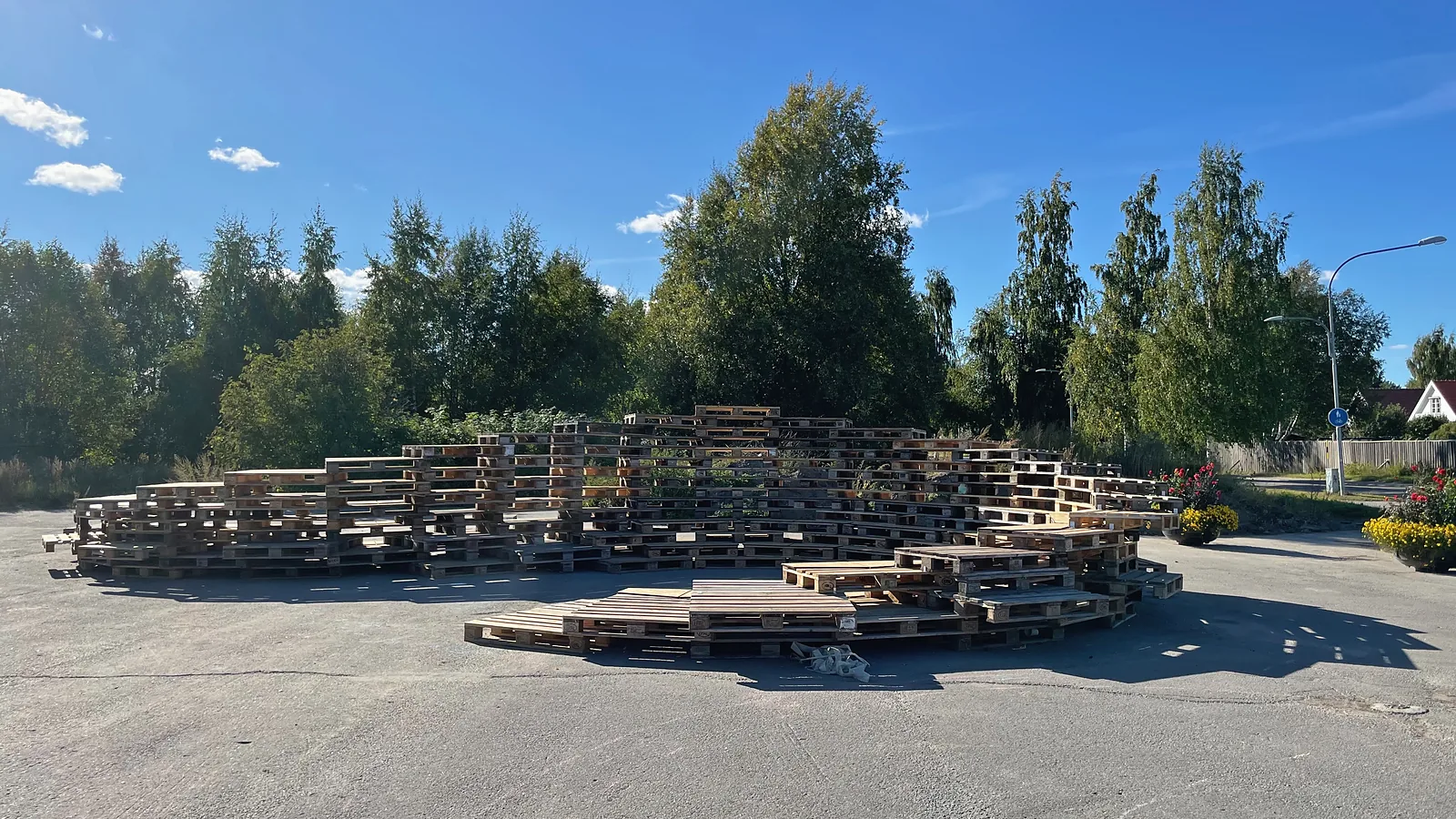
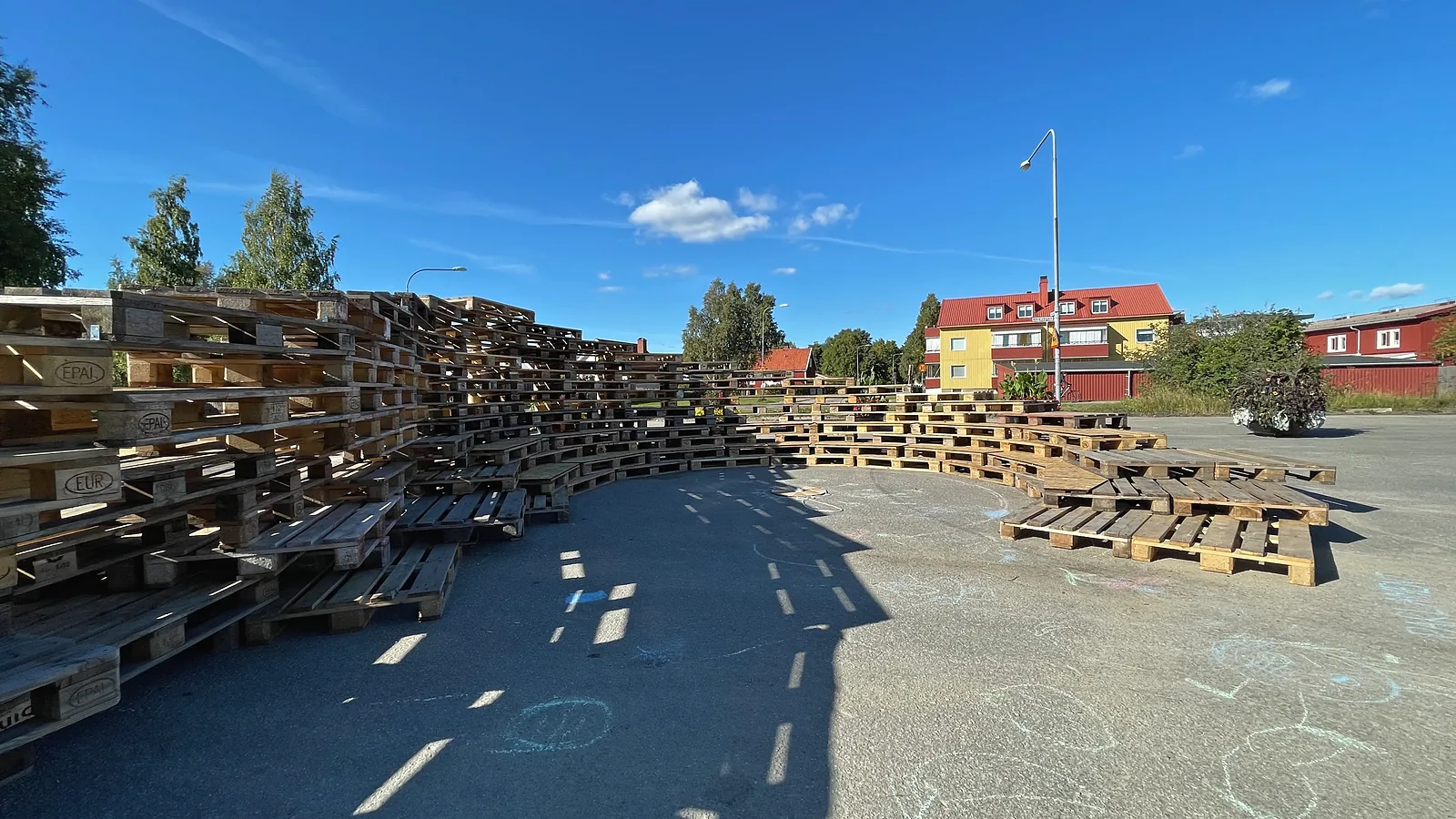
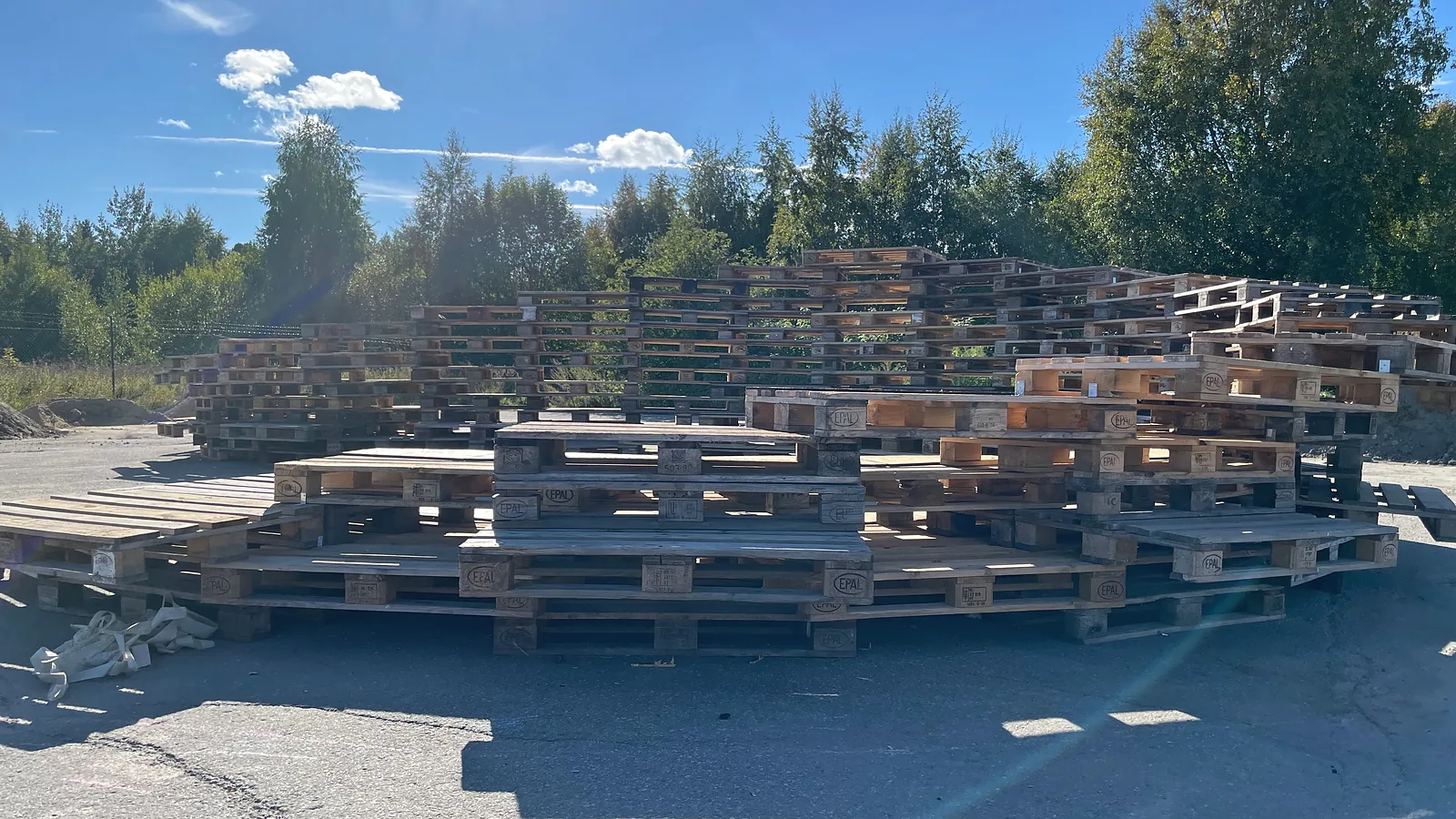
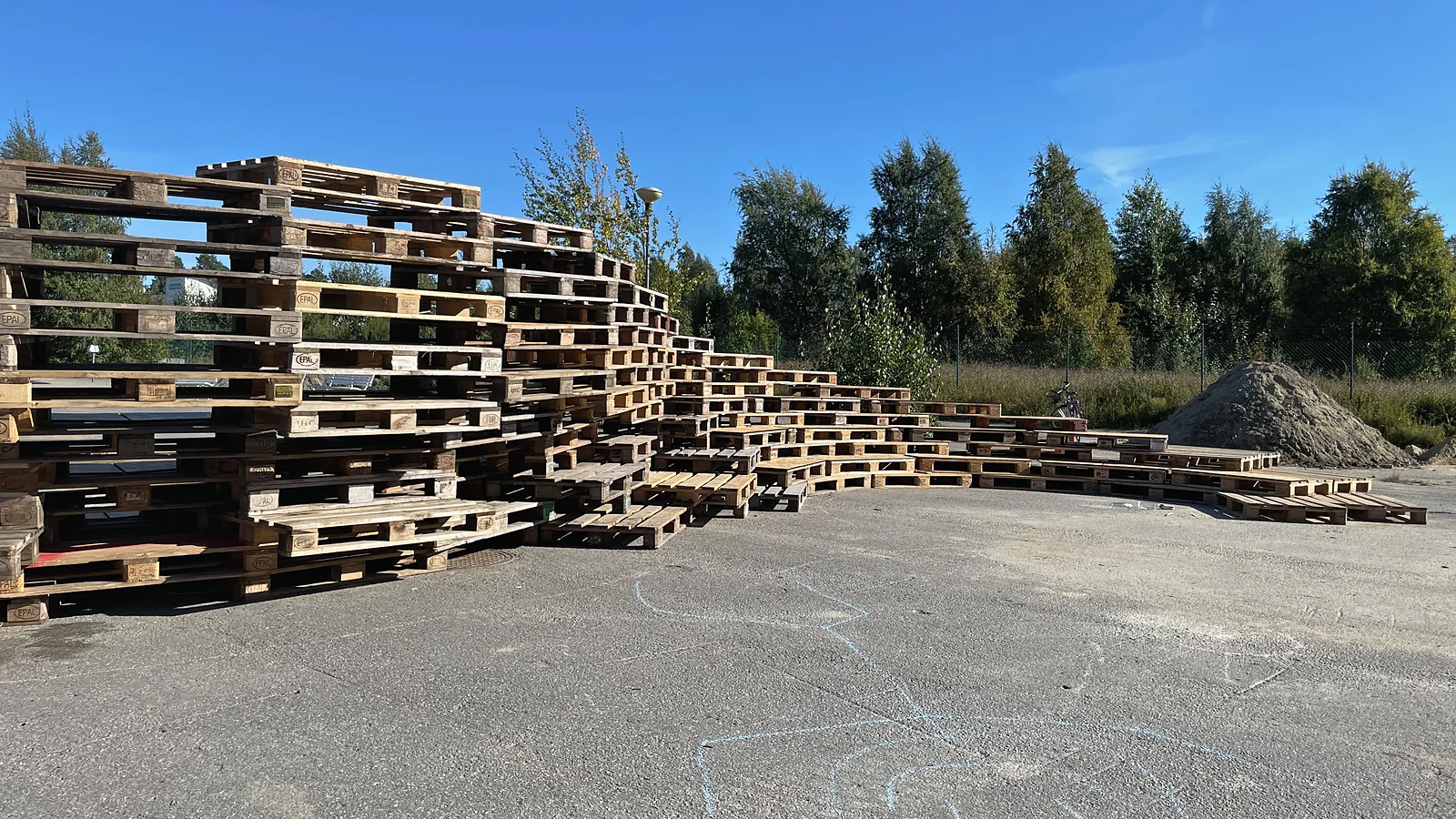
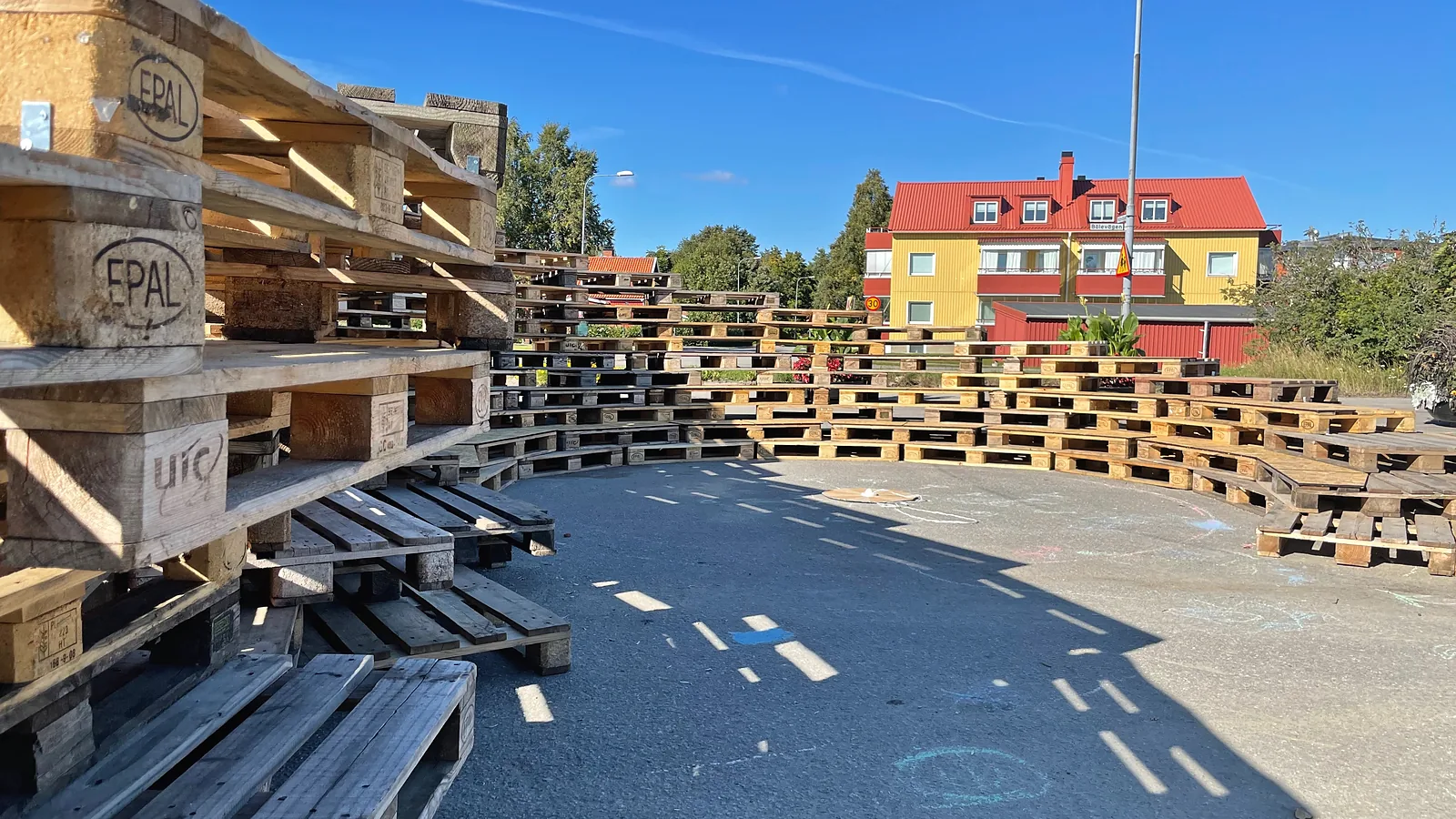
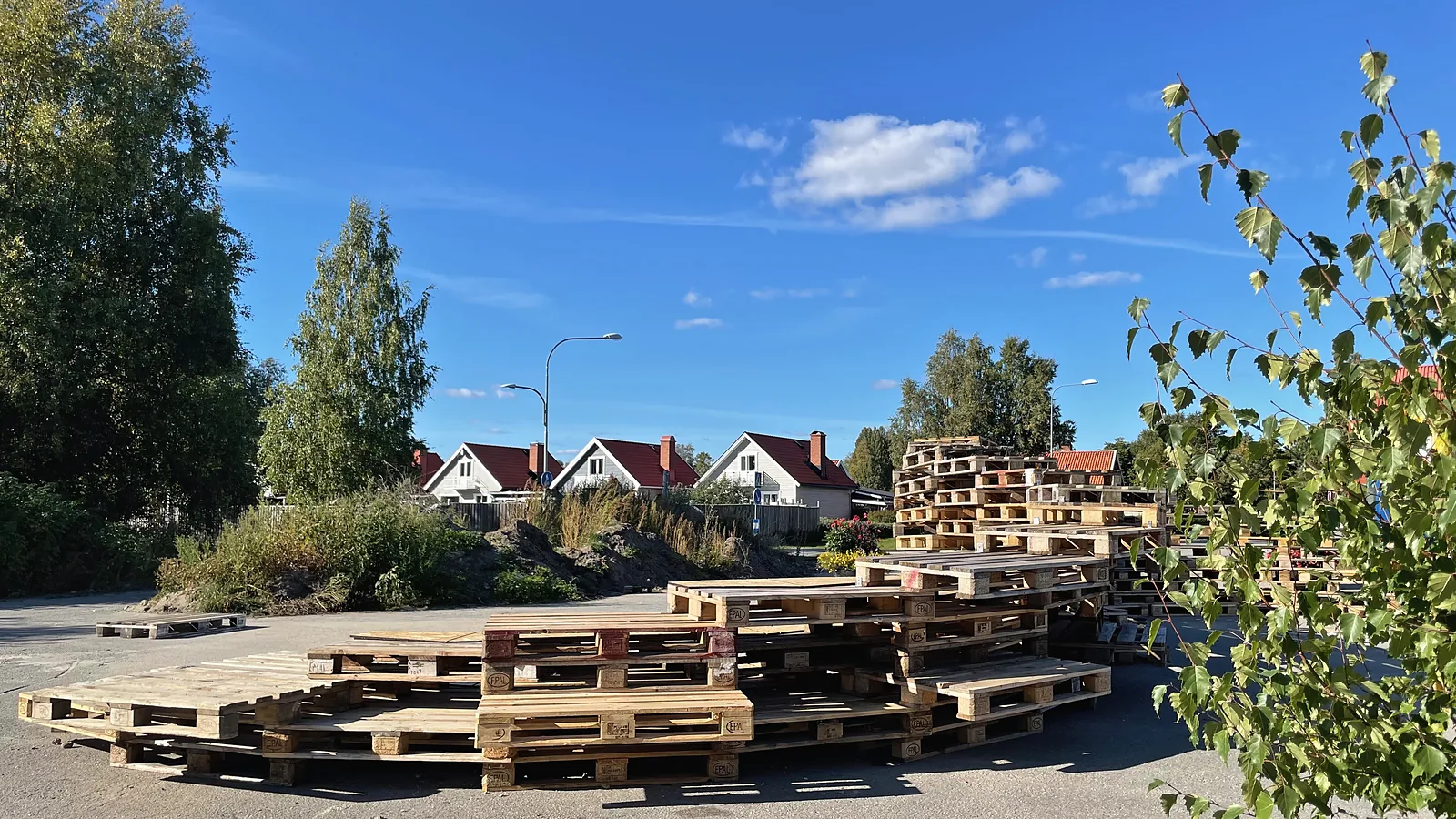
Used euro pallets, stacked into a curving amphitheatre on an empty parking lot in Teg. The parliament was a stage, a playground and an open classroom for the neighbourhood, built for the Böledagen day of the GoGreenRoutes project and used as a place to talk about the area's new street plan.

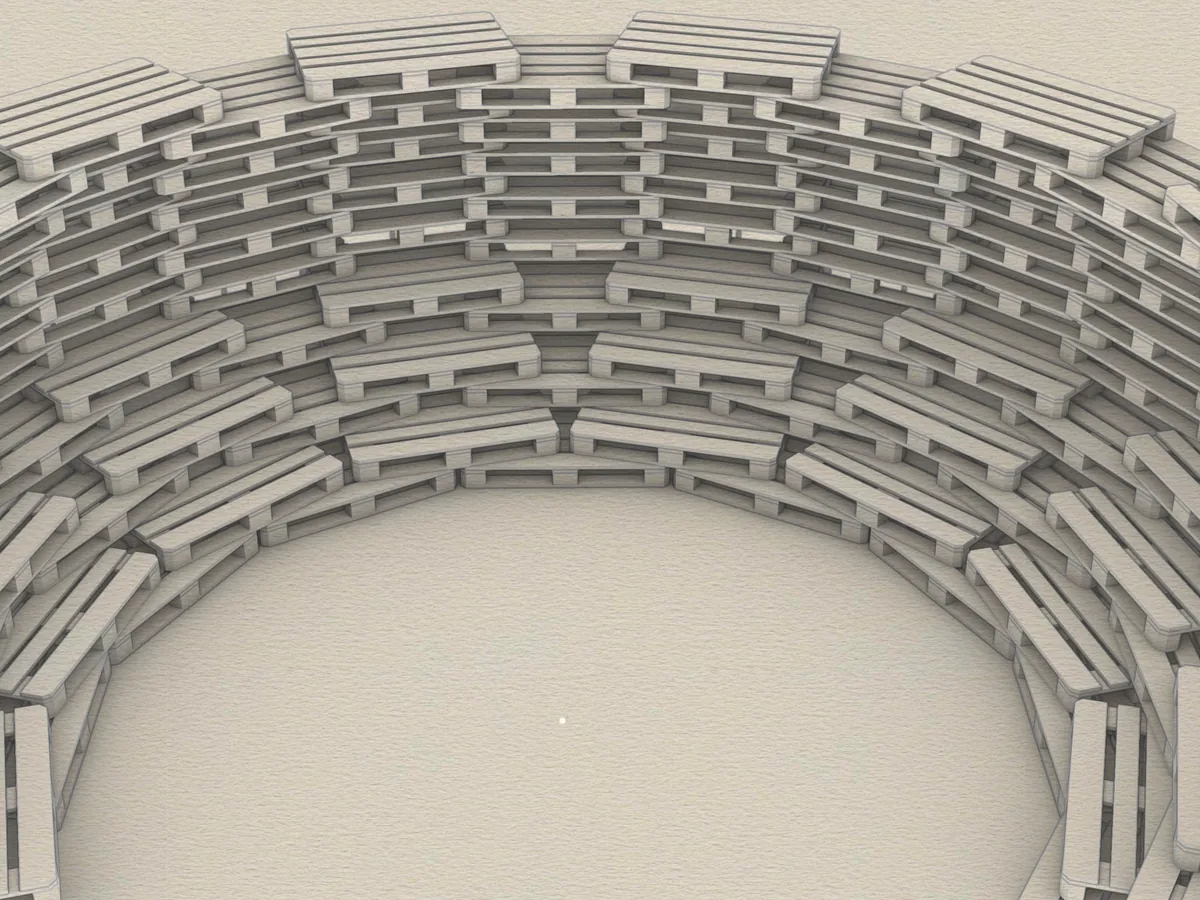
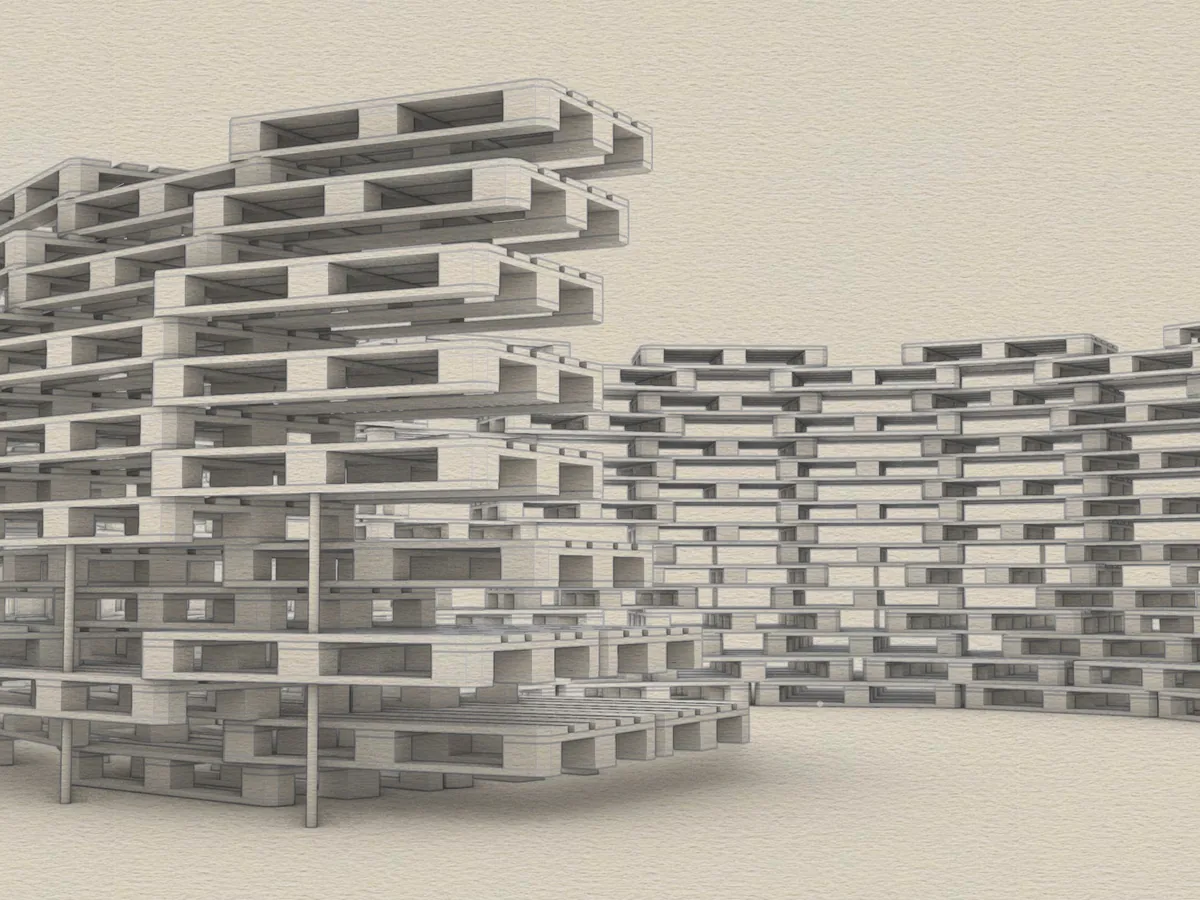
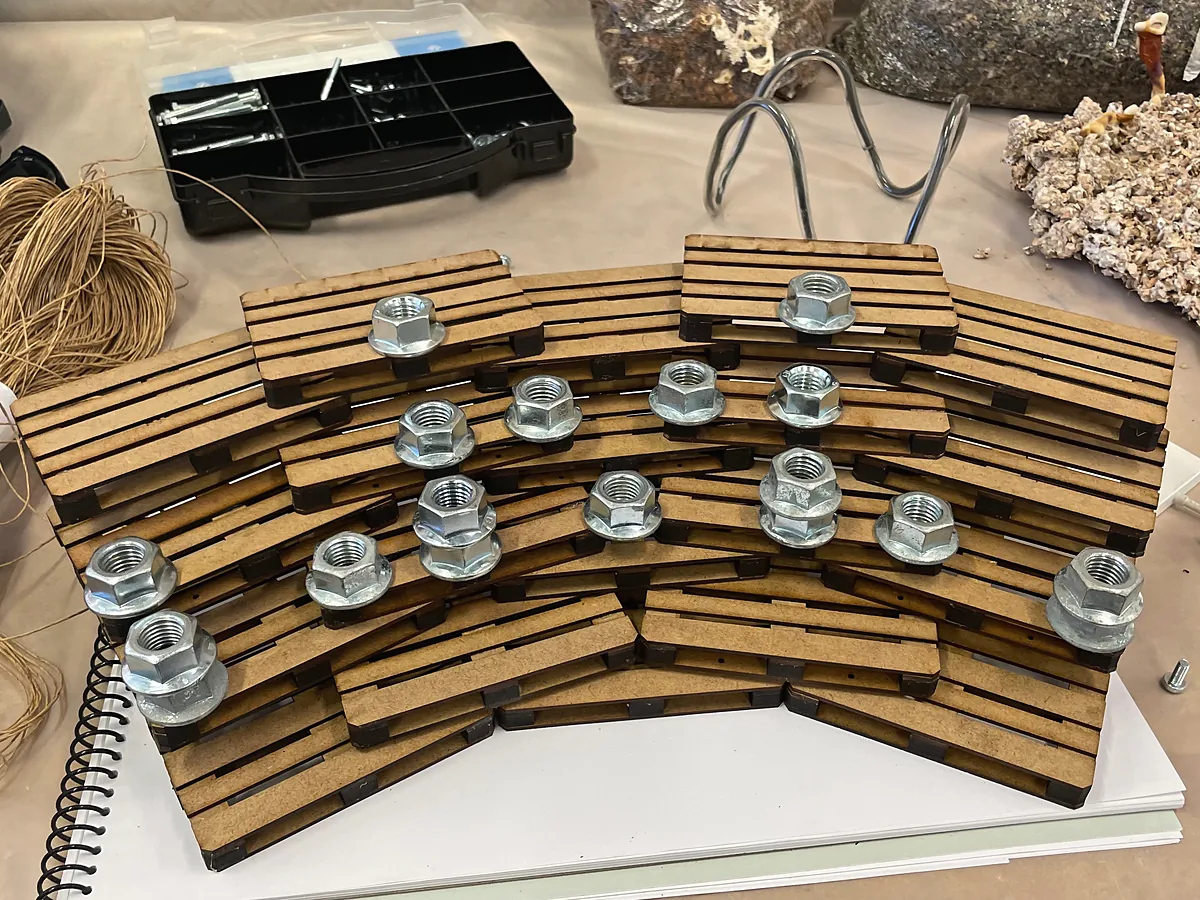
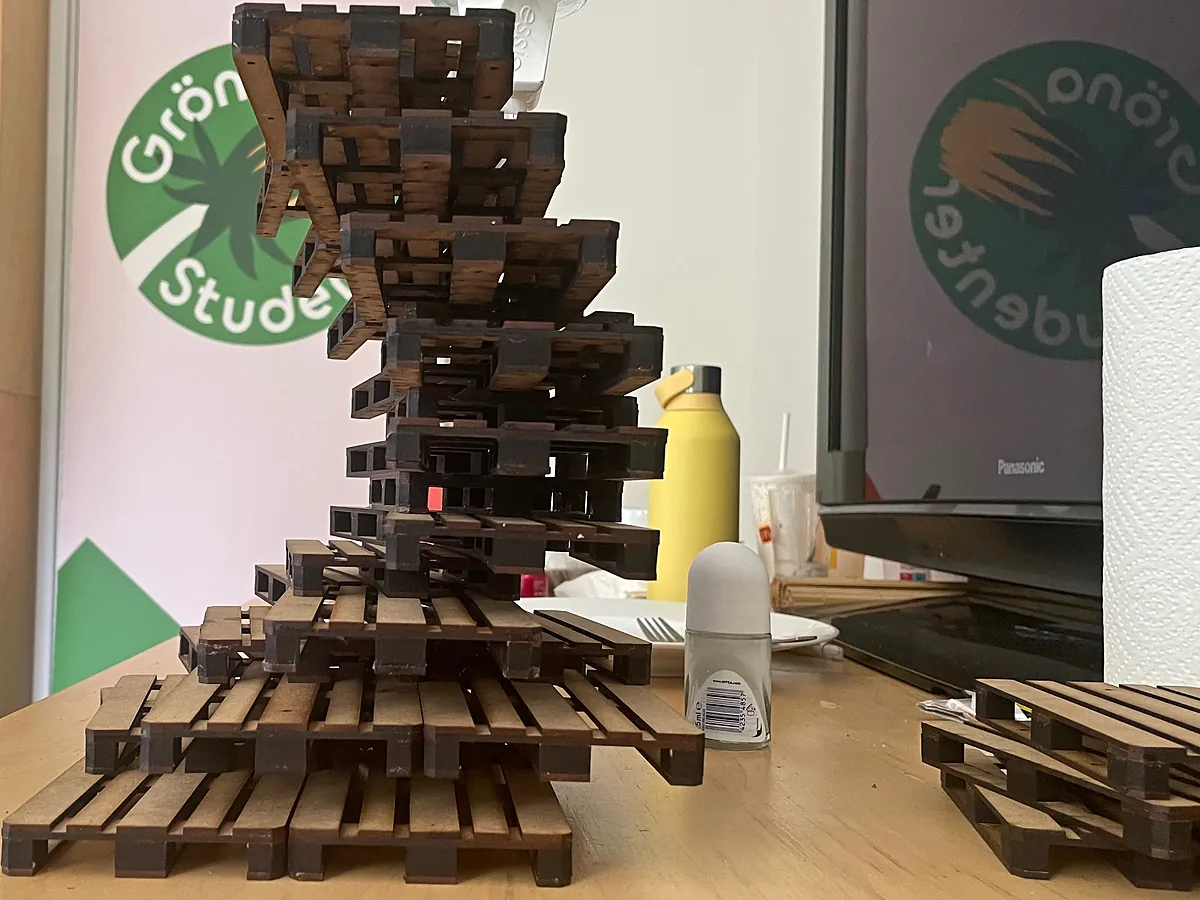
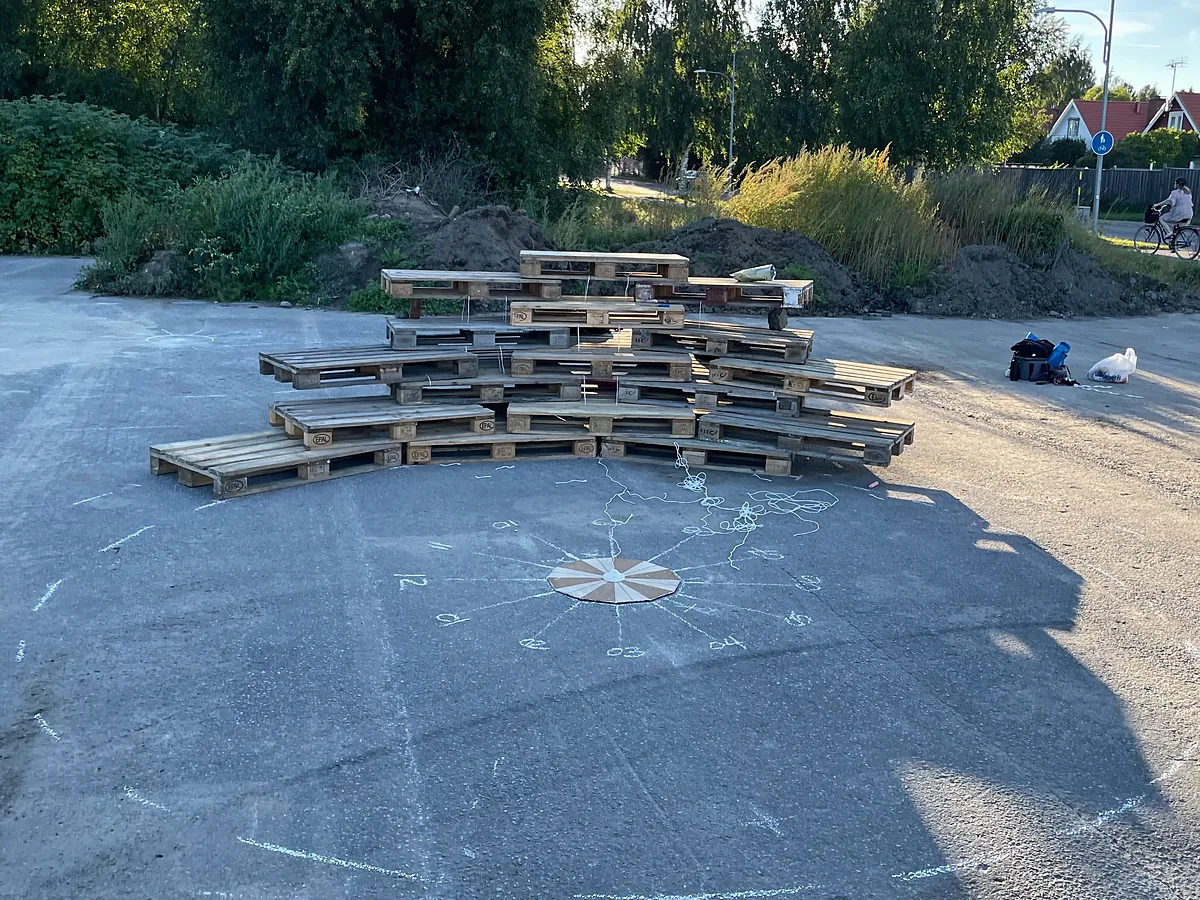
The curve was set out from one repeating module. We tested the stacking on a desk model of small pallets, drew the curve on the asphalt with chalk, and assembled it pallet by pallet.

The project at labprofab.org
The Rhino model of the amphitheatre: pallets stacked in curving tiers round an empty floor
The finished Pallet Parliament seen whole across the empty parking lot, its stacked tiers curving round under a blue sky

Left, the design and the making, August 2022: the Rhino model, the laser cutter and the laser-cut miniature pallets weighed down with nuts, a tower test on the desk, the chalk circle with the laser-cut setting-out disc at its centre, and the first ring. Right, the finished parliament from six sides on the afternoon of 5 September 2022.

2022, Umeå Arts Campus

The Winter Garden

2022

Umeå Arts Campus

People

Retake/Reuse, an UmArts Small Visionary Project. Umeå Arts Campus, 3 to 7 December 2022. With Alejandro Haiek Coll, Maria Luna Nobile, Marie Kraft, Tomas Mena, Rebecca Rudolph and Alejandra Diaz.

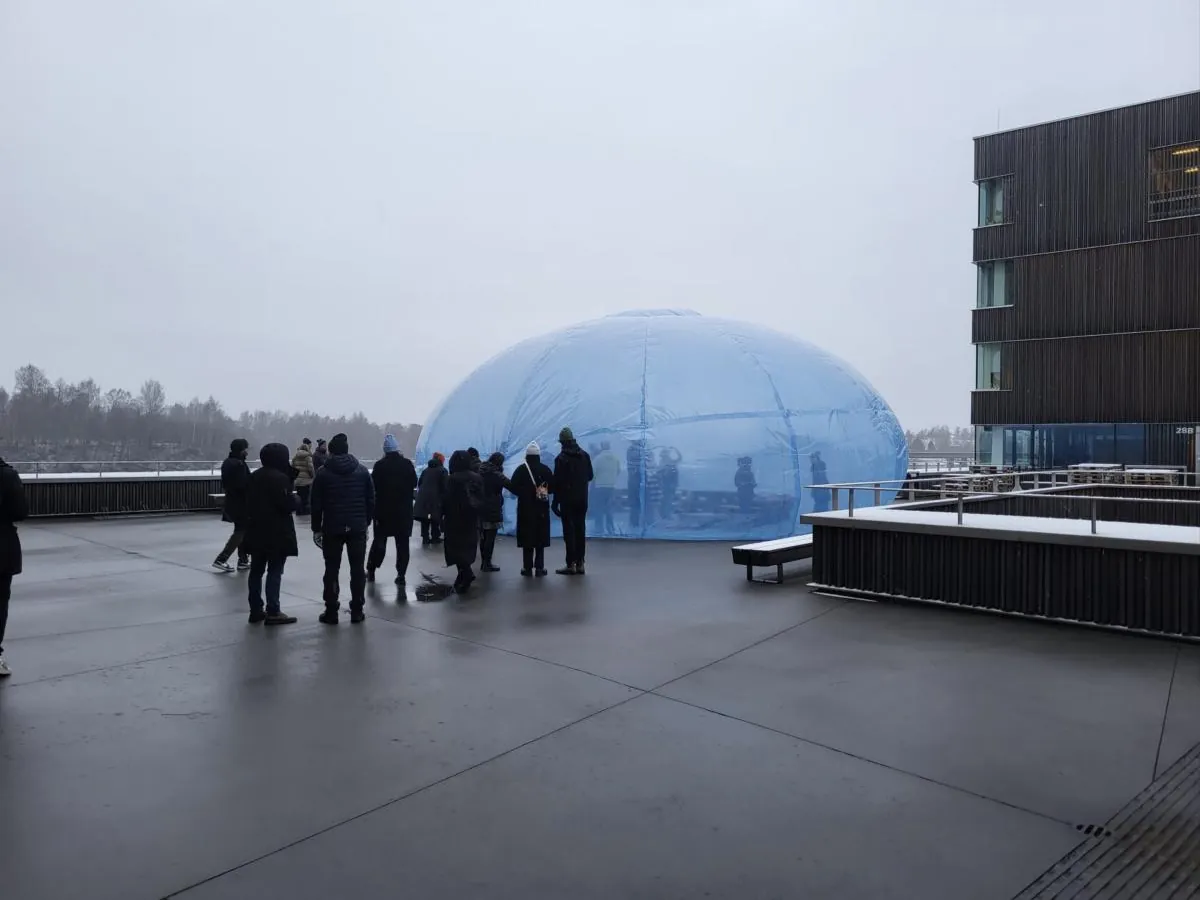
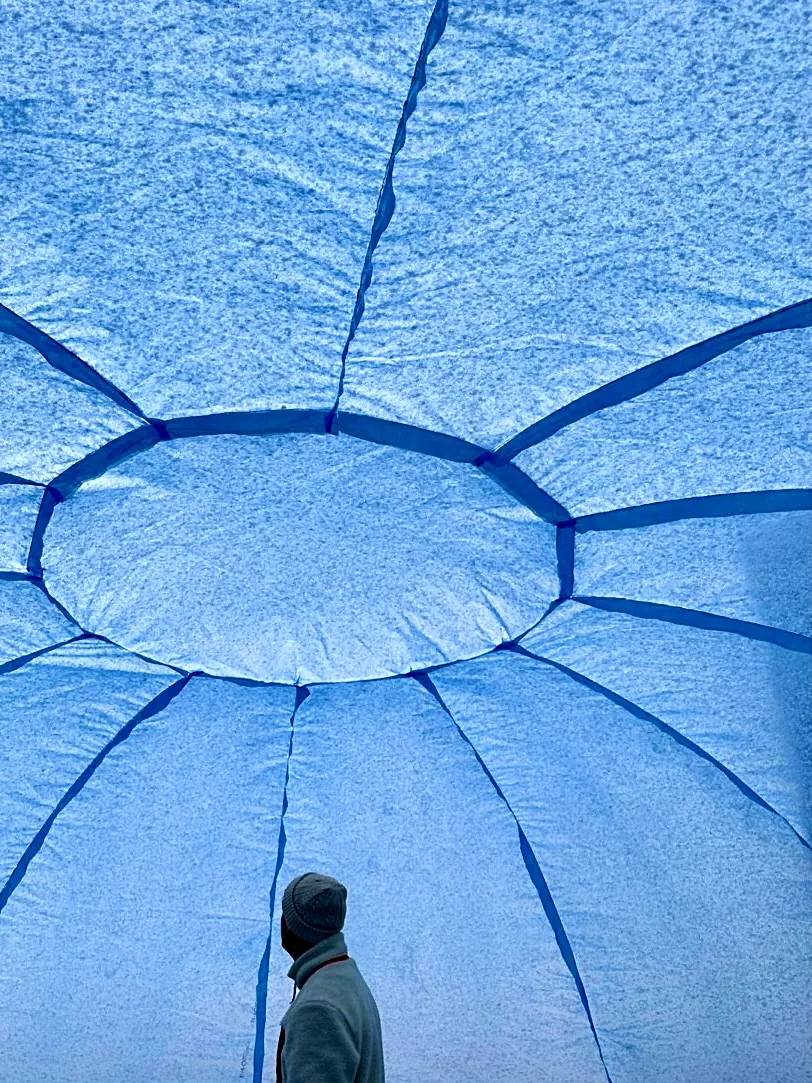
People gathered beside the blue dome on the snowy Arts Campus terrace
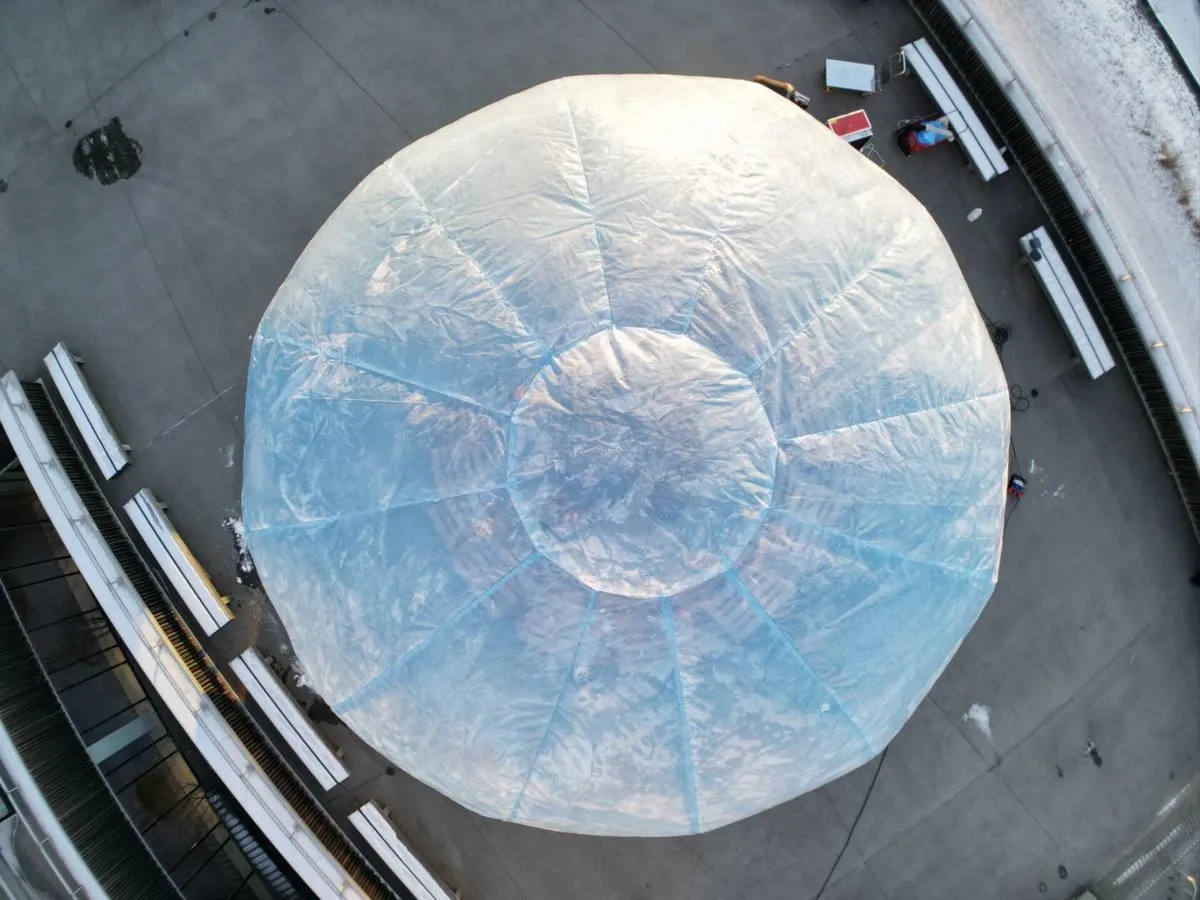
The transparent dome seen from directly above, its seams like the ribs of a shell
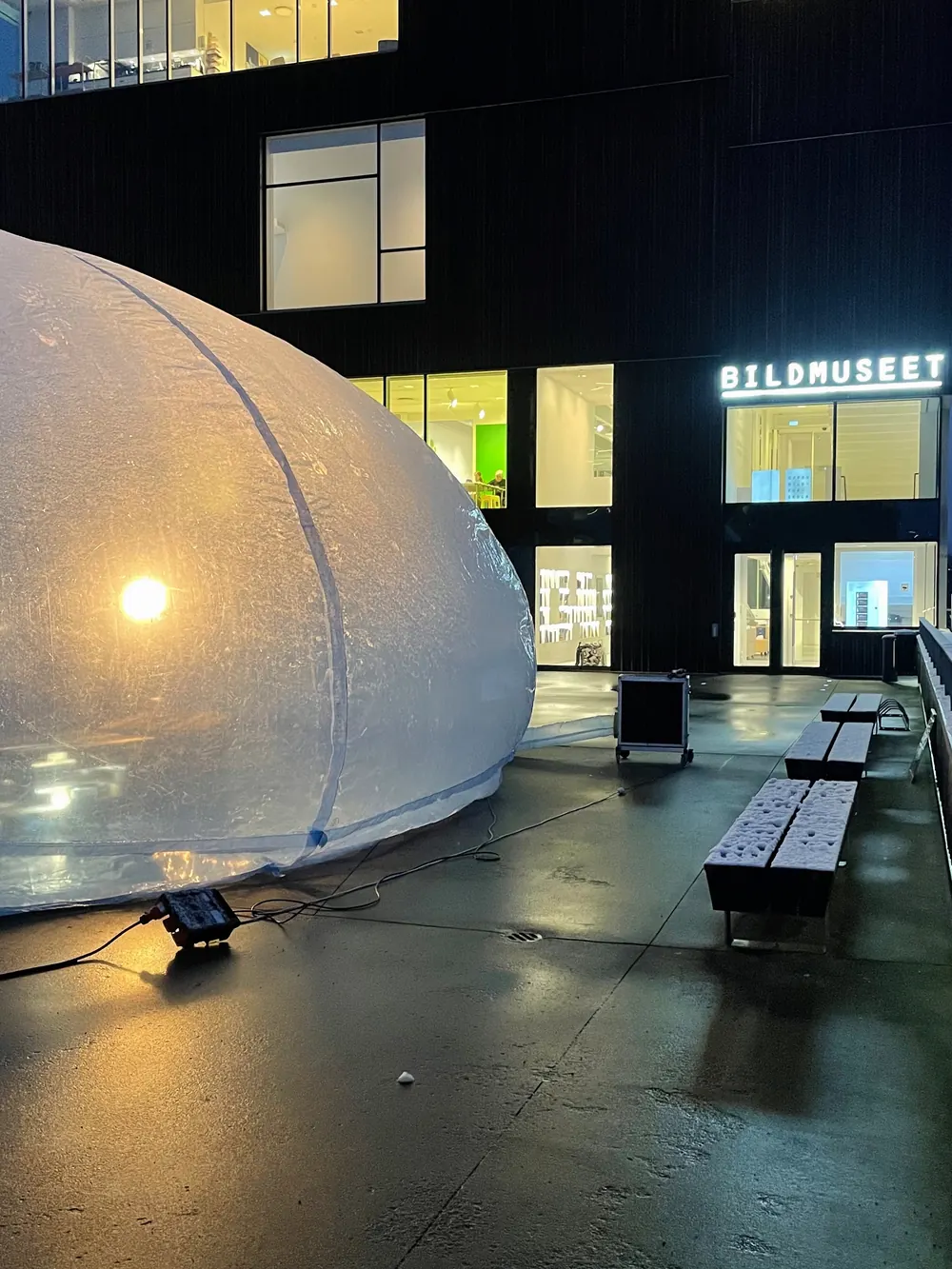
The dome lit from inside at night, next to the dark Arts Campus buildings
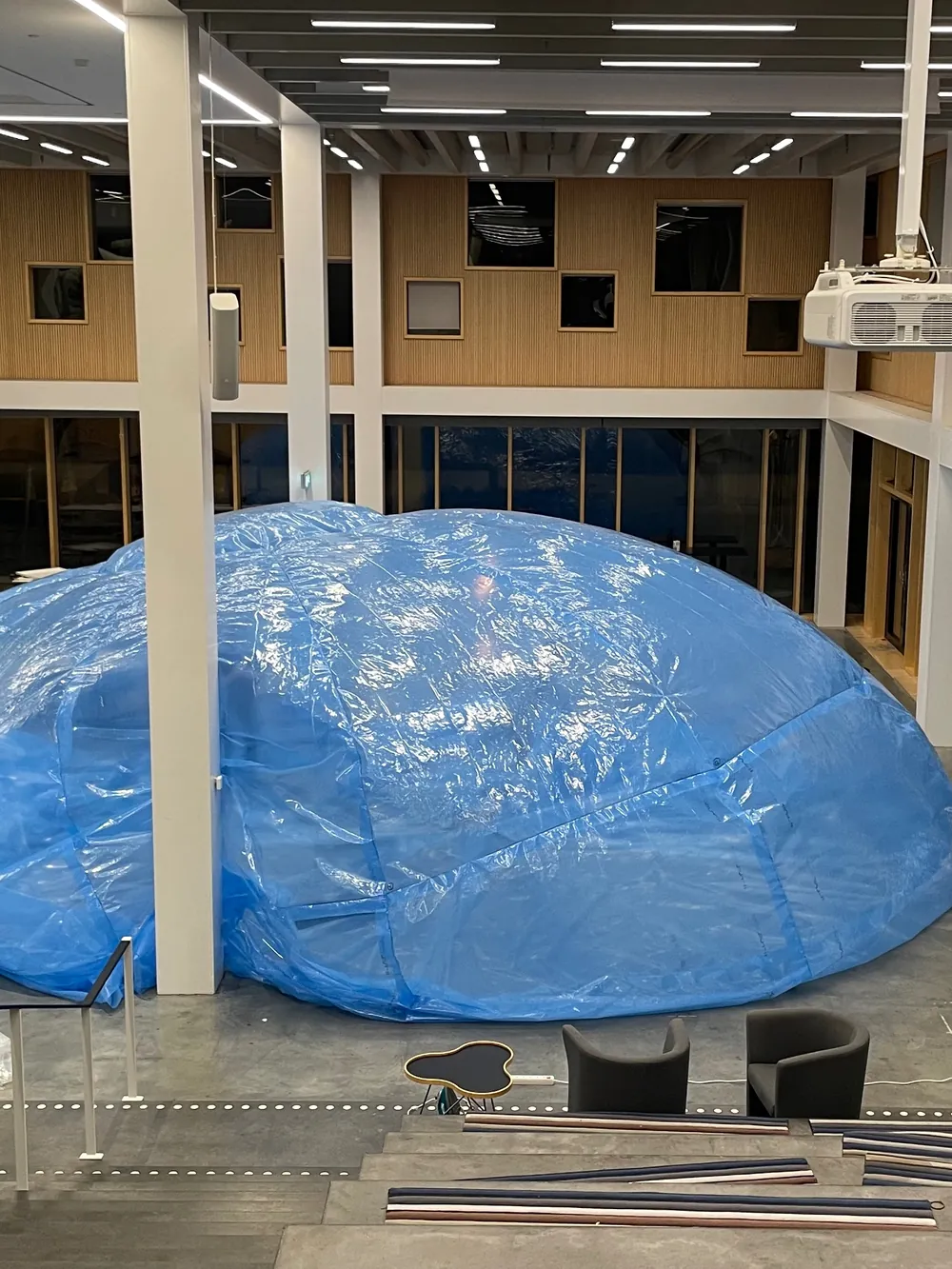
The blue membrane inflated indoors, filling the atrium of the Arts Campus

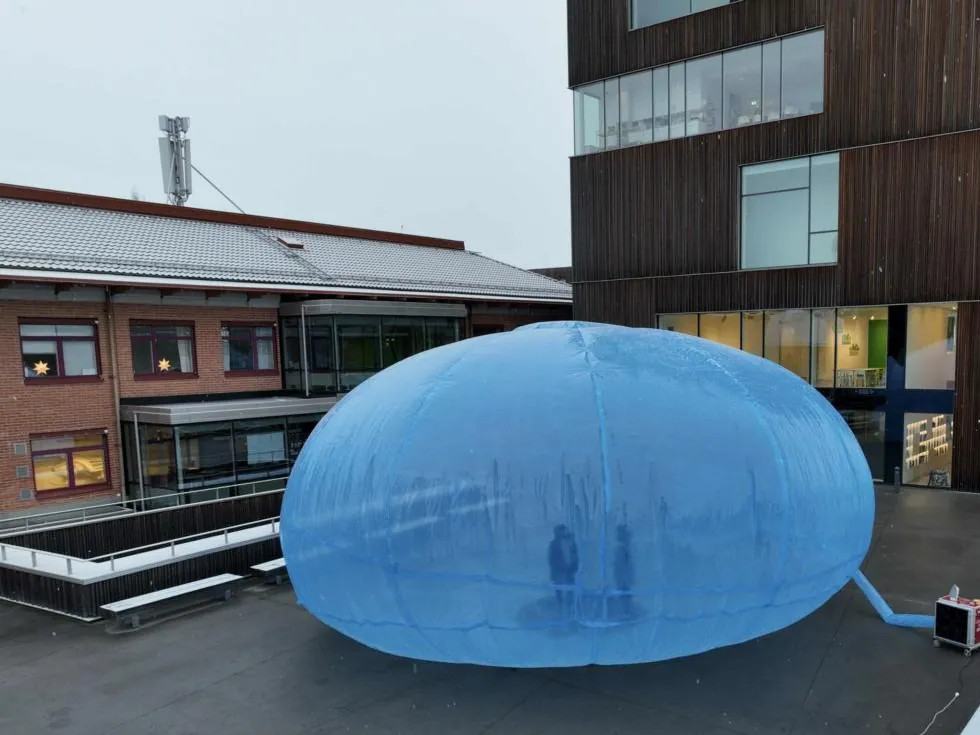
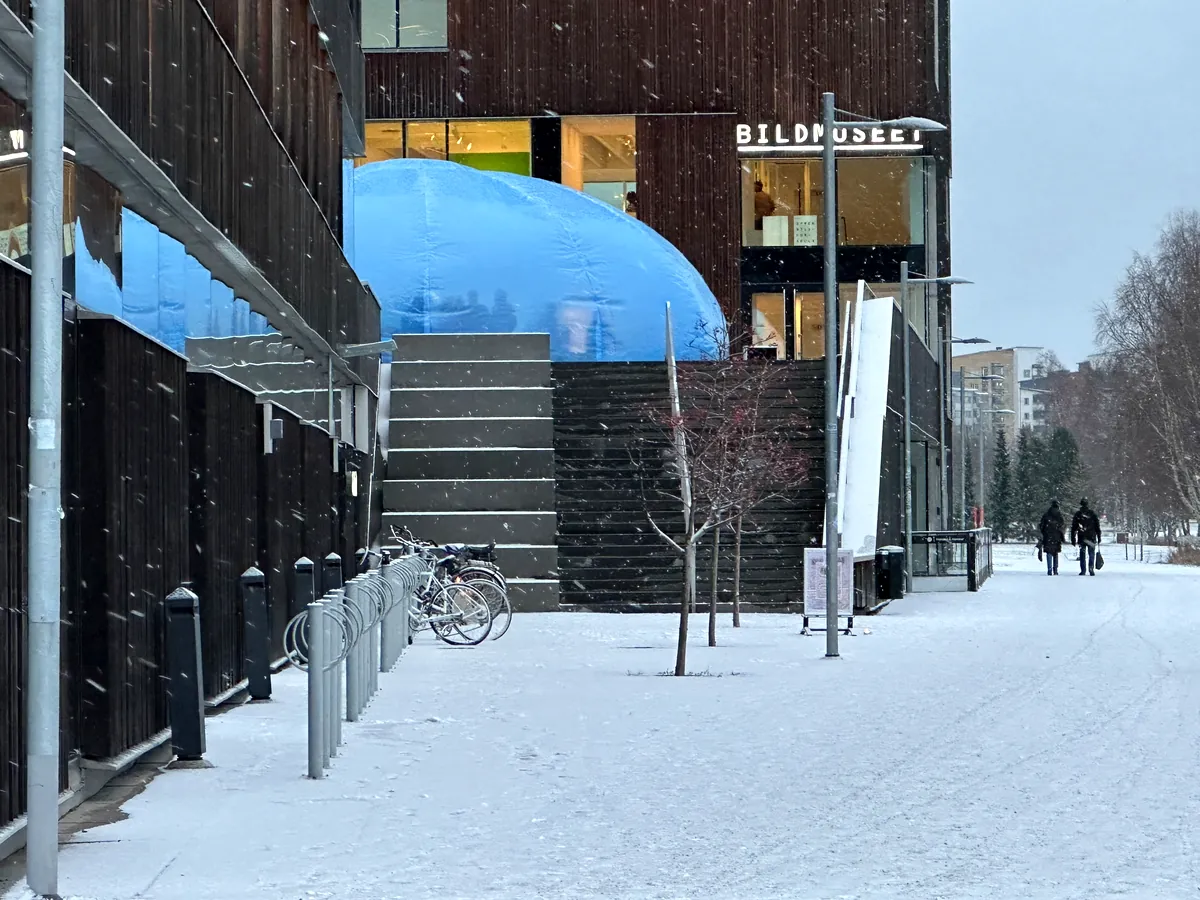
A transparent dome in the courtyard between Bildmuseet and the Academy of Fine Arts, put up in the first week of December with temperatures down to minus 13.8 °C. Inside were six eco-chambers with soil samples and 3D printed bodies infused with biomaterial, and sensors that made slow ecological processes visible.

The project asked how building something together in public can become an architectural language. I was in the core team, working on form-finding and fabrication.

The project at UmArts Watch the stories from the opening
The membrane being inflated next to the Bildmuseet building
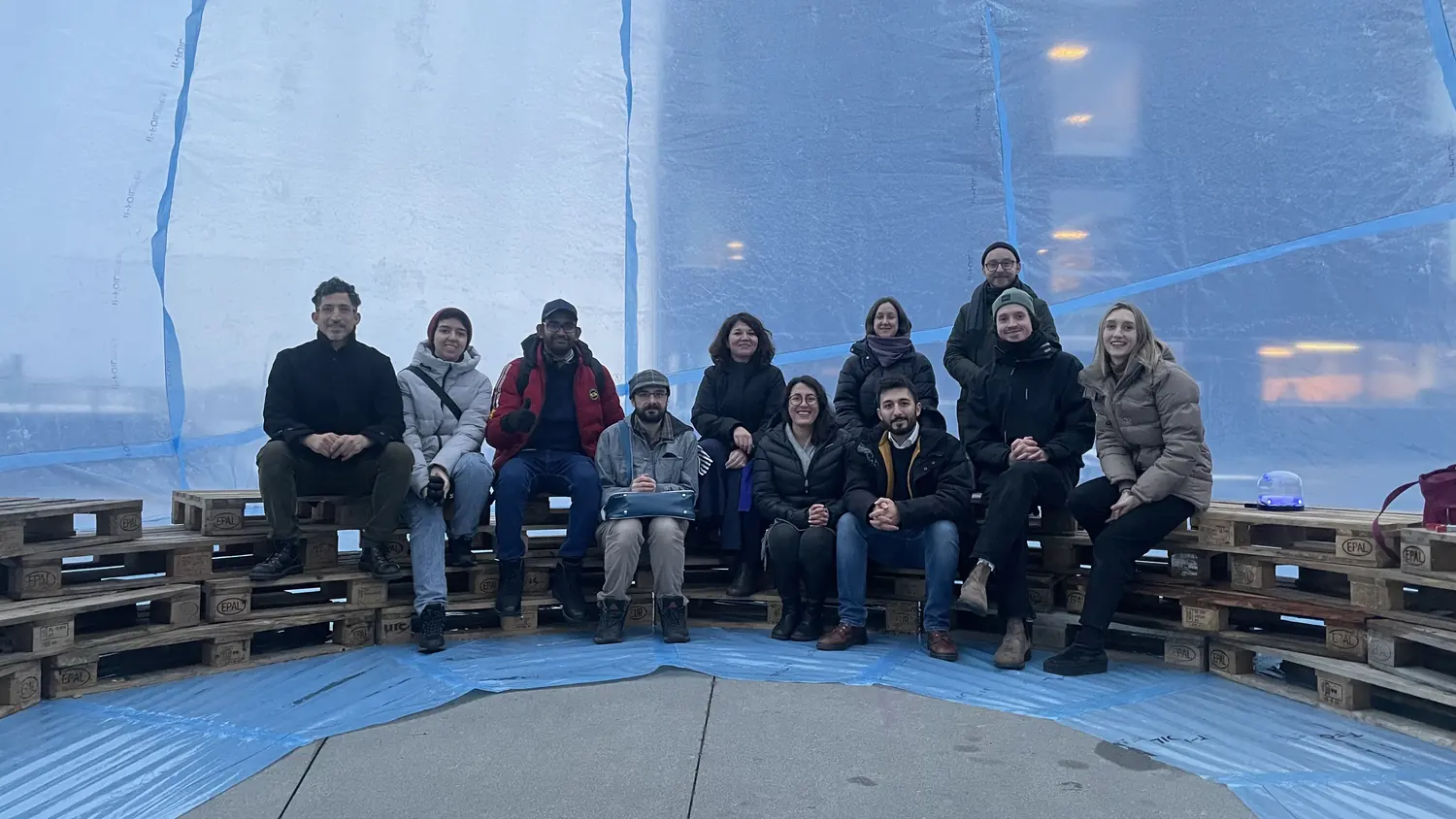
The team sitting together inside the dome
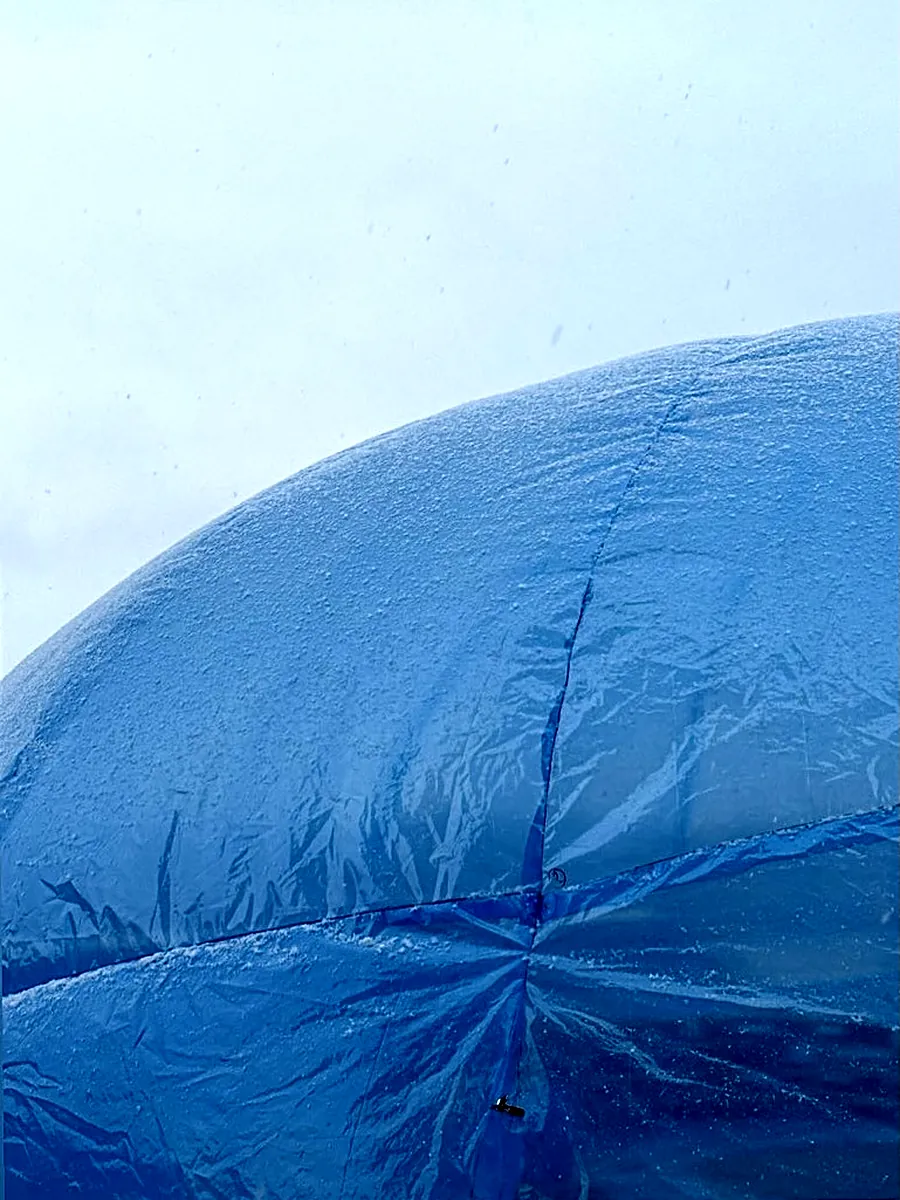
Snow on the dome's blue skin, its seams meeting at the top

Photographs of the opening, the dome from above, the inflation and the team from the Laboratory of Planetary Diplomacy. The night view, the dome in the atrium and the snow are mine.

2022 to 2024, Umeå

Studio 12

2022to 2024

Umeå

People

Man-made Geographies: from Planetary to Molecular. Master's studio led by Alejandro Haiek Coll at Umeå School of Architecture, 2022 to 2024. Tutor and guest teacher.

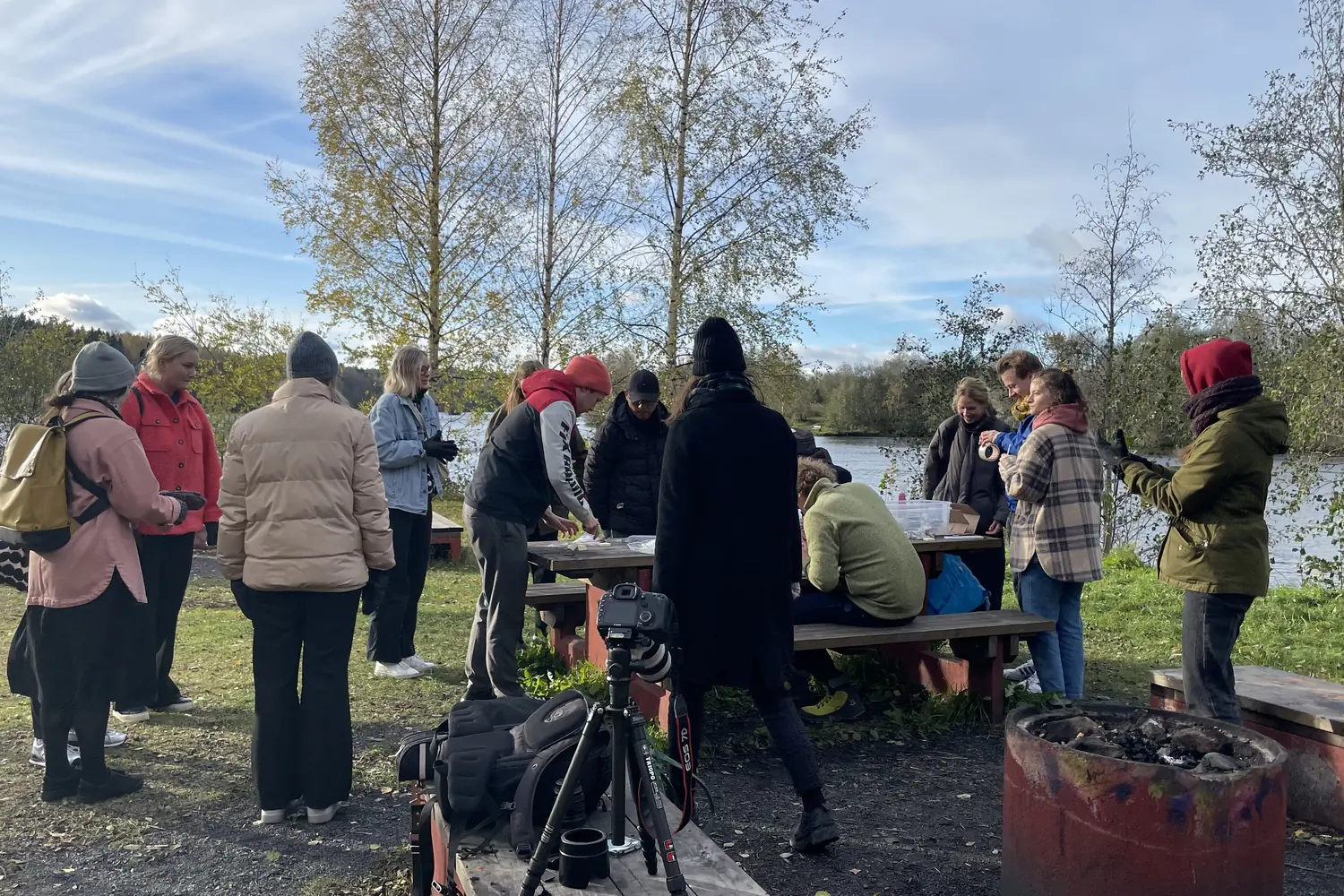
Students working at outdoor tables by a lake

The studio studied landscapes damaged by industry and extraction in the north of Sweden, and how they could be repaired: bioremediation, restoration, materials that grow. I taught the seminars and workshops on biomaterials, digital tools and digital fabrication.

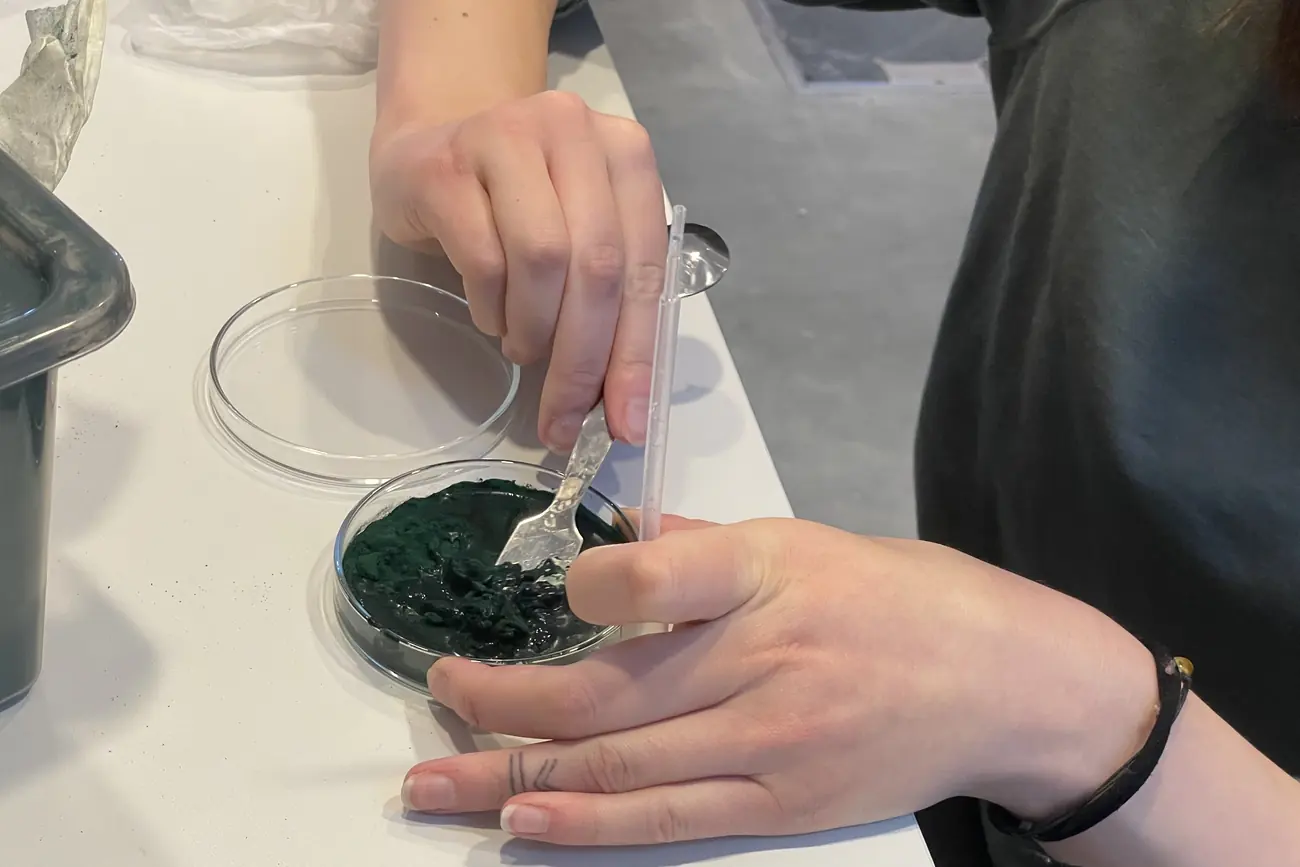
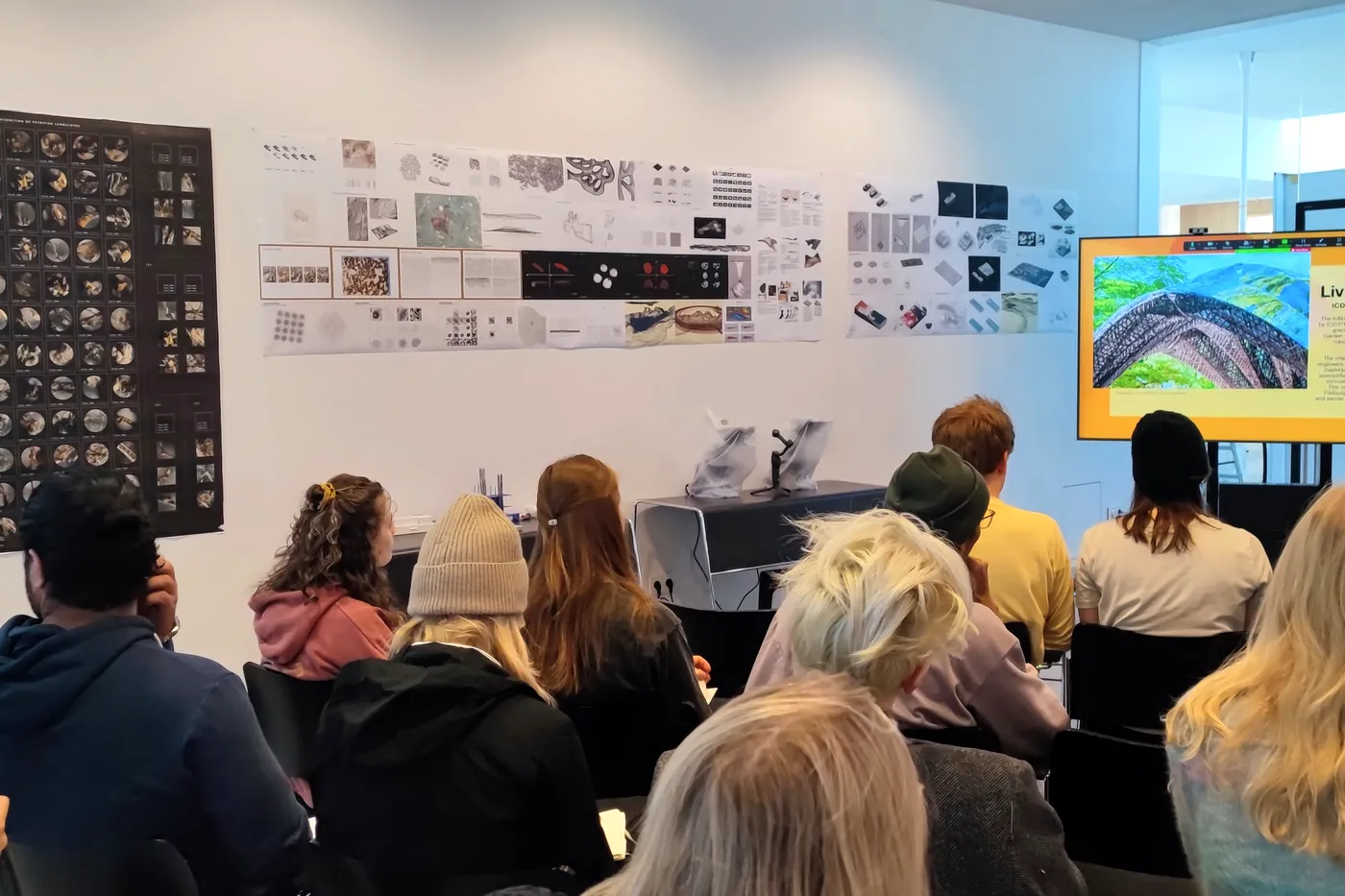
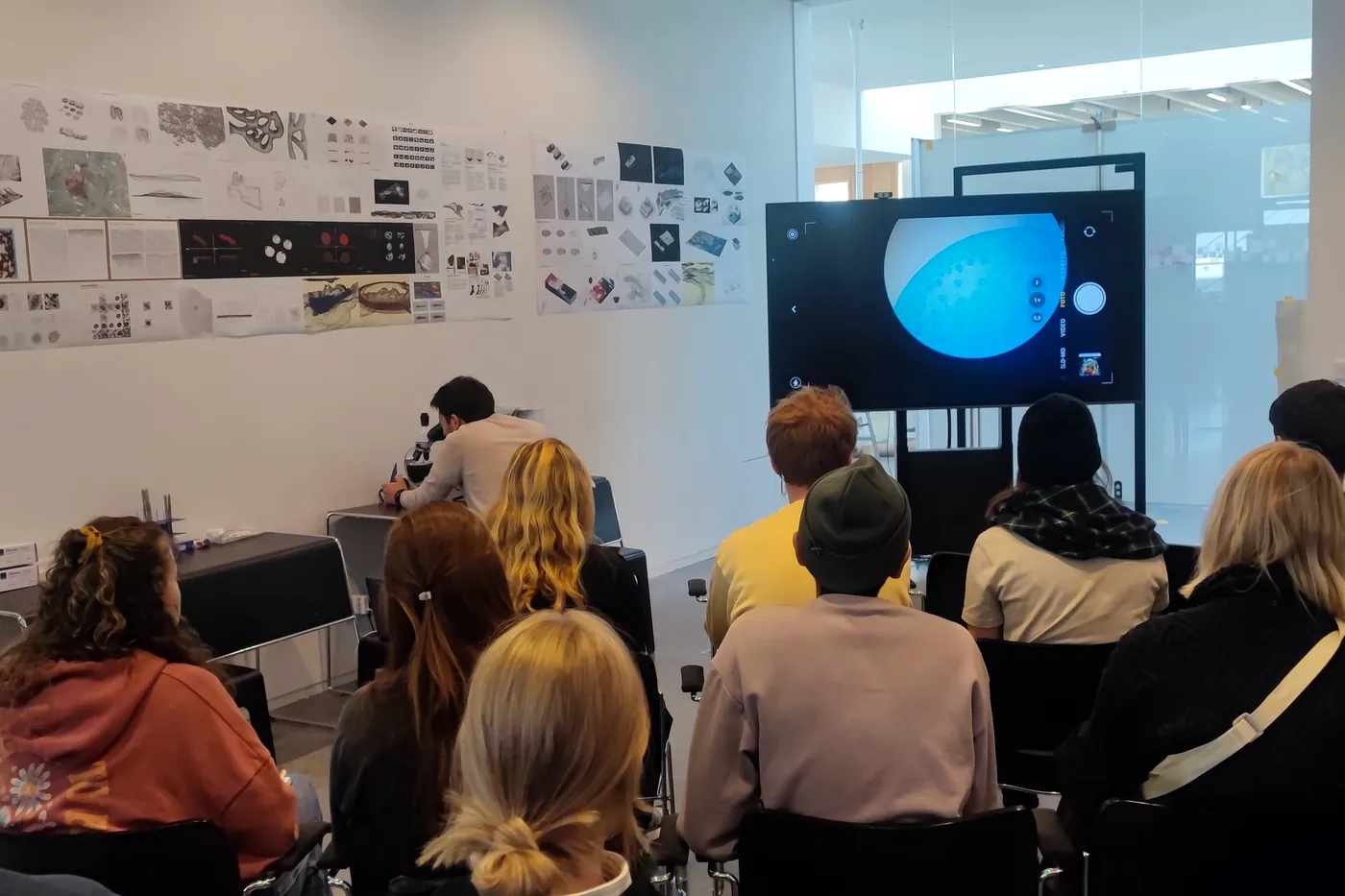
Students grew mycelium in petri dishes, looked at it under the microscope, sterilised substrates in a lab session at RISE, printed, and tested what AI image tools can and cannot do for design.

Watch the studio's story
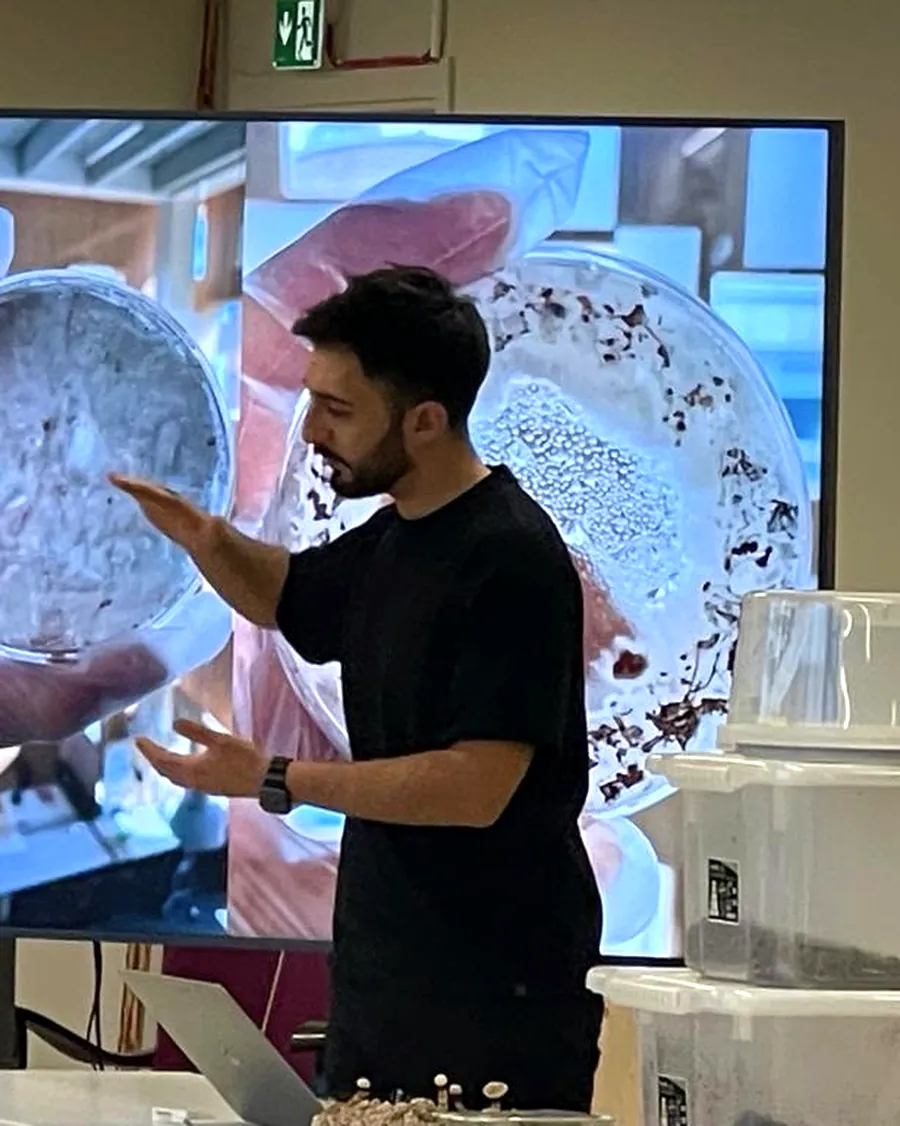
Raffaele lecturing in Studio 12 in front of a projected petri dish of mycelium, with samples on the table
A student's hands inoculating a petri dish
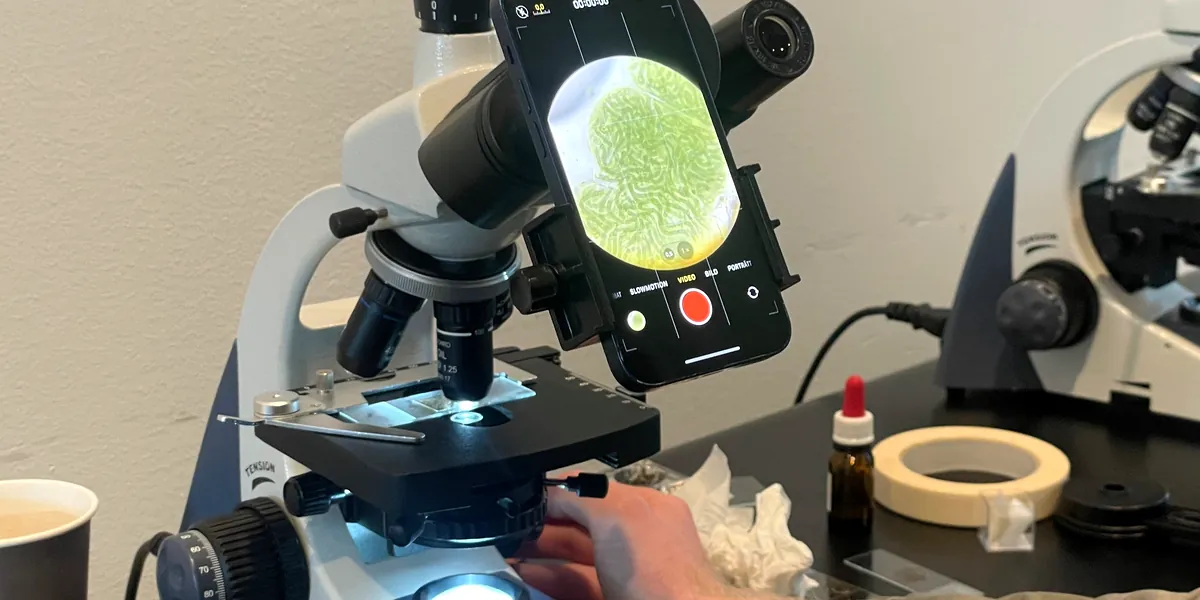
A hand on the focus of a microscope, a phone on the eyepiece filming the green cells of a section
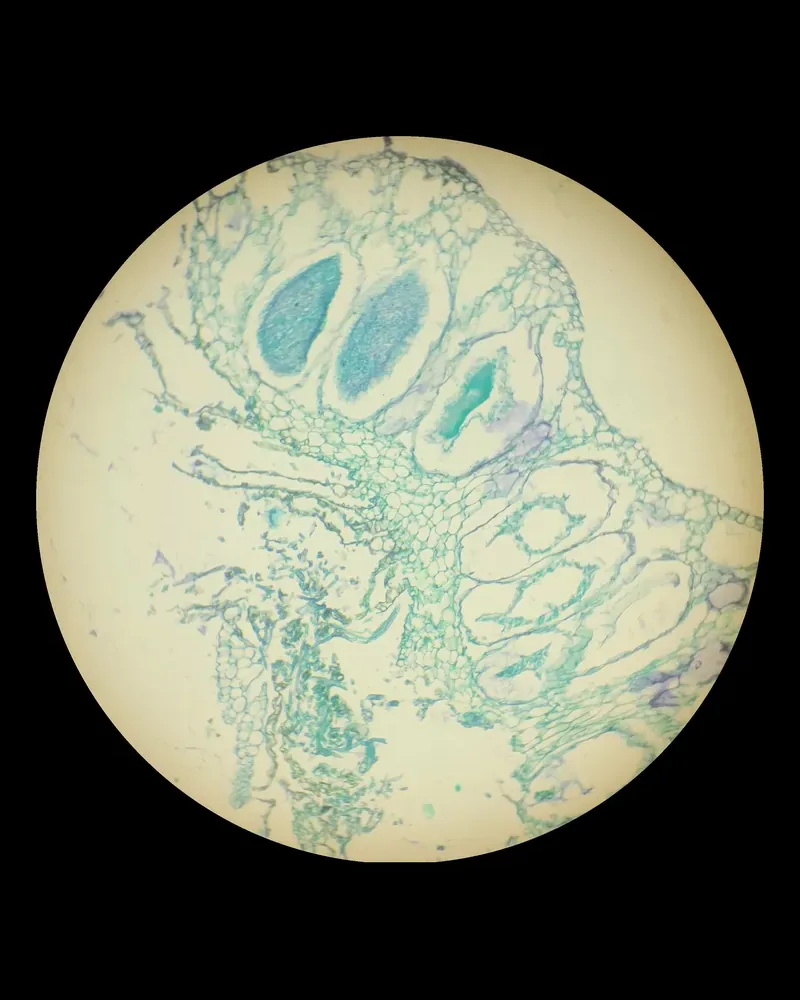
A stained plant section under the microscope from a studio session, cells in blue and green
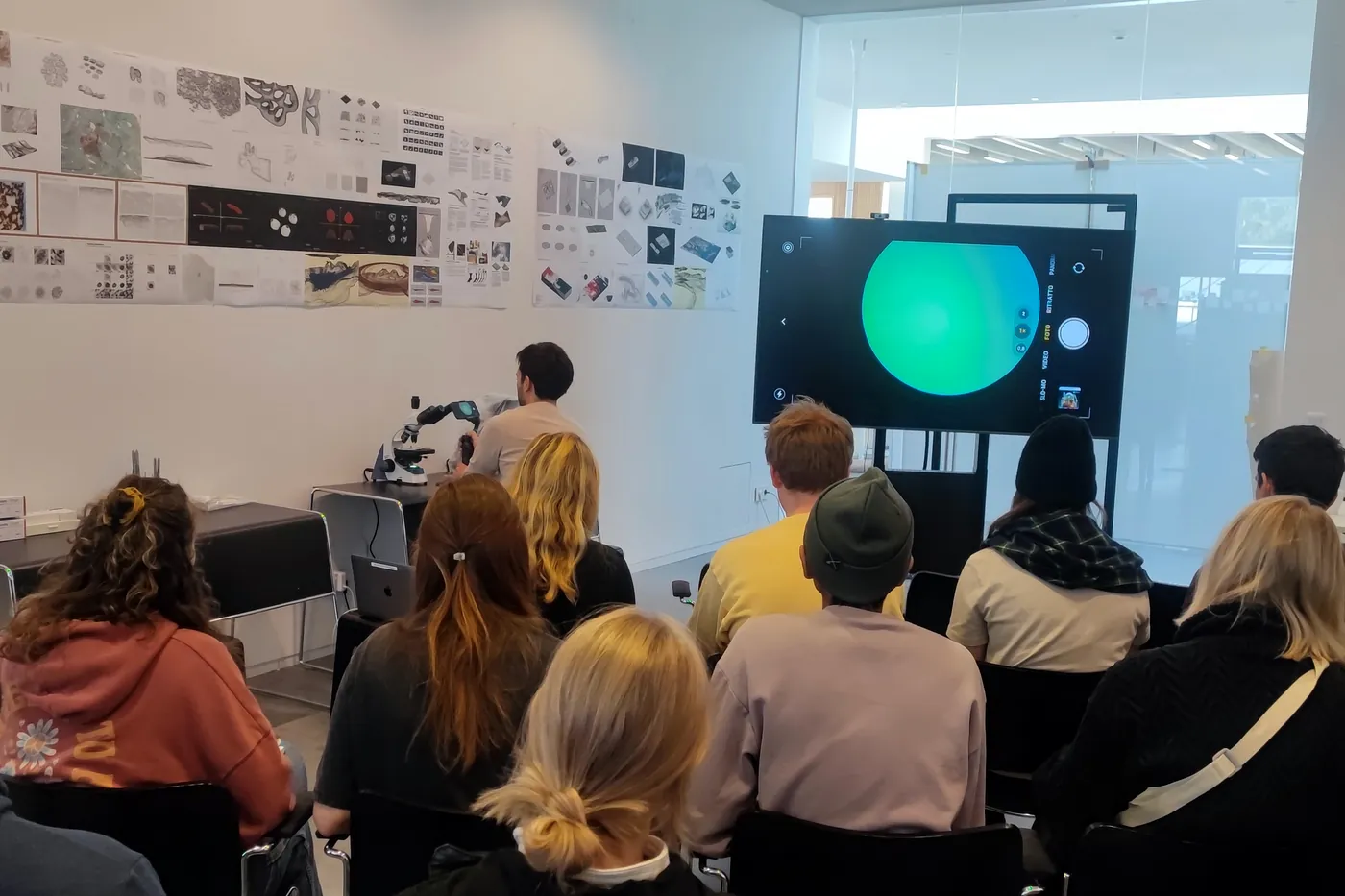
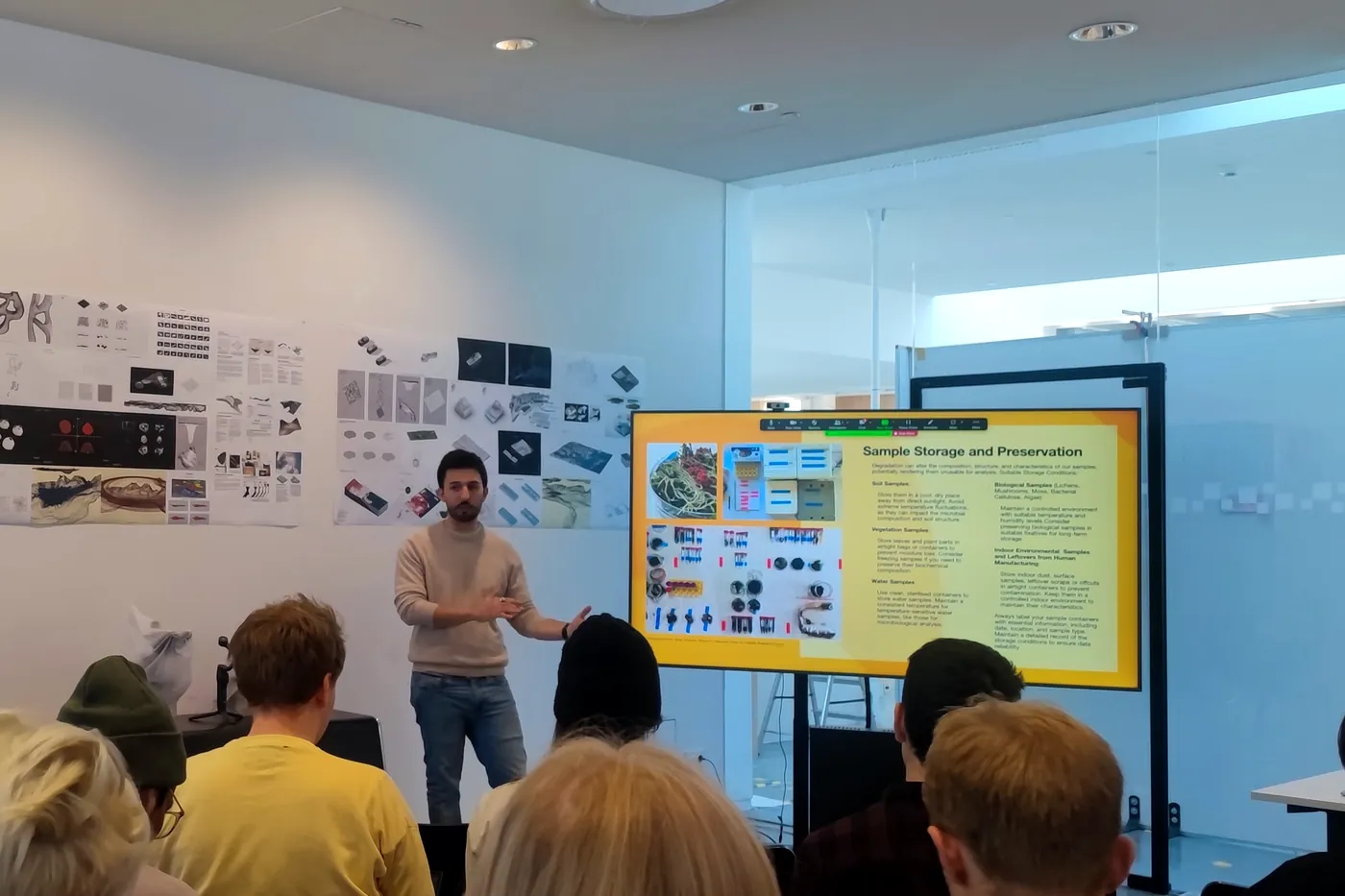
Raffaele giving a lecture to the studio, students seen from behind, a slide on sample storage and preservation beside him

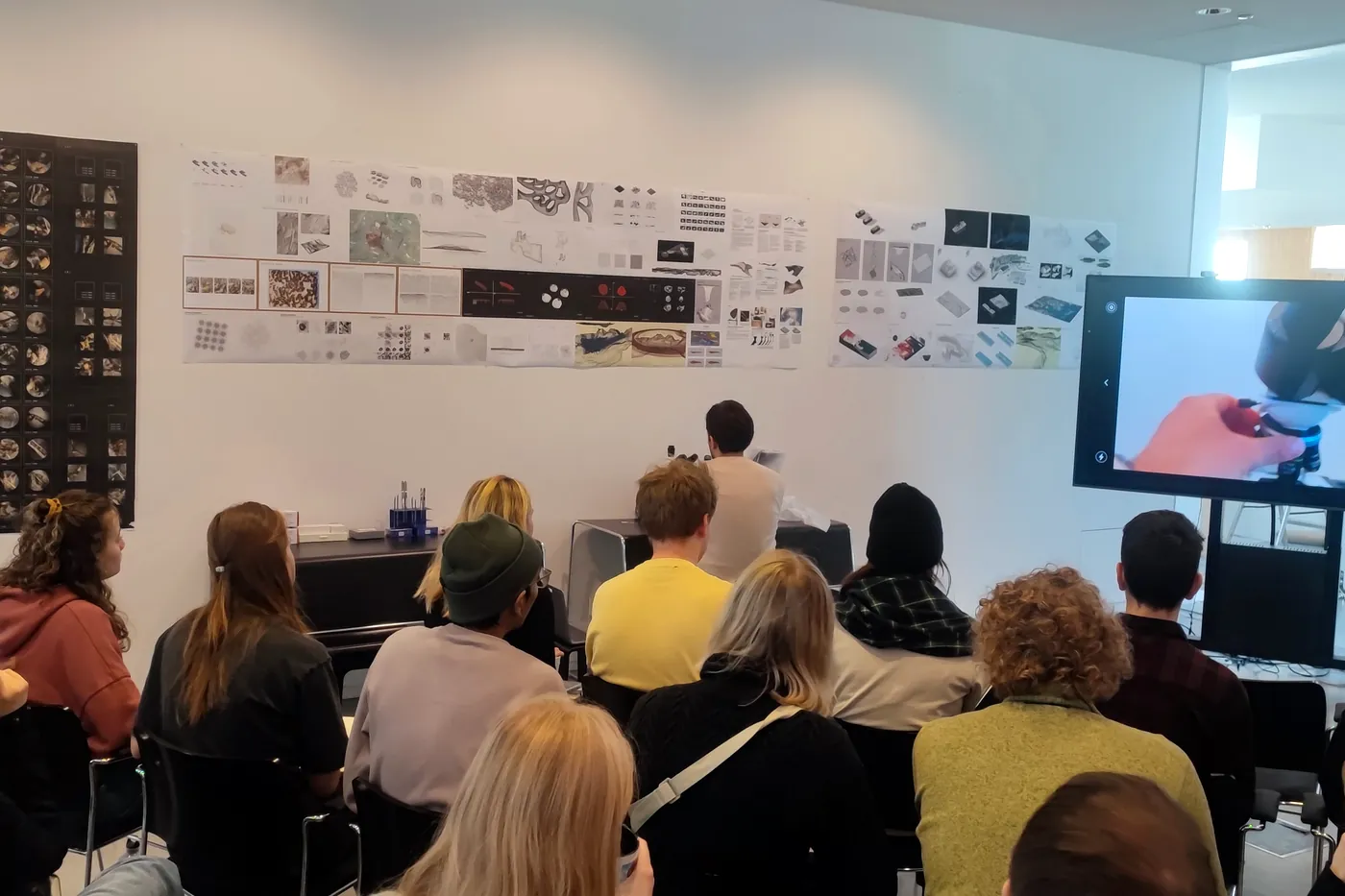
Lectures and lab sessions with the studio, February to October 2023: storing and preserving samples, the microscope on the big screen, sterile work in the lab.

2023, RISE, Umeå

First prints at RISE

2023

RISE, Umeå

Matter

Guest researcher with Ellinor Werner, RISE Research Institutes of Sweden, Scharinska Villan, Umeå, January to February 2023.

One of the first prints, January 2023.

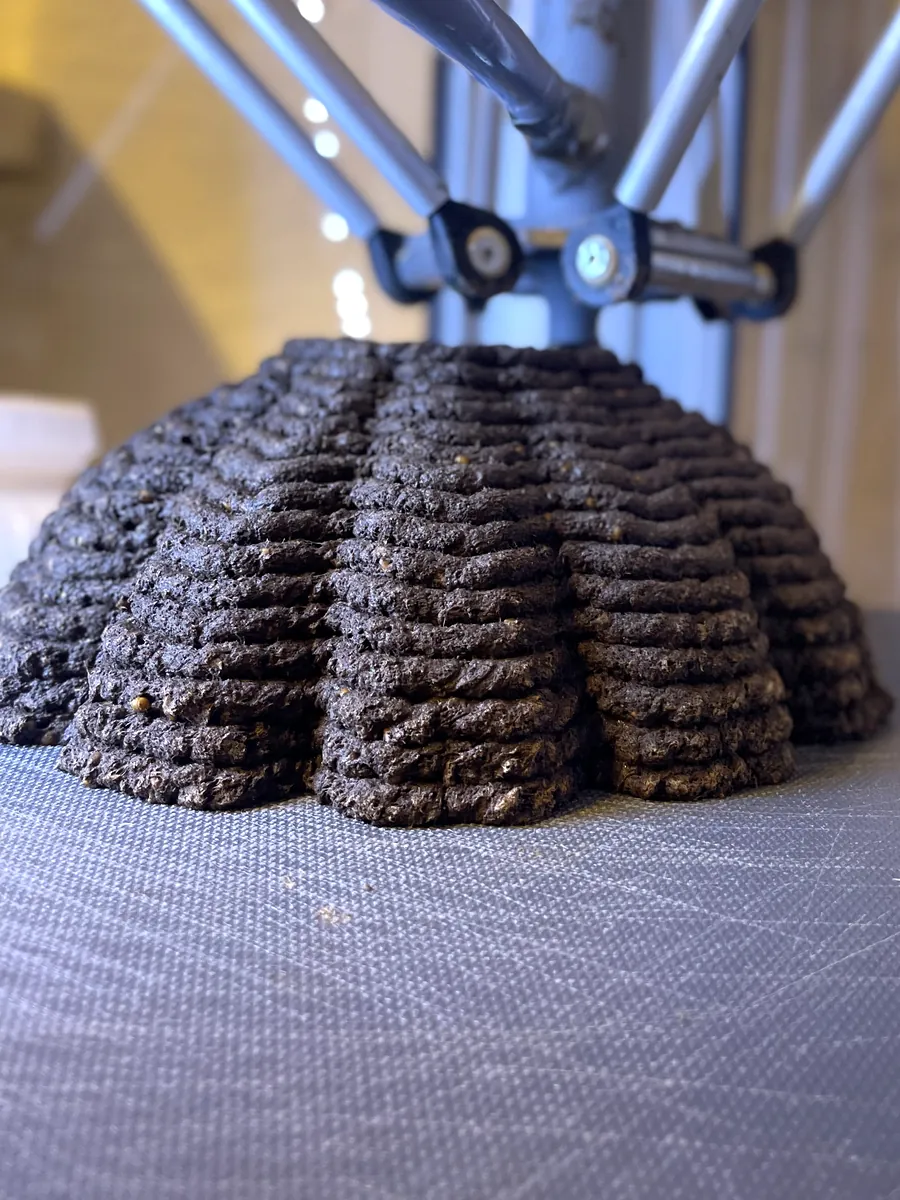
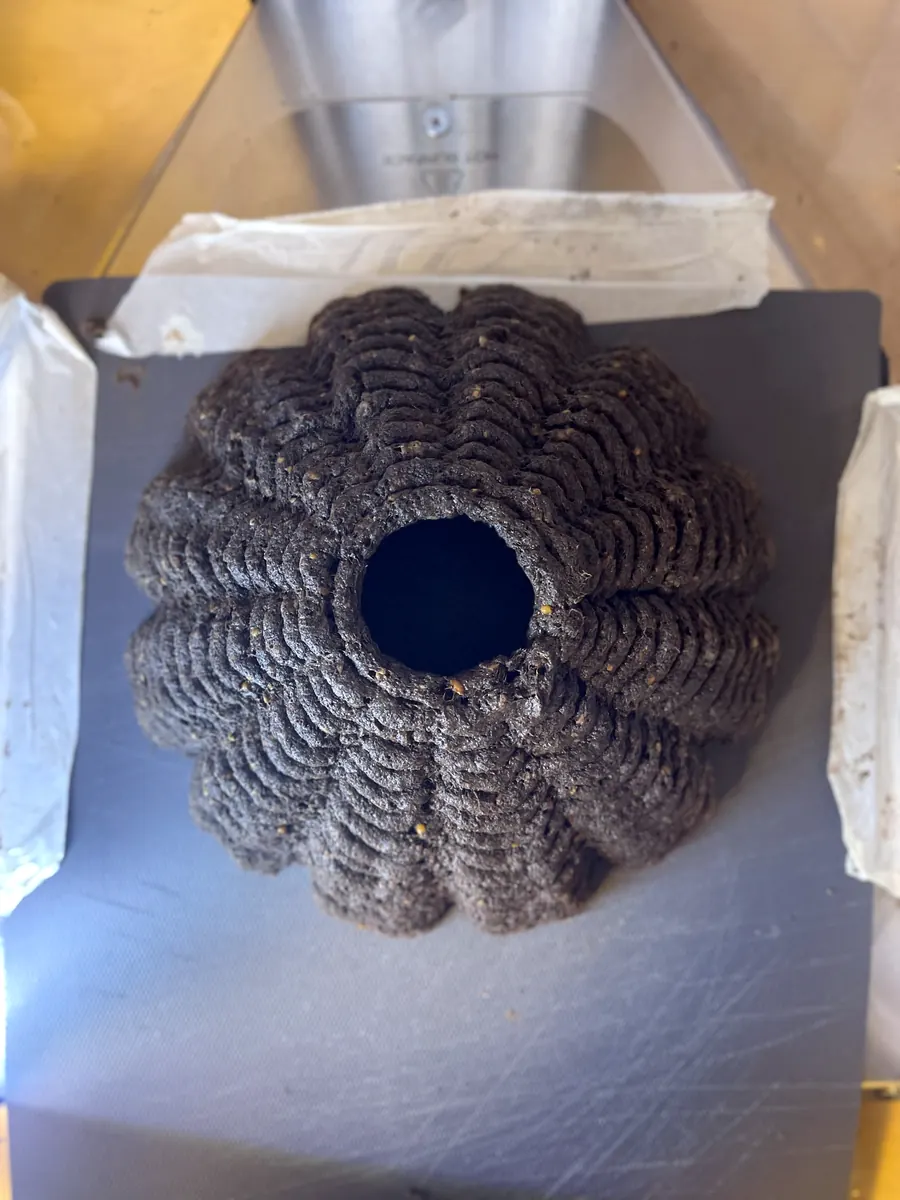
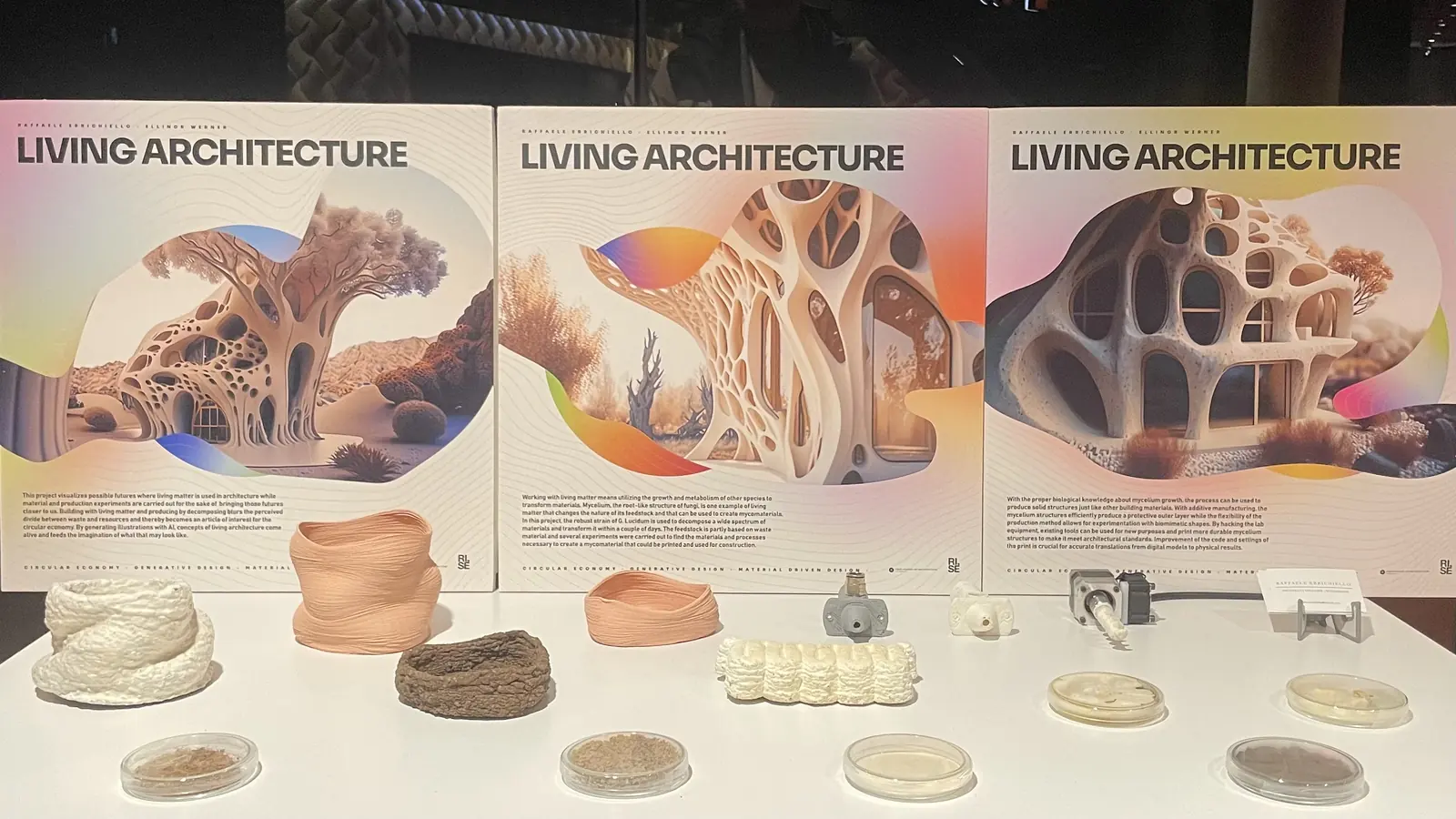
At RISE I began developing a mycelium-based, fibre-reinforced material that could be printed instead of cast. The first extrusions were rough, but they held their shape: low vessels, a fluted dome, a serpentine block. They were shown as Living Architecture.

Living Architecture at RISE
A fluted dome of dark paste on the printer bed
The fluted dome seen from above, a ring of folds around an opening
A delta printer extruding a grey mycelium paste
Living Architecture posters above a table of mycelium samples
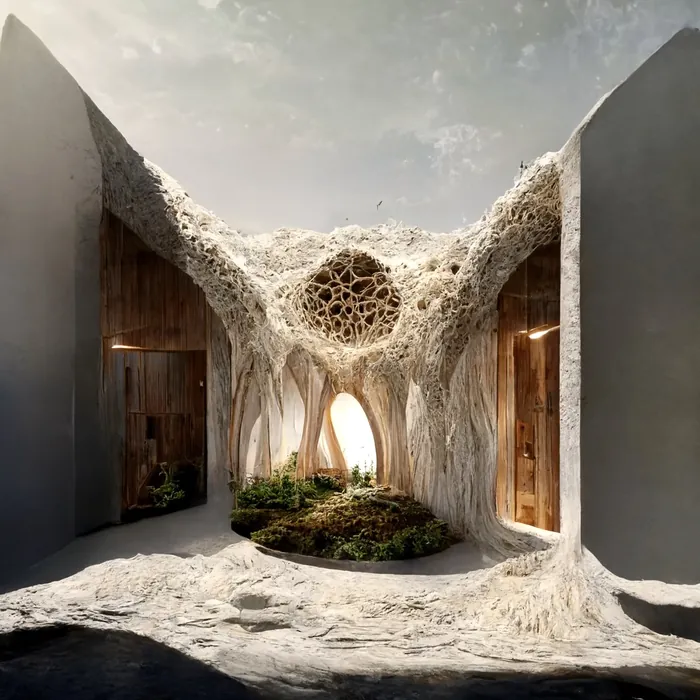
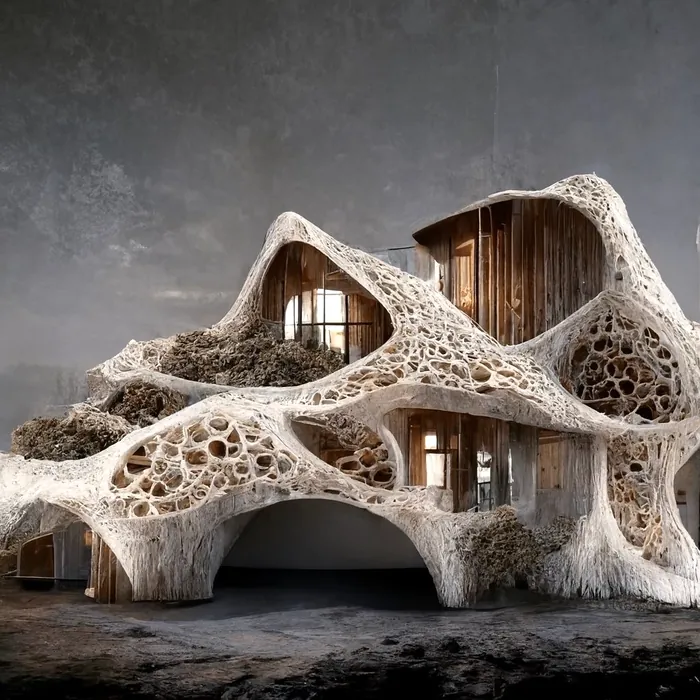
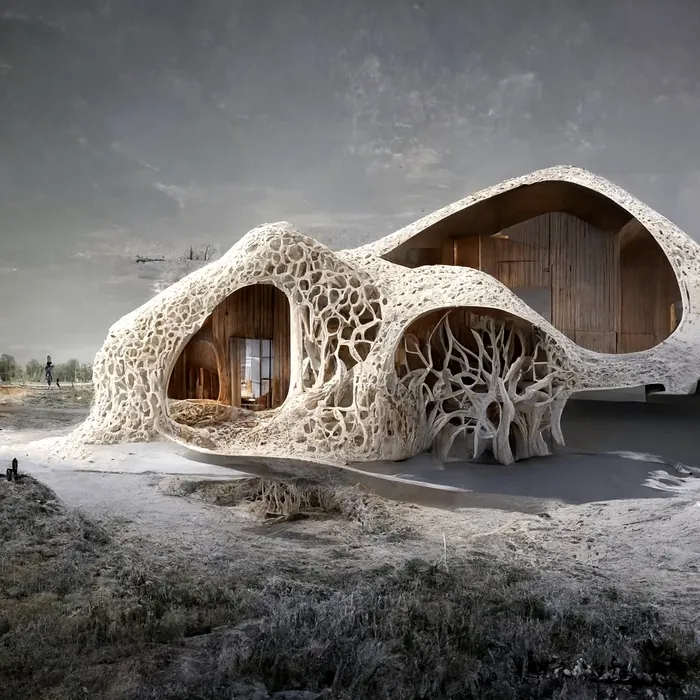
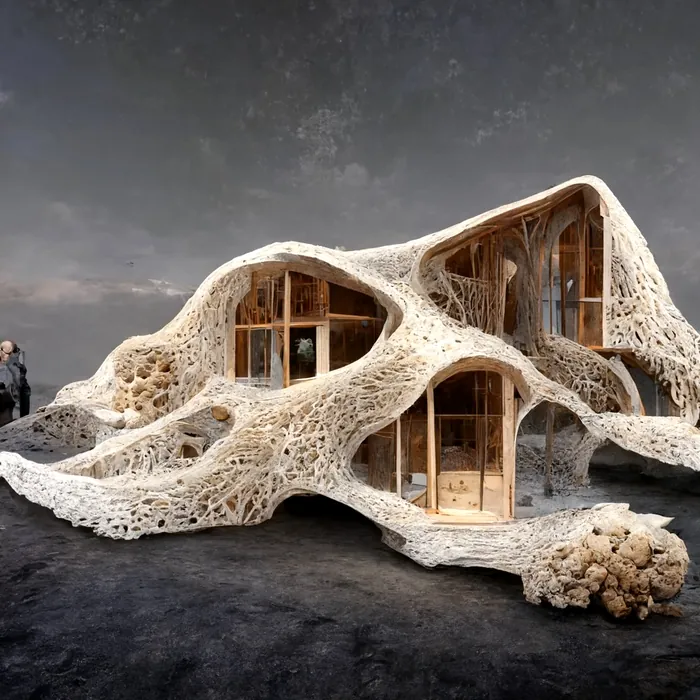
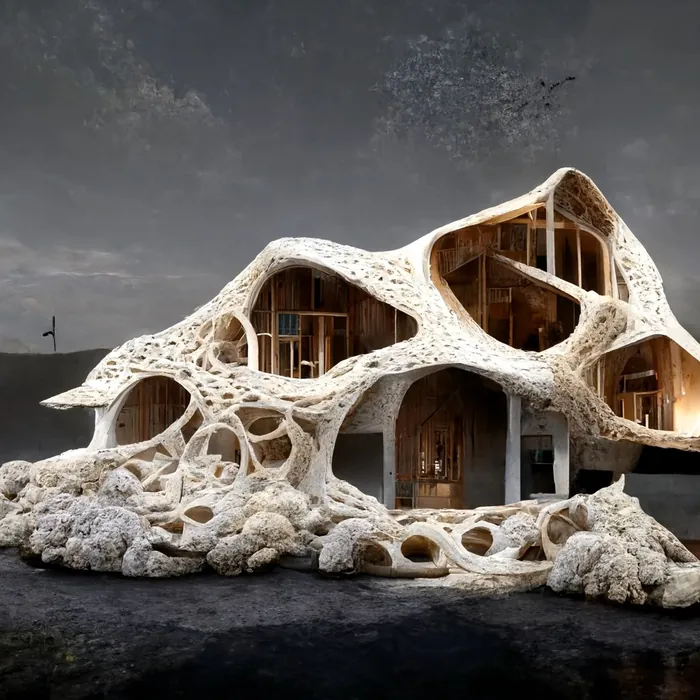
Image made with Midjourney: a house grown from white mycelium
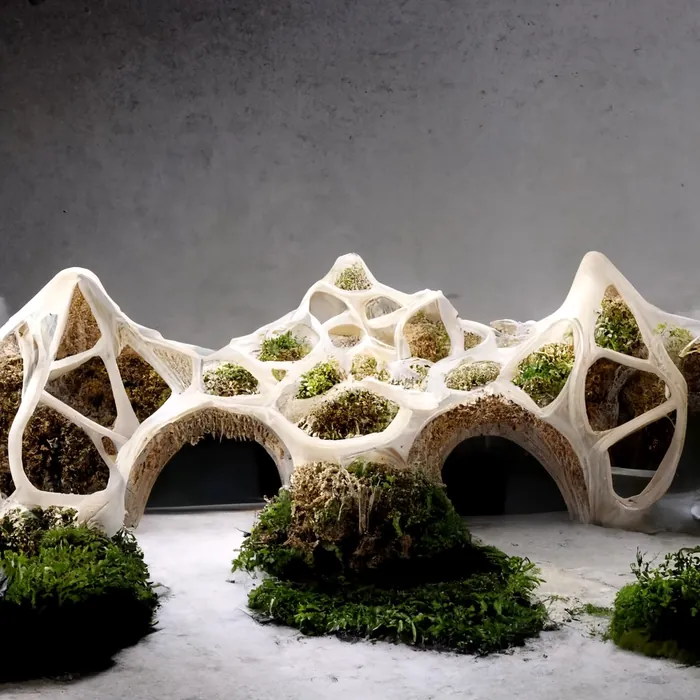
Image made with Midjourney: a petri dish holding a whole landscape
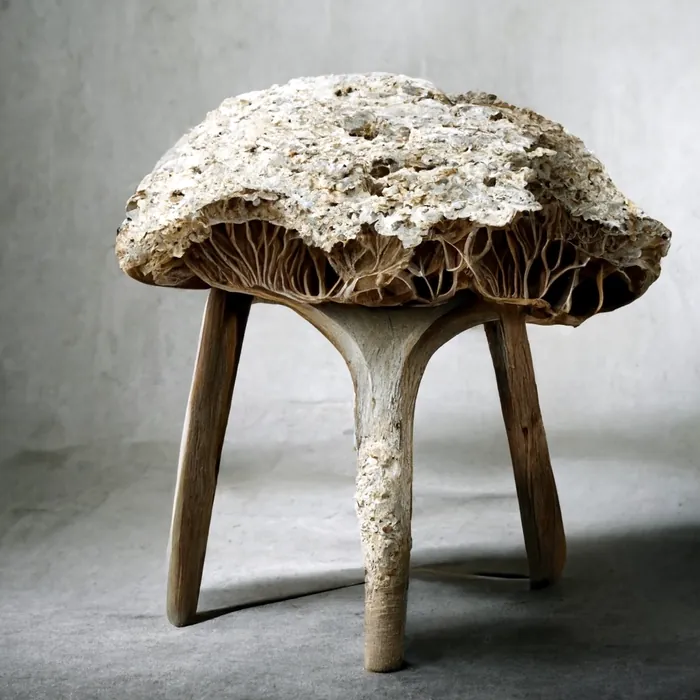
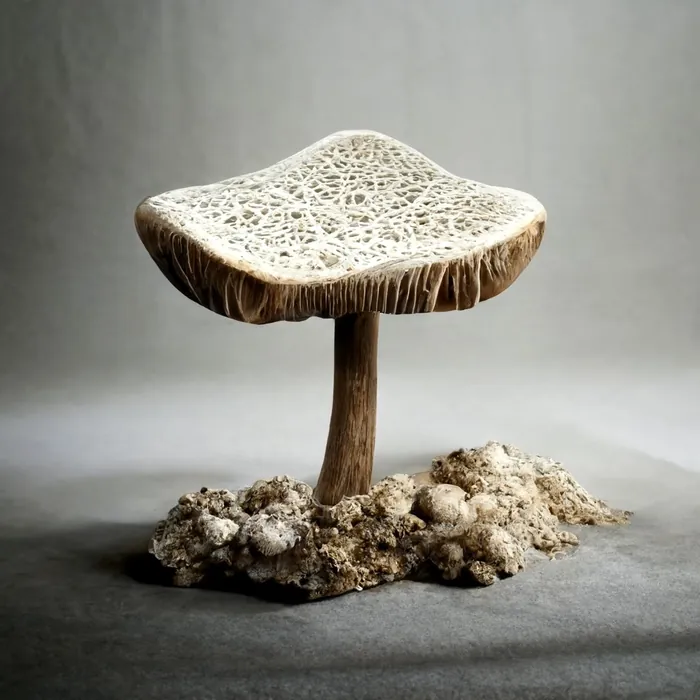
Image made with Midjourney: a stool grown from mycelium

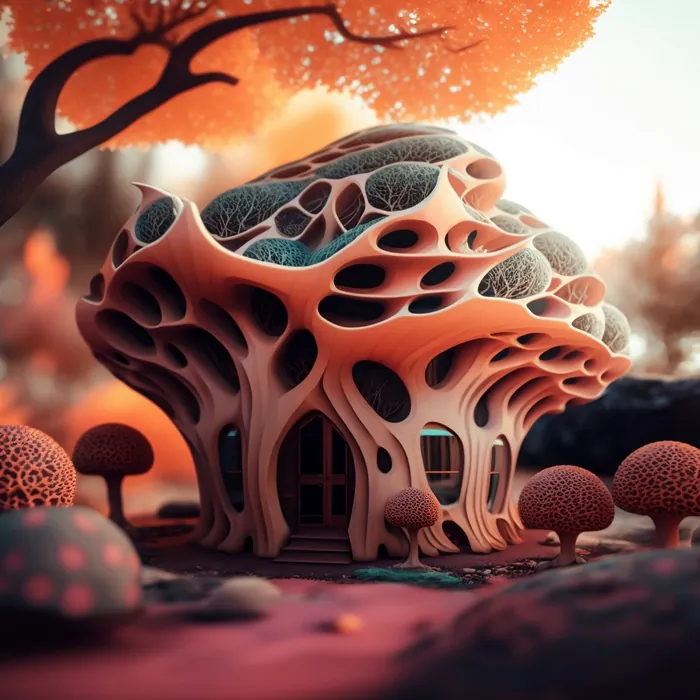
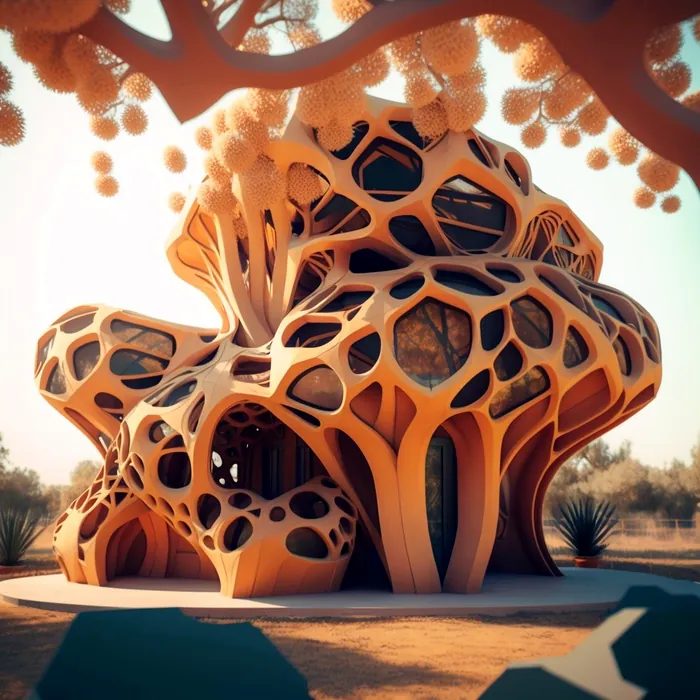
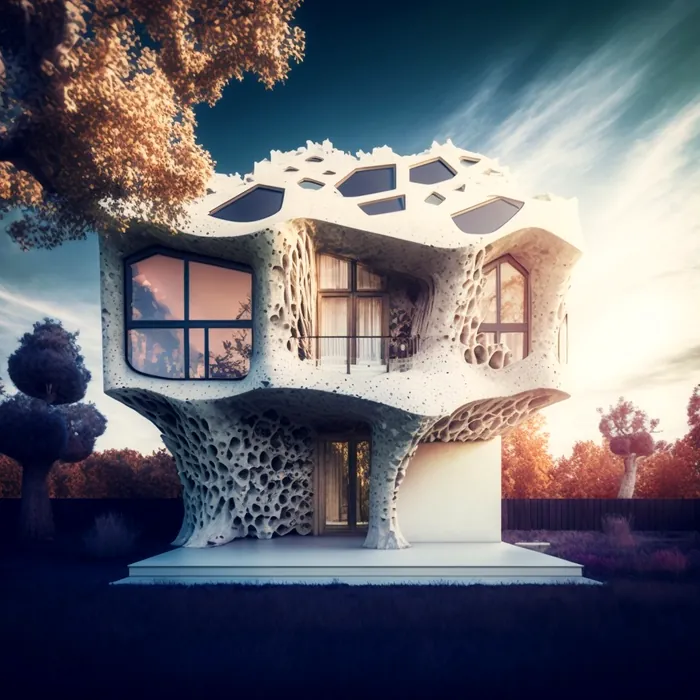
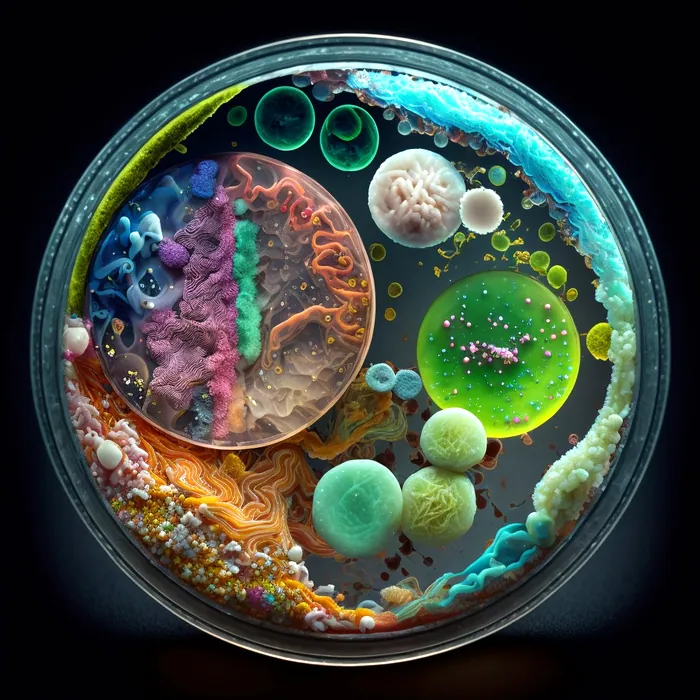
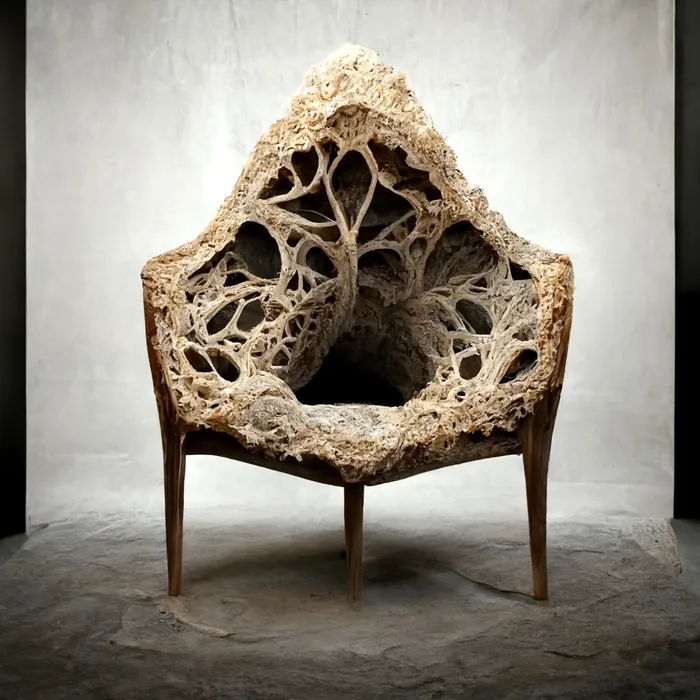
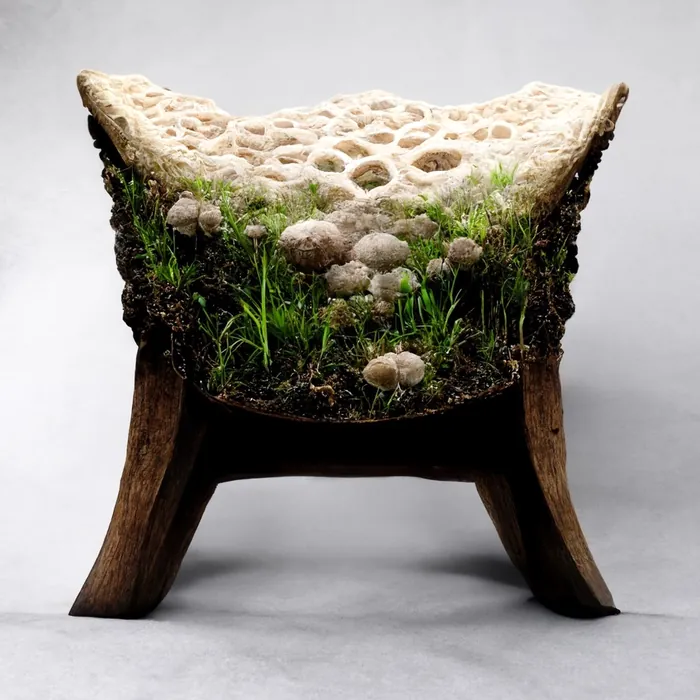
Images I made with Midjourney at RISE, December 2022 to February 2023, when the tool had just come out.
2023, Umeå and Stockholm

Design S awards

2023

Umeå and Stockholm

Matter

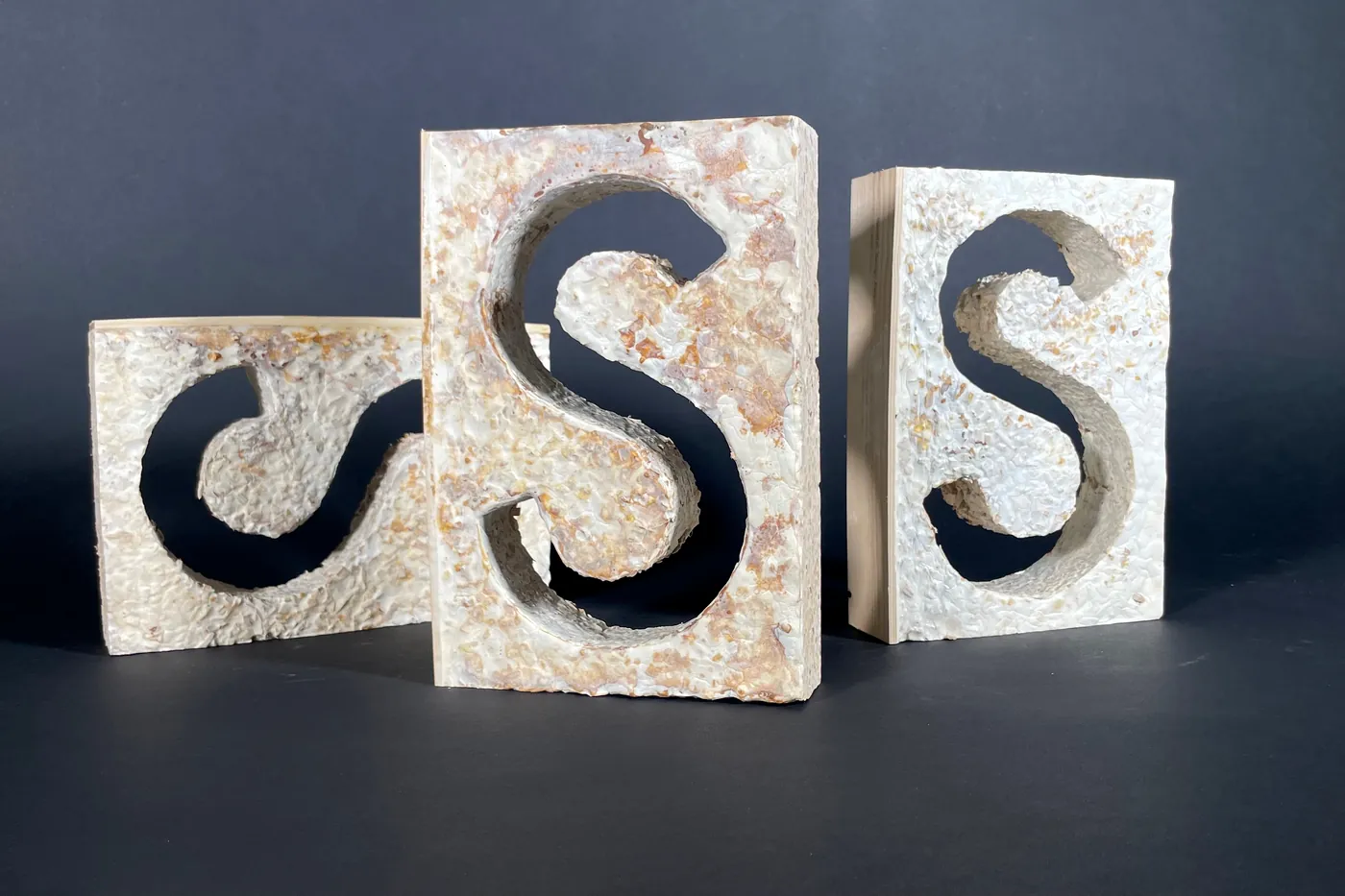
Design S, Swedish Design Awards 2023, by Svensk Form. Grown with Ellinor Werner at RISE in Umeå, January to May 2023. Original design by Doberman.

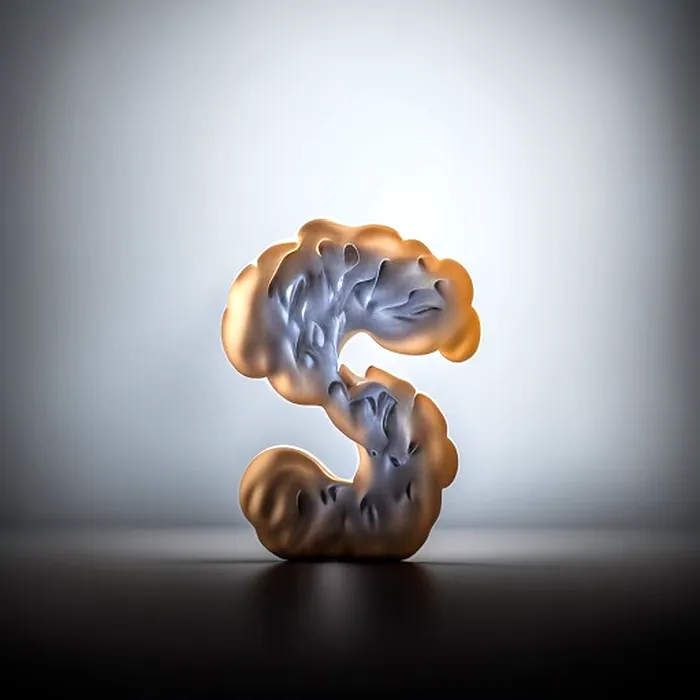
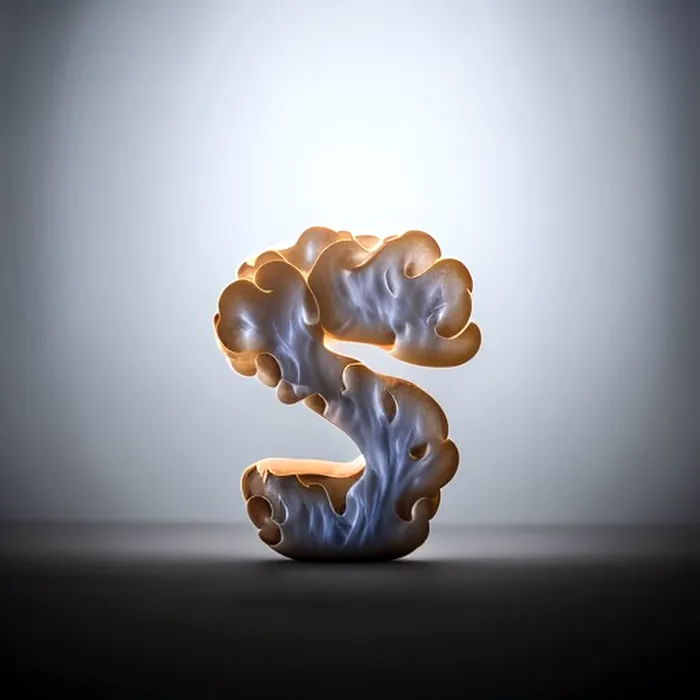
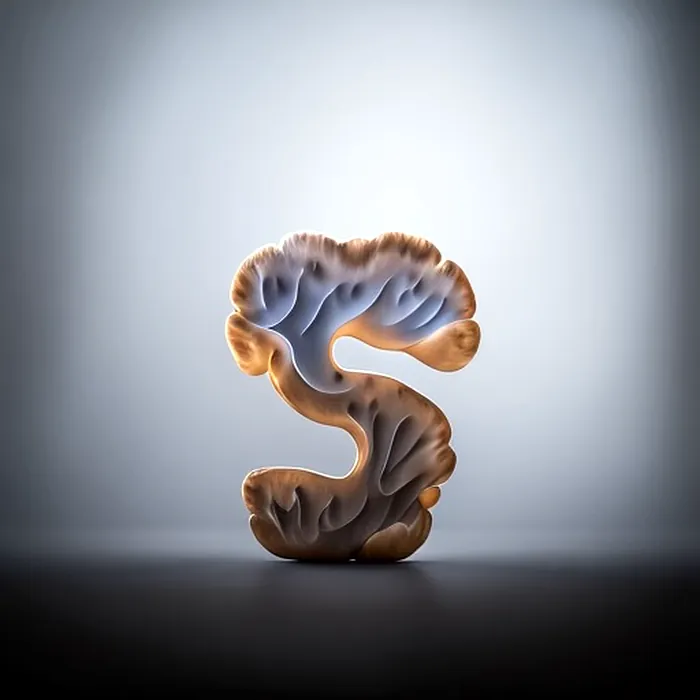
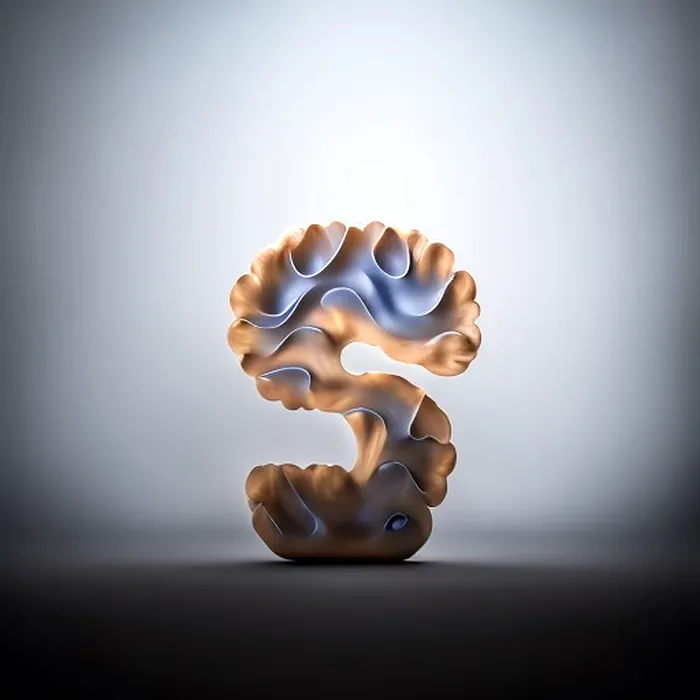
Three grown S trophies standing together on a dark blue background

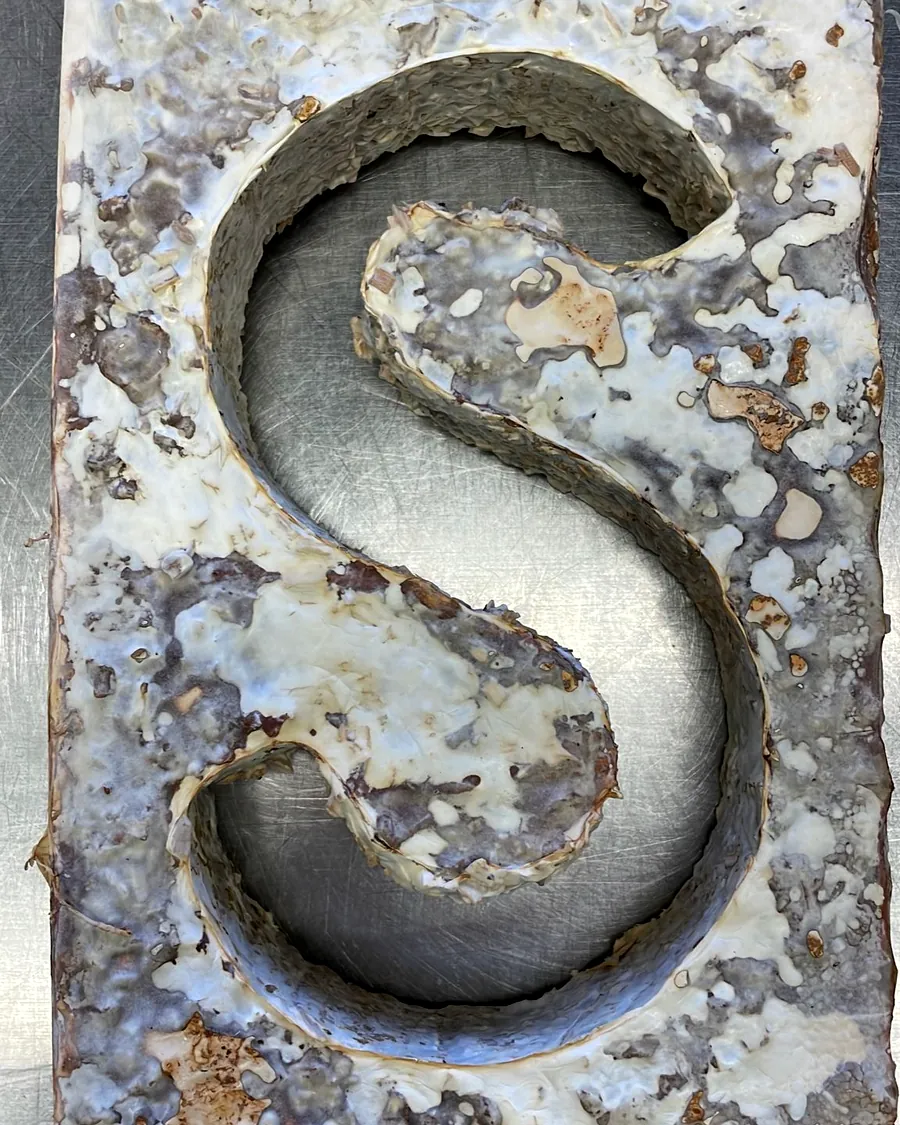
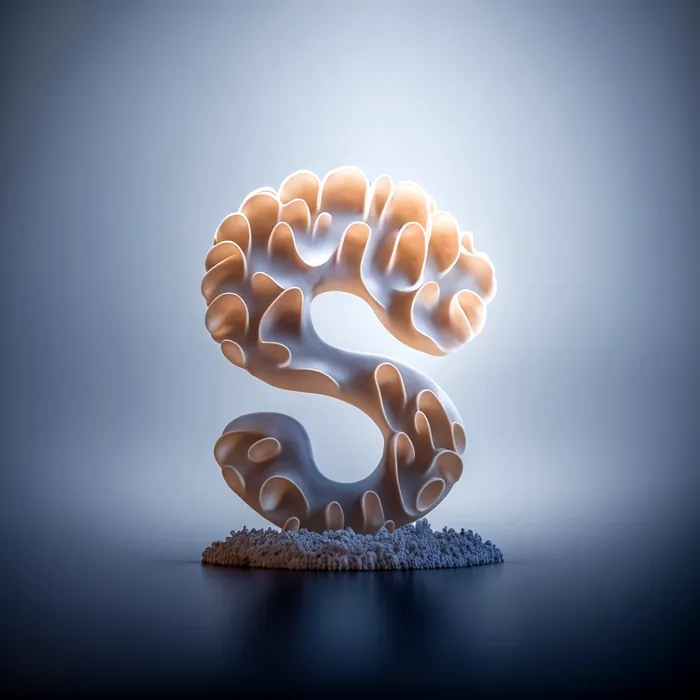
Each trophy for Sweden's national design awards was grown from reishi mycelium and chips of local waste timber, so it can be composted at the end of its life. Writing about them that spring, I named the material I wanted to make next: one that could be 3D printed into architectural structures.

The 2023 winners at svid.se
A freshly grown S trophy out of its mould on the steel table of the lab, still white with mycelium
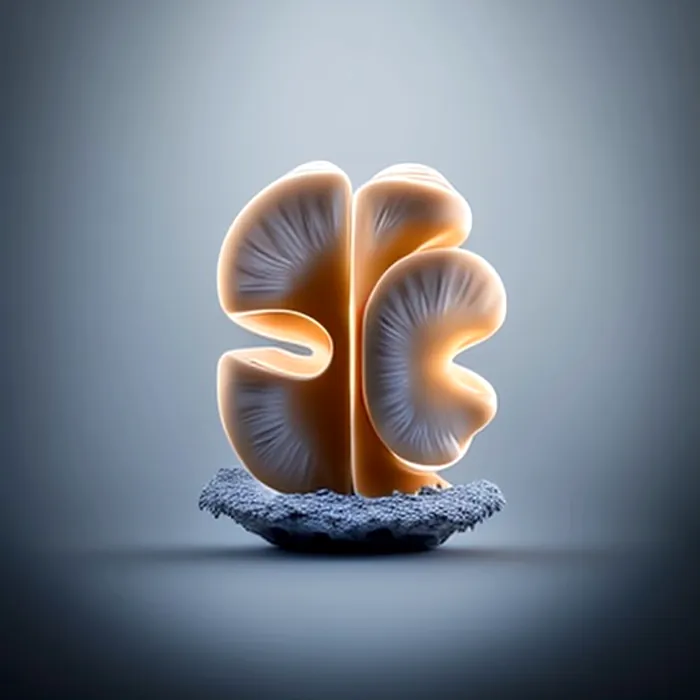
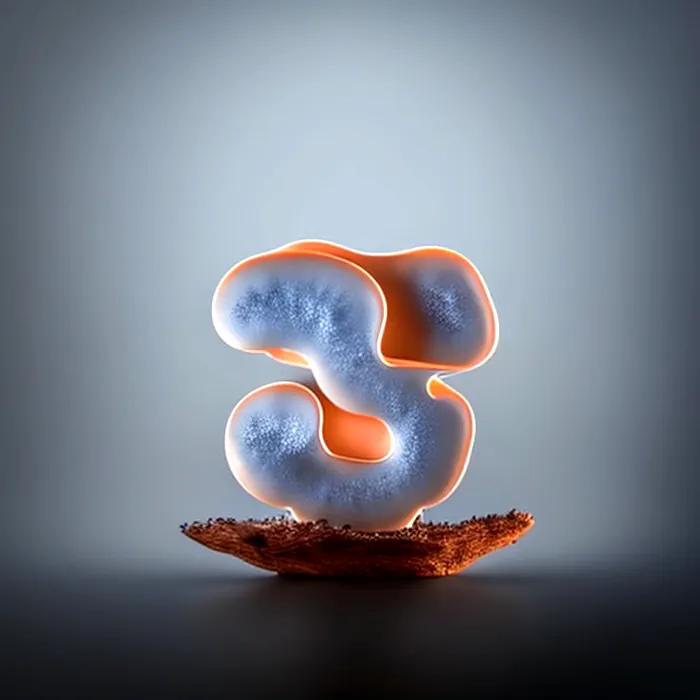
Image made with Midjourney: an S grown from mycelium, an early sketch for the trophy

Right: early Midjourney sketches for the trophy, December 2022. The design turned out to be set already, by Doberman.

Making the plaques, 21 and 22 April 2023: cut on the table saw and the band saw, planed to five millimetres, stacked and engraved by laser in the school workshop. Then the finished set filmed before the ceremony, 30 May.

2023 to 2024, UmArts

Nordic-Arctic Atlas

2023to 2024

UmArts

People

Nordic-Arctic Atlas of Environmental Injustices. Research assistant, Laboratory of Planetary Diplomacy, UmArts, 2023 to 2024.

Through the microscope: pale cells in a dense pattern Through the microscope: green-grey threads crossing Through the microscope: rounded golden cells Through the microscope: a round cluster among scattered particles Through the microscope: a dark branching mass Through the microscope: dark particles in soil Through the microscope: long transparent fibres Through the microscope: yellow-green tissue Through the microscope: a single oval cell on a pale field Through the microscope: a diagonal band of amber material Through the microscope: a pale green field dotted with particles Through the microscope: a golden edge crossing the field

Soil, moss and lichen samples under the microscope, October 2023.

Recorded through the headset at UmArts, January 2024: the objects in the room, the hand menu and the globe, then the worlds.

A collective atlas of environmental conflicts across the Nordic and Arctic region, made with Alejandro Haiek Coll and a team of researchers. For the exhibition at the UmArts studio in January 2024 we showed soil and plant samples from the sites, each jar labelled with its coordinates, a microscope to look closer, and a mixed-reality layer: 3D-scanned objects and imagined landscapes placed in the gallery and explored through a headset.
Open the atlas Watch the stories from the exhibition
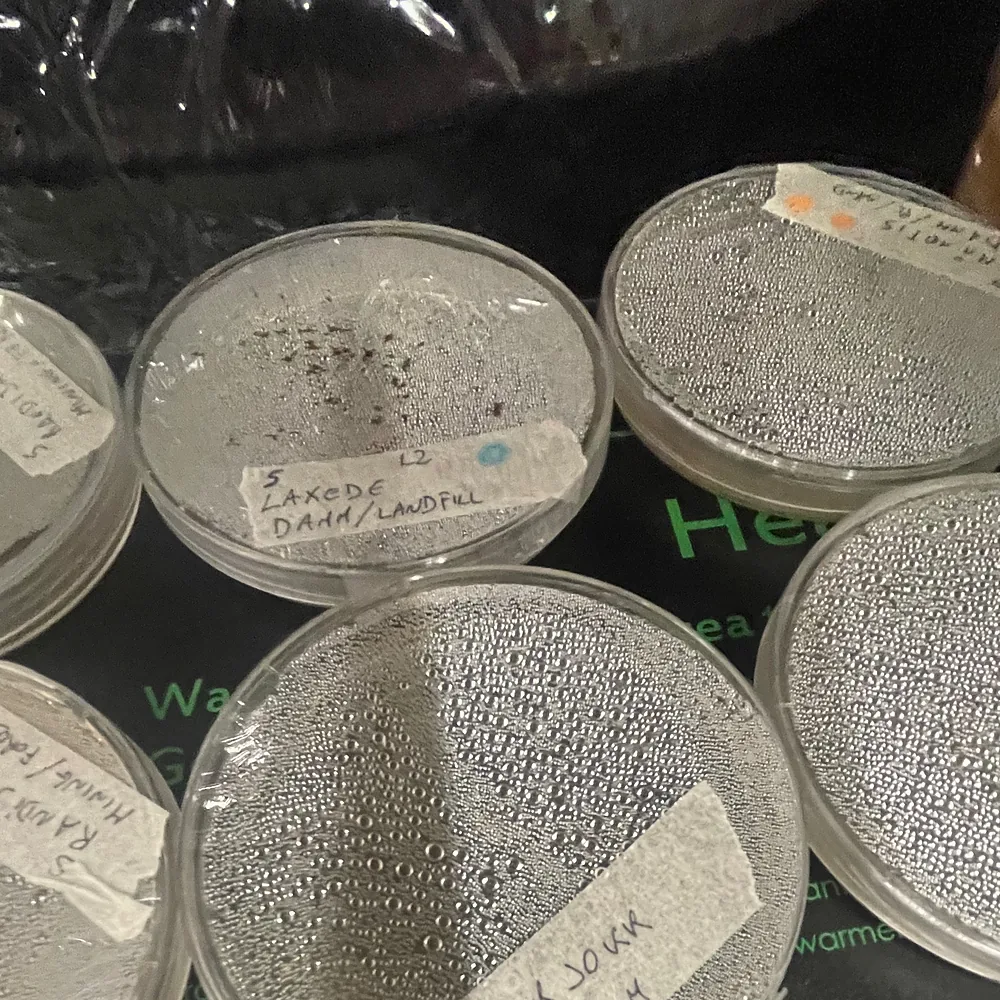
Petri dishes of soil samples, each labelled by hand with the site it came from, such as Lakode dam and landfill

2023 to 2024, Umeå and Stockholm

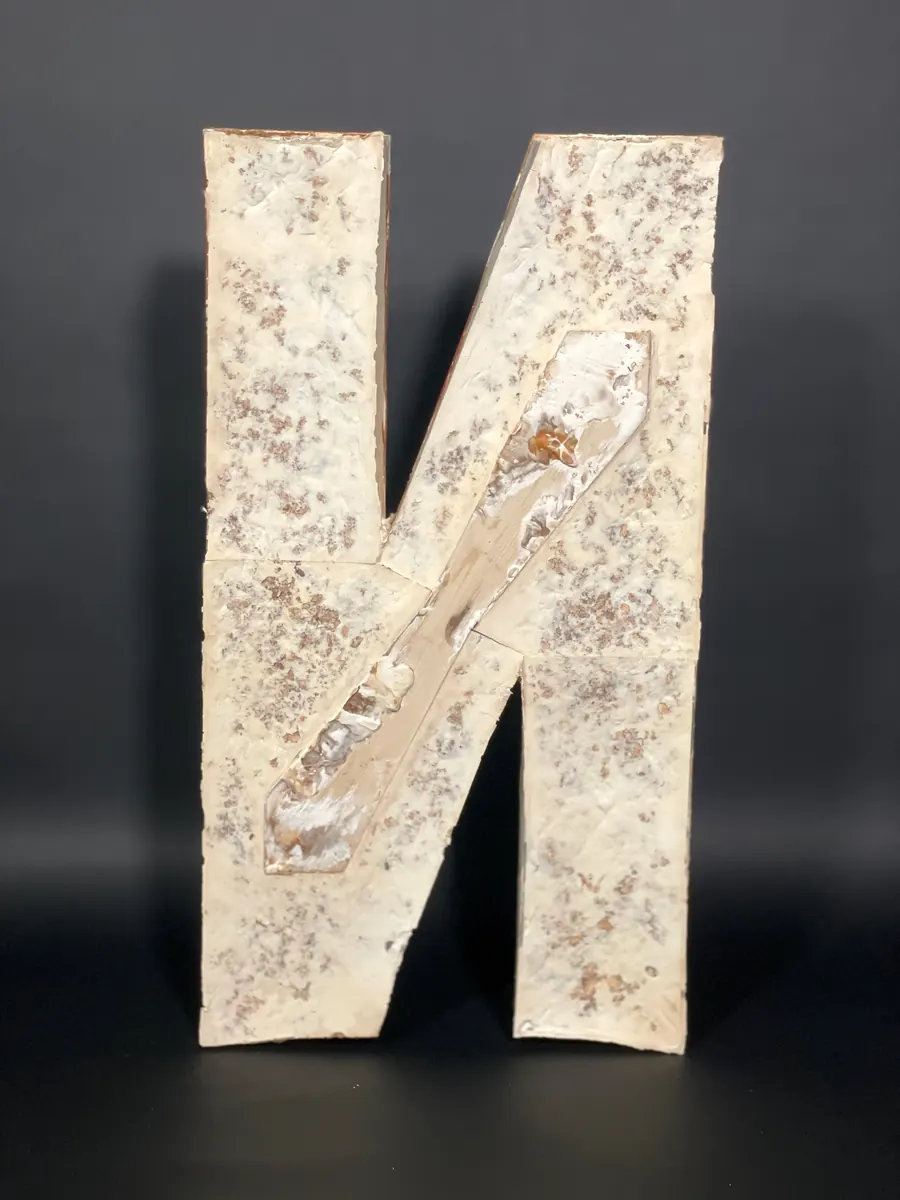
A letter N for Netflix

2023to 2024

Umeå and Stockholm

Matter

Commission from Open Studio Stockholm for Netflix's Stockholm office, December 2023 to March 2024. Shelving by Noas Sweden.
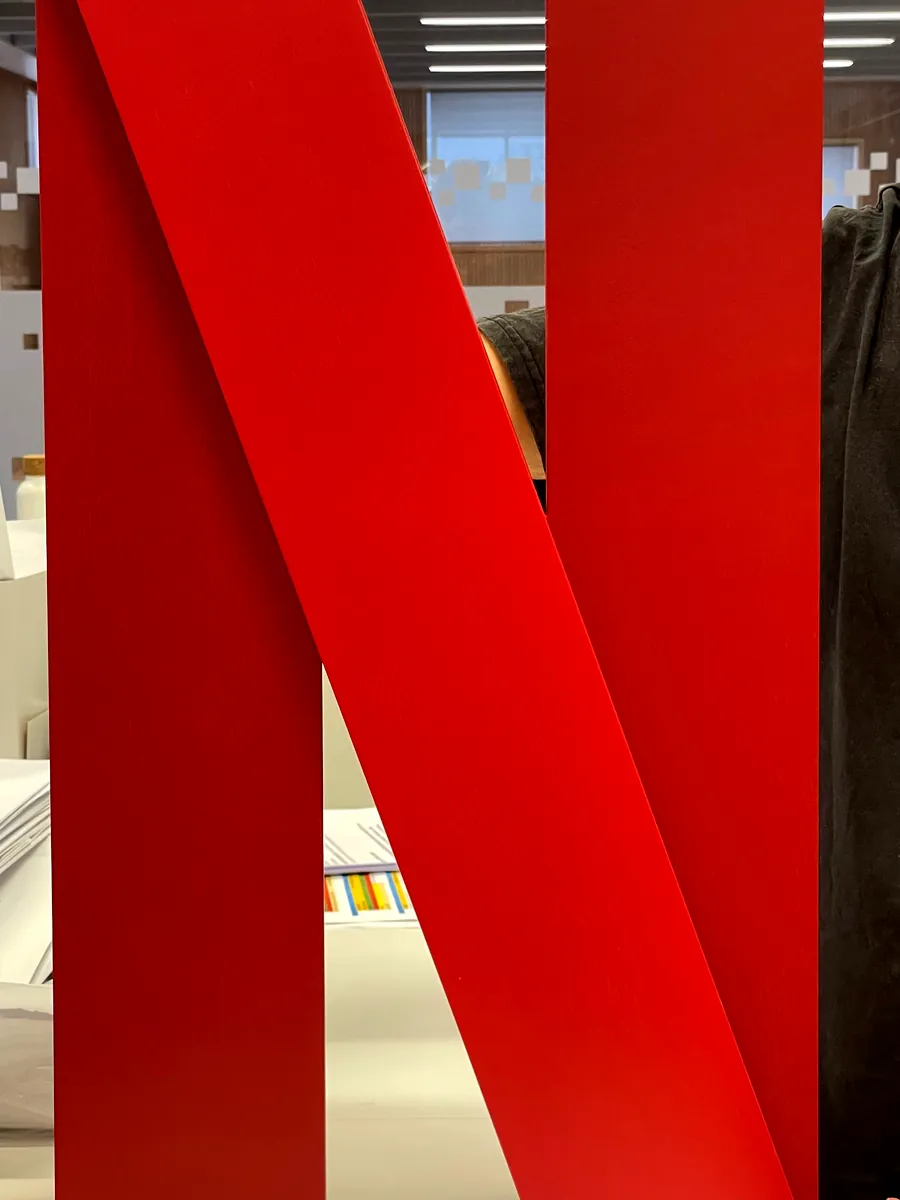
The finished letter N, painted red, its grown edges visible

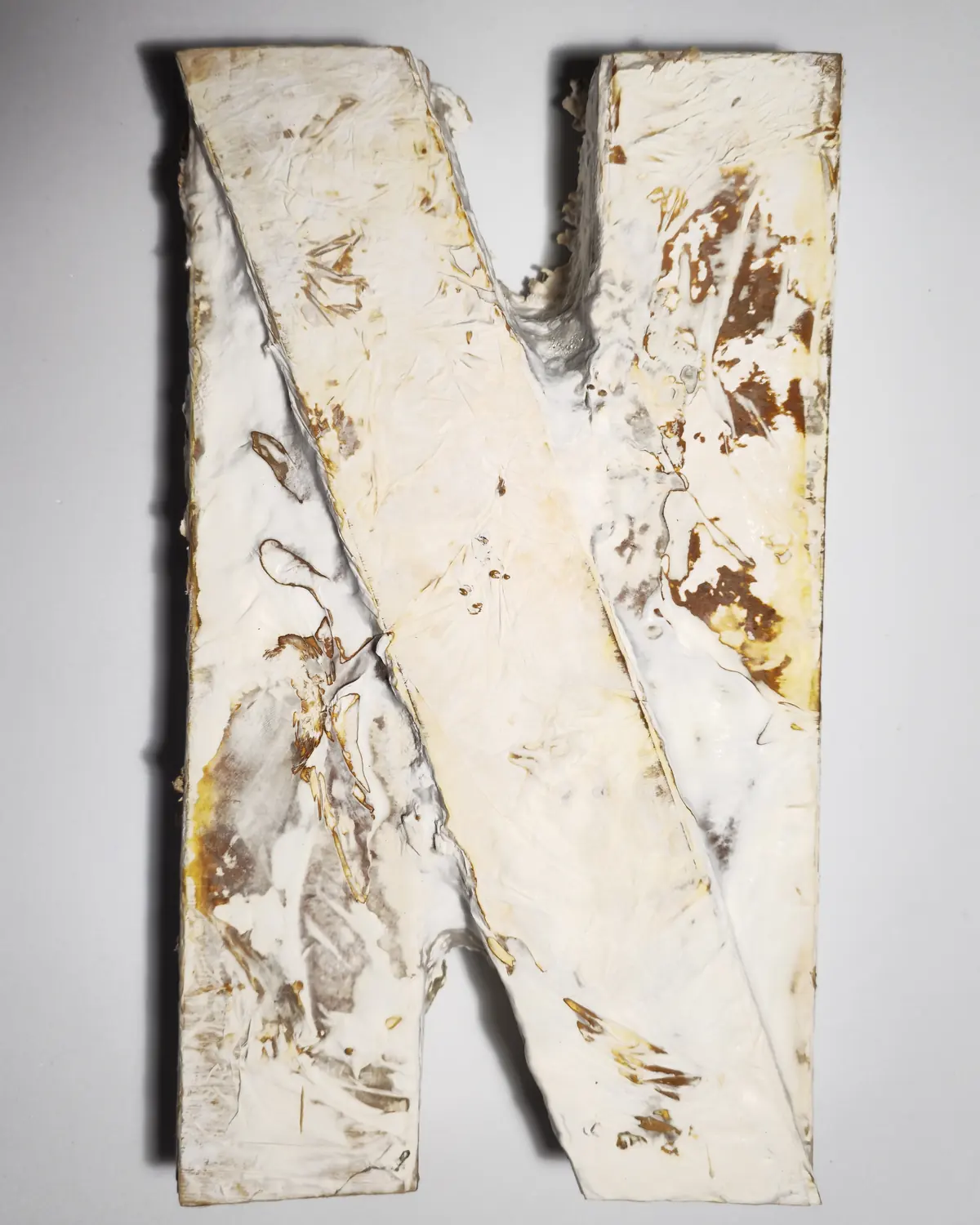
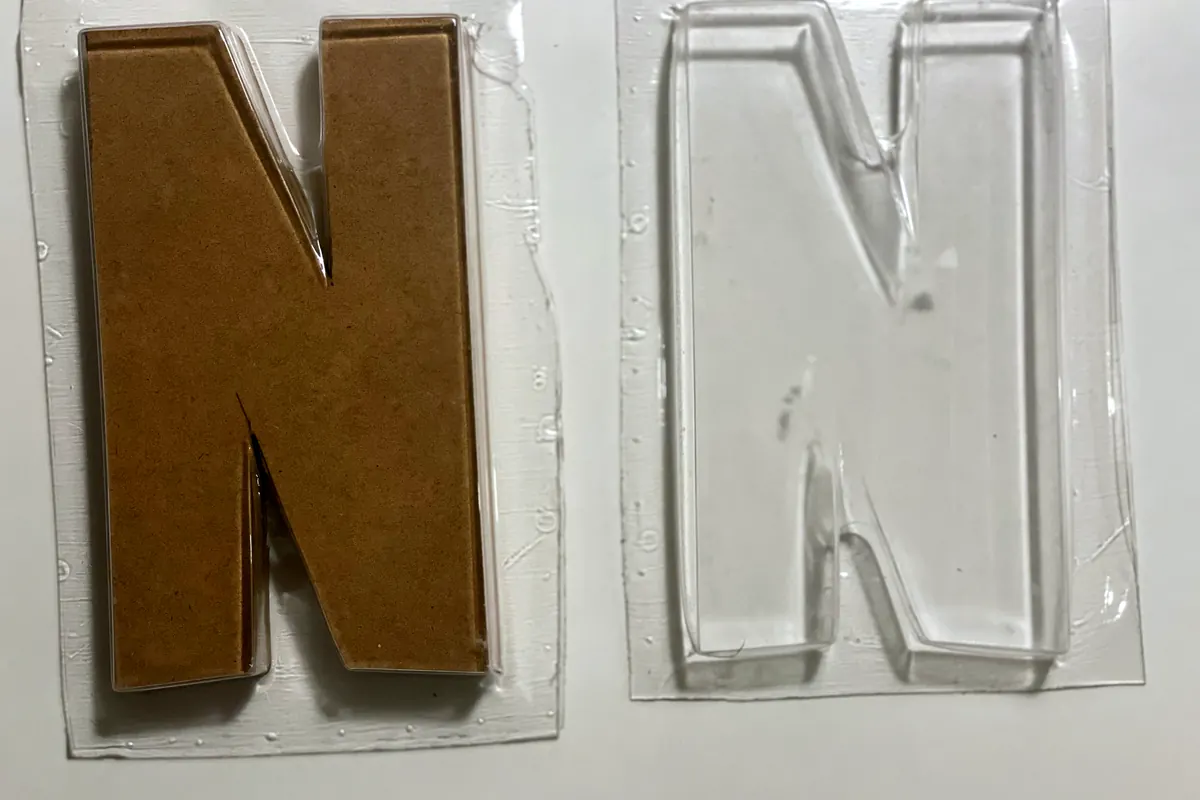
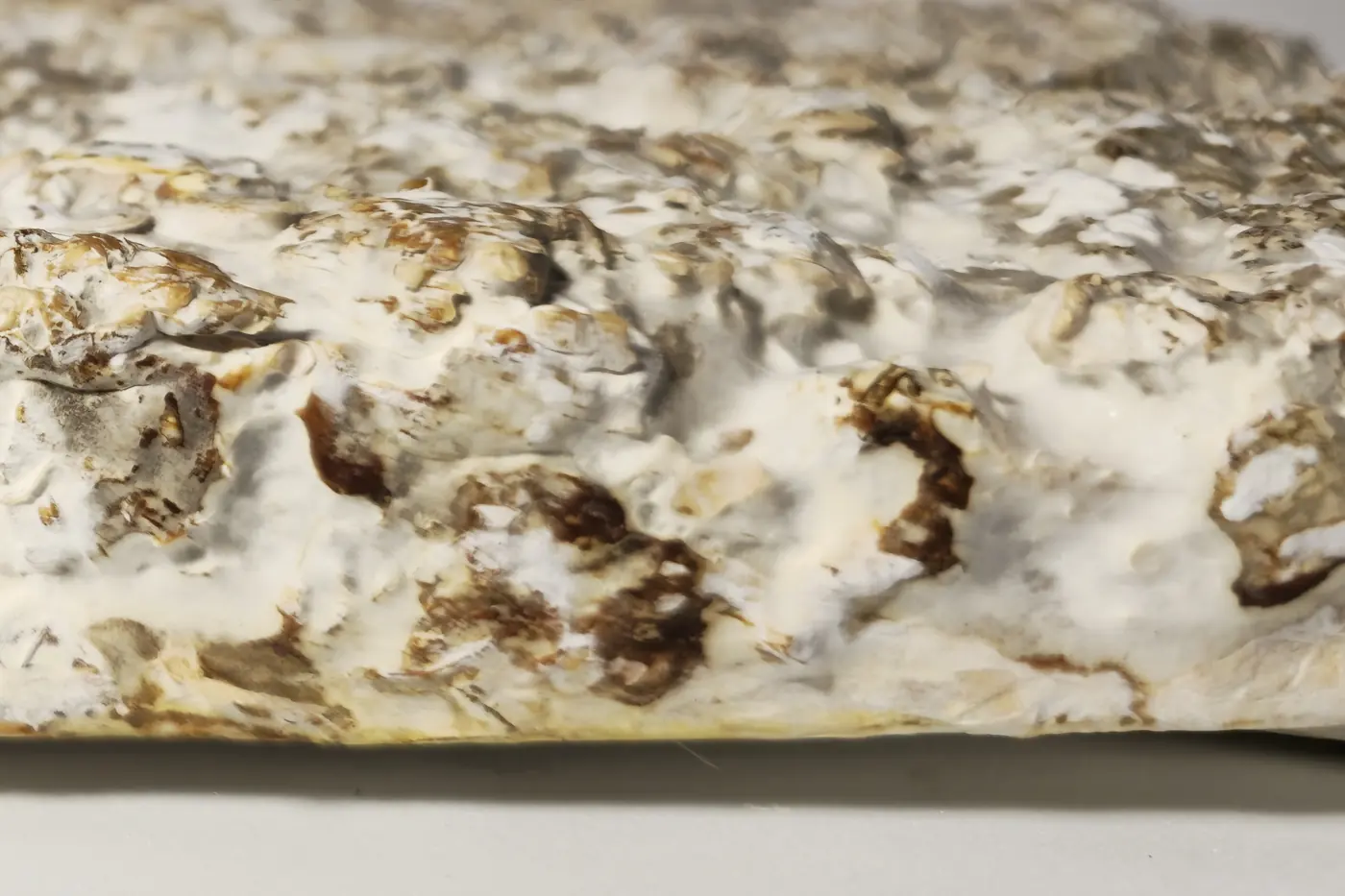
The material was the workshop's leftovers: coconut fibre, wood pulp and cellulose from discarded cardboard, colonised by reishi spawn into a light, solid letter. It grew in moulds of perforated acrylic, so the fungus could breathe, and was sprayed red at the end. I also designed the 3D printed brackets that fix it to the wave-shaped shelving made by Noas Sweden.

It was the first time a client asked for the material rather than a drawing.

The grown N before painting, white with brown patches
Two N-shaped moulds, one filled with substrate, one empty
The finished red N held up in the office
The back of a letter, white mycelium over coconut fibre
Close-up of the grown material's surface

2024 and 2025, Wrocław

ProtoLAB

2024and 2025

Wrocław

PeopleForm

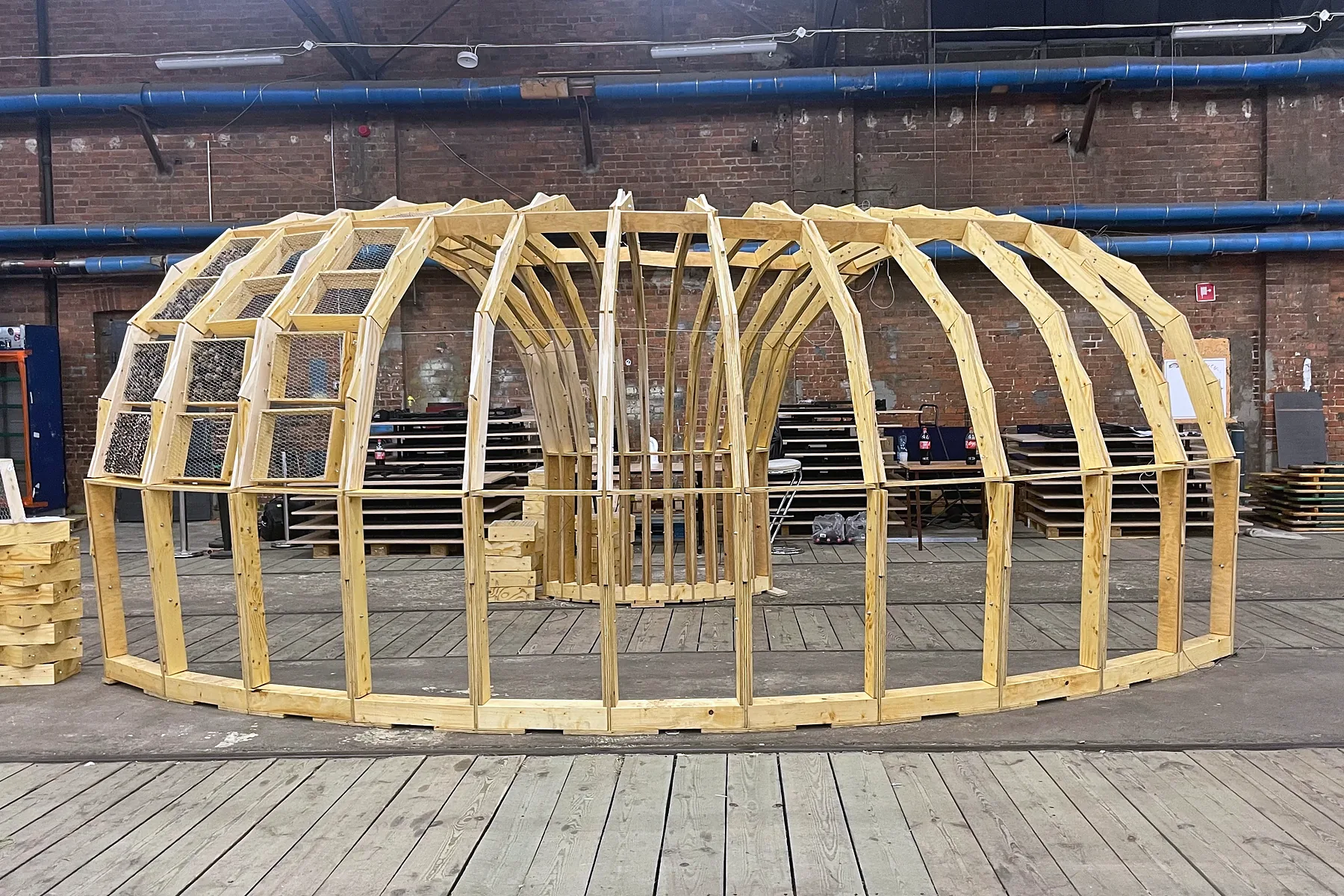
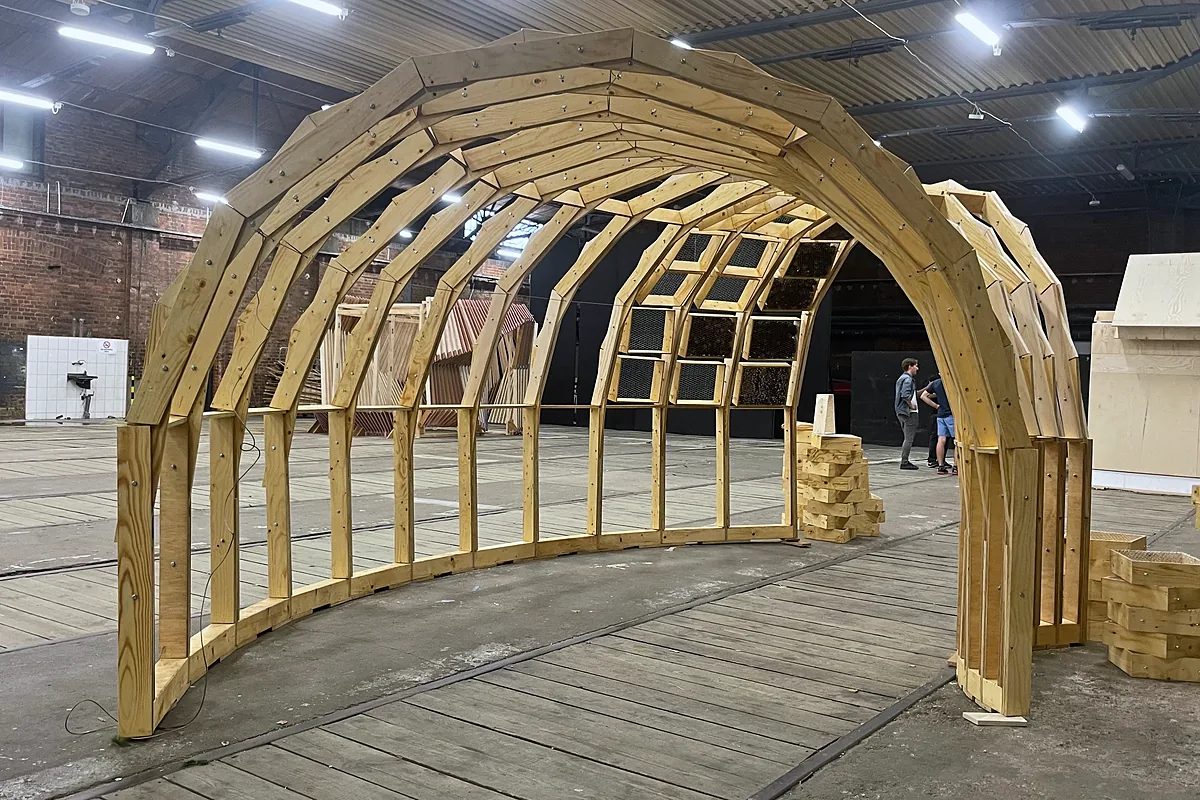
Tutor at the ProtoLAB workshop in Wrocław, July 2024 and July 2025.

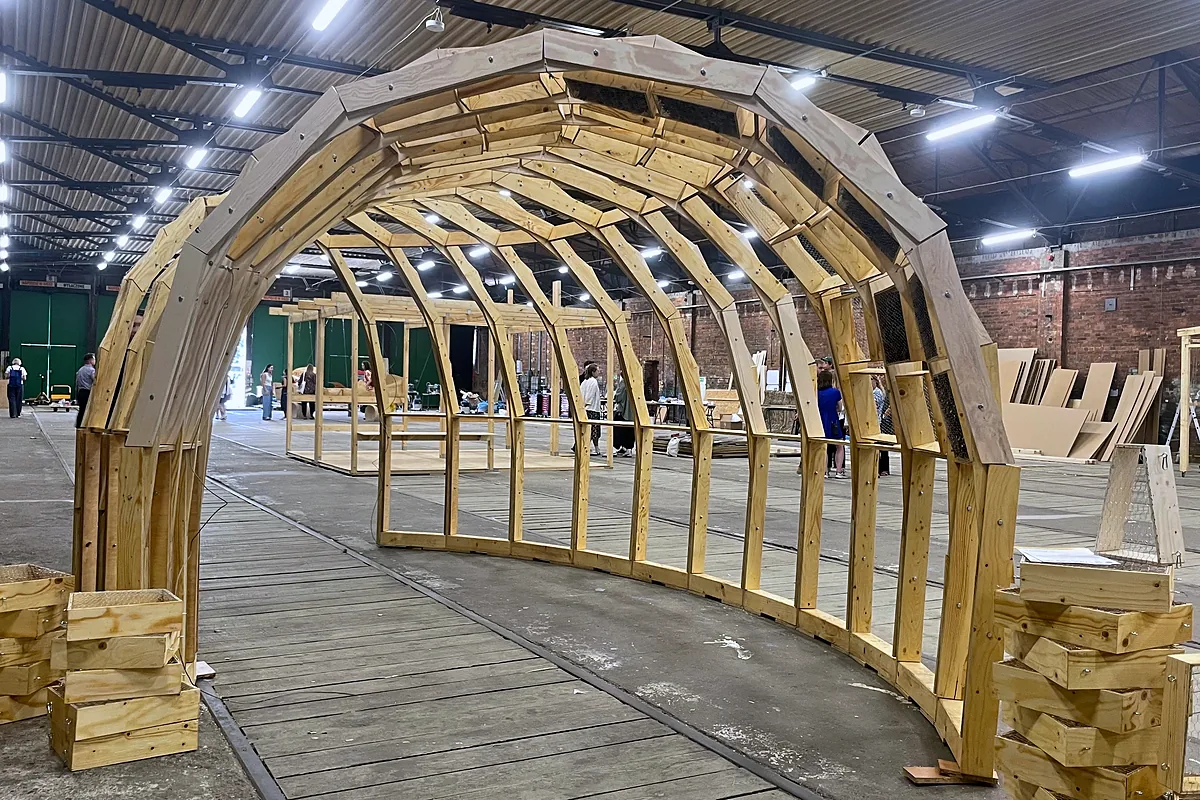
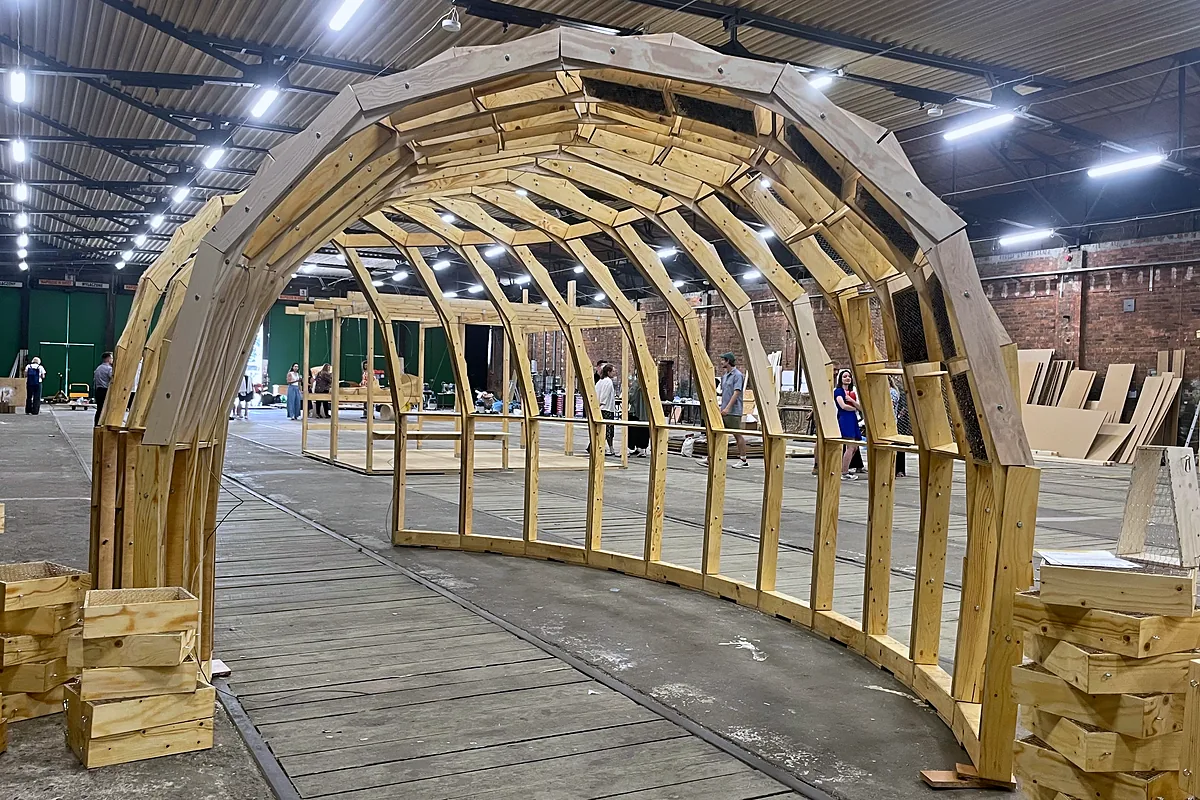
The armadillo from the side: a long vault of timber arches in a large hall, some of its bays filled with nesting boxes, boxes stacked beside it

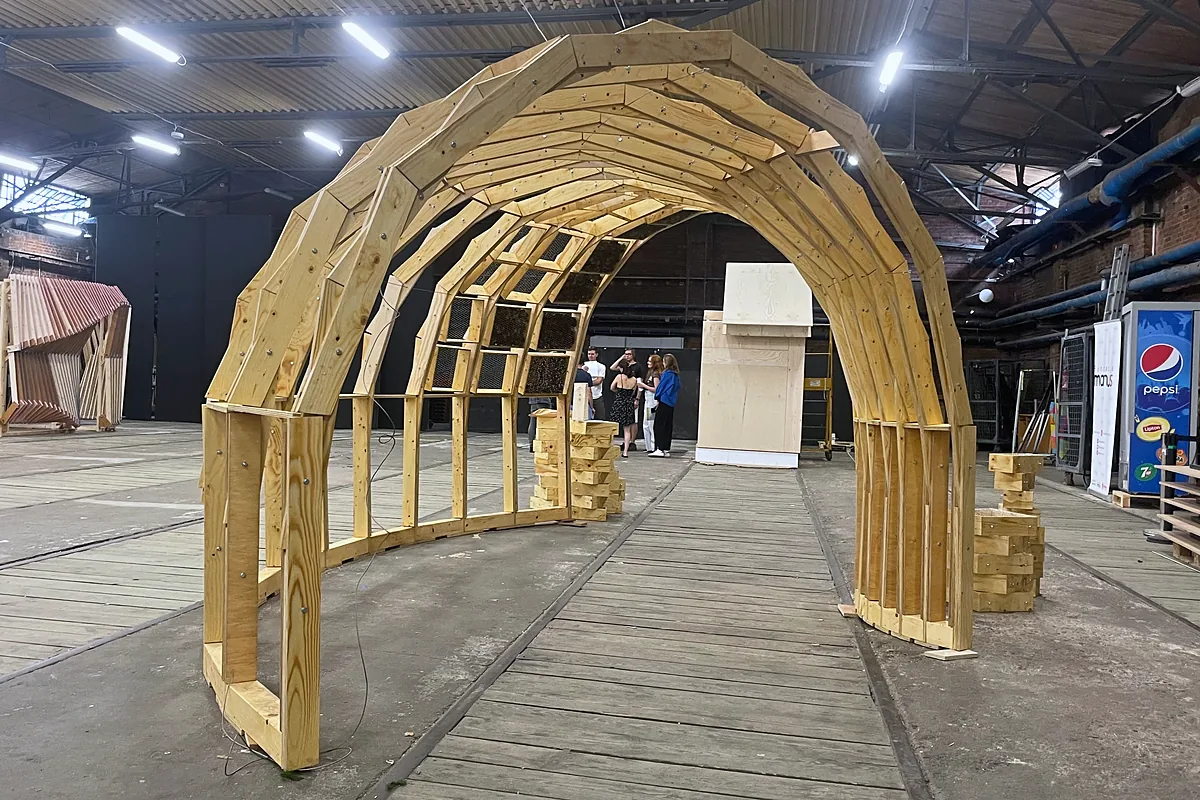
In 2024, with the students of my group and the other tutors, I built an armadillo: a vault of discrete timber arches carrying square boxes filled with straw, bamboo and pine cones, places for bees and other insects to nest.
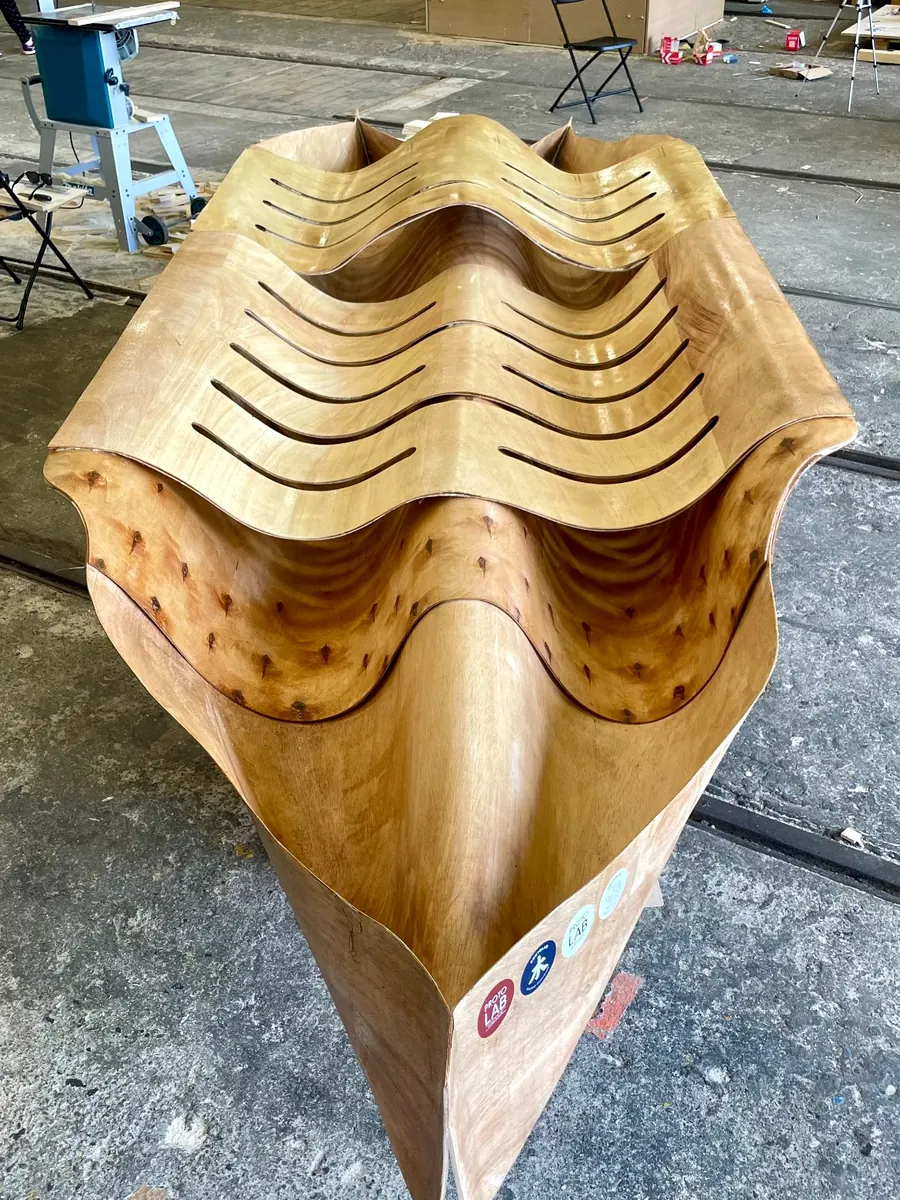
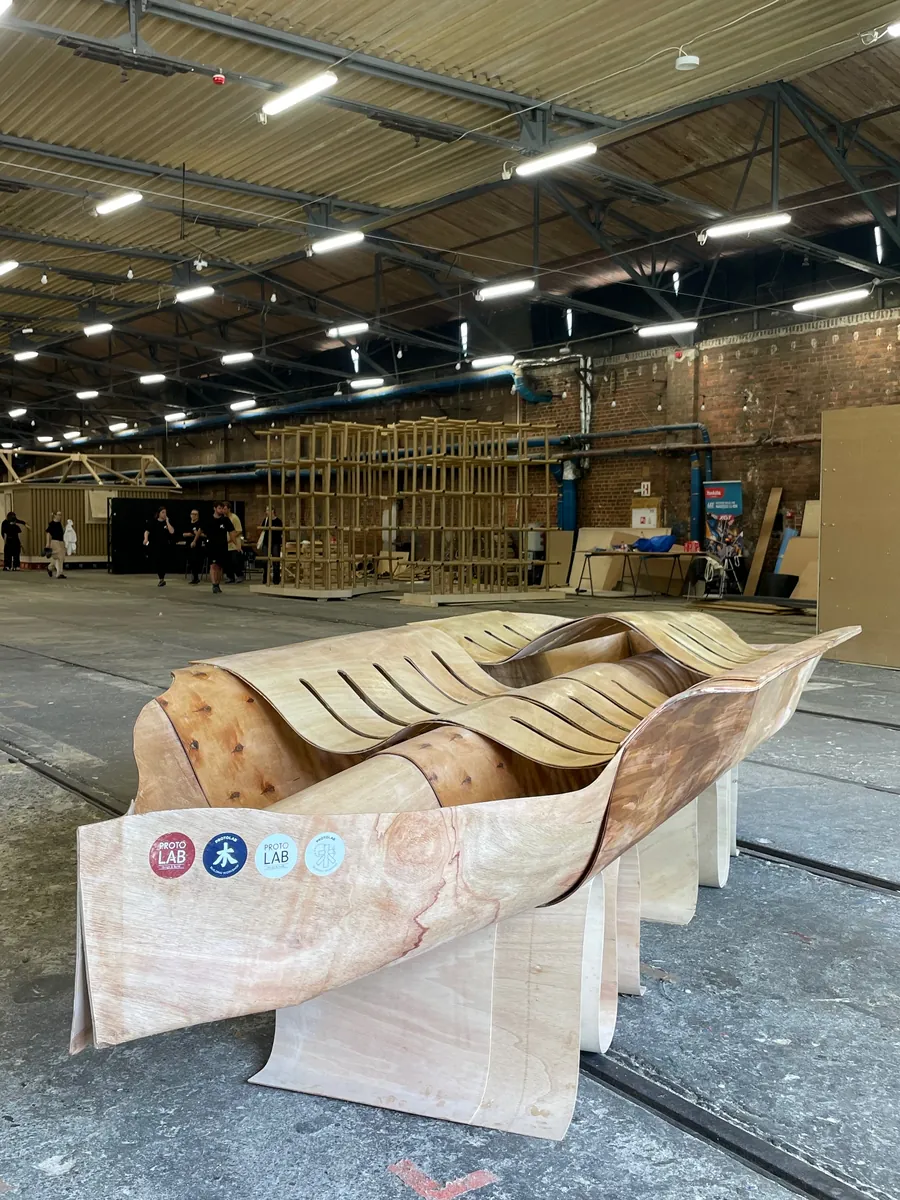
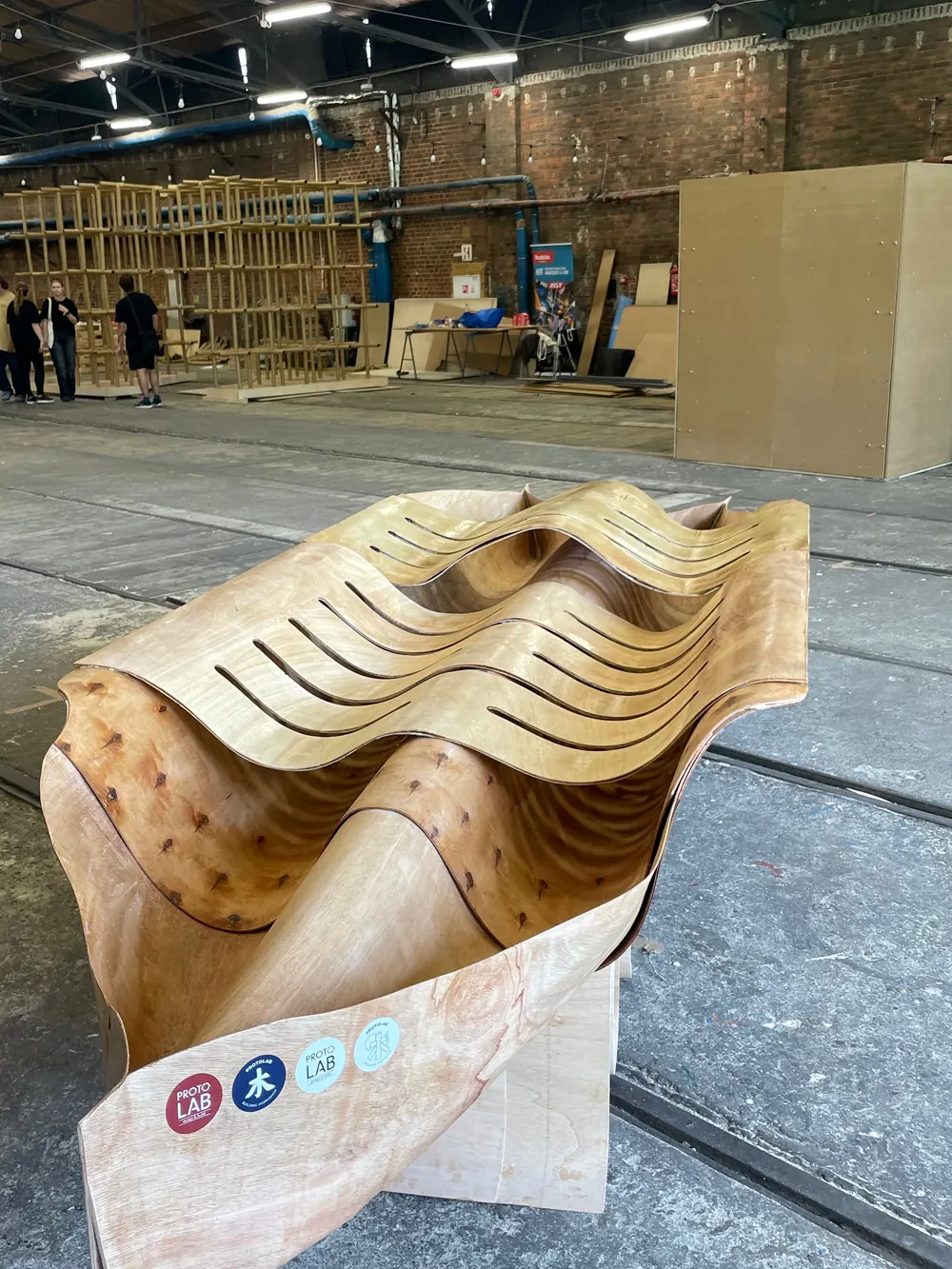
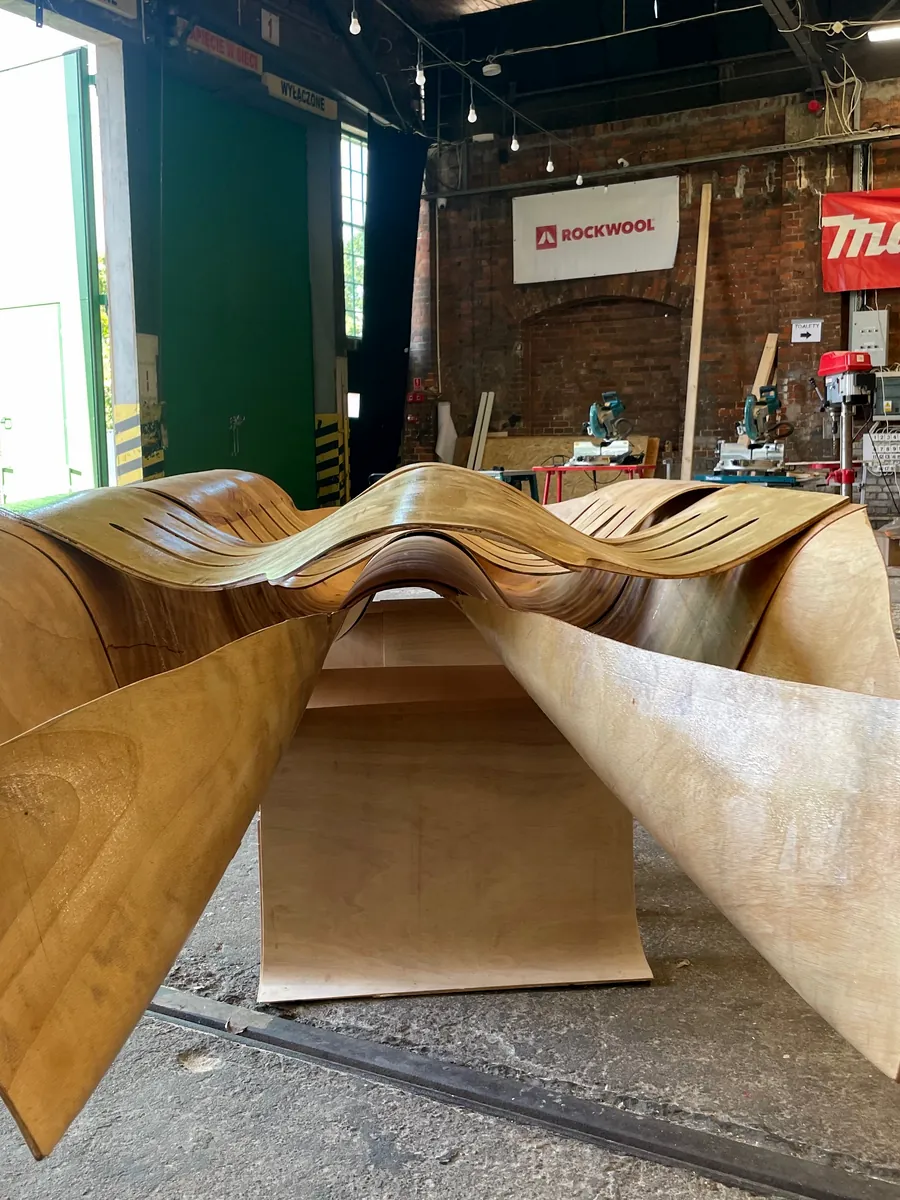
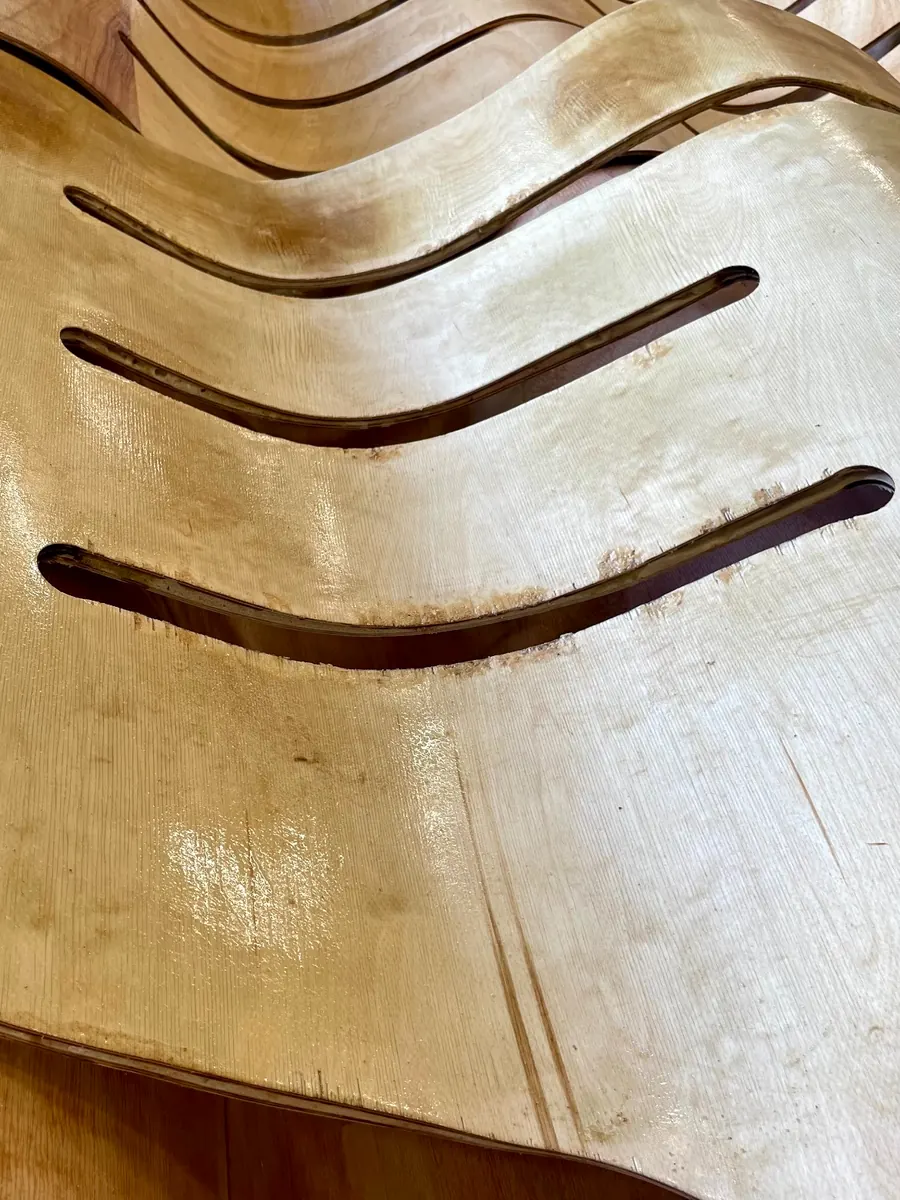
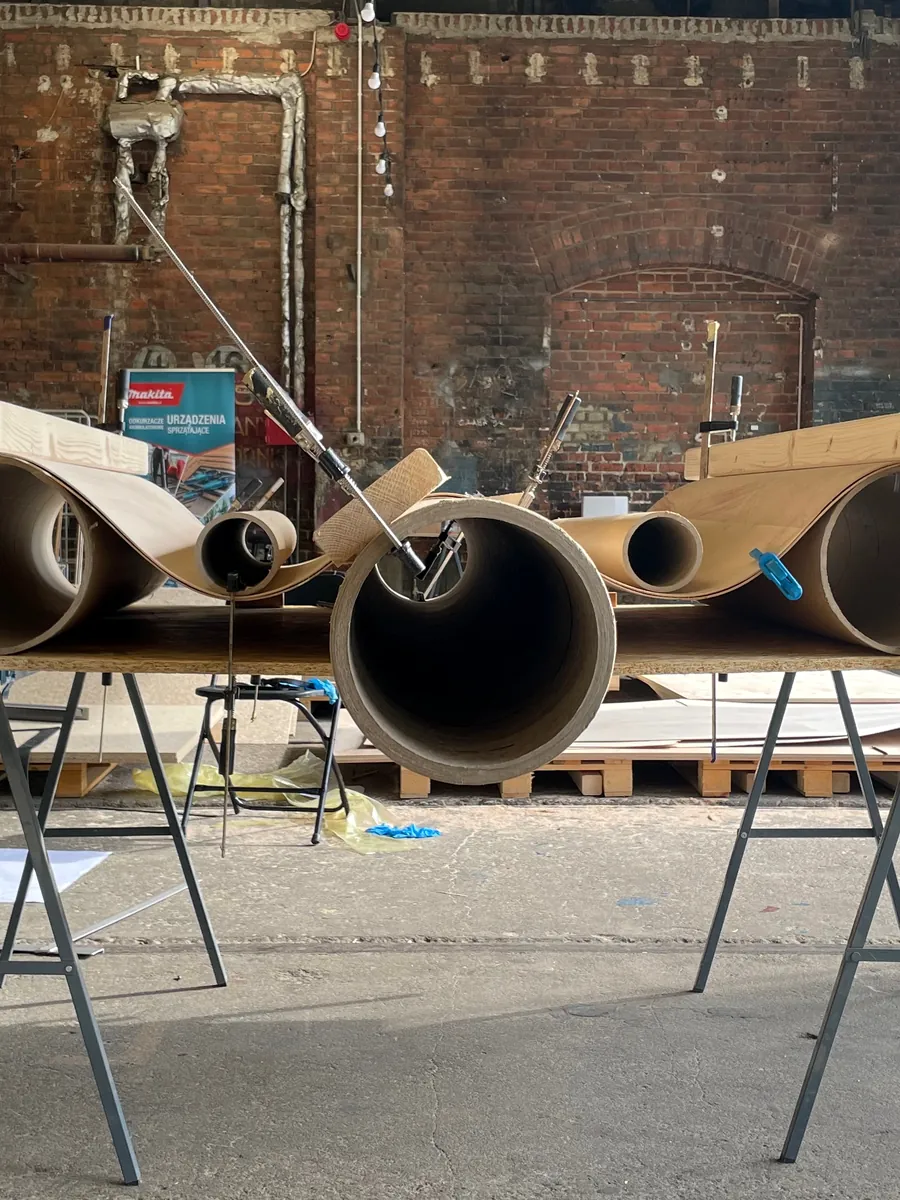
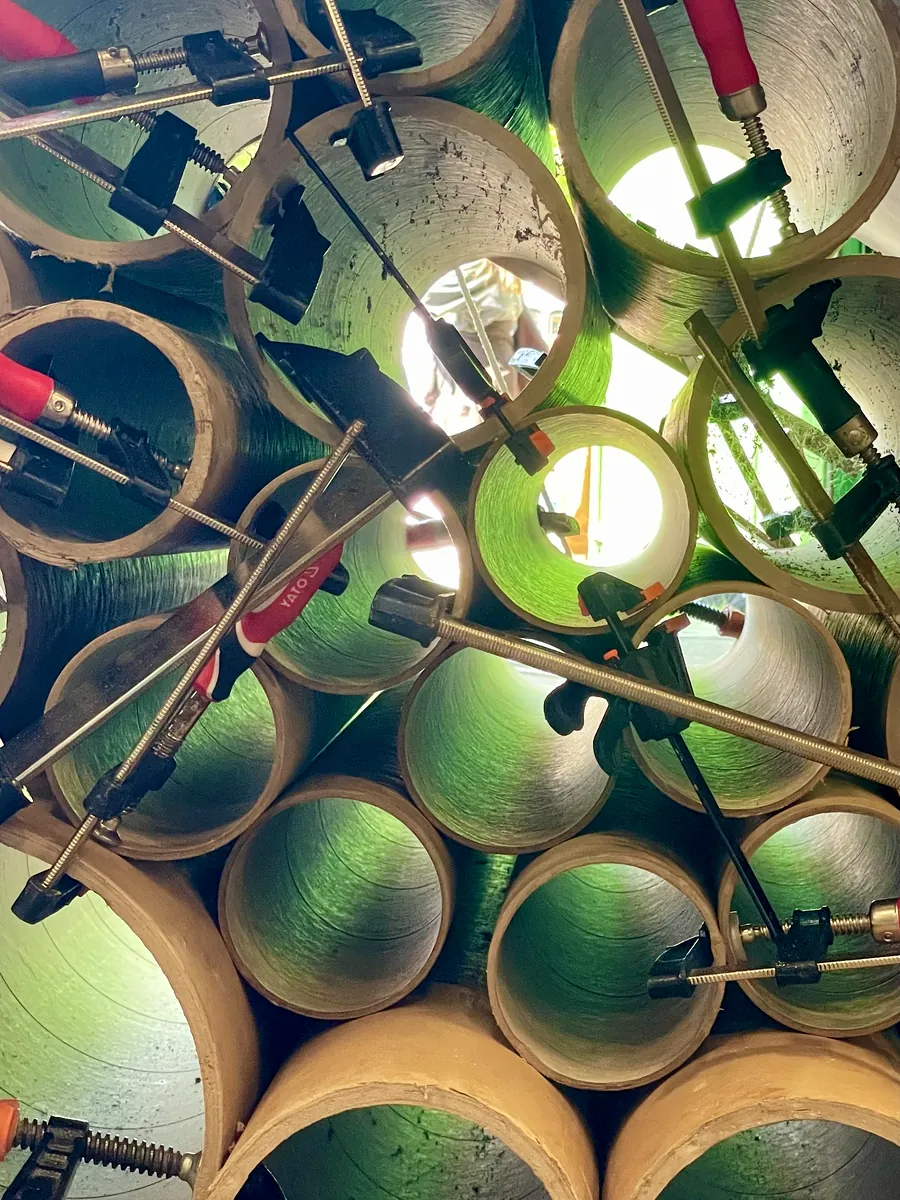
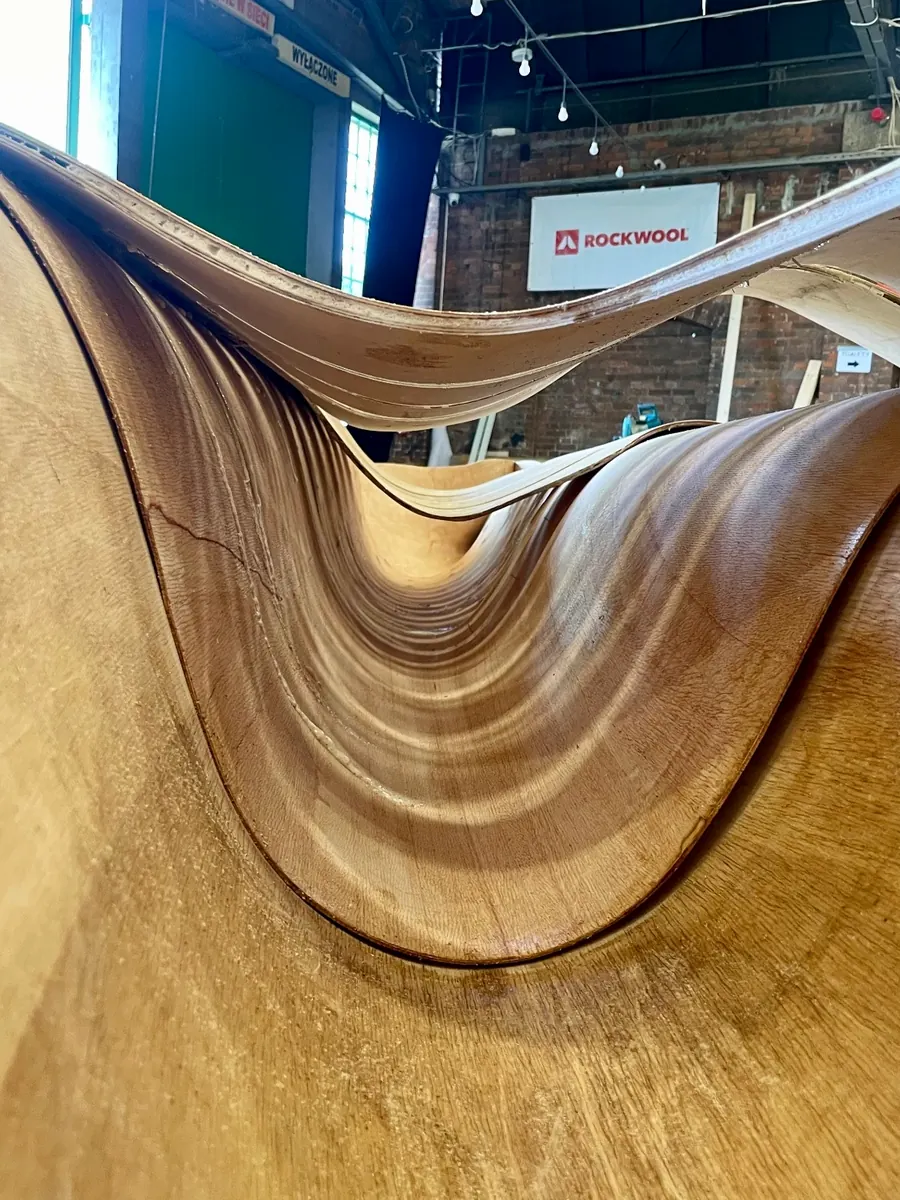
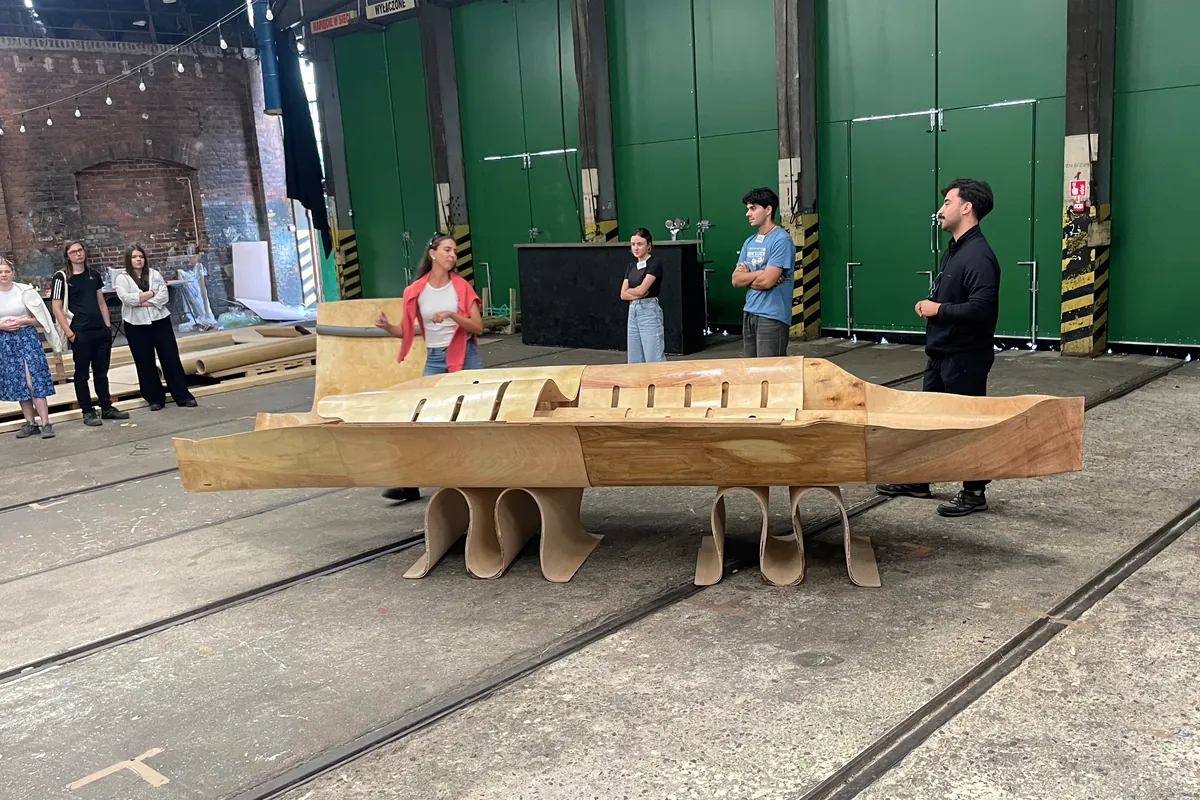
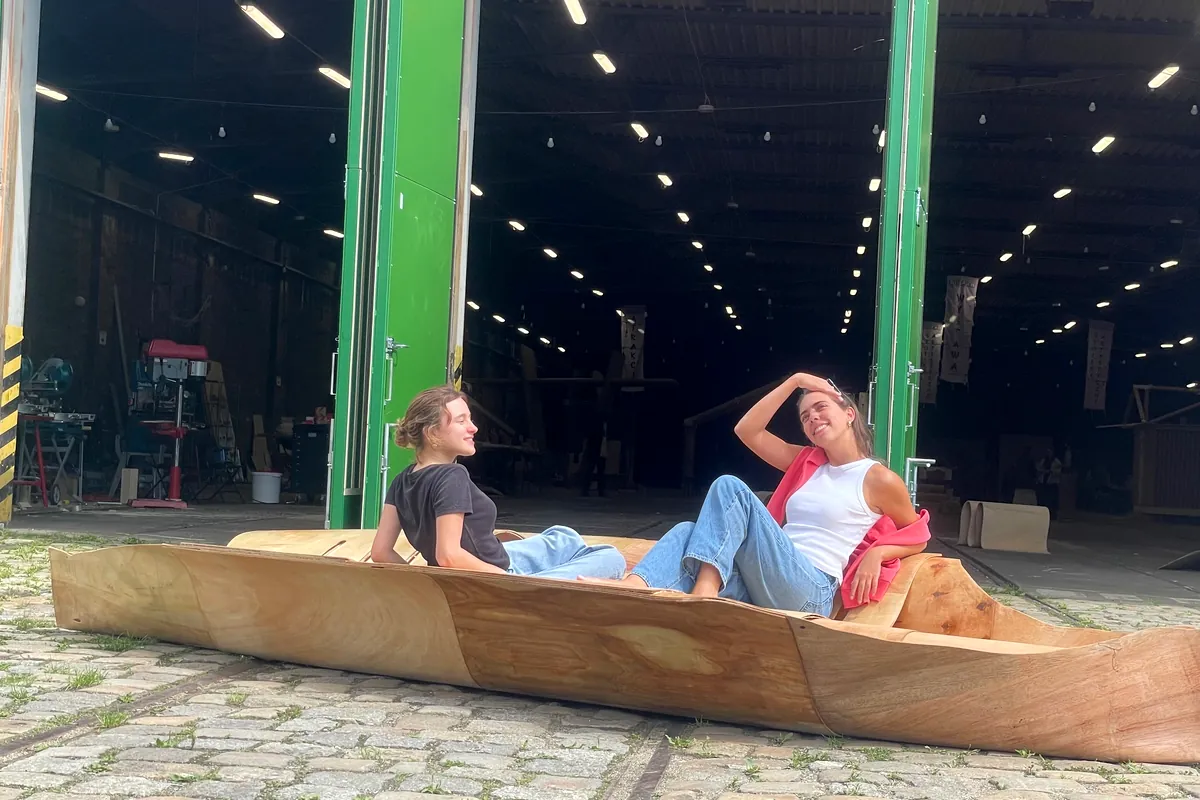
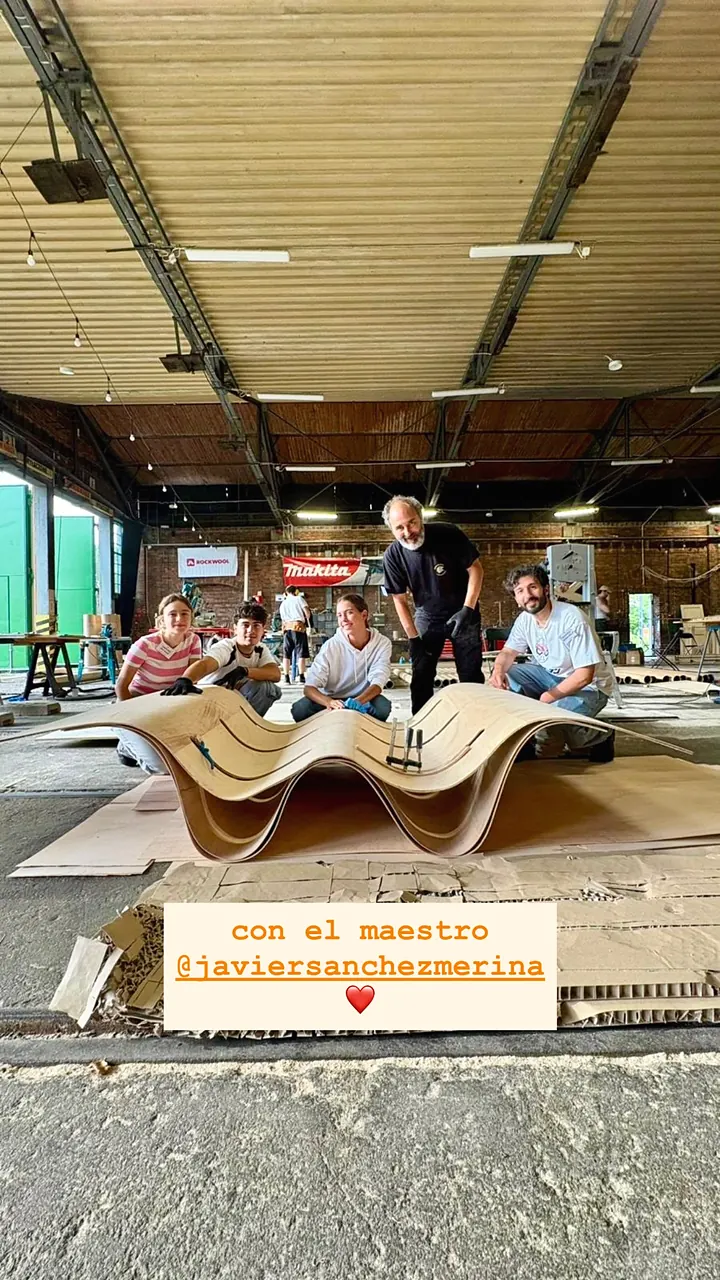
In 2025 I tutored, with Javier Sánchez Merina, a group of students who wanted to build a telescopic canoe. Its strength comes from double curvature and a thin skin of laminated wood.
The timber vault seen from one end at an angle, its arches stepping down towards the floor
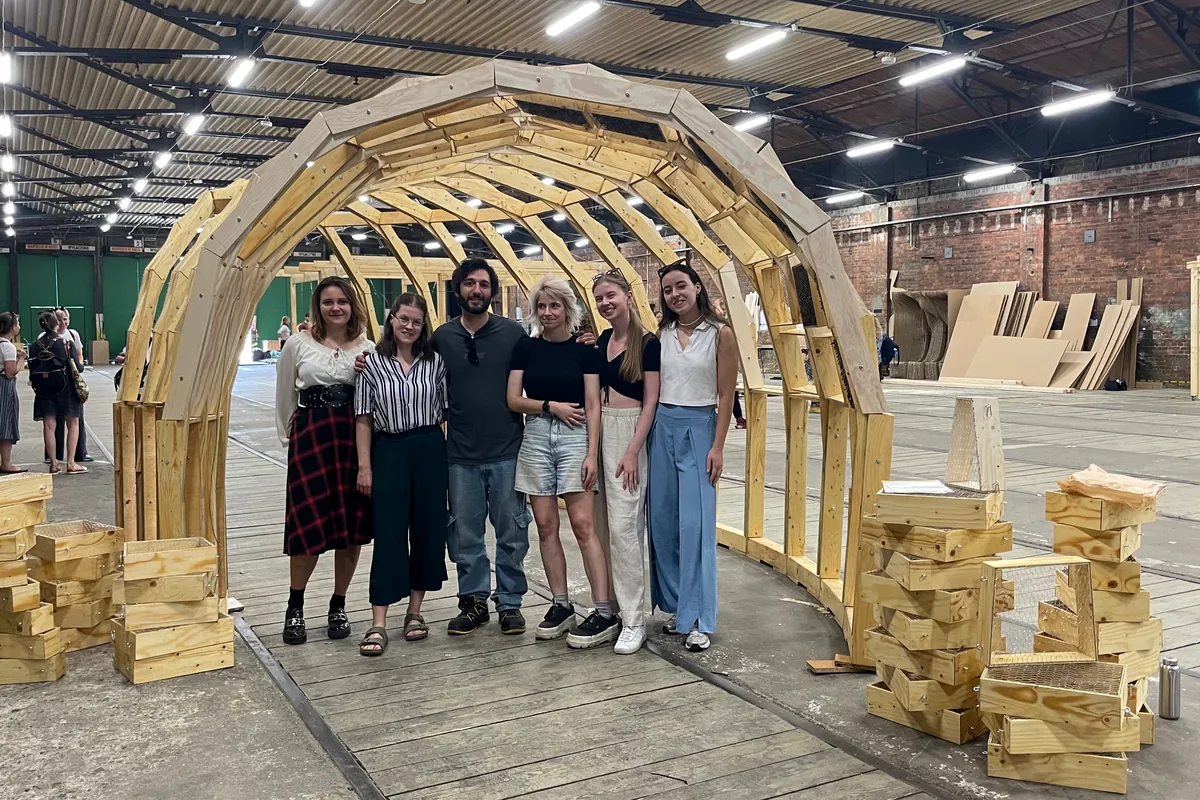
Raffaele with his group of students in front of the finished timber vault, the bee boxes stacked beside it
The team that built it, with their tutors.
The canoe from above, its laminated layers stepping in waves towards the bow
The canoe standing on its supports in the workshop hall
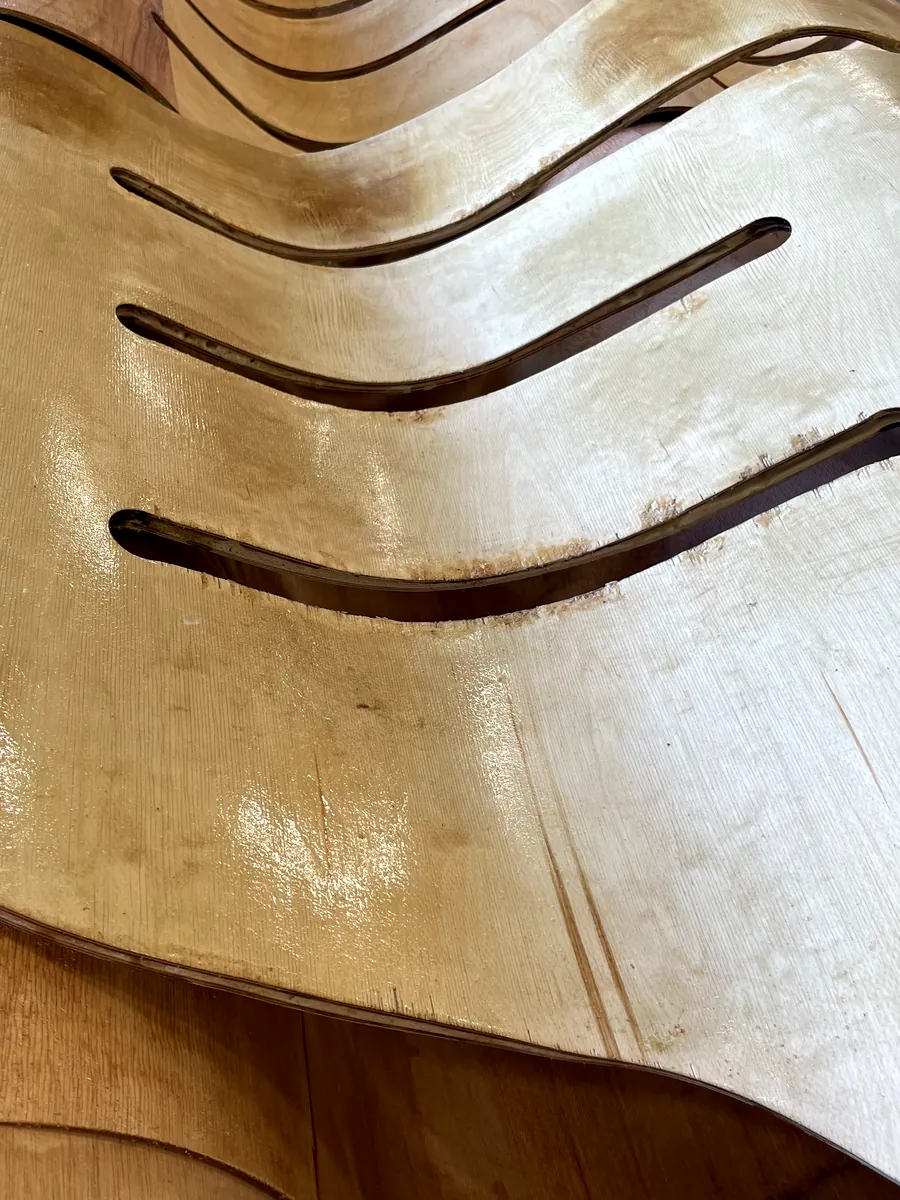
Close-up of the thin laminated wood, cut in long curving slots
The double-curved hull seen from inside
The canoe group presenting the finished hull to visitors in the hall, with their tutors
Two students lying in the finished canoe on the cobbles outside the hall

2024, Barcelona, and in the future

AURORA

2024

Barcelona, and in the future

FormDoctoral research

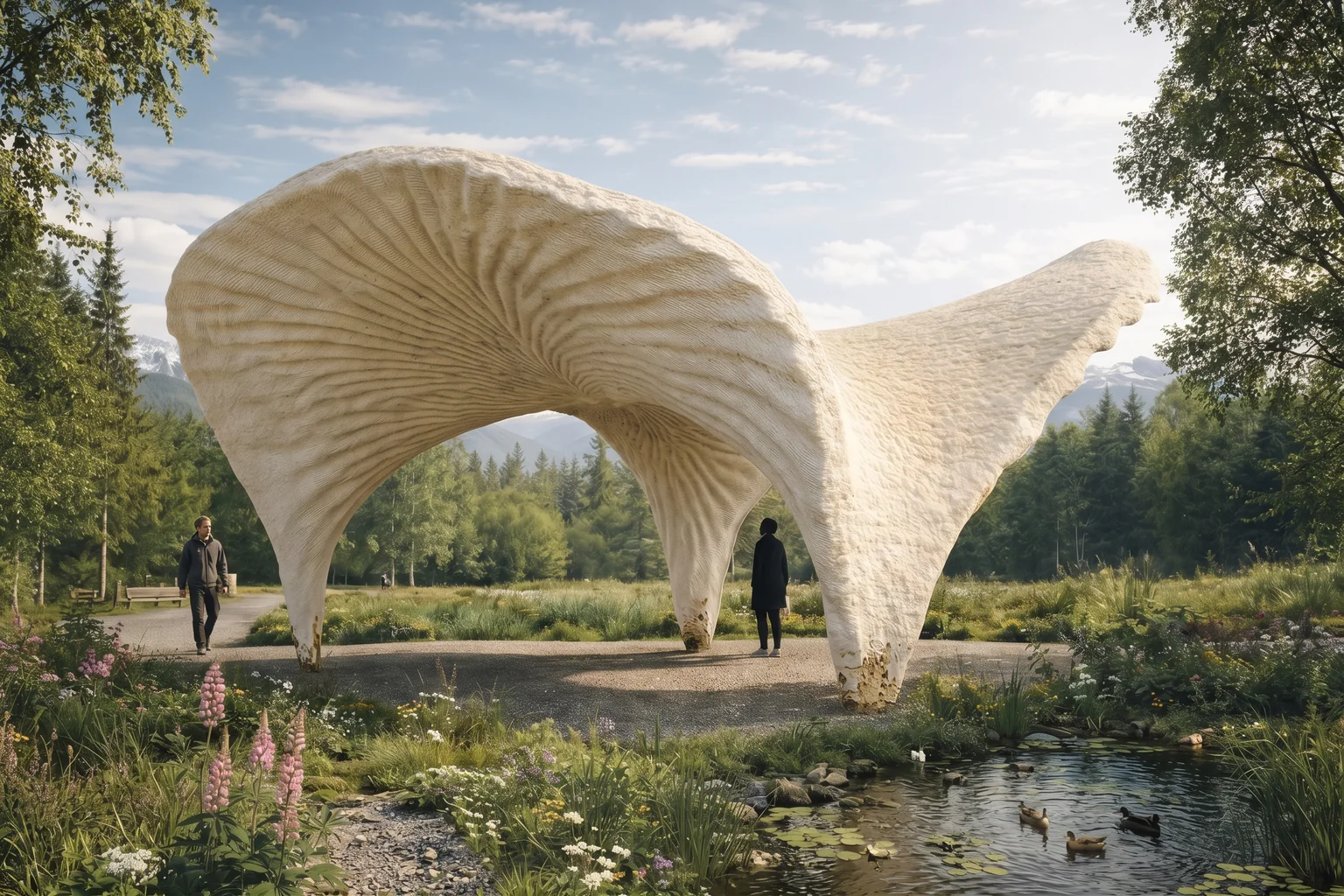
Adaptive Units for Rational, Organic and Resilient Architecture. Paper at SIGraDi 2024, Barcelona. Not yet built.

AI rendering: AURORA, a ribbed cream-white shell of printed mycelium composite, on a gravel path beside a pond in a Nordic birch and spruce landscape, two people under and beside it

Rendering.

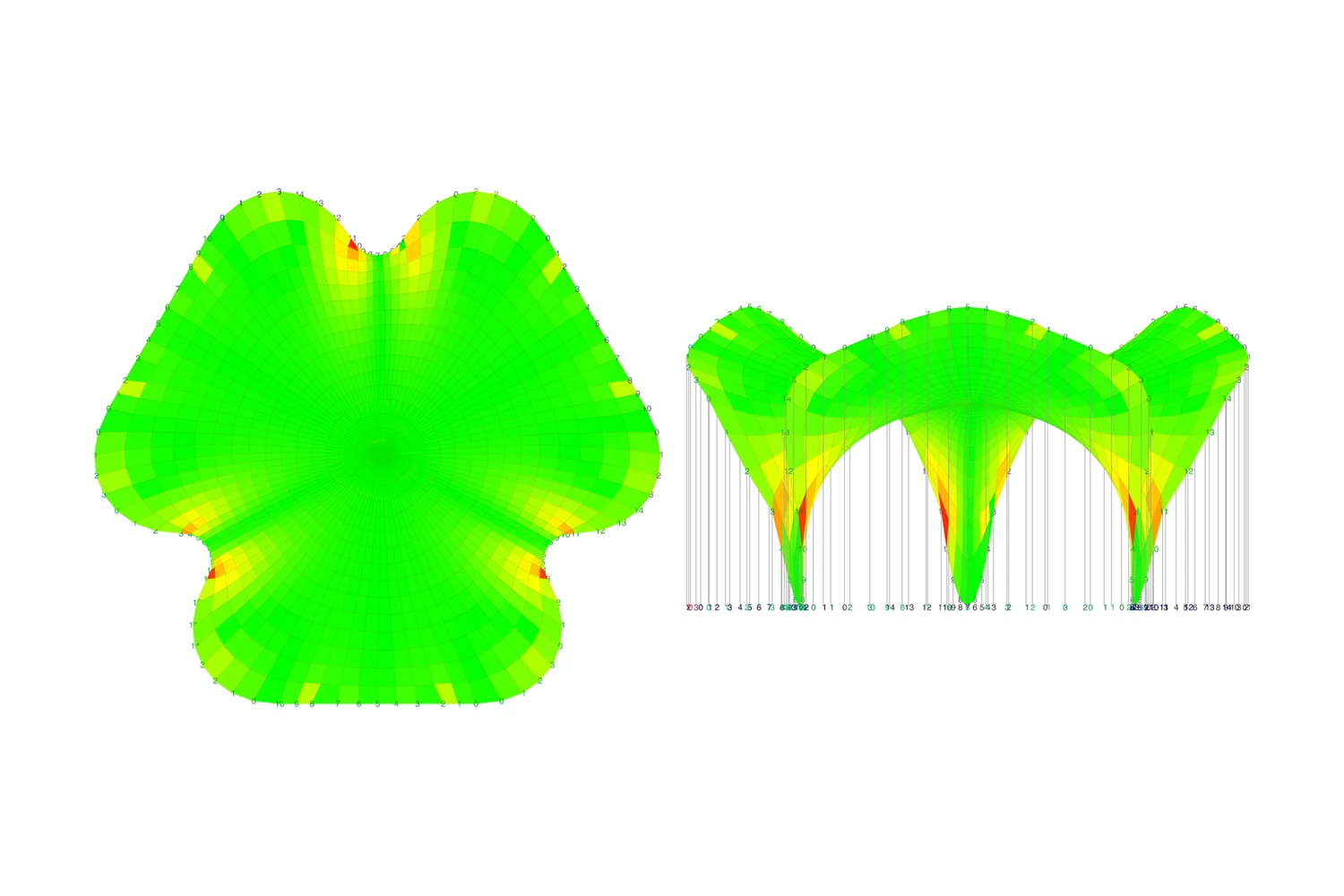
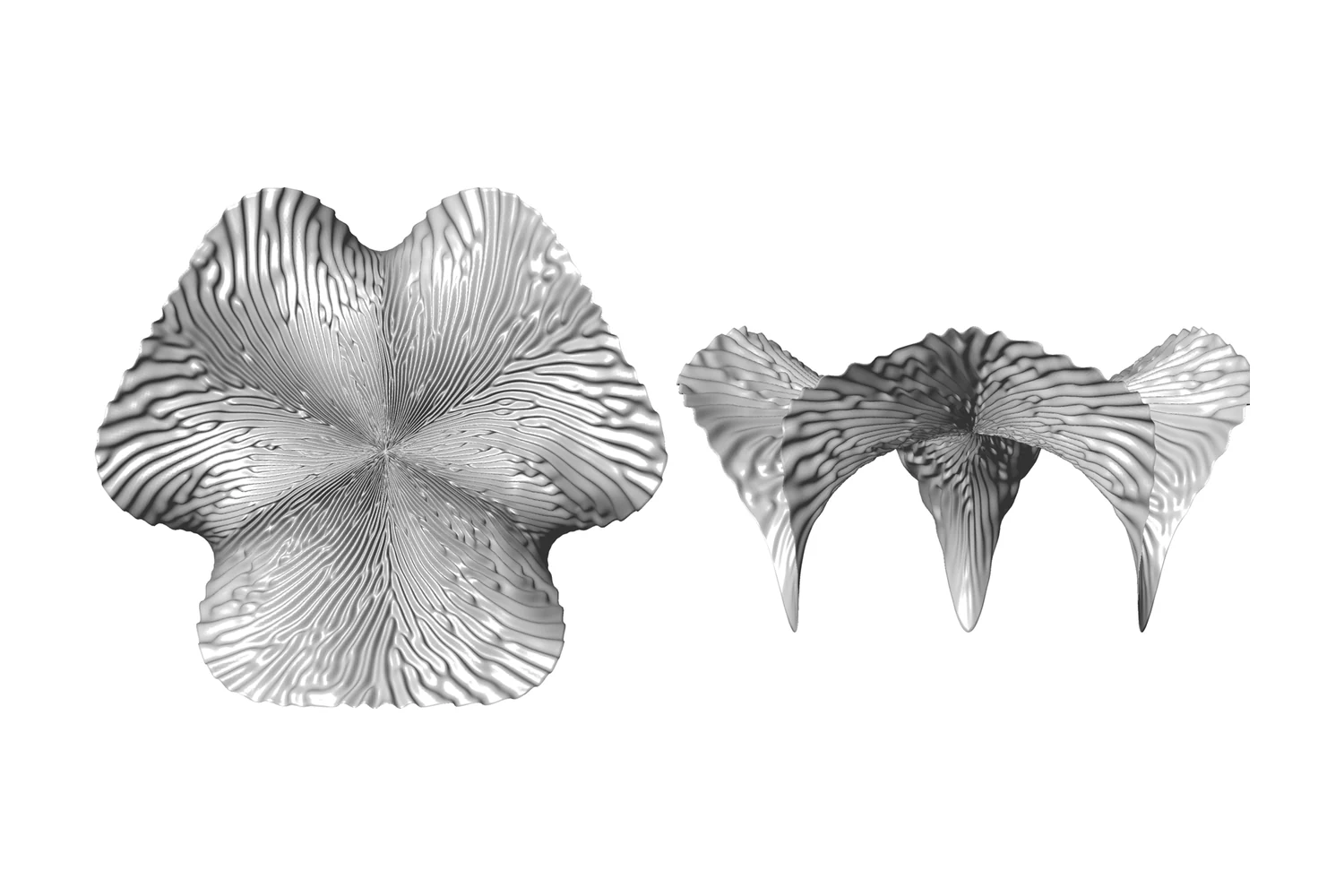
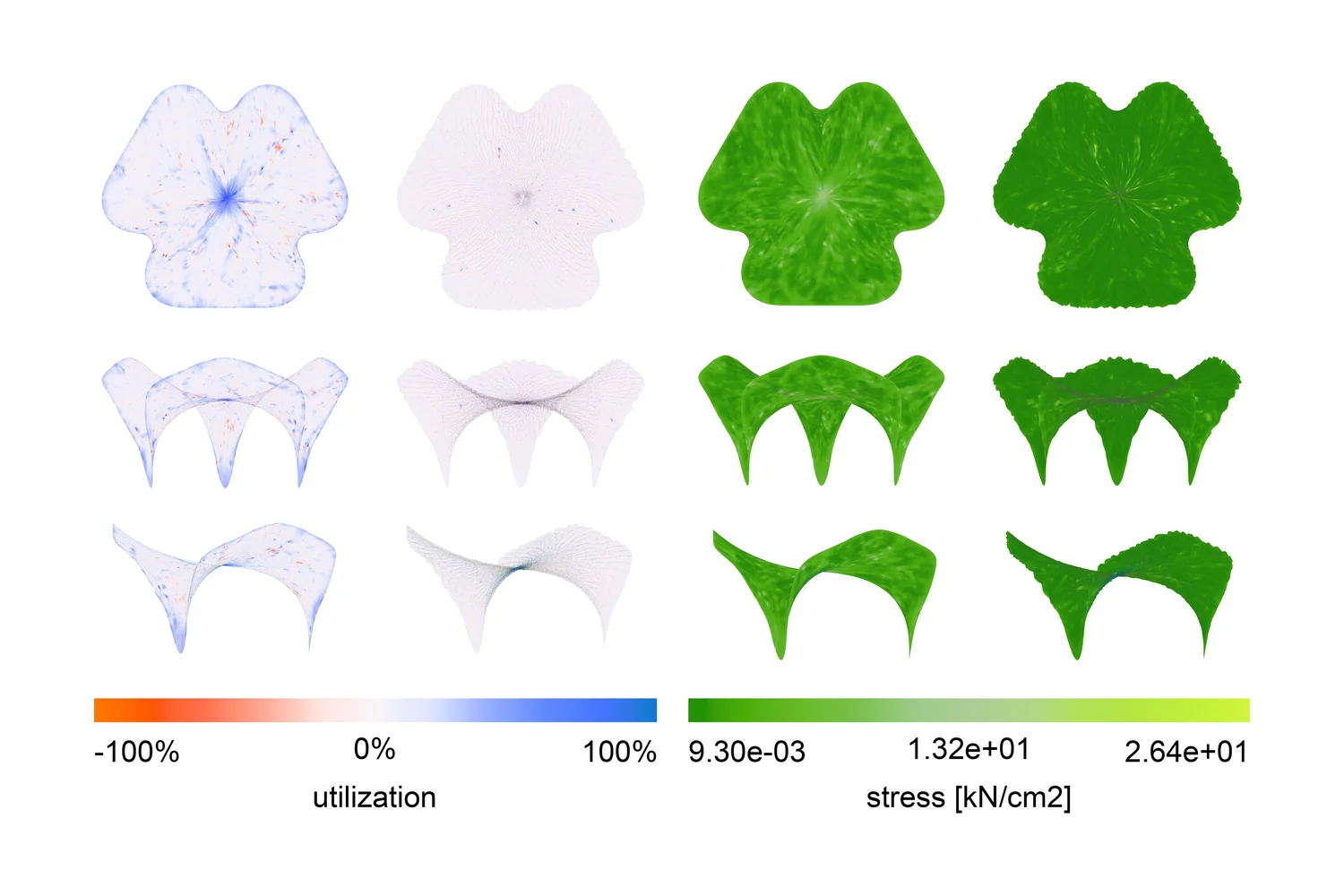
AURORA is where the form line has been heading since the snow shells of 2020. It took shape in the thesis, was rebuilt in steel and rope as MK3 in 2022, and was published at SIGraDi 2024: shells shaped like soap films, found with a physics solver and checked with structural analysis, with a reaction-diffusion pattern moving material to where the loads are. Hexagonal units combine to fit a site and the people who use it.

It has not been built. My doctorate is the groundwork: before AURORA can be printed in a living material, I need to know how its geometry changes growth, strength and dimensional stability. Building it is the step after the defence.

  1. The fabric prototype against the low winter sun

    2020Stasys, Umeå

  2. Thesis model of arches and nets with a small white figure

    2021Coltivare strutture

  3. MK3 in the workshop: bent steel hoops carrying a rope net

    2022MK3

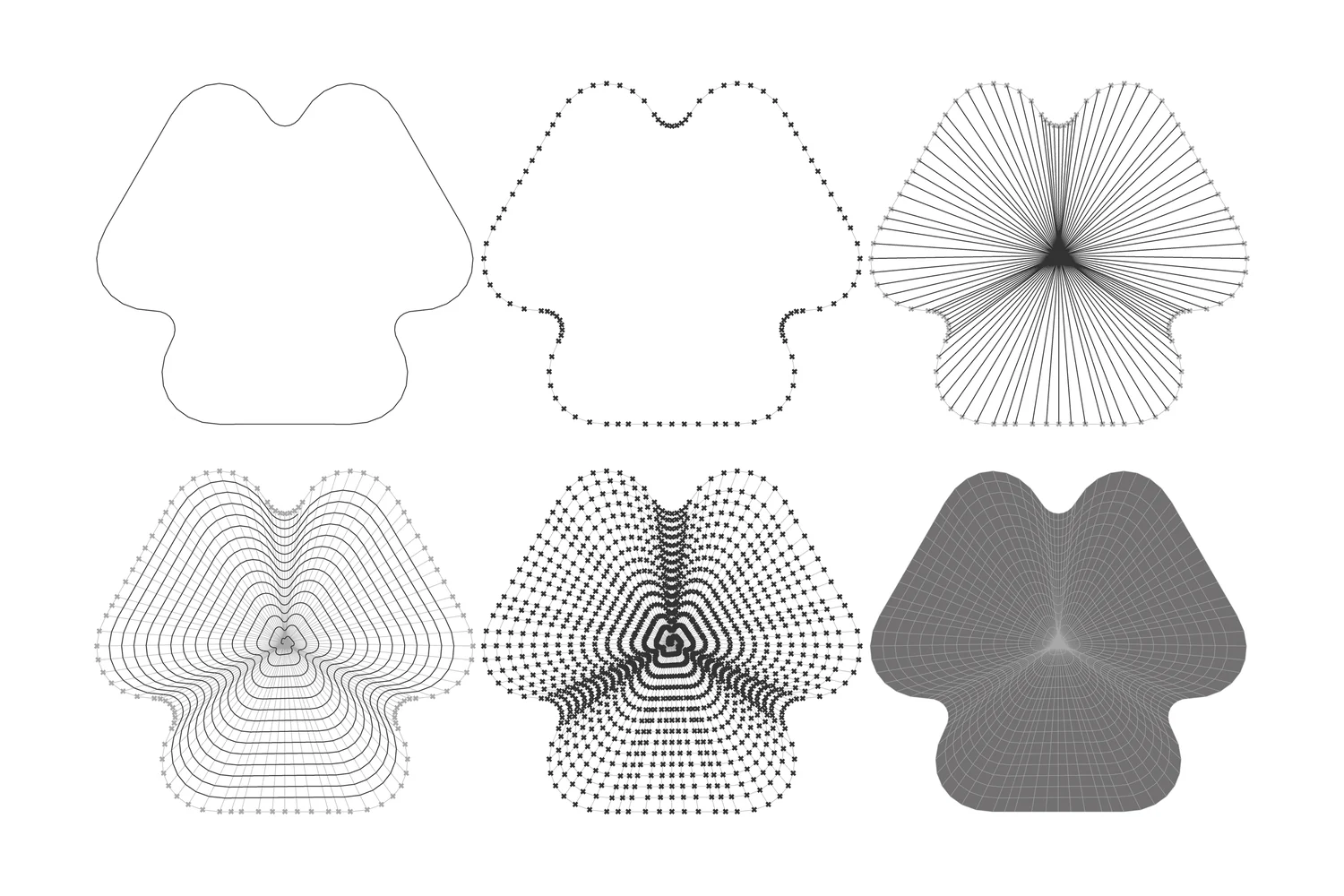
  4. From the AURORA paper: the outline of the shell found from a triangle, then divided by radial lines into a mesh

    2024AURORA, the paper: the form found from a triangle, the planarity of its panels, the reaction-diffusion relief, material use and stress

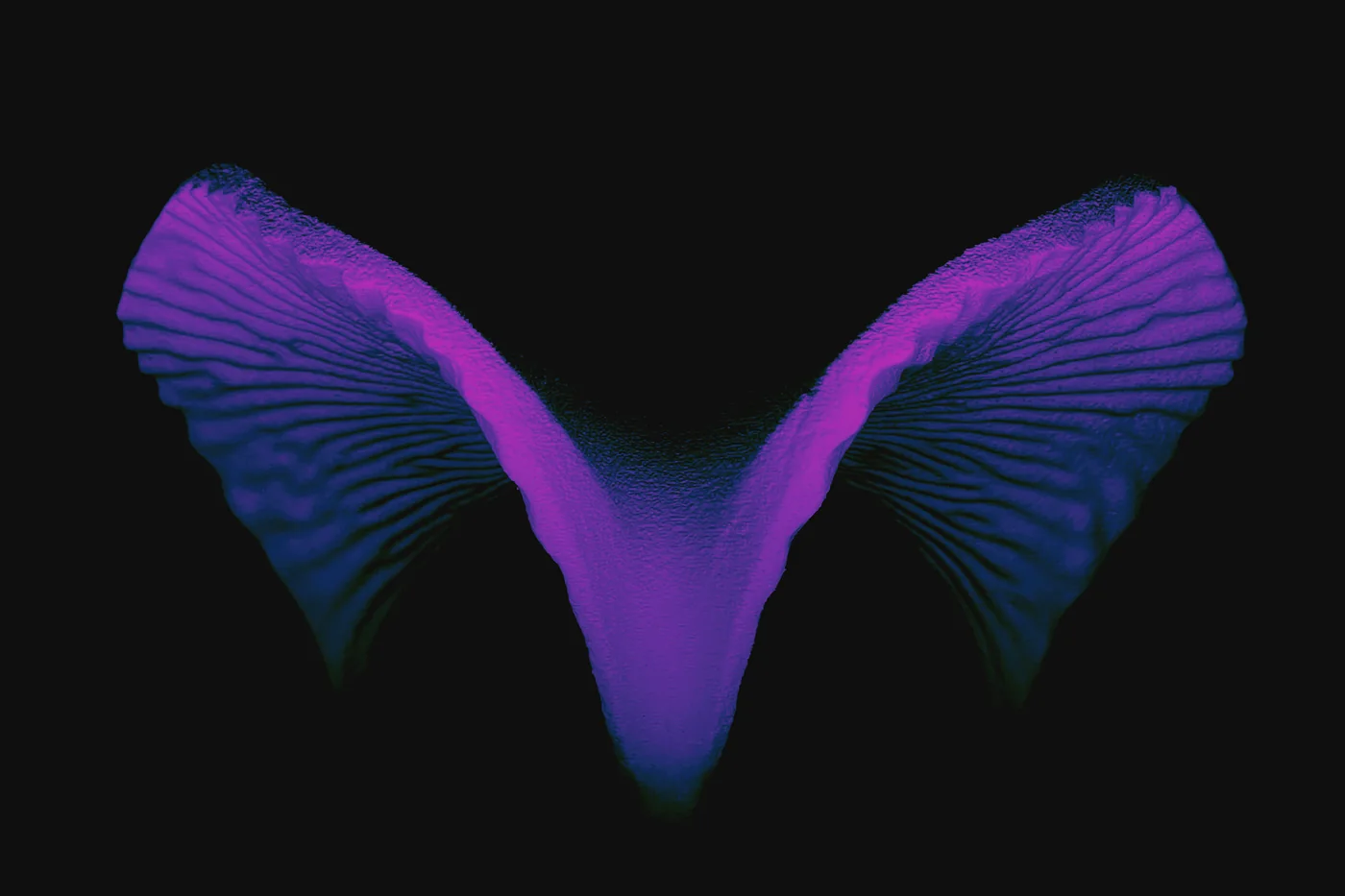
The AURORA cover from the SIGraDi 2024 talk: the shell in violet on black

The cover of the SIGraDi 2024 talk, and AURORA in the courtyard of Umeå School of Architecture (AI rendering).

Reaction‑diffusion pattern

Two substances react and spread at different speeds, and from an almost even start, stripes, spots and folds settle out on their own. Alan Turing described the mechanism in 1952, and these are often called Turing patterns: defined by mathematics, and found again in nature, from the stripes on a zebrafish to the ridges of brain coral.

AURORA uses this pattern to lay out its material, and the demonstrators use it in their toolpaths. The one above is computed live in your browser from a few random seeds, so you will never see the same pattern twice.

Storiesalong the way

What the labs, schools and people I worked with posted over these years.

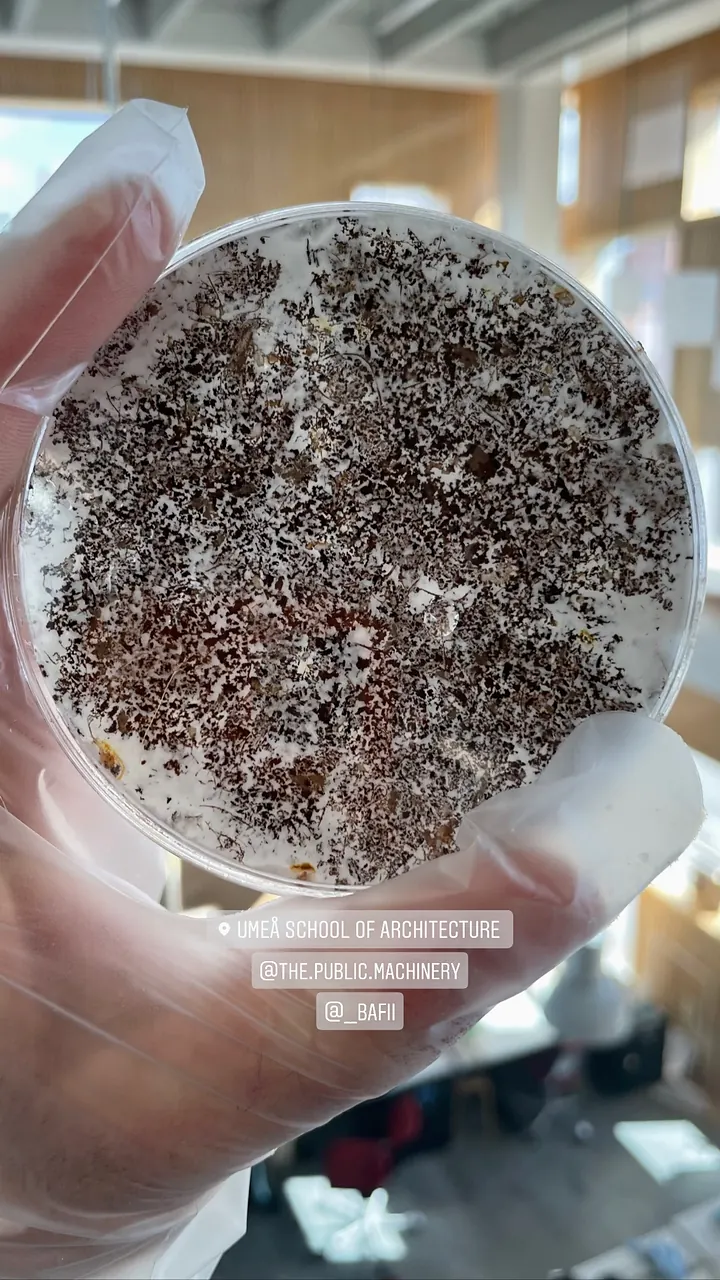
Story: a gloved hand holding a petri dish of woodchips and mycelium
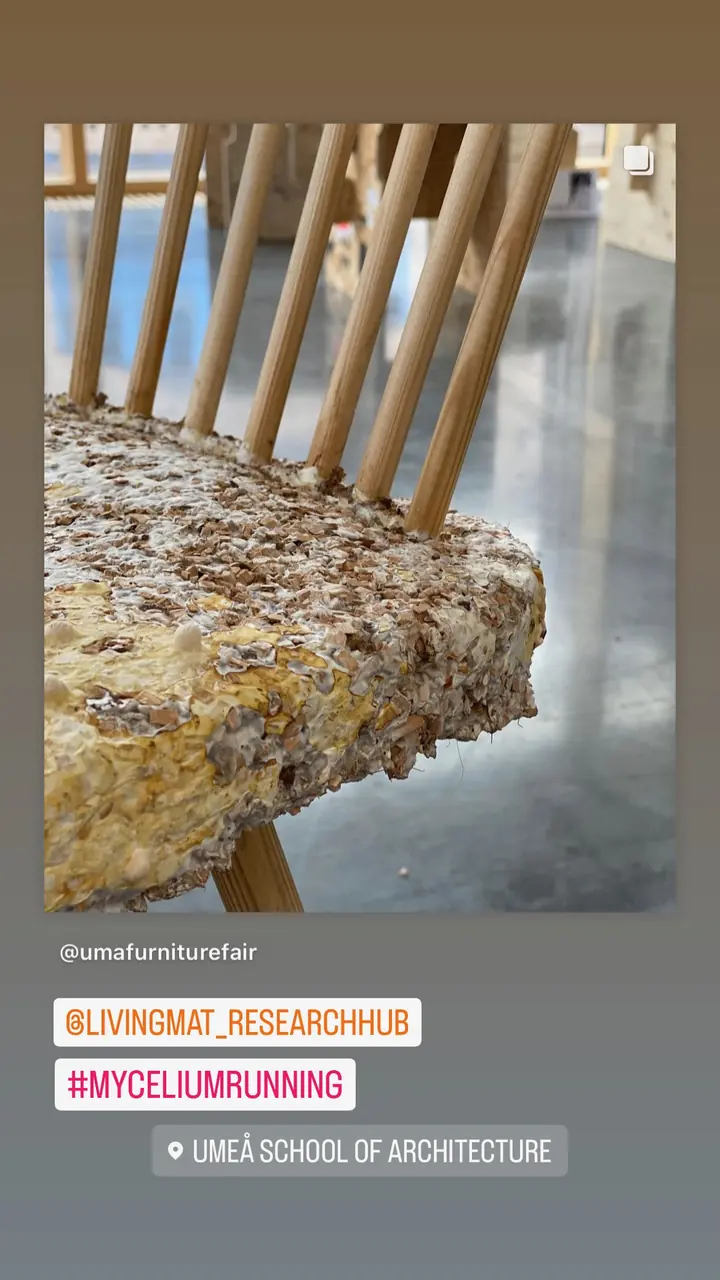
Story: the REishi chair's seat at the furniture fair
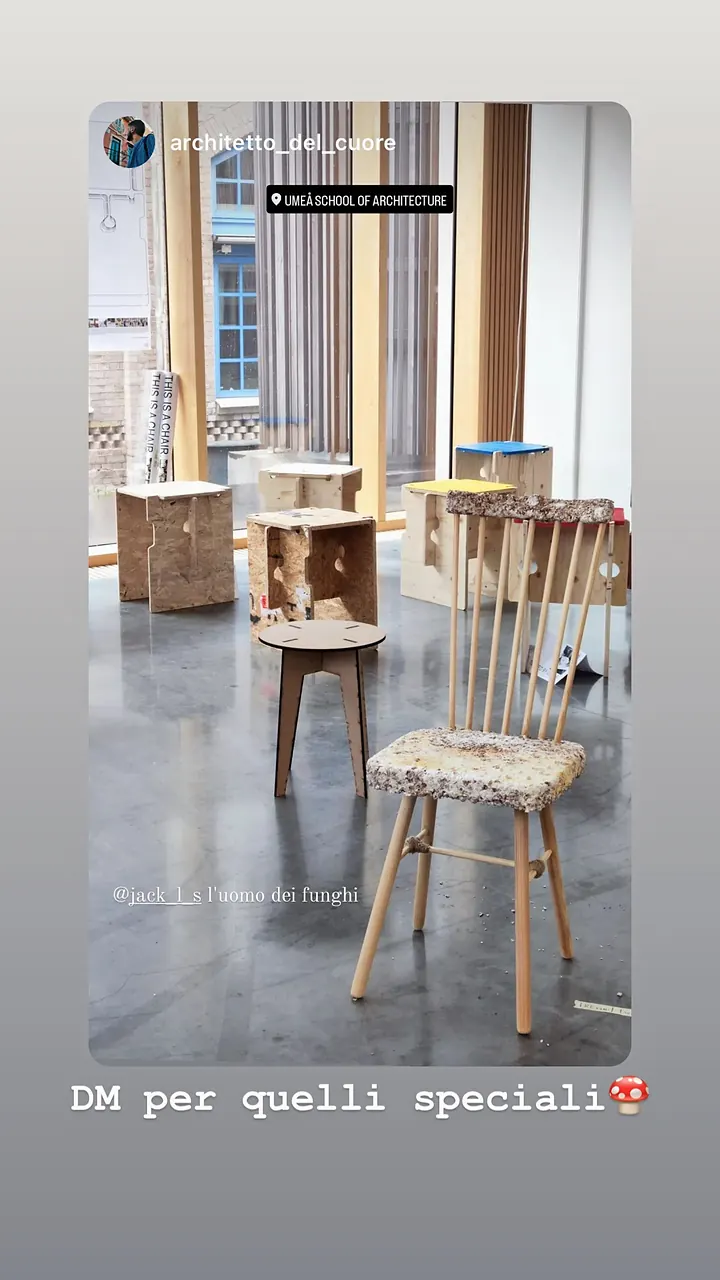
Story: the REishi chair on show at the furniture fair
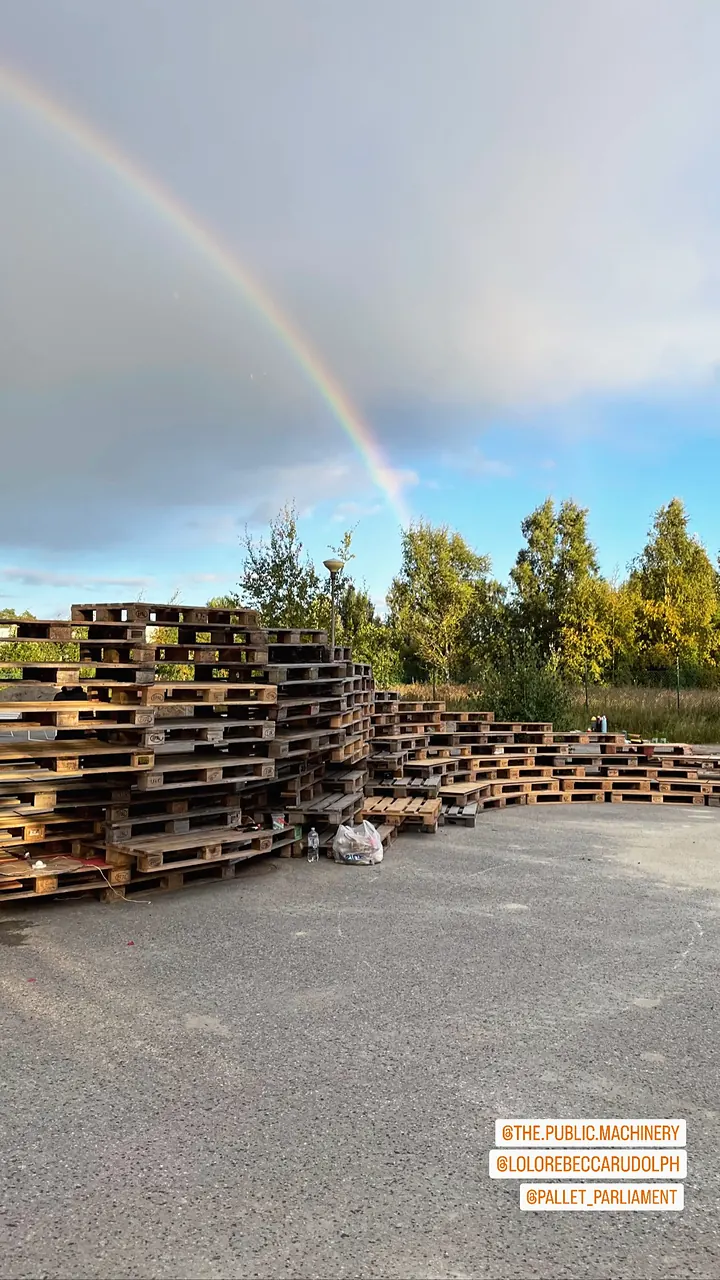
Story: the stacked pallets under a rainbow
Story: the Pallet Parliament seen from above, three years on
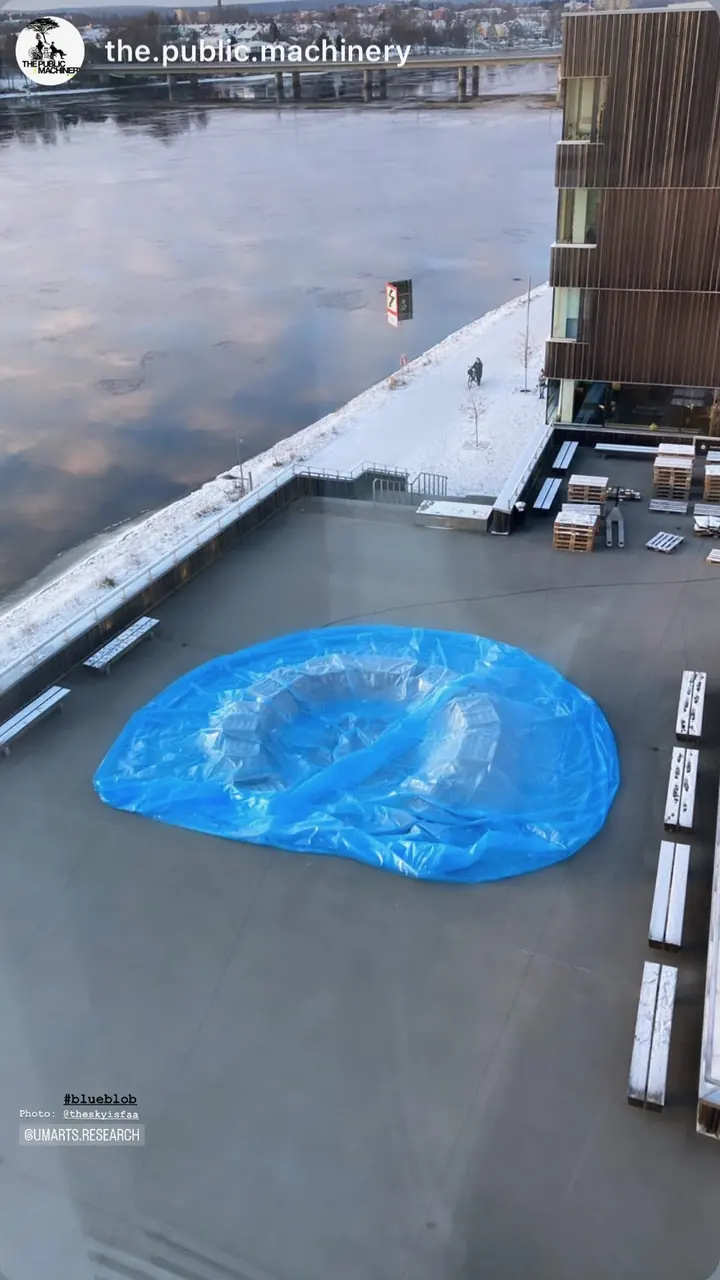
Story by the.public.machinery: the blue membrane laid out on the terrace by the river
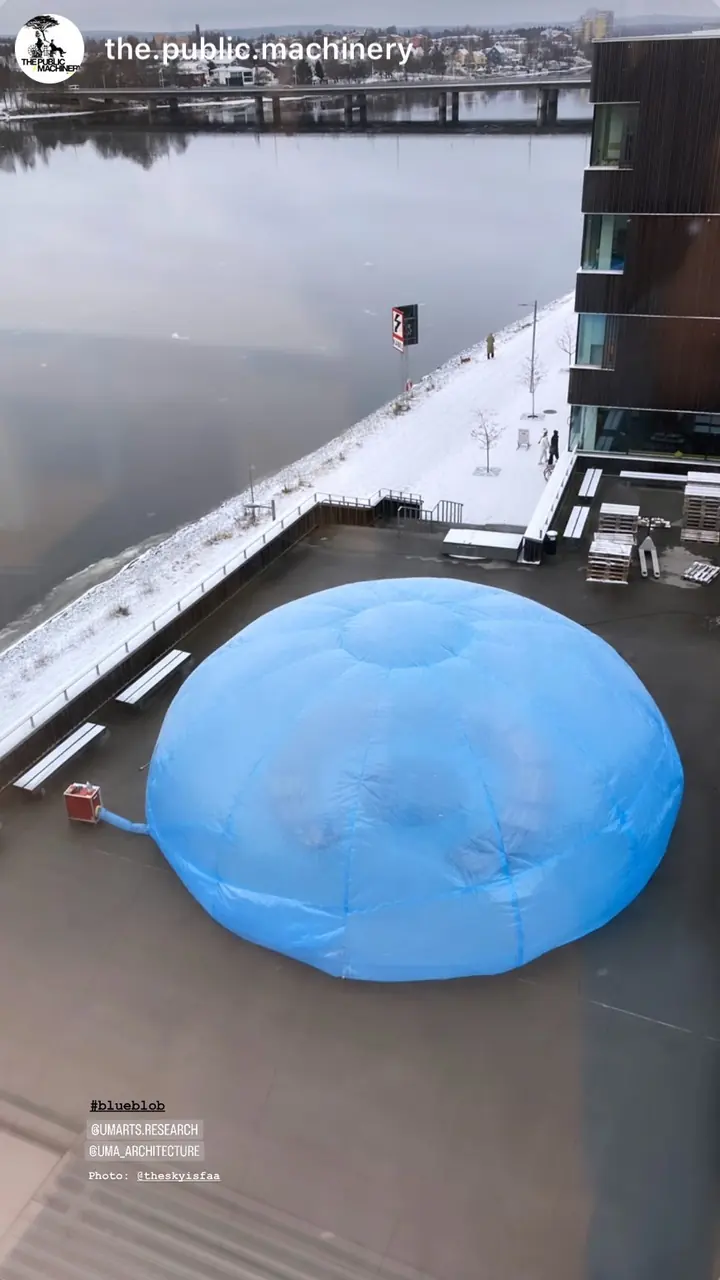
Story by the.public.machinery: the dome half inflated on the terrace
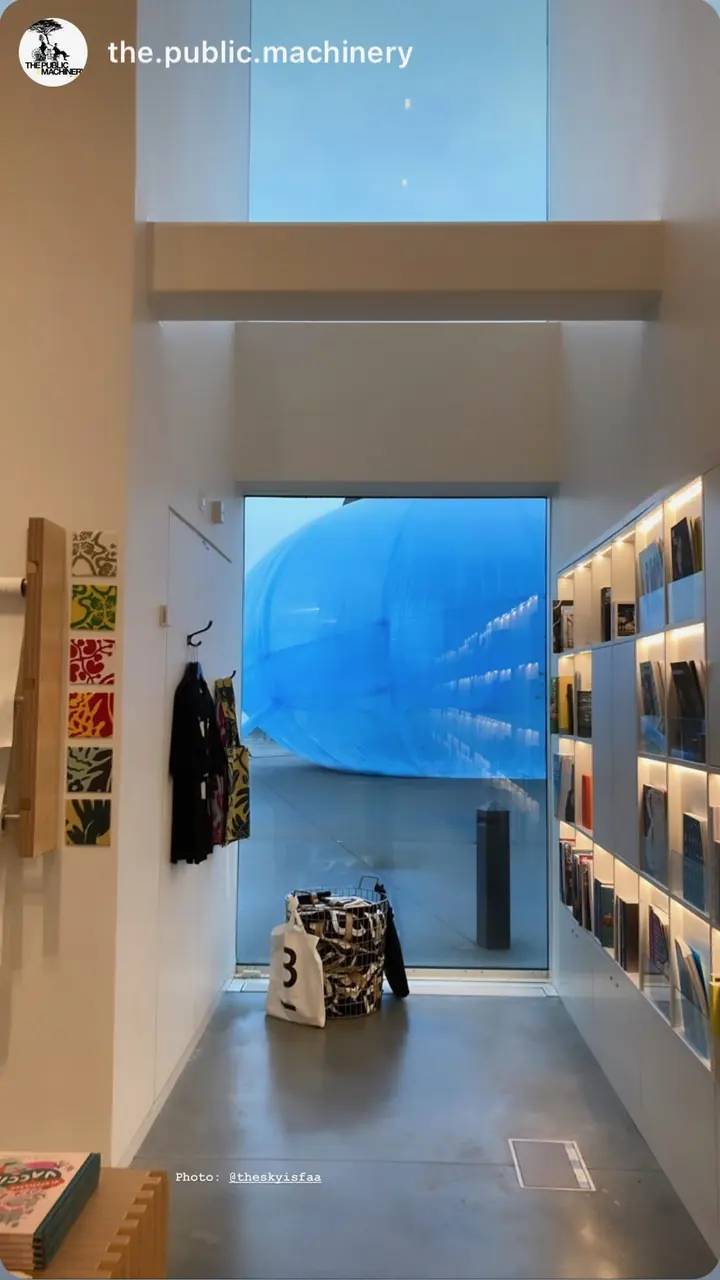
Story by the.public.machinery: the blue dome seen through a doorway
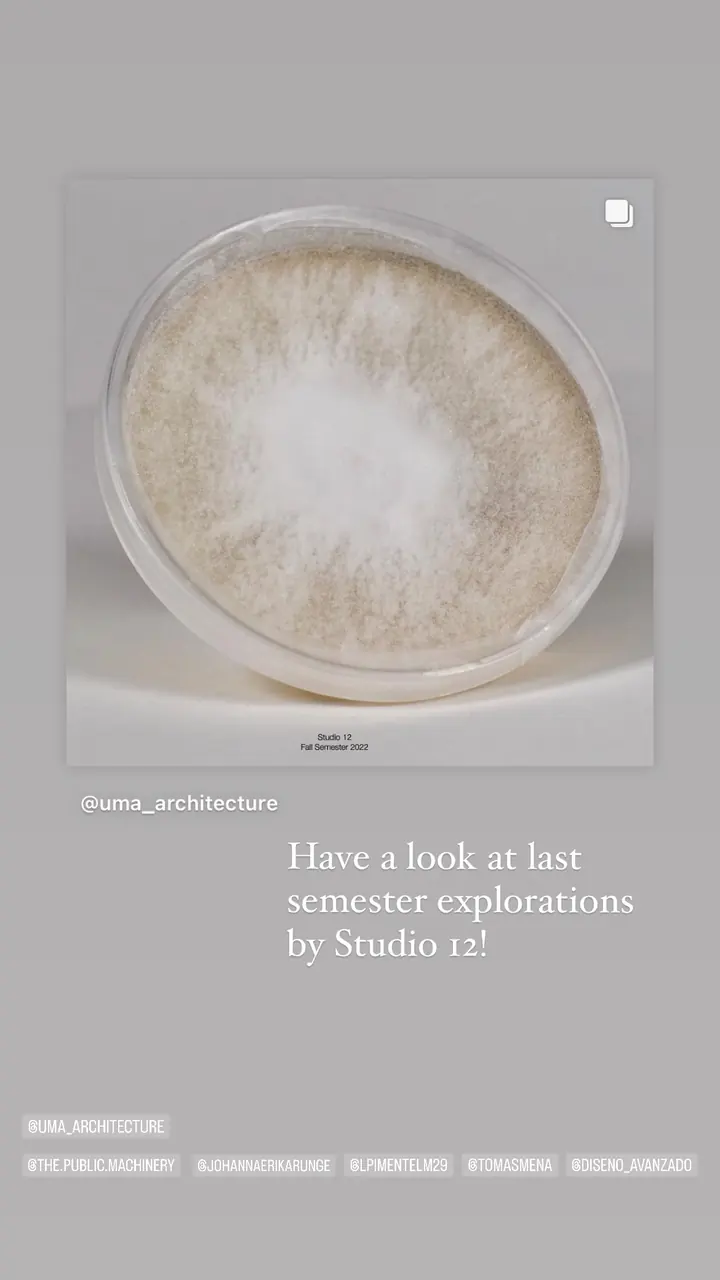
Story: a petri dish of mycelium, captioned have a look at last semester's explorations by Studio 12
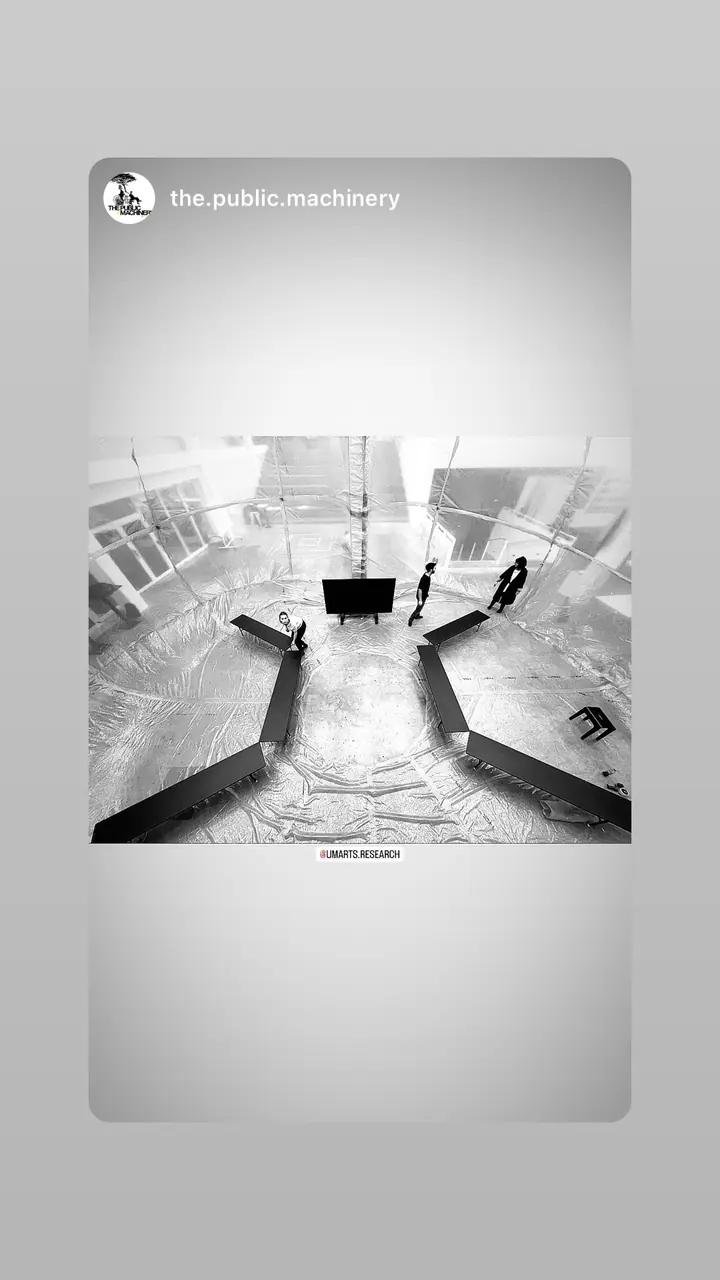
Story by the.public.machinery: black and white view of the dome in the hall
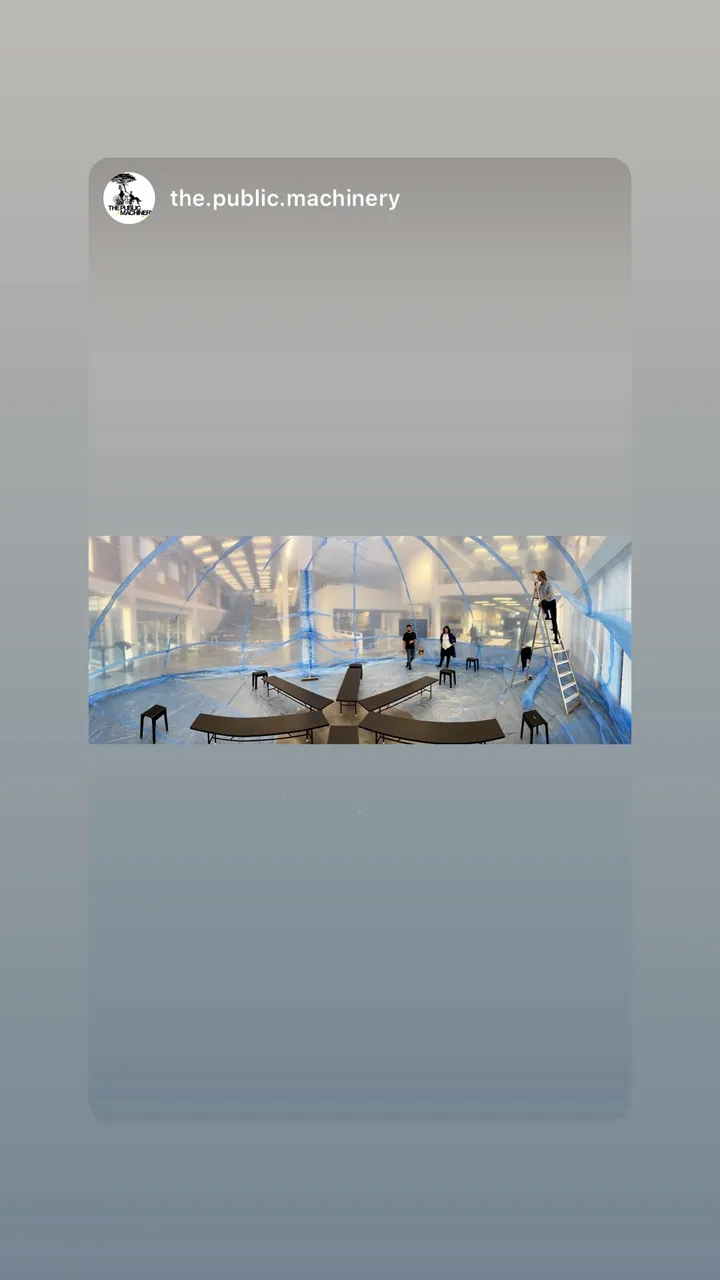
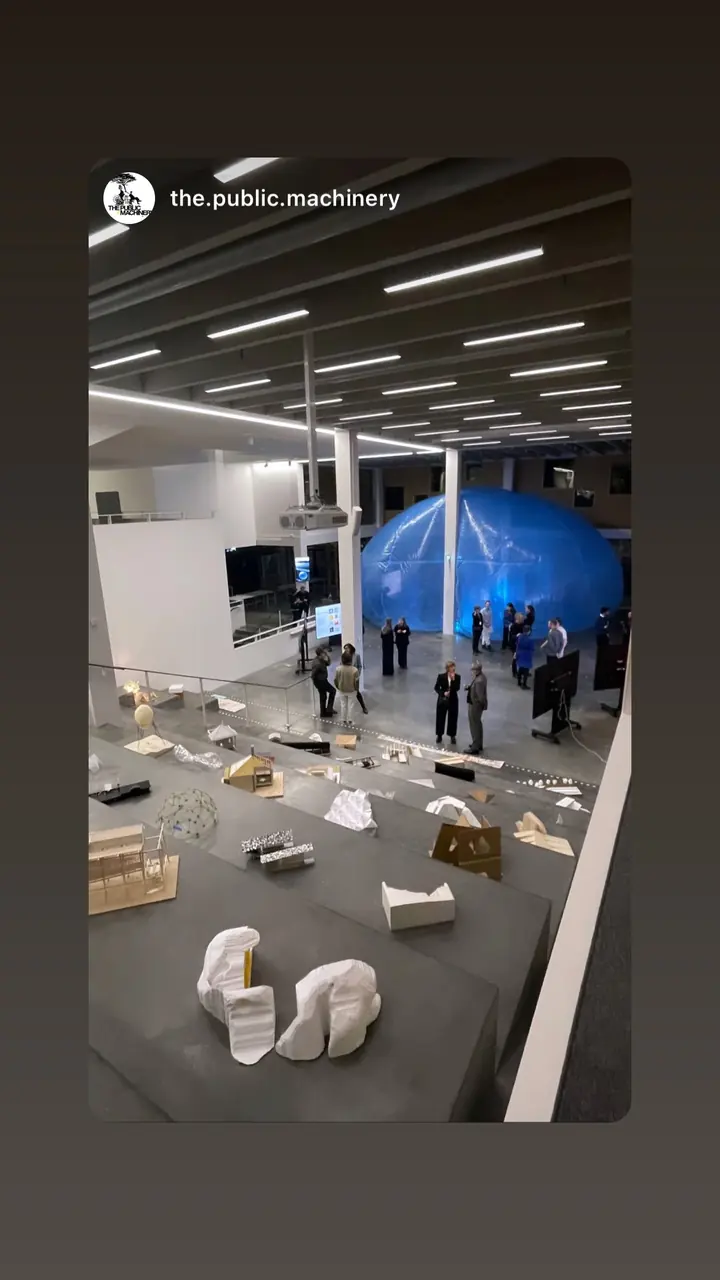
Story by the.public.machinery: the dome set up in the hall, seen from the balcony
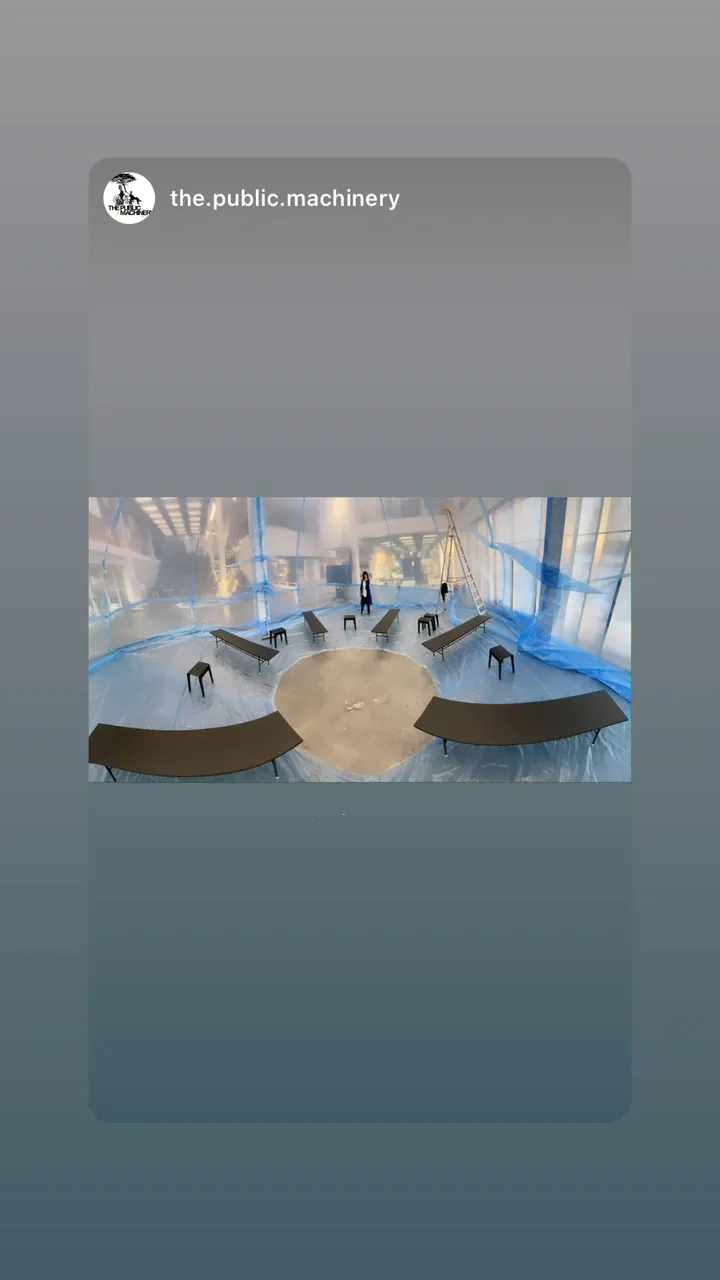
Story by the.public.machinery: the hall from above, the dome and benches laid out
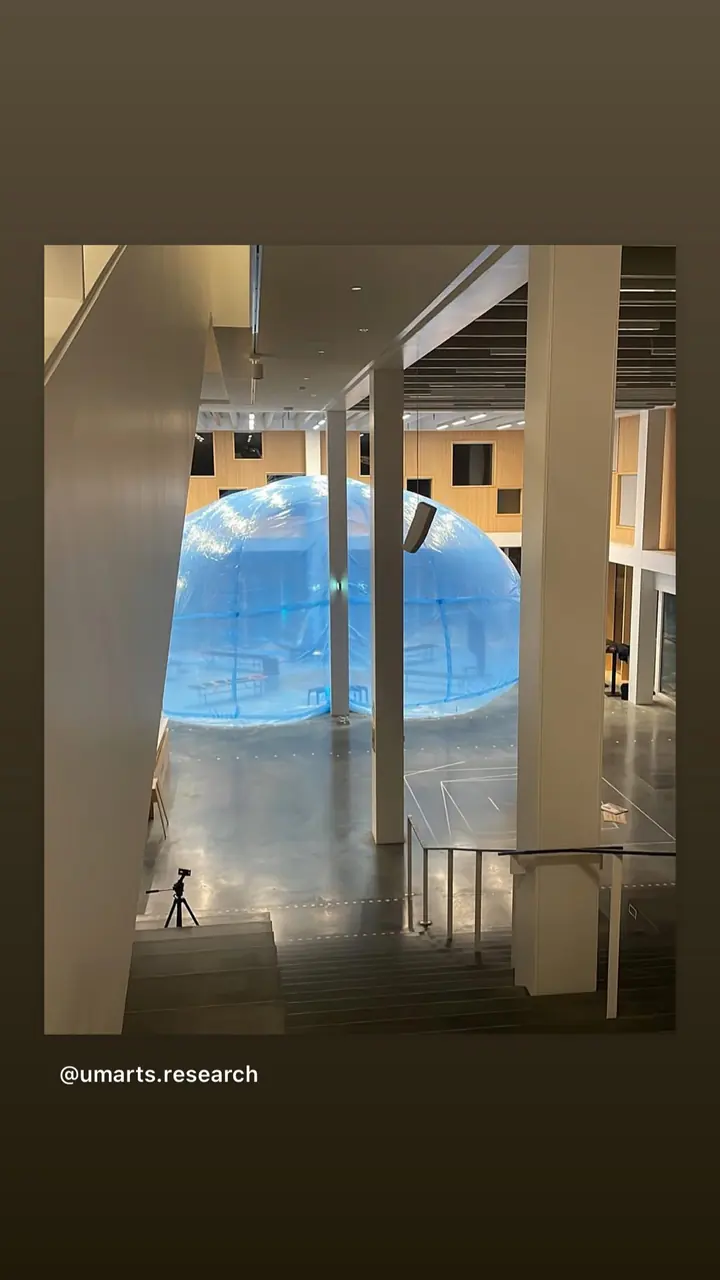
Story: the blue dome glimpsed through the Arts Campus atrium
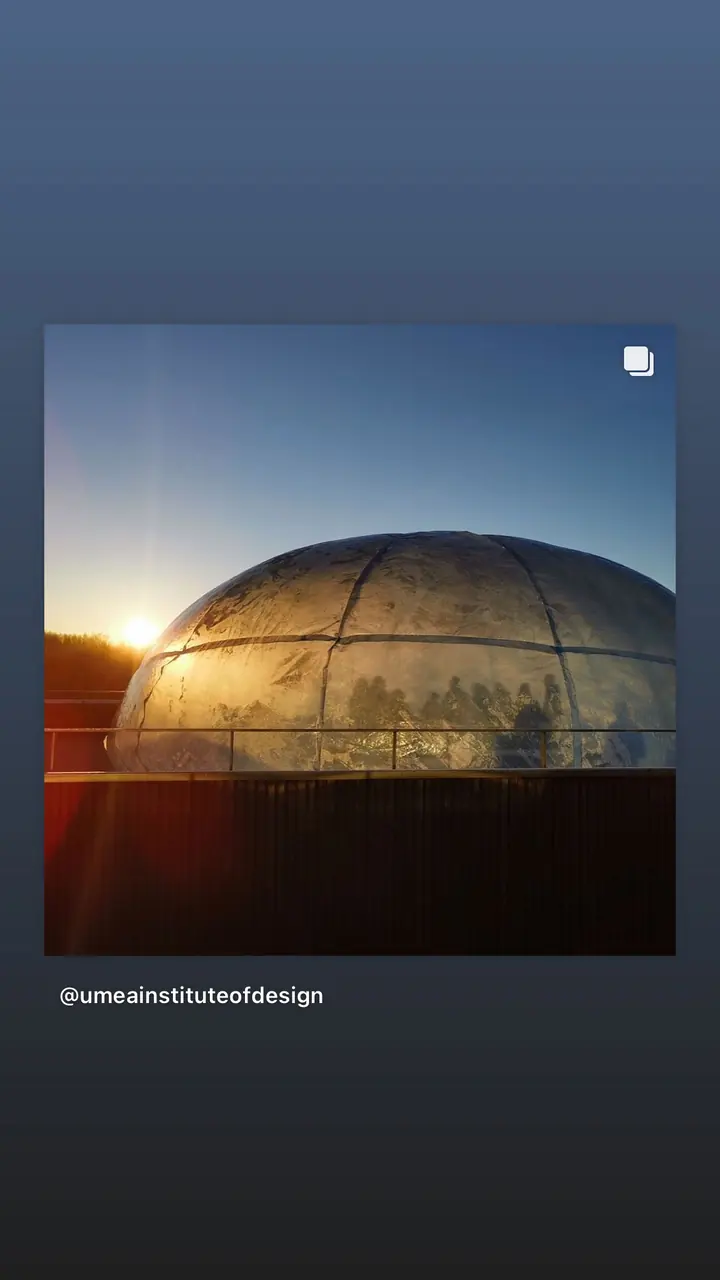
Story: the dome glowing at sunset
Story by the.public.machinery: grown white objects on the floor in front of the blue dome
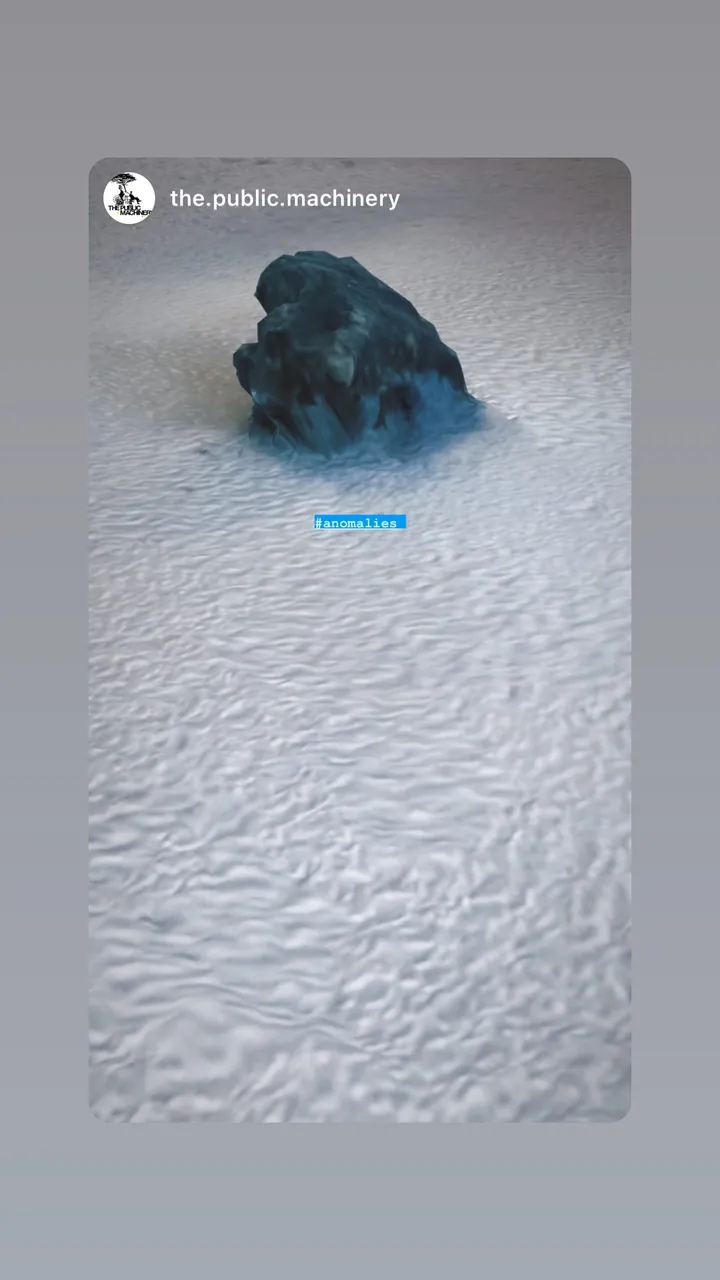
Story by the.public.machinery: a grown object lying on a field of white
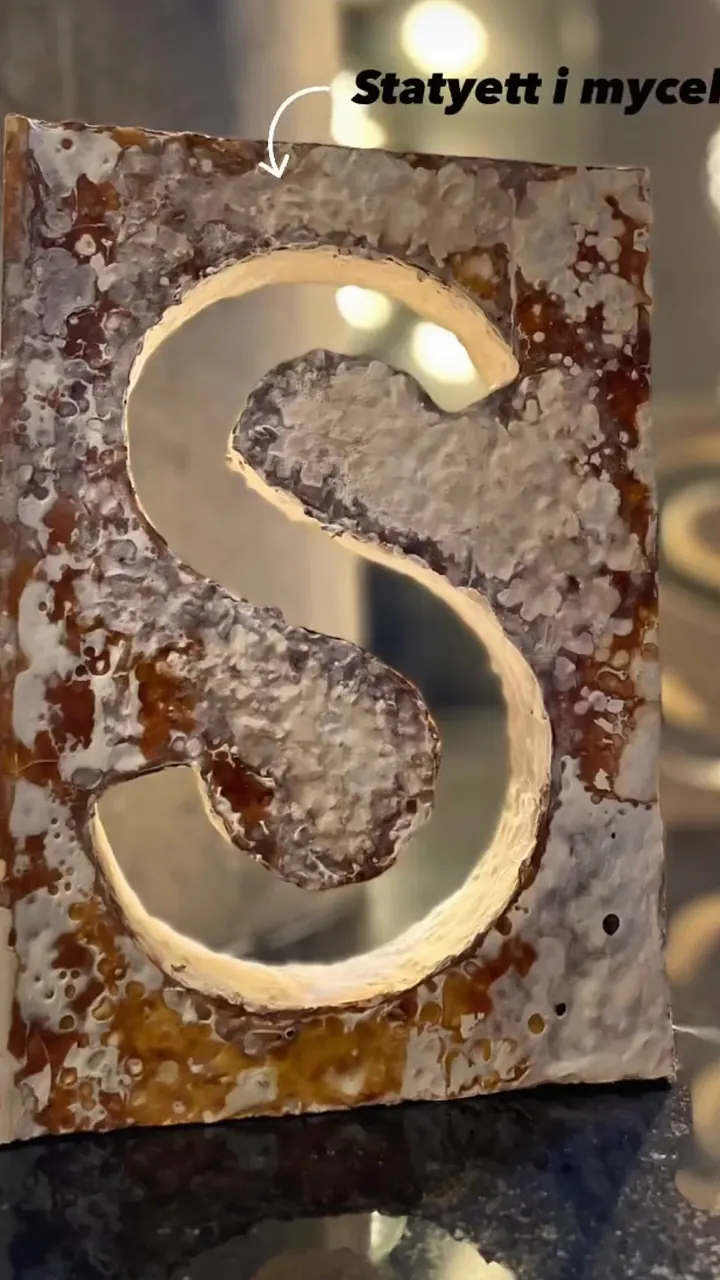
Story: one of the S statuettes, captioned statyett i mycel
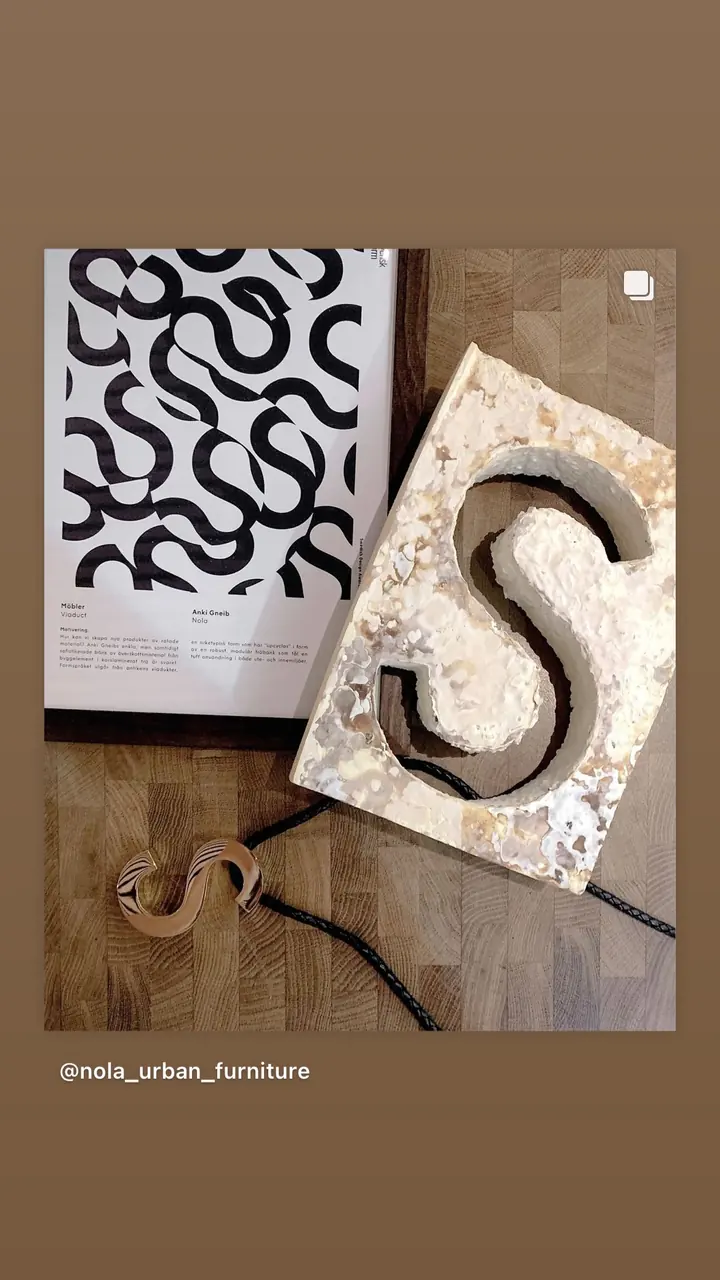
Story: an S trophy next to a black and white pattern
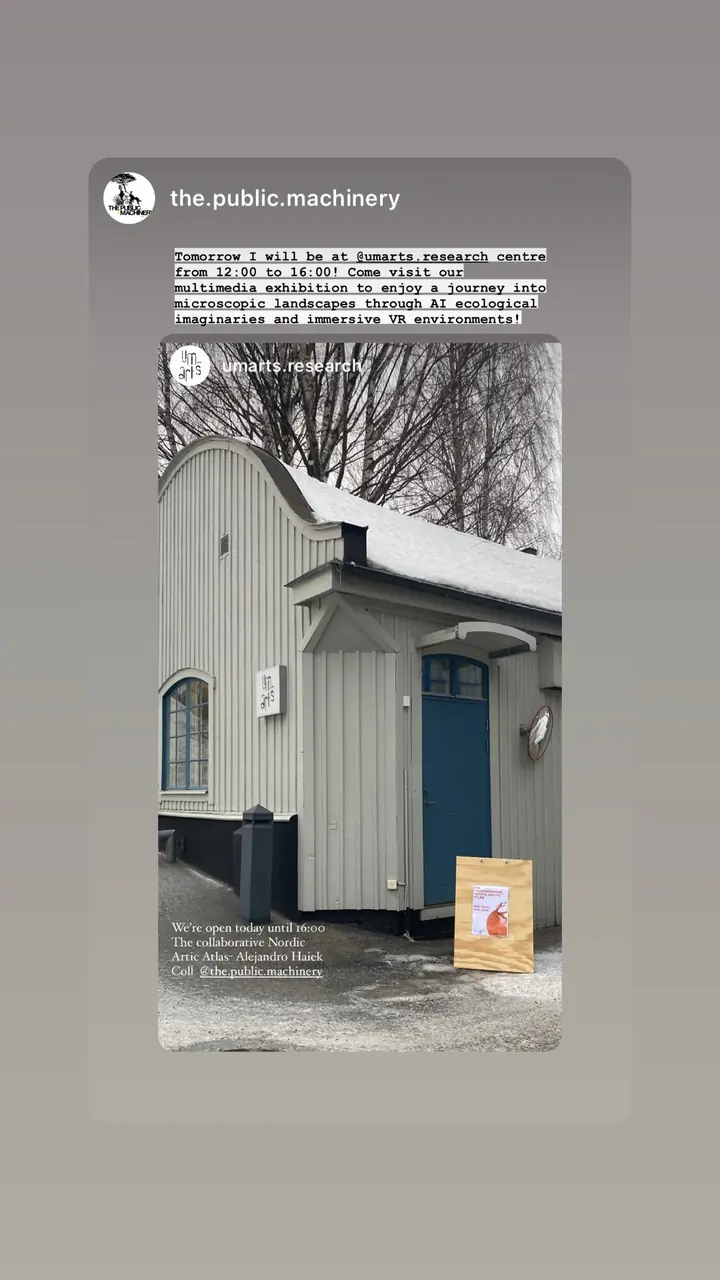
Story by the.public.machinery: the UmArts studio building in snow
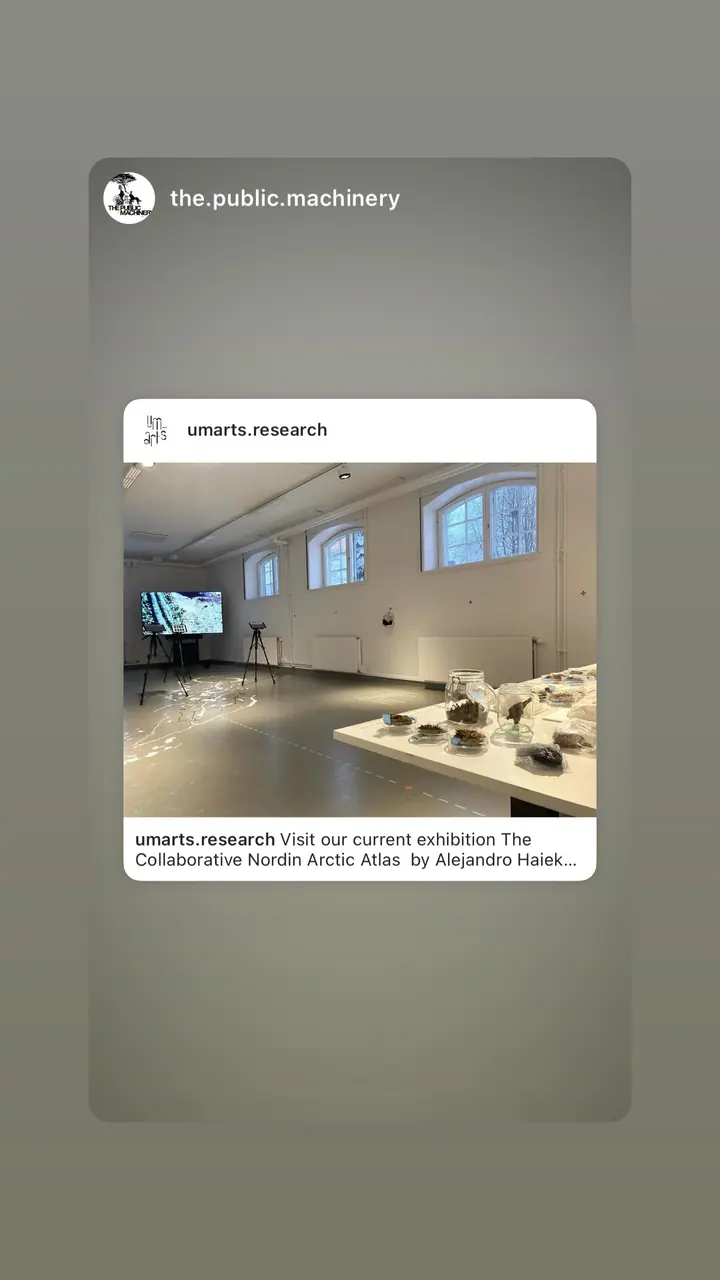
Story by the.public.machinery: the exhibition room with tables of samples
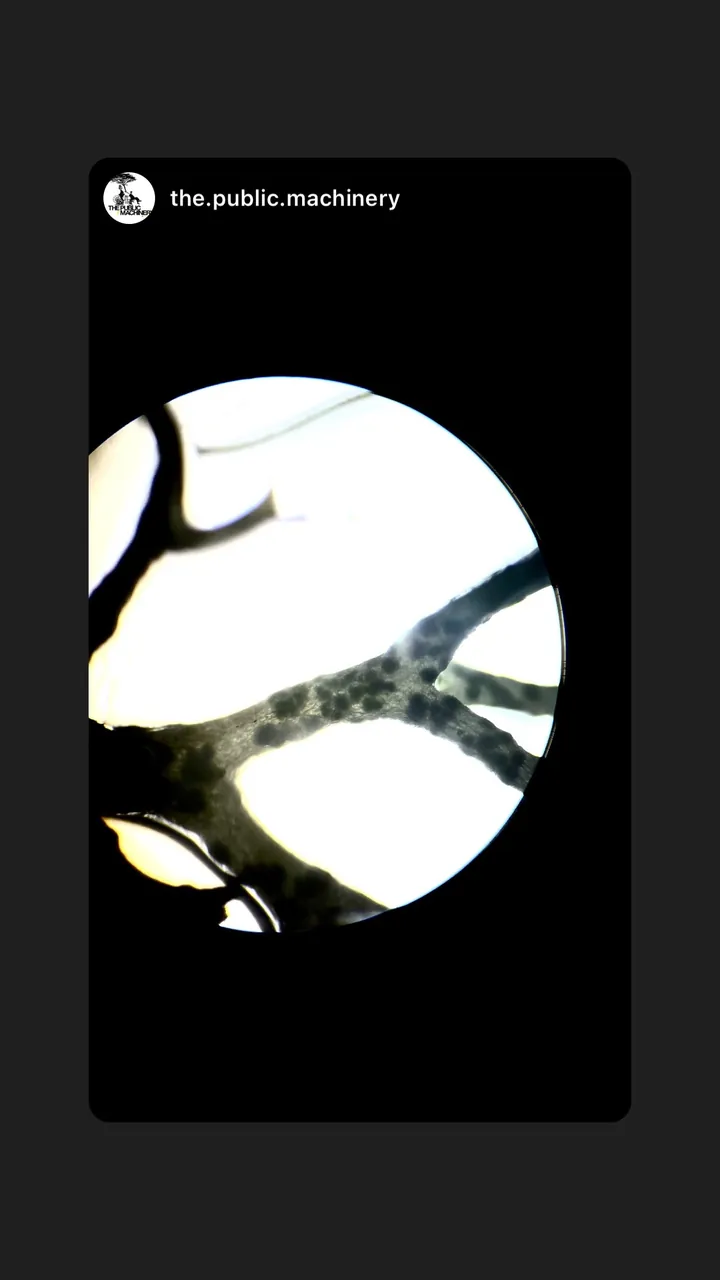
Story by the.public.machinery: branching threads seen through the microscope
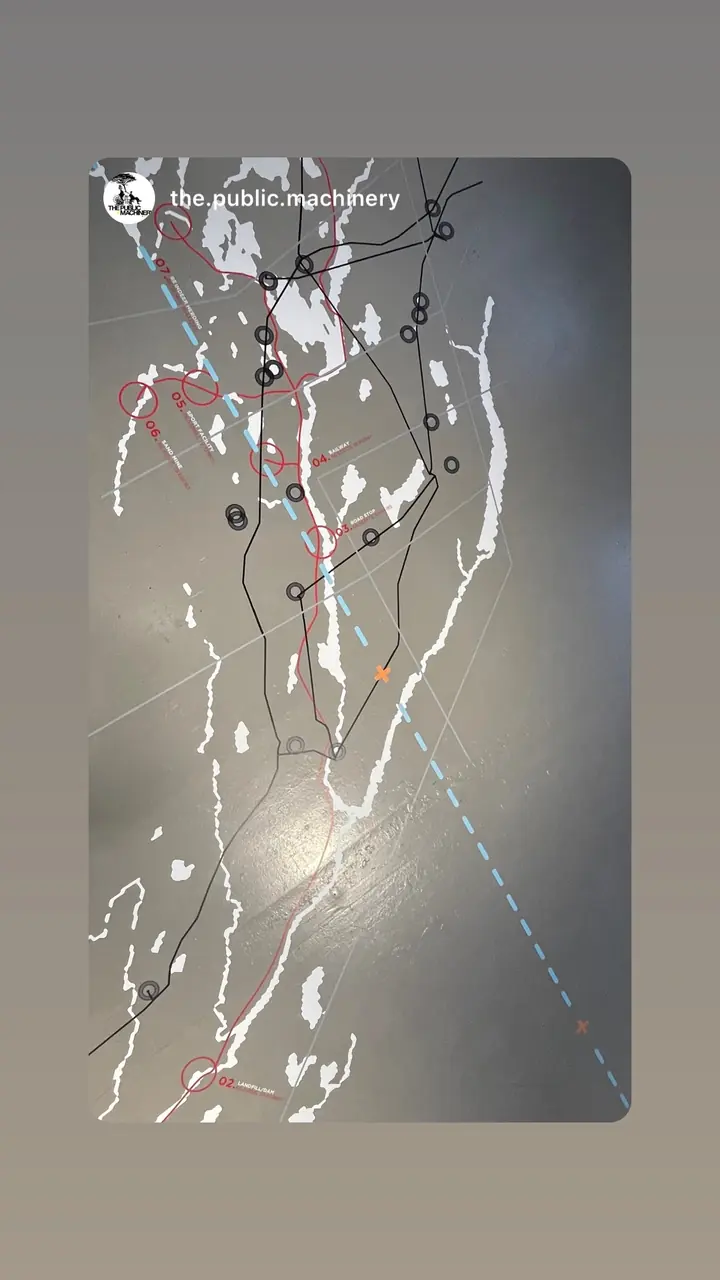
Story by the.public.machinery: a map of branching lines
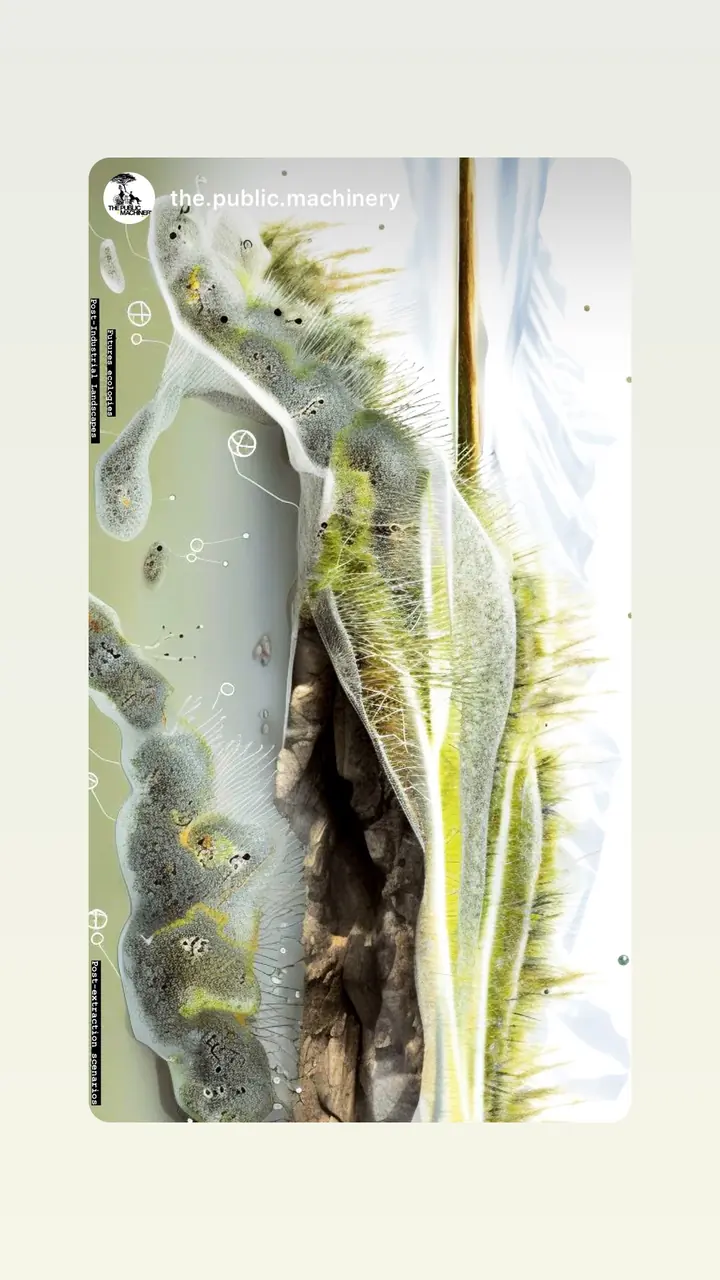
Story by the.public.machinery: a drawing of moss and water
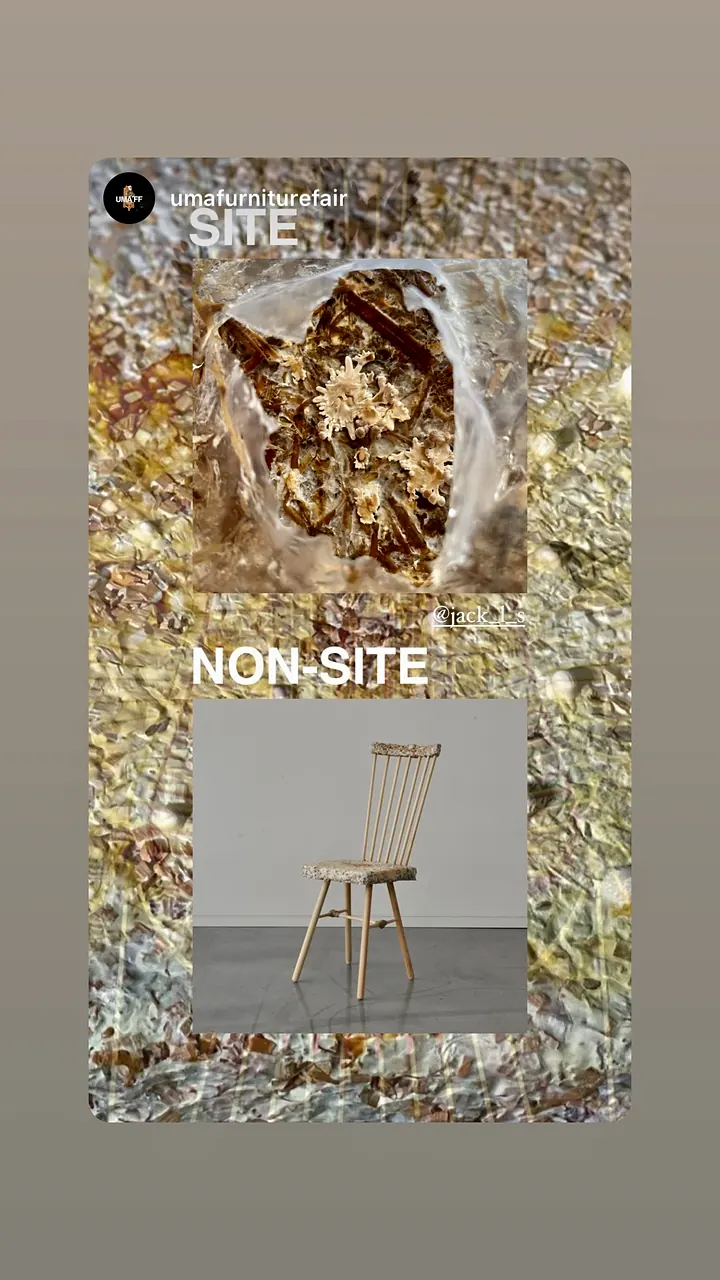
Story: the REishi chair in the NON-SITE exhibition at the furniture fair
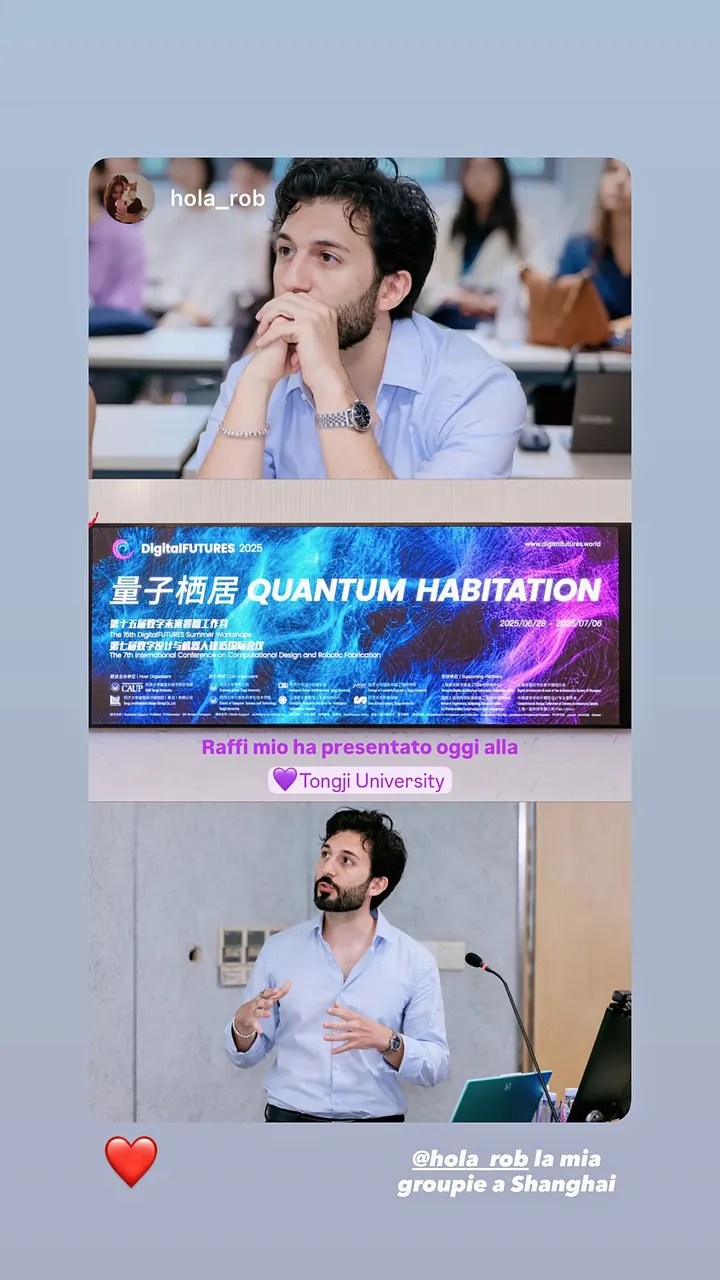
Story: Raffaele presenting at DigitalFUTURES and CDRF in Shanghai
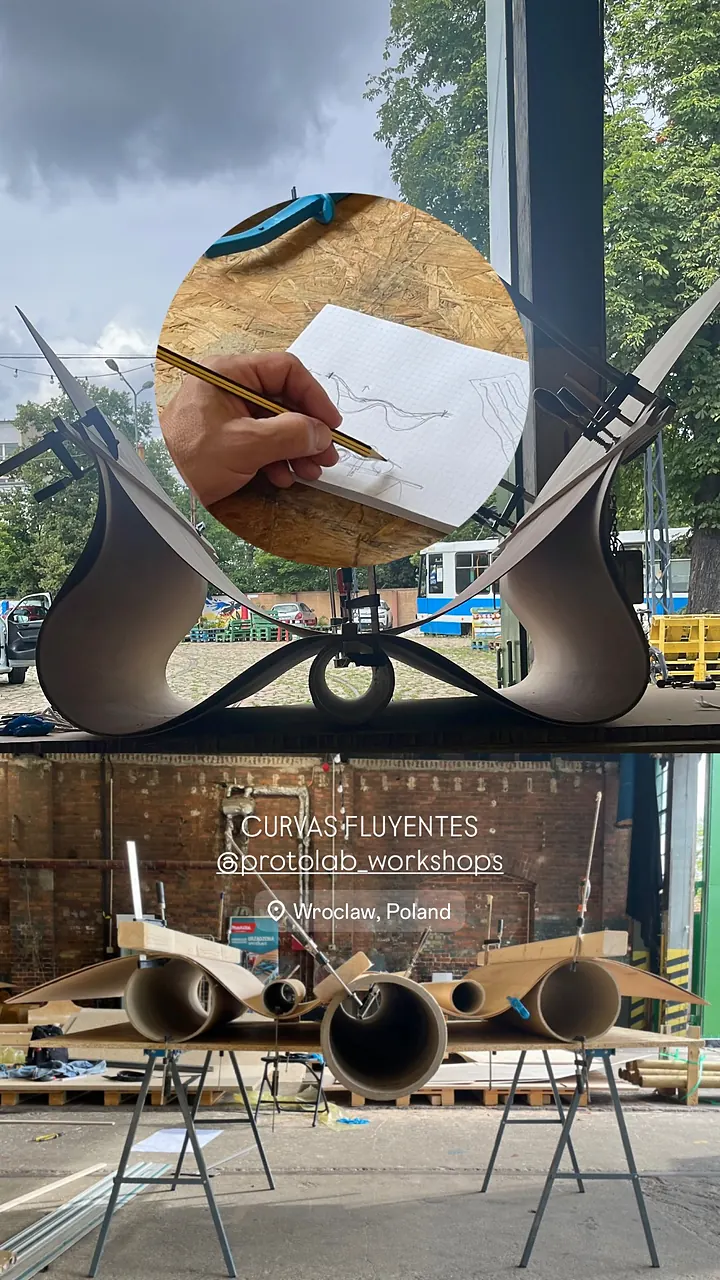
Story: Curvas fluyentes at ProtoLAB, Wrocław, the telescopic canoe in progress
Story: the ProtoLAB group with the finished canoe and Javier Sánchez Merina
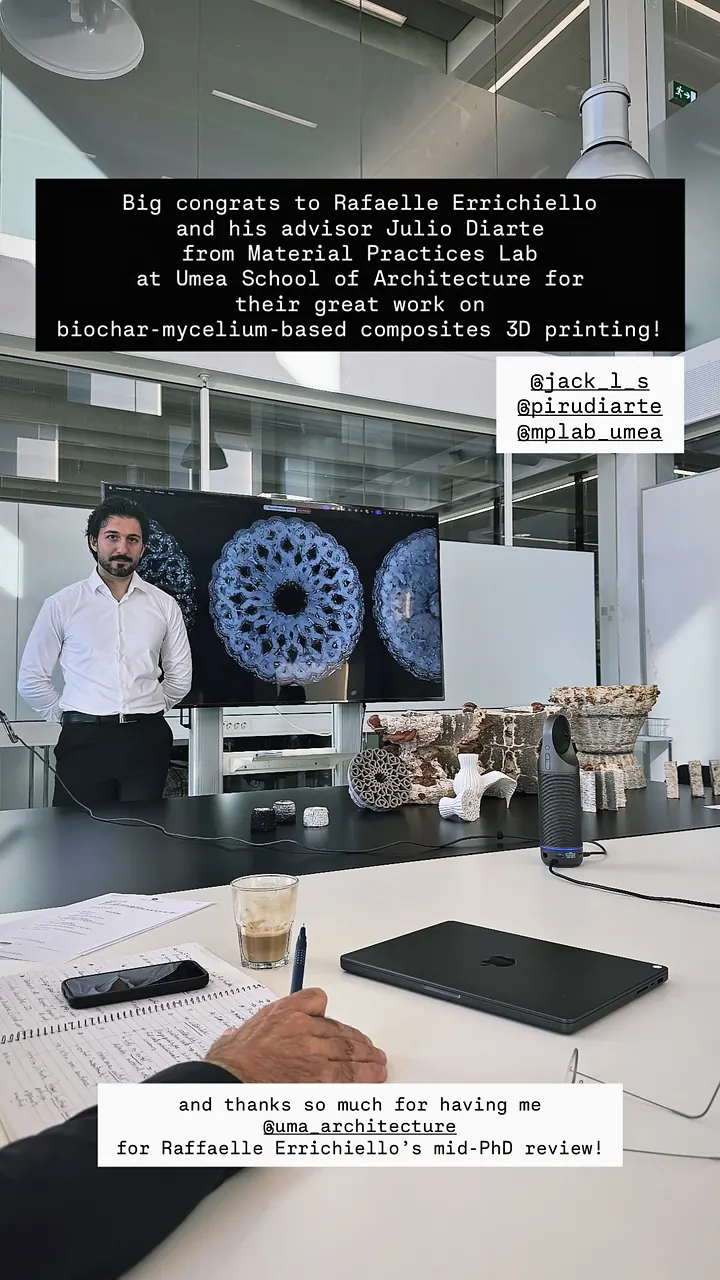
Story: congratulations on the mid-term seminar, Raffaele standing by a screen of brain-coral toolpaths

My own stories, and stories by @the.public.machinery, @umarts.research, @umeainstituteofdesign, @umafurniturefair, @uma_architecture, @nola_urban_furniture, @francescocamilli, @architetto_del_cuore, @lolorebeccarudolph, @hola_rob and @jack_l_s, shown with their permission.

Path

Naples, Umeåand further

  1. 2014
    NaplesArchitecture school at DiARC, the Department of Architecture of the University of Naples Federico II.
  2. 2016
    LeccehaMMMocks at Masseria Ospitale: three hammocks on three poles, built at no cost from what the farm had in store.
  3. 2019
    UmeåAn Erasmus year at Umeå School of Architecture. Shells in the snow.
  4. 2021
    NaplesJunior architect at FRAME. Master's degree in January 2022.
  5. 2022
    UmeåBack north as an Erasmus+ trainee with RISE. The chair, MK3, the pallets, the Winter Garden, the first teaching.
  6. 2024
    WrocławTutor at ProtoLAB. The doctorate begins in Umeå.
  7. 2024
    BarcelonaAURORA is presented at SIGraDi.
  8. 2025
    ShanghaiThe material paper at CDRF, Tongji University.
  9. 2025
    WrocławProtoLAB again: the telescopic canoe.
  10. 2026
    UmeåEURAU26 at home: a paper, a session to chair, the demonstrators on show.
  11. 2026
    OdenseSummer school on robotic clay printing at SDU CREATE.
  12. 2026
    LübeckThe eCAADe PhD workshop. Mid-term seminar back in Umeå in September.
  13. 2027
    MilanTwo papers at ICSA, Politecnico di Milano.
  14. 2027
    SendaiFive months at Tohoku University, funded by MIRAI.
  15. 2027
    TokyoA visit to the Institute of Industrial Science, University of Tokyo.
  16. 2028
    UmeåPublic defence, planned for late summer.

Writing

Papers, newest first. The ones with a link are open to read.

  1. 2026
    Experimental study of 3D printed biochar-mycelium composites via liquid deposition modeling for sustainable building components: compatibility, shrinkage control, structural integrity and prefabrication
    With Julio C. Diarte Almada. Architectural Intelligence 5, 16.
  2. 2026
    Biobased Material Confluences: investigating material formulation and 3D printing parameters for biochar-mycelium building composites
    With Julio C. Diarte Almada. In Transindividual Intelligence, CDRF 2025, Springer, pages 297 to 307.
  3. 2026
    From Biomass to Building: biochar-mycelium composites for circular construction in Northern Sweden
    Extended abstract, EURAU26 LATITUDES, Umeå.
  4. 2025
    Anatomy of a Living Joint
    UOU Scientific Journal 10, pages 128 to 135.
  5. 2024
    AURORA: Adaptive Units for Rational, Organic and Resilient Architecture. Form finding of biomimetic minimal surfaces
    SIGraDi 2024, Barcelona, pages 2383 to 2394.
  6. Under review
    3D printing of mycelium-based composites for architecture, engineering and construction: a systematic review of geometry, toolpath design and structural performance
    With Gireesh Nair and Julio C. Diarte Almada. Case Studies in Construction Materials.
  7. 2027
    Two papers for ICSA 2027, Politecnico di Milano: toolpath geometry and colonisation, and hybrid bio-composites with reinforcement
    Abstracts accepted, full papers in preparation.

A full academic or professional CV is available on request.

Archive, 2016 to 2026

Ten years,1,676 photographs

Every photograph of the work in my archive, without people, in the order it was taken, grown like a colony: 2016 at the centre, 2026 at the tips. Most of them only make the shape. The thirty with a white ring are the best of them: scroll to dive into eight of them, or point at any ringed cell to open it under glass.

June 2016haMMMocks, Lecce0 photographs

Work with me

What we couldgrow together

I am looking for partners, sites and good questions. If one of these sounds like you, write to me.

  • A pavilion that grows in place

    AURORA at full size, printed in the living composite in sections, grown, and welded on site. I am looking for a festival, a school or a park that wants to host the first one.

  • Your residue as a material

    Sawdust, pulp, bark, fibre or biochar: if your production leaves something behind, I would like to test whether a fungus can make it printable.

  • Living material, measured properly

    Mycologists, soil ecologists and materials scientists: how should a living building part age, decay and be tested? I would like to answer that with you.

  • A studio or workshop week

    From petri dish to printed object in five days, for students of architecture, design or biology.

  • An exhibition that keeps growing

    Printed pieces that change during the show, with the fungus still at work, for galleries, design weeks and science festivals.

  • Research positions

    I am open to research collaborations now, and to postdoctoral and research positions after my defence in 2028.

Write to me

raffaele.errichiello@umu.se
LinkedIn ORCID Umeå University

Material Practices Lab, Umeå School of Architecture, Umeå University, Sweden.